





Written by: Tanay Ved, Matías Andrade
Compiled by: Mars Finance, MK
The Launch of Ethereum ETFs
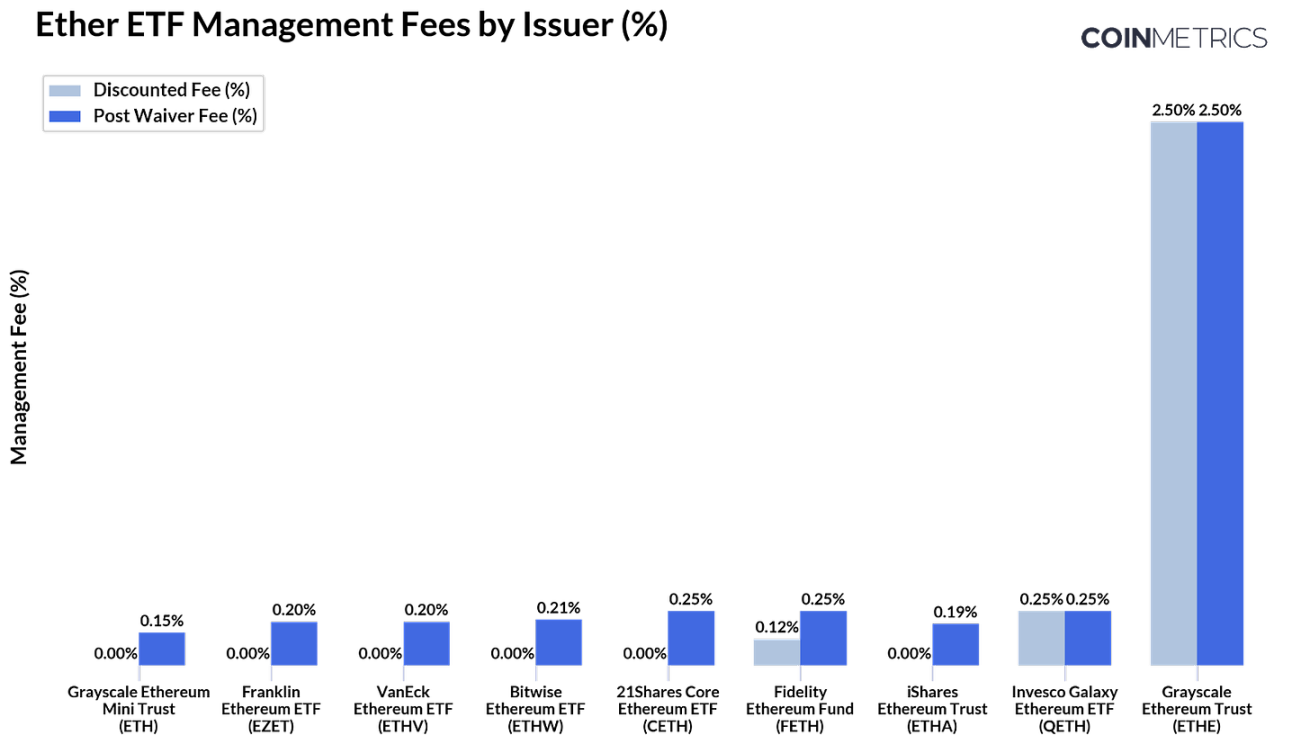
Key Takeaways: The nine spot Ethereum ETFs set to debut on July 23 feature fee structures ranging from 0.15% for the Grayscale Ethereum Mini Trust to 2.5% for Grayscale's ETHE.
Currently, Ethereum's total market value stands at $420 billion, approximately one-third of Bitcoin's $1.3 trillion market cap. According to reliable trading platform data from Coin Metrics, ETH's average daily spot trading volume is roughly half that of BTC.
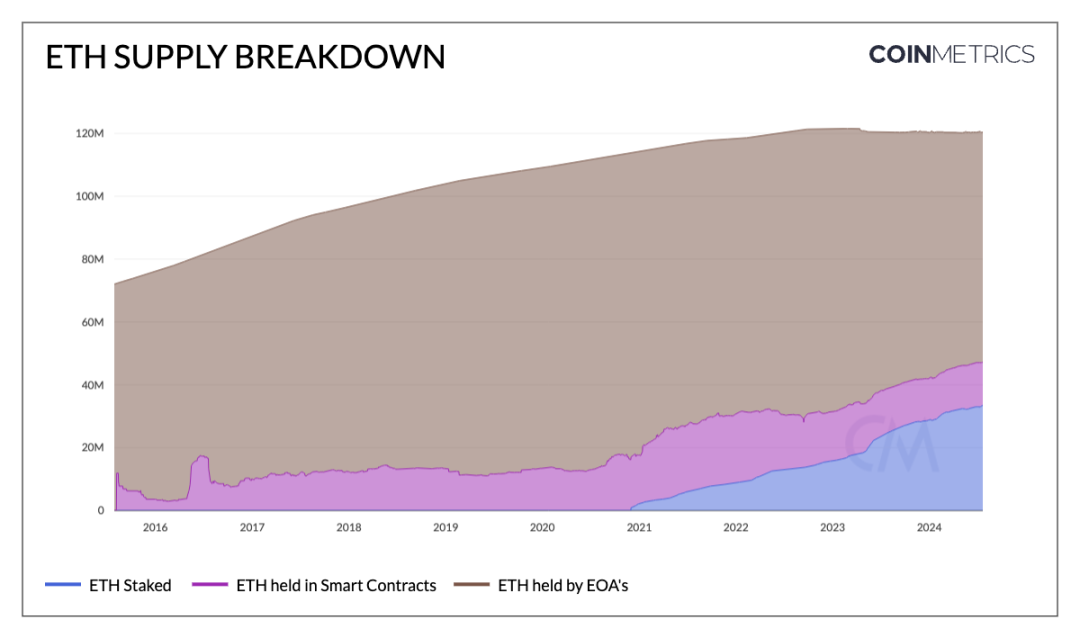
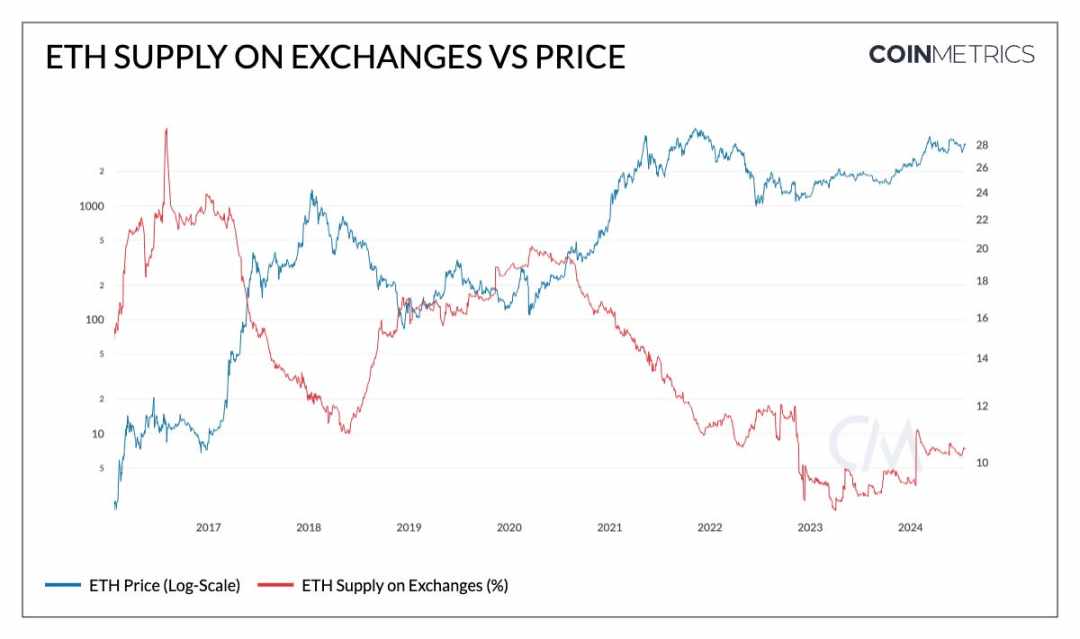
Of the total supply, 33.2 million ETH (28%) is staked on the Ethereum consensus layer, 13.5 million ETH (11%) is locked in smart contracts, and 12.5 million ETH (10%) is held on exchanges. The ETF launch could potentially drive prices higher by locking up these widely utilized assets.
The introduction of spot Bitcoin ETFs in January marked the culmination of a decade-long anticipation for this space, significantly expanding access to the leading cryptocurrency through familiar, regulated investment vehicles. The latest 13-F filings reveal over $16 billion in inflows (and growing) into these products. As market focus intensifies on this emerging sector, Ethereum (ETH), with its $420 billion market cap, naturally emerges as the next logical successor, with ETF approval seeming only a matter of time. In a surprising move this May, the U.S. Securities and Exchange Commission approved spot Ethereum ETFs, clarifying ETH's status as a commodity and thereby strengthening the value proposition of this asset class. Now, just six months later, spot Ethereum ETFs are poised for launch.
In this edition of Coin Metrics' State of the Network, we delve into the launch of spot Ethereum ETFs, market demand and supply dynamics, and their potential impact on Ethereum and the broader digital asset ecosystem.
Issuers in the ETH ETF Race
The nine Ethereum ETFs expected to debut on July 23 will further broaden the landscape of cryptocurrency-based financial products. Sponsored by traditional asset management giants like BlackRock and Fidelity, as well as crypto-native firms like Bitwise and Grayscale, these products will track ETH's spot price. By listing on public trading platforms such as CBOE, NYSE, and Nasdaq, investors can now gain exposure to ETH through mainstream brokerage platforms, complementing existing investment avenues like self-custodied wallets.
Source: Bloomberg, James Seyffart
As the launch date approaches, competition over fees has intensified. Issuers have submitted their final S-1 registration statements, disclosing management fees ranging from 0.15% for the newly launched Grayscale Ethereum Mini Trust (ETH) to 2.50% for Grayscale's Ethereum Trust (ETHE), the latter of which will convert from its existing trust structure to an ETF post-launch. Some issuers are also temporarily waiving fees as part of their strategy to attract assets under management (AUM), mirroring the approach seen with Bitcoin ETFs.
Linking Demand and Short-Term Pressure
As a barometer for gauging demand for ETH relative to BTC, we can explore the potential demand for Ethereum ETFs from several angles.
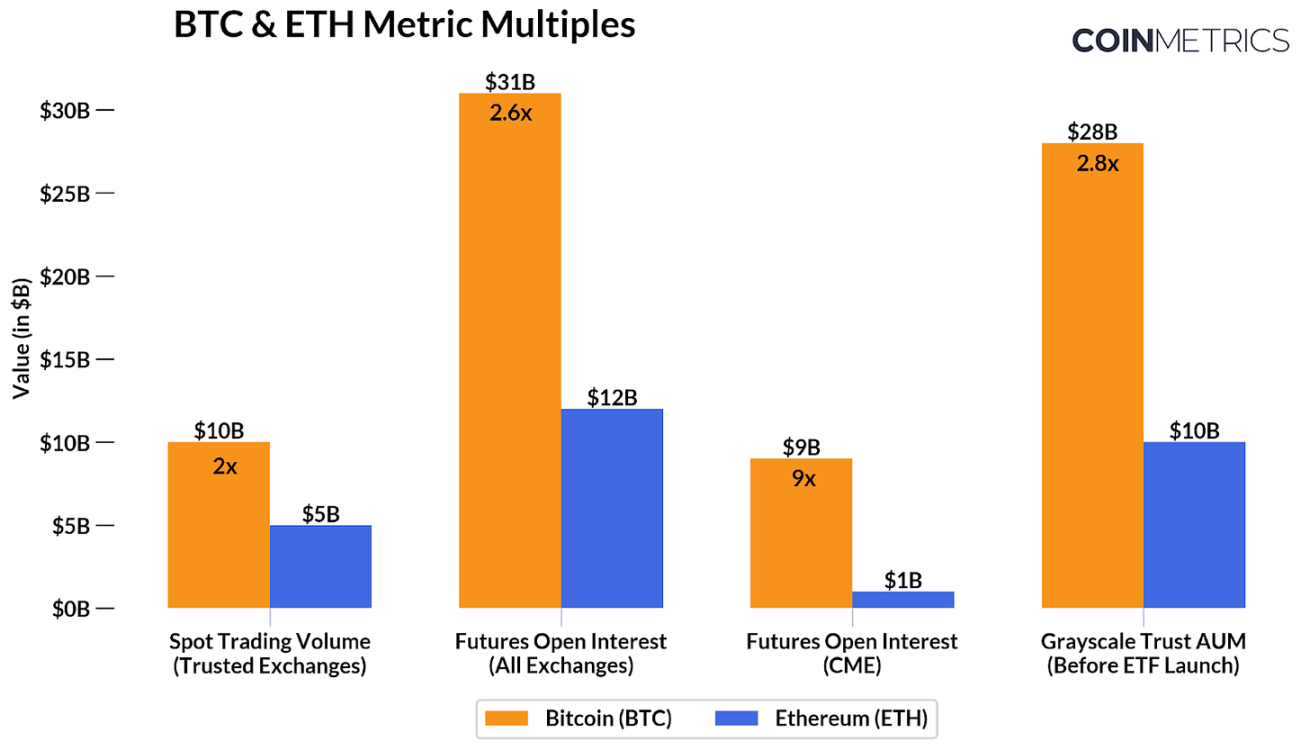
Ethereum's current market capitalization of $420 billion is approximately one-third of Bitcoin's $1.3 trillion. On credible trading platforms, ETH's average daily trading volume is half that of BTC, reflecting its relative market activity and liquidity. In futures markets, BTC's open interest across all exchanges is about 2.6 times that of ETH, and roughly 9 times on the CME. Prior to their respective ETF launches, Grayscale's Bitcoin Trust (GBTC) AUM was approximately 2.8 times larger than its Ethereum Trust (ETHE). Overall, these metrics suggest that ETH ETF inflows could align with the existing scale disparity between the two assets.
Source: Coin Metrics Market Data Feed
A key consideration is that the current ETF structure excludes staking, introducing an opportunity cost for potential investors forgoing additional staking yields. This limitation might dampen demand for Ethereum ETFs in the short term and could spark discussions about developing more comprehensive ETH investment products that include staking rewards. Furthermore, incorporating staking involves considerations around ETH's staking ratio and rewards, overall network security, and regulatory clarity surrounding the Proof-of-Stake (PoS) consensus mechanism.
Focus on Grayscale Funds
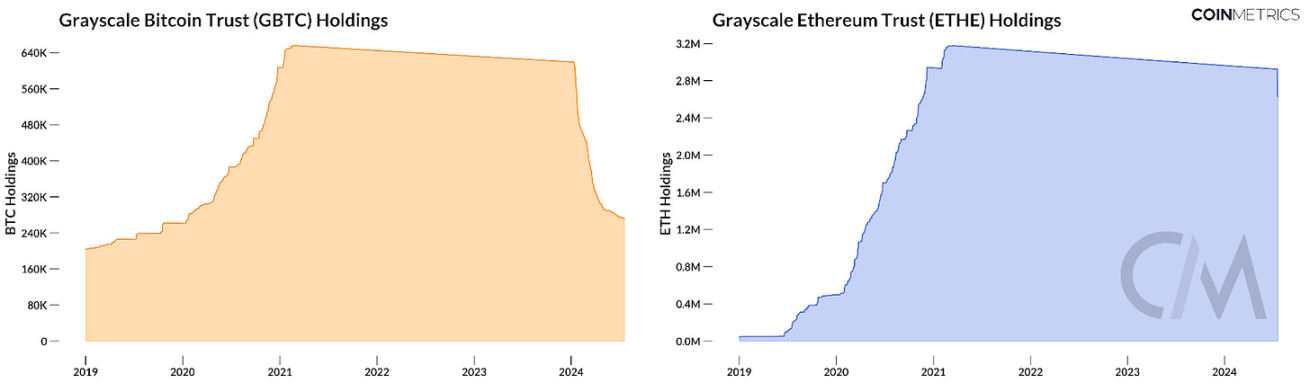
As Grayscale's Ethereum Trust (ETHE) transitions from a trust structure to an Exchange-Traded Fund (ETF) upon launch, a deeper analysis of potential outflows is warranted.
Source: Coin Metrics Institutional Data, Grayscale
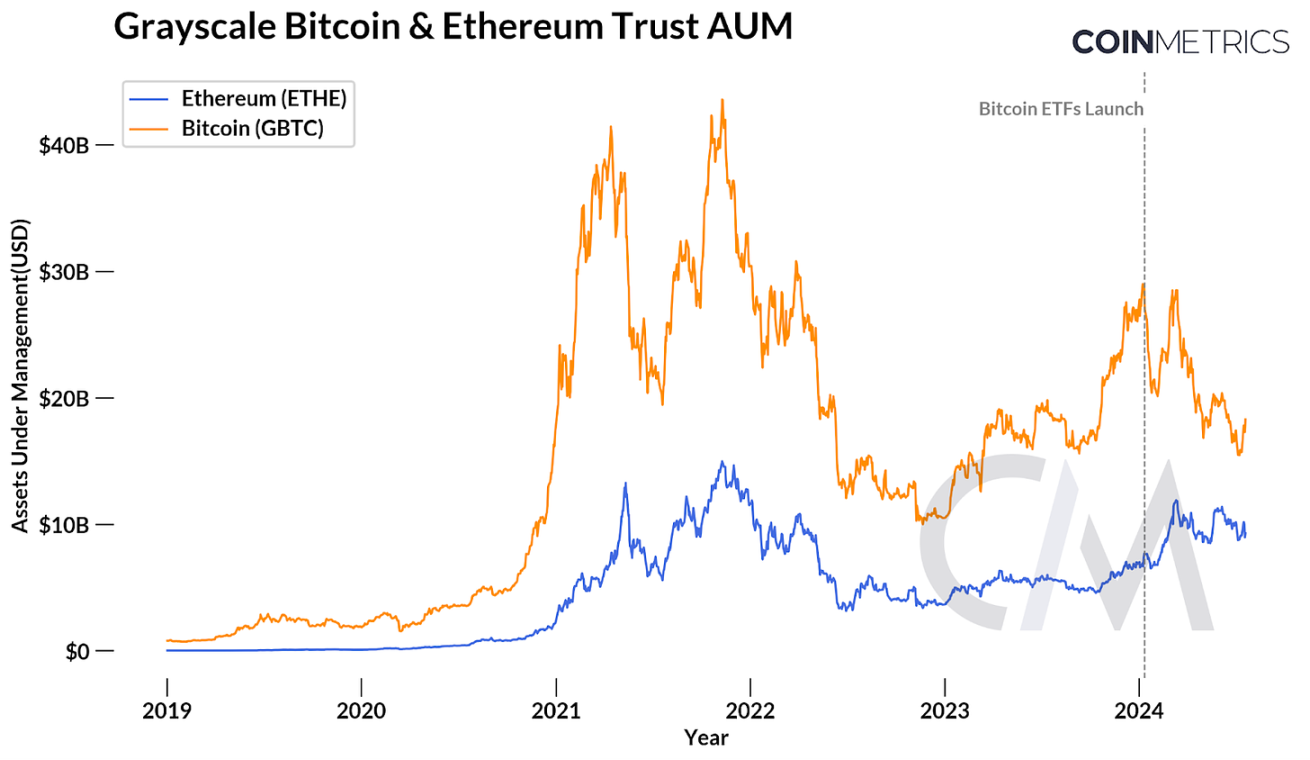
The trajectory of Grayscale's Bitcoin Trust (GBTC) serves as a reference case. Before the spot Bitcoin ETF launch, GBTC held approximately 620K BTC (roughly 3.1% of Bitcoin's total supply), with total assets around $30 billion. As GBTC converted to an ETF, early investors who purchased shares at a discount had the opportunity to exit their capital or switch to ETFs with lower fees. Consequently, GBTC's Bitcoin holdings decreased by about 55% to 270K BTC, exerting some downward pressure on Bitcoin's price.
On the other hand, Grayscale's Ethereum Trust (ETHE) started with approximately $10 billion in Assets Under Management (AUM), comprising 3 million ETH (2.5% of Ethereum's total supply). While ETHE might face similar outflows, events preceding the Ethereum ETF and Grayscale Ethereum Mini Trust (ETH) launch may help mitigate this impact.
From one perspective, ETHE's discount to Net Asset Value (NAV) narrowed rapidly following the ETF approval in May, providing investors ample time to exit near par value. Additionally, the Mini Trust's fee of 0.15% offers a transition option for cost-sensitive investors into such lower-cost products. Approximately 10% of ETHE's capital has been seeded into the new Mini Trust product, resulting in a reduction of about $1 billion in AUM or 300K ETH holdings.
Source: Coin Metrics Institutional Data, Grayscale
ETH Supply Dynamics
ETH's high utility across multiple fronts contributes to its liquidity, which significantly influences its supply dynamics as an ETF.
Ether plays a central role in the Ethereum ecosystem, serving not only as the backbone of its Proof-of-Stake (PoS) consensus mechanism but also as crucial collateral or liquidity in payment networks and decentralized finance (DeFi) platforms, including lending applications and decentralized exchanges (DEXs). With the ongoing growth of Ethereum's Layer 2 ecosystem, substantial amounts of ETH are being bridged to these layers, enabling users to access Ethereum-based services and infrastructure more efficiently.
Source: Coin Metrics Network Data Pro
As of July 22, out of the 120 million ETH in circulation, approximately 33.2 million ETH (28%) is staked on the Ethereum consensus layer, about 13.5 million ETH (11%) is locked in various smart contracts, and around 12.5 million ETH (10%) is held on exchanges. In total, roughly 39% of ETH's supply is not readily available for market circulation, and this figure does not yet account for inactive supply portions.
Source: Coin Metrics Network Data Pro
The launch of Ethereum ETFs could further amplify demand for ETH, thereby constraining the available supply in the market. However, the extent of this impact will depend on the market reception of these newly launched ETFs.
Other Notable Ethereum Metrics
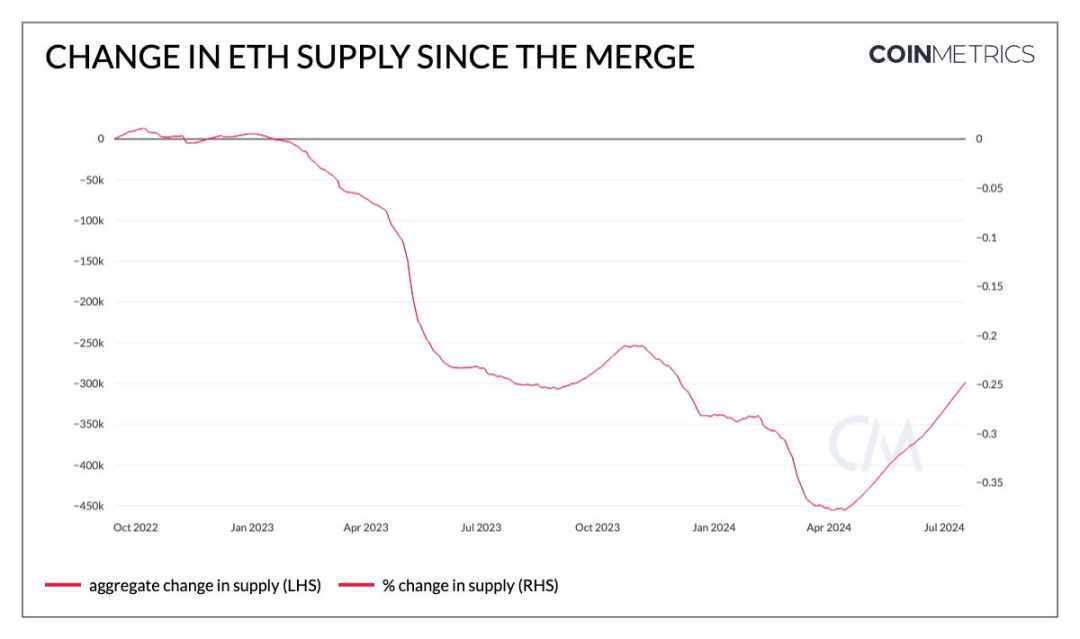
Although Ethereum has recently shown inflationary trends, partly due to increased Layer 2 activity and fee reductions from Dencun, ETH's supply has actually been slightly deflationary (-0.24%) since the Merge. The constrained ETH supply interacting with potential ETF inflows could accelerate network activity and positively impact ETH's overall economic state and on-chain metrics.
Source: Coin Metrics Network Data Pro
Whether through increased stablecoin supply, adoption of L2 solutions, or heightened DEX trading volume, increased activity on Ethereum could reduce base fees on the mainnet, subsequently driving up ETH's burn rate. This would further restrict ETH's market supply, making its price more susceptible to shifts in market demand.
ETH Performance and Volatility
As indicated by the ETH/BTC ratio, ETH's performance relative to BTC has been volatile since 2021. The current ratio stands at 0.052, down from 0.084 at the time of the Merge. Since the spot Bitcoin ETF launch in January, ETH has returned 35%, trailing slightly behind the Coin Metrics Total Market Index (CMBITM) and BTC's returns of 41% and 46% respectively, reflecting strong market demand for BTC.
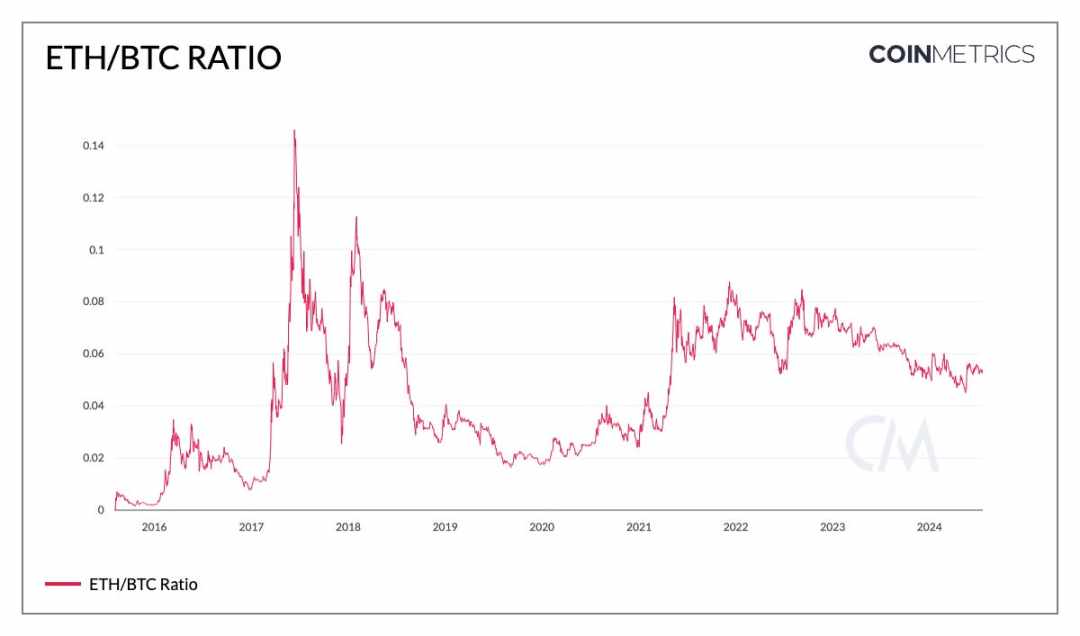
Source: Coin Metrics Reference Rates, Formula Builder
ETH's future trajectory remains to be seen, but the launch of spot Ethereum ETFs undoubtedly serves as a significant catalyst for broader recognition and adoption of ETH as an asset, the Ethereum ecosystem, and the digital asset industry as a whole.
Conclusion
While initial focus may center on the performance of Ethereum ETFs, their true impact will unfold over the coming months. We will delve deeper into the market demand for ETH ETFs relative to Bitcoin, investor demographic characteristics, and the broader implications for the Ethereum ecosystem, including network adoption, scaling infrastructure, and applications. This launch represents not only a critical milestone in the expansion and maturation of the crypto asset market but also signifies that the introduction of ETH ETFs provides investors with new avenues for exposure while acting as a key catalyst for Ethereum's expanding role in the global financial landscape.
[Disclaimer] The market carries risks, and investment requires caution. This article does not constitute investment advice. Users should consider whether any opinions, views, or conclusions herein suit their specific circumstances.