






Written by: The Rhythm BlockBeats
On July 23, according to official SEC information, the agency has formally approved the S-1 applications of multiple ETF issuers. The spot Ethereum ETF has been officially approved for listing and trading, with initial trading expected to begin tomorrow (Tuesday morning U.S. time, tomorrow evening Beijing time).
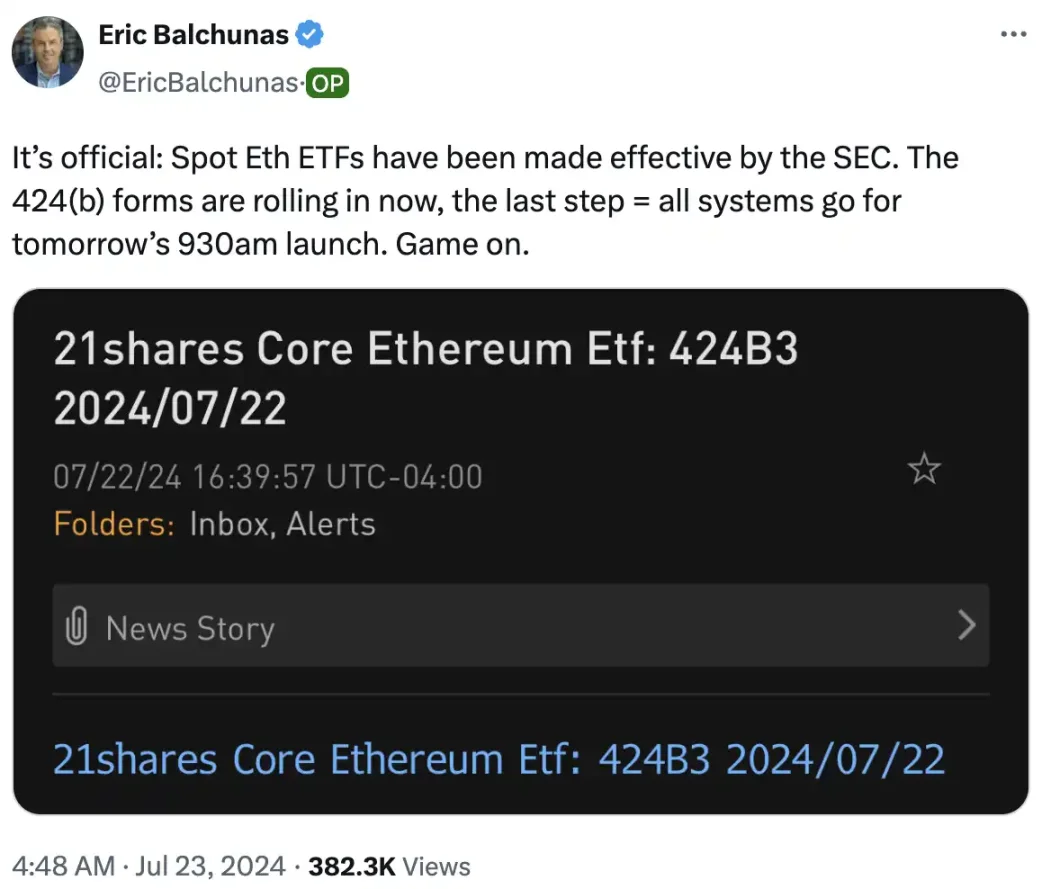
According to the notification, the SEC has informed at least two of the eight companies applying to launch the first U.S. spot Ethereum ETFs that their products can begin trading on Tuesday. Products from BlackRock, VanEck, and six other companies will start trading on Tuesday morning across three different exchanges: the Chicago Board Options Exchange (CBOE), Nasdaq, and the New York Stock Exchange, all of which have confirmed their readiness to begin trading.
This represents another milestone achievement for the crypto industry, with institutions and analysts in the sector expressing their views.
Cryptocurrency trading platform Coinbase officially stated that today, the U.S. Securities and Exchange Commission (SEC) approved applications for nine spot Ethereum ETFs. Following the approval of spot Bitcoin ETFs in January this year, the approval of spot Ethereum ETFs marks another significant milestone for cryptocurrencies, reflecting ongoing innovation around crypto assets and an increasingly mature regulatory environment. Coinbase has also become a trusted partner and custodian for 10 Bitcoin spot ETFs and eight newly approved Ethereum spot ETFs.
Bloomberg ETF analyst Eric Balchunas posted on social media, "Jay Jacobs, Head of U.S. Thematic and Active ETFs at BlackRock, said in a video promoting Ethereum to the general public that while many see Bitcoin's main appeal in its scarcity, many others see Ethereum's appeal in its utility. You can think of Ethereum as a global platform for applications that run without decentralized intermediaries."
London-based investment management firm Farside Investors released a report stating, "We believe that inflows into Ethereum ETFs may be smaller than those for Bitcoin ETFs for the following reasons: Bitcoin ETFs were approved first, attracting more attention; the market size for Bitcoin exchange-traded products (ETPs) was larger than Ethereum's before U.S. spot ETF approval; the lack of staking functionality makes Ethereum ETFs relatively less attractive; Bitcoin has stronger correlations as a financial asset, while Ethereum focuses more on decentralized applications (dApps) and on-chain usage."
Market maker Wintermute believes that Ethereum ETFs could attract up to $4 billion in inflows from investors over the next year. Wintermute expects that, driven by these inflows, Ethereum's price could rise by as much as 24% over the next 12 months.
As of the time of writing, Ethereum's price is $3,445, down 2.5% over 24 hours, suggesting that the positive impact of the spot Ethereum ETF approval may have already been priced in.
Ten years ago, on July 22, 2014, Ethereum officially launched its ICO fundraising. The team raised funds by preselling ETH, collecting a total of 31,529 Bitcoin (at an exchange rate of 1 Bitcoin for 2,000 Ethereum), which amounted to over $18 million at the time.
Two months ago, the spot Ethereum ETF went from being widely dismissed with only a 7% approval probability to seeing its approval odds surge to 75% overnight. In the early hours of May 24, the U.S. Securities and Exchange Commission approved 19b-4 forms for multiple spot Ethereum ETFs, including those from BlackRock, Fidelity, and Grayscale.
Today, the spot Ethereum ETF has been officially approved for listing and trading, with the Chicago Board Options Exchange (CBOE), Nasdaq, and the New York Stock Exchange all prepared to trade spot Ethereum ETFs.
What Challenges Did the Spot Ethereum ETF Overcome?
Security Attributes and PoS Concerns
Over the past six months, the progress of the Ethereum ETF approval has kept the community on edge. Following this approval, previous negative viewpoints have been addressed one by one. Unlike Bitcoin ETFs, the path to Ethereum ETF approval faced significant obstacles.
Since Ethereum conducted an ICO in 2014 to raise funds, this fundraising activity made ETH potentially considered an asset with security attributes. Additionally, Ethereum theoretically has no total supply cap. Under the PoS mechanism, ETH issuance is related to network activity, and the actions of large holders could cause ETH price volatility. According to previous statistics from Glassnode, nearly 55% of ETH supply is held by 1,041 addresses, which could significantly influence Ethereum network upgrades and operations.
This also led the SEC to believe that the high concentration of ETH holders increases the risk of market manipulation. Galaxy Digital's Head of Firmwide Research, Alex Thorn, had previously expressed pessimism about Ethereum ETF approval based on this.
According to Alex's report, after Ethereum transitioned to a new governance model called "Proof-of-Stake (PoS)" in September 2022, the U.S. Securities and Exchange Commission (SEC) opened an investigation into the Switzerland-based Ethereum Foundation.
Although "Proof-of-Stake" helps Ethereum overcome the defect of energy waste by using a model that relies on a network of trusted validators, it actually provided the SEC with a new pretext to attempt to define Ethereum as a security.
As a compromise, ETF applicants such as Ark Invest, 21Shares, and BlackRock have removed the staking portion from their ETF proposals, stating they will not stake a portion of the trust's assets. This measure reduces the risk of ETH being considered a security, as staking may involve expectations of future returns, which is precisely a characteristic of security attributes.
The Prelude to Hong Kong's Spot Ethereum ETF
Looking back at the crypto market performance over the past year, Ethereum has appeared relatively weak compared to Bitcoin's strength. Its price and gains couldn't match Bitcoin's performance nor that of altcoins. During this period, Hong Kong gradually shifted to a more crypto-friendly policy stance, allowing its spot Ethereum ETF to be approved ahead of the U.S., which brought significant positive momentum for Ethereum.
On April 15, 2024, the Hong Kong Securities and Futures Commission officially announced the list of approved virtual asset spot ETFs, including Bitcoin spot ETFs and Ethereum spot ETFs from ChinaAMC (Hong Kong), Harvest International, and Bosera International.
These six spot ETF products opened for subscription from April 25-26 and listed on the Hong Kong Exchange on April 30, marking the first time spot Ethereum ETFs were listed on a major exchange.
Currently, Hong Kong's spot cryptocurrency ETFs are primarily issued simultaneously by three companies: ChinaAMC (Hong Kong), Bosera Fund (International), and Harvest International. These include Bosera HashKey Bitcoin ETF (03008), Bosera HashKey Ethereum ETF (03009), ChinaAMC Bitcoin ETF (03042), ChinaAMC Ethereum ETF (03046), Harvest Bitcoin Spot ETF (03439), and Harvest Ethereum Spot ETF (03179).
In community research and analysis, the reasons Hong Kong approved spot Ethereum ETFs earlier than Europe and the U.S. are attributed not only to its flexible regulatory environment and openness to financial innovation but also to strong market drivers, geographical and strategic advantages, and the desire to seize pricing power first.
Although many community members were initially not optimistic about this development, believing it wouldn't have much effect from a market perspective, the U.S. SEC's dramatic shift in attitude toward Ethereum by approving VanEck's application—even though approving the 19b-4 filing alone doesn't guarantee final ETF approval—in such a frenzied market, any positive factor can be seen as a major victory. Perhaps as Hong Kong Cyberport Director Kong Jianping said, "Hong Kong's率先 approval of Ethereum ETFs was a lifesaver for Ethereum."

What Impacts Will the Spot Ethereum ETF Approval Have?
The approval of spot Ethereum ETFs may have been unexpected, unlike spot Bitcoin ETFs where investors began positioning themselves six months before approval, resulting in large-scale inflows. However, for the crypto industry, the approval of spot Ethereum ETFs remains a milestone event, and its impacts lay a positive foundation for the future development of the crypto industry.
Are Altcoins Saved?
The most direct impact of spot ETF approval will be reflected in prices. Bitcoin rose 75% after its spot ETF approval, indicating the potential price impact of Ethereum spot ETF approval. However, this Ethereum ETF approval news didn't immediately shake up the altcoin sector, with slight declines compared to previous days.
Geoff Kendrick, Head of FX Research and Digital Assets Research at Standard Chartered Bank, stated: "Following approval, we expect spot Ethereum ETFs to drive inflows of 2.39-9.15 million Ethereum in the first 12 months after approval." He added: "In dollar terms, this represents approximately $15-45 billion in assets."
Kendrick added, "Given we now see Bitcoin reaching $150,000 by the end of 2024, this implies an Ethereum price of $8,000."
Beyond impacting ETH's price itself, spot Ethereum ETFs will also positively affect the altcoin market. Since the vast majority of altcoins on DEXs use ETH as trading pairs, ETH's rise will lead to passive increases in altcoin prices.
Additionally, some market views suggest that with the approval of spot Ethereum ETFs, there is strong reference significance for future cryptocurrency ETF applications.
Potential Shift in Crypto Regulatory Policy
Another important impact of the spot Ethereum ETF approval is reflected in the changed attitude of U.S. regulatory agencies toward crypto policies.
With the U.S. election campaign underway, the tendencies shown by Democrats and Republicans toward the crypto industry deserve attention.
Previously, former U.S. House Speaker Nancy Pelosi was considering supporting a Republican-backed crypto bill, FIT21, during this week's House vote. Additionally, a bill regarding cryptocurrency accounting standards, SAB121, will also be resolved soon.
After the spot Ethereum ETF approval, mainstream market views believe this has brought positive influence to the cryptocurrency regulatory environment.
Previously, Galaxy Digital's Head of Firmwide Research Alex Thorn stated that the SEC's regulatory attitude toward Ethereum would attempt to find a balance between "ETH" itself not being a security and "staked ETH" (or more tenuously, "staking ETH as a service") being a security.
This is quite similar to the诉求 in the FIT21 bill, which aims to clarify which digital assets fall under the Commodity Futures Trading Commission (CFTC) regulation and which fall under Securities and Exchange Commission (SEC) regulation. This is important because there are key differences between the definitions of "commodity" and "security," which affect how they are regulated.
In summary, as a crypto asset category with smart contracts, ETH's spot ETF approval will undoubtedly have a profound impact on the crypto industry.
【Disclaimer】The market carries risks, and investment requires caution. This article does not constitute investment advice. Users should consider whether any opinions, views, or conclusions in this article suit their specific circumstances.