






When OpenAI unraveled the mystery of GPT-5 in August of this year, the spotlight on the field of artificial intelligence was once again focused. It brought new advancements in programming and complex research tasks, and confirmed the steady pace of technological evolution. However, while this “progress report” brings joy, it also conveys a sobering message: it is not the leap-forward breakthrough to general artificial intelligence (AGI) expected by the public, but more like a gradual upgrade
.However, on the other side where technological progress seems to be “gentle,” the “appetite” for AI computing power has entered a “crazy mode” that is almost out of control. Nvidia Rubin chips already consume up to 600kW of power in a single rack, 12 times more than three years ago. This is like a heavy hammer, sounding a wake-up call about the sustainability of AI development. The long journey to AGI at the technical level contrasts strongly with the exponential rise in energy consumption at the real
level.In this edition of the SunFlush Roundtable, the guests focused on the sharp conflict between the current state of AI technology and the explosive growth in computing power and energy consumption, and carried out an in-depth analysis. This article systematically reviews the wonderful speeches of the guests, leading everyone to break through the fog and discuss the driving forces of AI development, short-term strategic shifts, and the implications of Sunpump's AI agent strategic layout for the Web3
industry.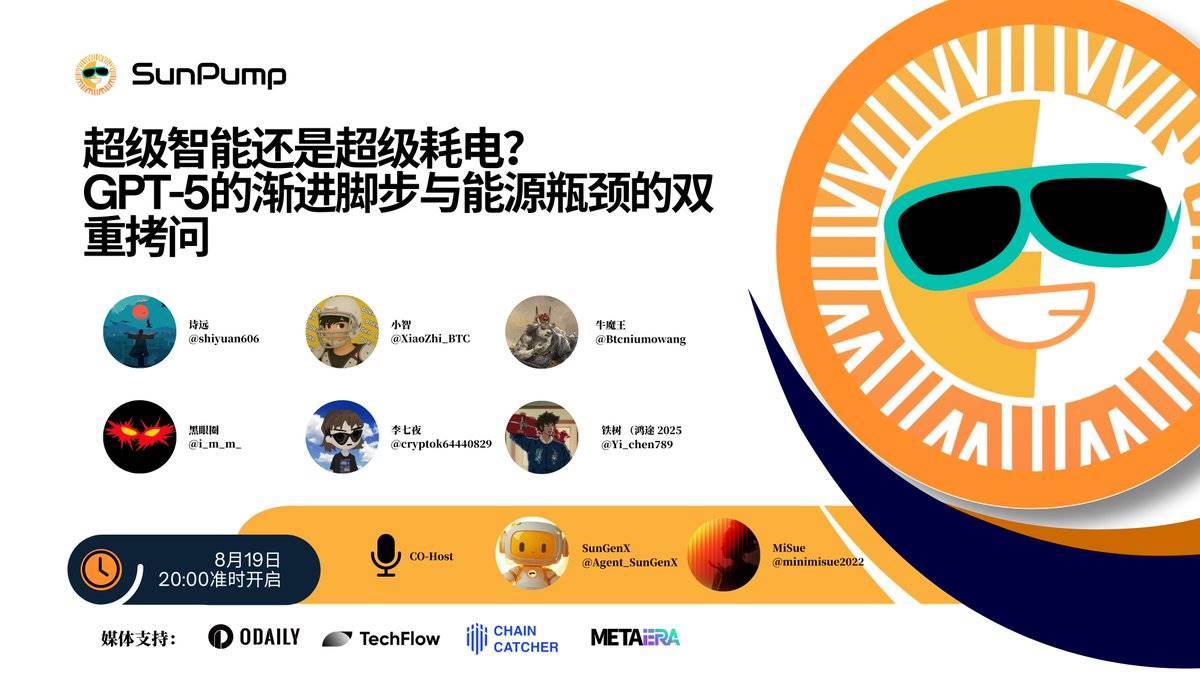
The future of
AI: GPT-5 iteration controversy, computing power
and energy consumption shackles, and technological collaboration 8 On January 7th, GPT-5, the latest AI model that the industry has been eagerly awaiting, was officially unveiled, but it failed to win a big splash. Starting from everyday usage experience, Mr. Iron Shu affirmed GPT-5's progress in improving efficiency and handling complex tasks, and placed particular emphasis on optimizing its code generation and research support capabilities. But he also sharply pointed out that this iteration is more like “upgrading from iPhone 15 to 16,” with no changes to the framework, only partial optimizations, and a lack of revolutionary breakthroughs.
In an in-depth discussion on “whether AI computing power consumption will become the biggest bottleneck in future development”, the guests agreed that the energy consumption issue has become a key constraint on the large-scale implementation and sustainable development of AI, but it may also force technological innovation and green transformation. Although the guests had different perspectives, they generally agreed on the basic judgment of looking at algorithms in the short term and relying on energy in the long term. In the short term, algorithm innovation is the main path to breaking through bottlenecks. However, in the long run, if there is no revolutionary change in the energy landscape, the large-scale expansion of AI will sooner or later hit an insurmountable
“energy wall.”Shi Yuan clearly stated that every qualitative transformation of the big model stemmed from the evolution of algorithms. “If we simply relied on computational power stacking, we wouldn't have today's GPT.” Regarding the energy consumption issue, he proposed that in the future, energy efficiency can be greatly improved through “multiple small model collaboration”, etc., and performance leaps can be achieved without significantly increasing
energy consumption.Teacher Li Qiye pointed out that the realistic constraints on computing power forced development logic to return from “unlimited storage” to “efficiency first,” and cost reduction on the reasoning side became the key. He predicted that the GM large model will still develop, but “small end-side models and AI agents will be rolled out on a large scale.” Mr. Xiao Zhi focused on the prospects of technology marketization in 3-5 years, stressing
that existing conflicts need to rely on new support points to trigger industrial upgrading, and to achieve “smarter without a behemoth” through “small models+personalized smart devices”.The
guests generally agreed that the gradual upgrade of GPT-5 and imminent computing power anxiety are driving a phased shift in the AI development pattern: the focus of the industry has shifted from simply pursuing “greater parameters” to being pragmatic and pursuing “more efficiency.” Lightweight, scenario-based AI agents and specialized small models may be the main
theme for the next few years. Whether practical problems can be solved at a lower cost and with greater agility has become a new yardstick for measuring the value of technology.A
revolution in creativity and efficiency: Sumpump uses AI agents to build a bridge for Web3 applications. It is worth noting that in the face of these trends, Sumpump
has already developed a layout. With its unique AI agent layout and product innovation, Sumpump shows a possible path for artificial intelligence to empower Web3. Its core AI product lines, SunGenx and SunAgent, are promoting the evolution of AI technology towards more efficient, easier to use, and more integrated through practical solutions.
As an innovative AI agent launched by Sumpump, Sungenx provides users with an unprecedented meme token issuance experience. Users only need to use @Agent_SunGenX on the X platform and enter the token name and symbol, and SungenX can automatically complete the coin issuance process, truly “tweet and send coins”. This feature greatly reduces the technical threshold and operational complexity of token issuance, and allows users to focus on project ideas and community building without worrying about complicated technical implementation
details.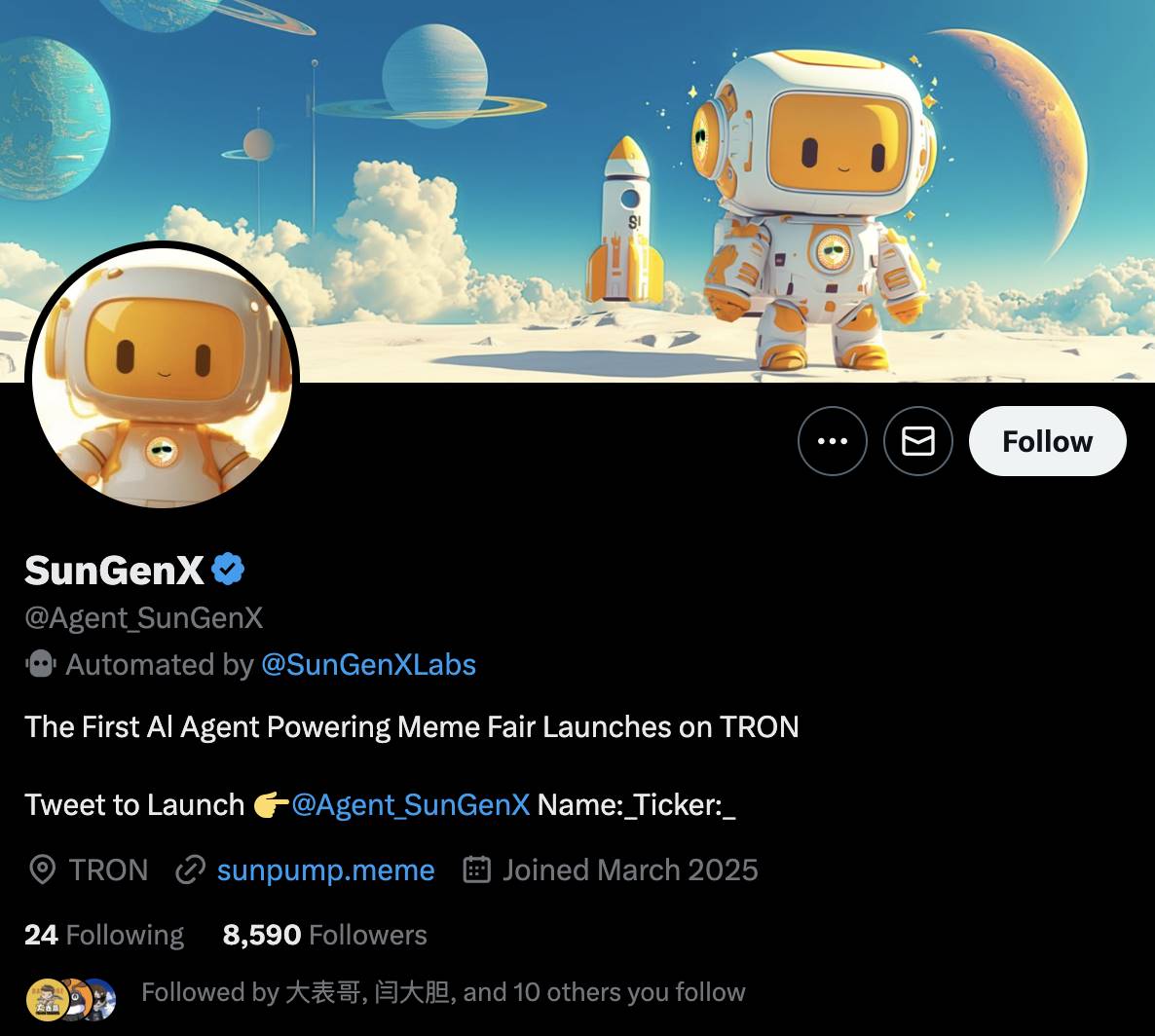
The advent of SungenX not only showcased the innovative application of AI agents in the blockchain field, but also reflected Sumpump's commitment to making AI technology more popular The concept of socialization and practical use. By simplifying the complicated process of issuing coins into a single tweet operation
, SungenX provides new possibilities for the spread of digital currency and blockchain technology.Currently, SungenX continues to be the core traffic portal of the SunPump platform. At the “Interstellar Heatwave” eco-month event hosted by TRON Eco in July, SungenX's coin issuance increased dramatically, accounting for more than 80% of the total number of coins issued on the entire site. At the same time, its convenient and friendly coin issuing experience has also been sought after by more and more meme players. At the “#TagSunGenXEverywhere” event held recently, The number of interactions on SungenX's official X account
has surged, fully confirming its growing community influence.The perfect complement to SunGenX is SunAgent, a product focused on improving users' task execution efficiency.
The core function of SunAgent is to be able to have natural language conversations with users and quickly understand and respond to users' needs. It focuses on the Web3 vertical field and can answer questions about blockchain, digital currency, artificial intelligence, technology trends, economics, etc. Whether it is project analysis or token issuance, SunAgent can be used as an intelligent assistant to help users improve decision-making and execution efficiency.

The collaborative development of
SungenX and SunAgent reflects Sumpump's deep thinking at the AI application layer: the former has been reduced The threshold for using blockchain technology has made digital asset creation more democratic, while the latter aims to improve the level of intelligence in everyday work and make AI an accessible productivity tool
in the Web3 field.This “creation+efficiency” two-wheel drive model is building a seamless bridge from AI technology to actual application. Its technical route not only responds to the market demand for simple and easy to use blockchain tools, but also provides a promising application path for how artificial intelligence can be integrated more deeply and
conveniently into Web3.Conclusion
In the sharp confrontation between technical reality and computing power consumption revealed by GPT-5, we can clearly see that the development of artificial intelligence has entered a more complex yet more rational stage. It's no longer just a race for parameter scale, but a deep exploration that requires finding the perfect balance between intelligence, energy consumption, and efficiency
.What is
worth looking forward to is that, as shown by practitioners such as SumPump, using AI agents to drive lightweight and scenario-based applications is becoming a key path to open up technical capabilities and real needs. The future of AI is both written in the blueprint for high-performance computing and in
ecosystems that efficiently transform intelligence into productivity and creativity.