






Arranged & Compiled by: Deep Wave TechFlow 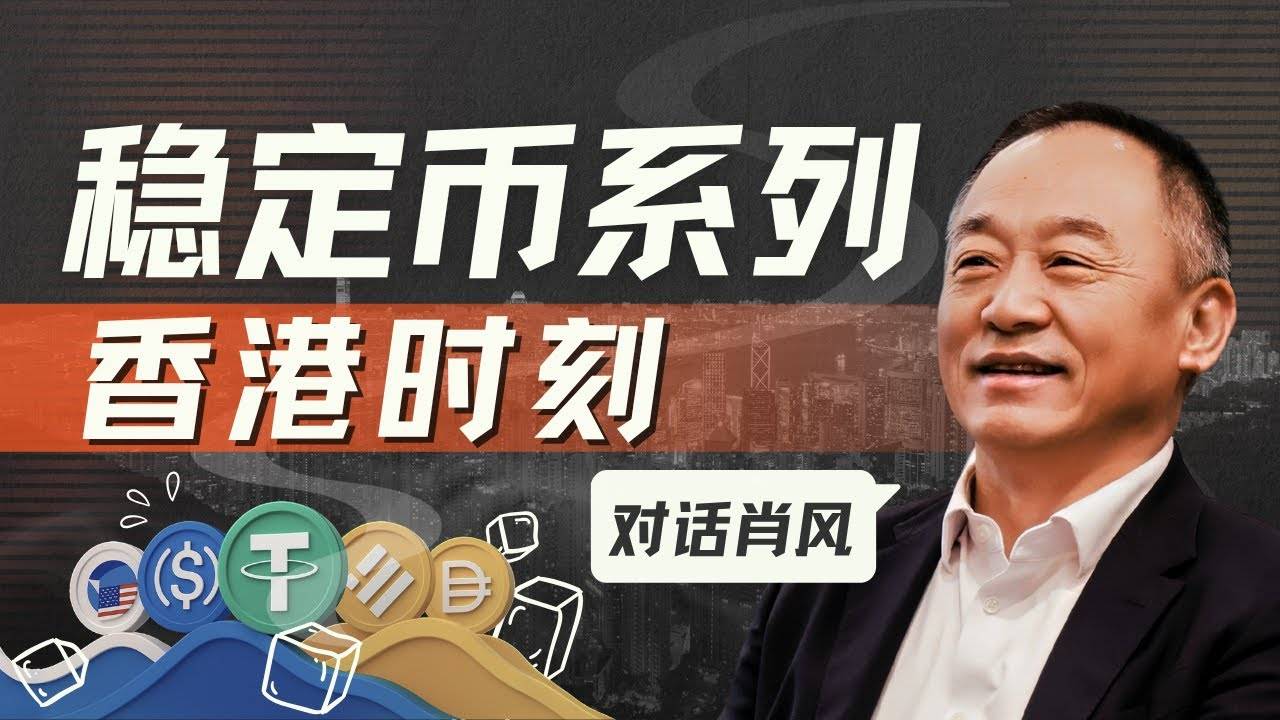
Guest:
Xiao Feng, Chairman and CEO of HashKey Group Moderator
BODL Ventures Partner, Former Chainwen Editor-in-Chief, Hong Jun Jane, Founder of Silicon Valley 101 Podcast Source: Silicon Valley 101 Podcast Original Title: E202 | Dialogue with Xiao Feng: In the boiling moment of Hong Kong
stablecoins, some cold thoughts returning to common sense
Broadcast date: July 31, 2025 Summary When
Hong Kong stablecoins were
issued, stablecoins and RWA became super popular terms in the Chinese world. Dr. Xiao Feng, Chairman and CEO of HashKey Group, known as the “Godfather of China's Blockchain,” shared with us some of his cold thoughts on returning to common
sense about this boom.Highlights Summary Hong Kong's regulation of stablecoins
is unexpectedly strict.
Stablecoins themselves were not created to pay.
The mainland will start by accepting stablecoins and then accept the whole of Crypto. The mainland discusses stablecoins
from the perspective of major currency competition; Hong Kong is more concerned about anti-money laundering loopholes.Crypto does a better job of anti-money laundering than traditional finance.
Alliance chains don't work, and stablecoins on affiliate chains won't succeed.
Most successful apps are created without a license.
Hong Kong has the potential to once again become a world center for digital asset trading.
Singapore's location is Switzerland in Asia, while Hong Kong's location is Wall Street in Asia.
Next year will be a period where traditional financial markets are embracing the rapid growth of cryptocurrencies.
The underlying protocol of blockchain is decentralized, but the application layer must be centralized.
Although Hong Kong's stablecoins are popular, the regulatory authorities are very cautious about this topic; this is a huge gap.
In Beijing, everyone gradually formed a two-point consensus. The first consensus is that it is impossible for China to continue to turn a blind eye in the face of a wave of US legislative compliance on crypto, stablecoins, and blockchain around the world; the second consensus is how it should respond. If China turns a blind eye forever
and does not accept these new things, it may be at a disadvantage in the national currency competition.At this time next year, we may be discussing RWA. The mainland may begin to accept asset tokenization, and after RWA, the third step in the future may be to accept Bitcoin.
RWA has three stages, the easiest of which is tokenizing fiat money; the second stage is financial assets; and the final stage is tokenizing physical assets.
Today's market interprets stablecoins from a monetary perspective, and there is a lack of thinking about changes in underlying logic.
All tokens wouldn't exist without technology, bookkeeping methods, and financial infrastructure.
The core point of Hong Kong's stablecoin legislation for stablecoins issued under license is related to anti-money laundering.
Hong Kong has also become a capital market favorite for two reasons. The first factor is the advent of DeepSeek, and the second is that America's traditional alliances have weakened due to Trump's policies, and everything has become a
business.
Now that you've started to accept stablecoins, you must accept public chains; otherwise, your stablecoins won't be globally competitive, and you'll have gray hair.
In the future, stablecoins will become a measure of value in the virtual and digital worlds, and they are a medium of exchange for all virtual and crypto assets.
Exchanges strive to build very good liquidity for any trading pair. Building any liquidity pool requires costs, and this cost needs to be amortized.
Calm thoughts amidst the stablecoin and RWA boom Liu Feng: Now I can see that in places where Chinese can be spoken, whether in Hong Kong or the mainland
, stablecoins have become a popular word.
Could you please tell our audience briefly about why people are paying so much attention to Hong Kong's stablecoin regulations? Also, if you can draw a picture of the key points, what are Hong Kong's special concerns in the regulation of cryptocurrencies and digital assets?
Dr. Xiao Feng:
I personally feel that the heat is a bit too much. I had coffee with friends at a hotel cafe a few days ago, and found that people at several tables around me were talking about stablecoins. Not long ago, we also went to the Hong Kong Monetary Authority to have an exchange on stablecoins. Officials also repeatedly reminded us that the stablecoin sector is too hot, and Hong Kong will not issue
many licenses.Stablecoin issuance in Hong Kong will be very strict at the initial stage. Not only will licensing be strict, but regulations will also be very strict, especially on Crypto's use of stablecoins to fight money laundering. August 1 is only the day the Hong Kong Stablecoin Act comes into effect, but that doesn't mean that everyone can apply for a stablecoin license in Hong Kong starting August 1. Although the market says that dozens or even hundreds of companies are applying, I believe there will be very, very few applications that can actually be accepted by the HKMA. Mainly, everyone is very concerned about the background of each
applicant, especially the background of financial risk management and anti-money laundering experience and ability.Hong Kong is an international financial center with decades of experience, so Hong Kong's regulators, whether SFC or HKMA (i.e. the HKMA), are very sensitive to some trends in the international financial market. This is in stark contrast to the mainland. The mainland explains stablecoins, especially offshore RMB stablecoins, more from a monetary perspective, from the perspective of currency competition among major countries, and from the perspective of the hegemony of the US dollar. However, Hong Kong is different. Originally, I thought that if the mainland had so many institutions, so many people, and so much money willing to come to Hong Kong, whether it was to build stablecoins, issue stablecoins, or use stablecoins, this would be a huge benefit for Hong Kong's international financial center. The Hong Kong regulatory authorities gave me the impression that their first concern, or the core concern was whether the issuance of stablecoins would lead to a lack of regulation due to leaving the bank account system. In fact, financial regulators currently lack the means to
regulate the circulation of stablecoins after Mint.Therefore, in this regard, Hong Kong is more concerned about whether there will be any loopholes in anti-money laundering. As an international financial center, if Hong Kong is criticized by other major international financial centers around the world for anti-money laundering, then this will have a huge impact on Hong Kong's reputation as an international financial center.
Conversely, this may be completely different from everyone's feelings. Although Hong Kong is hot, the regulatory authorities are very cautious about this topic; this is a huge gap.Looking back in time: Treated coldly by Hong Kong regulators Liu Feng: You've actually been calling for and promoting transparency and regulation of digital asset legislation in Hong Kong
for many years.
Can you tell me what you think today is that Hong Kong is a global financial center. While fully embracing digital assets and cryptocurrencies, there are still many concerns and a very cautious attitude? What do you think of this contrast, and the different contrasts over the years, past criticisms and rejections that
now seem to have opened their arms, this new attitude?Dr. Xiao Feng:
I can tell you a story from my own experience. This story fully explains the issues you just mentioned. HashKey was established in Hong Kong at the end of 2018. We moved this business to Hong Kong in '18 because the mainland had stricter regulations on this in '17, because after all, Hong Kong is legal and compliant. At the beginning of 2019, I visited the Hong Kong Securities Regulatory Commission to apply for a Crypto Exchange license. The official who received me told me, “Mr. Shaw, you don't need a license to open a virtual currency exchange in Hong Kong, and it's not against the law; you can open it
by turning left when you go out.I
actually heard this statement when I visited the head and deputy secretary of the Hong Kong Economic Management Bureau in 2022. I said we want to apply for a Hong Kong stablecoin license. The Deputy Secretary said, “Mr. Shaw, issuing stablecoins in Hong Kong is not against the law, and we have no right to supervise you. I told him that we have actually invested in a stablecoin company in Hong Kong, but we can't do it because no bank in Hong Kong dares to provide us with stablecoin services, and customers cannot deposit and withdraw funds normally in
fiat currency.Why did the two people in charge say the same thing? Because Hong Kong is an Anglo-American legal system, in the framework of common law, the first sentence is “anything can be done without law”, so in 2019, Hong Kong did not have any laws on Crypto, you can do anything, and there are no laws prohibiting setting up an exchange. At the same time, both institutions (the Hong Kong Securities Regulatory Commission and the Hong Kong Monetary Authority) say that we have no authority to issue a license or supervise you, because the second sentence in the common law system is “You cannot act without authorization by law”. You set up an exchange on the street; they
have no right to investigate and punish you.I was joking at the time, but if you say that, no one cares about me in Hong Kong? He answered that it's not that no one cares; the police department's commercial crime investigation department will take care of you. Although what you are dealing with is not securities, at least
if it is a commodity, consumer protection is managed.It is true that everyone in the industry is talking about the high cost of compliance in Hong Kong; it is not profitable to do this in Hong Kong. Compliance has a cost, but the cost of compliance also makes some sense. After all, we are working in an emerging financial industry. The new finance brought about by fintech has strong externalities. Over the past few hundred years, a set of rules to protect investors and consumers has gradually been accumulated. Of course, these rules
will bring operating costs.If our industry isn't willing to bear these costs, we may never grow. If you imagine a market of 10 trillion dollars, tens of trillions of dollars, or even 100 trillion dollars, then you will inevitably be constrained by spillover effects, which you must endure
.New hope: “The mainland will start by accepting stablecoins and accept Crypto as a whole”
Dr. Xiao Feng:
So until now, in my opinion, mainland China began restricting
, regulating, or even banning certain crypto-related businesses in 2017. I've been wondering the question: when
and where will mainland China start accepting these again? There have actually been no answers for years. In the last month and a half, I think I've found the answer because I went to Beijing to attend many internal seminars, and also because of the impact of Hong Kong and the US stablecoin
laws.Most discussions in the mainland took place after the Hong Kong stablecoin regulations were passed on May 21. Since then, the US has also been intensively advancing the relevant legislation, so Beijing has aroused a lot of discussion.
In these discussions, I suddenly got the hang of it and realized that the mainland would start by accepting stablecoins and then accept Crypto as a whole.I participated in a lot of discussions during this time, which lasted a month and a half. Although there were still different opinions in Beijing until Sunday, everyone gradually formed a two-point consensus. The first point of consensus is that in the face of a global wave of US legislative compliance with crypto, stablecoins, and blockchain, it is impossible for China to continue to turn a blind eye and not take countermeasures. The second consensus is, how to deal with it? In the words of a friend in Beijing, it was “Can't fight the Battle of Huaihai? ” The issue has been decided and must be addressed. How do you hit it? Is it a minor or a big hit? Which army should be destroyed first? The current discussion is about this. I sat there and felt that the mainland will start accepting it from here, because if China turns a blind eye forever and does not accept these new things, it may be at a disadvantage in the national currency competition. I think senior Chinese officials are actually aware of this kind
of problem, and that is why a speech by former central bank governor Zhou Xiaochuan at the Lujiazui Forum was to be wary of the impact of US dollar stablecoins on the dollarization of the international monetary system.This obviously means looking at US dollar stablecoins from the perspective of national currency competition; China clearly must deal with it. At the same time, I made my own predictions. This is the saying, “If you have a first year, you will have fifteen.”
Now that you've started to accept stablecoins, you must accept public chains; otherwise, your stablecoins won't be globally competitive, and you'll have gray hair.Now that you've accepted the RWA, what is the next step you might accept? I think at this time next year, we'll probably be discussing RWA, and the mainland may start accepting the tokenization of assets. After all, RWA has the same attributes as stablecoins, that is, it supports the real economy. Anything that can support the real economy is easier for mainland officials, regulators, and governments to accept.
After you accept RWA next year, you'll have to consider the third step in the future, possibly accepting Bitcoin.Challenges affecting China's embrace of digital assets: Increased abduction Liu Feng: You've drawn us a route you've outlined in your mind that may be how we can actually embrace blockchain and digital assets in the future
in the land of China.
It sounds like learning about this technology starting with stablecoins, because of the last-resort method behind the currency game, everyone must first embrace stablecoins. This doesn't seem like a special Crypto product, and then slowly embrace the trend of tokenizing using blockchain technology like RWA, but it can support the real economy. Further down, you may find it necessary to embrace a wider range of blockchain-based technologies, or some product forms, business models, and financial
innovations.I'd like to ask, what challenges do you think might be in this process? Your prospects for being this good may be affected a bit.
Dr. Xiao Feng:
I think the challenge comes from two aspects.
On the one hand, it is true that whether it is the European Union, the United States, or some economically developed countries, or the International Anti-Money Laundering Organization or the Financial Stability Committee of the Bank for International Settlements, they have all expressed concern with the Hong Kong side about Hong Kong's aggressive implementation of stablecoins, especially RMB stablecoins . Stablecoins may facilitate oil trade between China and Russia, Iran, and Venezuela, as these countries are all subject to UN sanctions
.Previously, if the fiat currency channel was relatively troublesome, it could also be monitored, but if the stablecoins used were separated from banks and SWIFT, then they were completely decoupled from the entire financial rules and regulation system originally established by Europe and the US. This pressure is something they have begun to pay attention to so far, and I'm sure they will continue to exert pressure. However, if we want to issue offshore renminbi and stablecoins, there must also be demand in this
regard.The second aspect is that we have seen some signs so far. Recently, in the mainland, stablecoins have gone from Hong Kong to Beijing, and even Beijing is sometimes hotter than Hong Kong, leading to the phenomenon of fraud and abduction. In fact, the current trend of pyramid scheme scams in the name of stablecoins is not happening in a single province, but is already happening a lot in many economically developed regions. So when we saw the news, financial supervisory authorities in different provinces in the mainland began to issue continuous warnings. This trend is indeed a trend worth watching out for. I also often tell myself, let's not add fuel to the fire. We all clearly remember that internet finance continues to be rectified. Let's not fall into a state where internet finance continues to be rectified; this will seriously slow down the mainland's process of accepting these stablecoins or RWA. The current trend is indeed quite serious. This is putting pressure on the mainland, because for the regulatory authorities, if they haven't seen a good situation, the first thing they see is that all kinds of scams are rampant in the mainland
, then obviously they will slow down their pace.Re-understand the three stages of RWA (real world assets): tokenization of fiat currency; tokenization of financial assets and tokenization of real assets Liu Feng: Some innovative ones like
RWA use new blockchain technology to promote some finance
Innovative development. You also mentioned that it may lead to some fraud. Can you share what you think is correct and promising, and some scenarios or directions where blockchain technology
is really valuable for applications such as RWA.Dr. Xiao Feng:
RWA I call it asset tokenization, and I split it into three stages. The first stage, which can be calculated starting in 2014, is the tokenization of USDT fiat currency. The second phase should begin in 2024. Tokenization of financial assets will follow US companies such as BlackRock, Fidelity, and Franklin Templeton, which turn their dollar bond funds, dollar monetary funds, etc. into the blockchain
.But what most people in the market are interested in talking about is tokenizing physical assets. I think the most core problem of the tokenization of real assets has not been solved until now, which is oracles. How can you guarantee that an off-chain physical asset can correspond to its digital twins (digital twins) on the chain one by one, and stay anchored forever to ensure the existence of offline
assets.There isn't a good solution to this technology right now; DePin is a solution. DePin has always been a premature baby and hasn't found an independent business model for 20 years. DePIN may be a solution for tokenizing physical assets in the future, but currently the technology is not mature, so tokenizing physical assets will take a longer time. If it is to be promoted or accepted on a large scale
, the issue of oracles also needs to be solved.The three stages are like water flowing, from easy to difficult.
Of course, the easiest ones are fiat currencies like the US dollar, the euro, and the renminbi. Their trust and endorsement are very simple, and everyone recognizes them.In the second step, from the perspective of trust and endorsement, what is easier to solve is financial assets. Its issuer and custodian are licensed financial institutions and are strictly regulated, making it easier to complete the digitization and tokenization
process.Tokenizing physical assets is a very difficult thing; I don't think a good solution has been found; I think it will take time.
Therefore, I now recommend that those interested in RWA first turn physical assets into financial products and then tokenize them on the basis of financial products. For example, gold. If just a gold miner told me that he produces 8 tons of gold a year, I wouldn't believe it. However, if you produce this gold, according to financial standards, what kind of gold nuggets can become currency anchors or collateral assets, then there are
standards.Once done, a licensed financial institution issues a gold fund or gold ETF. These gold nuggets are tested and placed in a treasury by a reputable bank, and this bank is the custodian of these gold assets. The escrow bank gave us instructions stating that he received gold that met the standards and then helped him
mint a token to circulate on the chain. This is probably the best solution so far.Liu Feng:
This makes it very easy to understand and deliver when issuing tokens. What you mentioned sounds more like telling us that although RWA is a so-called real world asset, not all real world assets can simply be mapped onto the chain. Instead, you should go through a very standardized process in the early stages. First, it is verifiable and auditable, and in addition, it can be structured as much as possible. In the future, it will be easier to circulate in the transaction process, and transactions between the two parties will also be easier to reach. This
is an effective RWA process.But I think in this process, the so-called RWA is not creating a new type of asset; it's just from the physical to the original financial ledger to the chain. This sounds more like a very simple use case of using blockchain to complete settlement and transactions in the transaction process. As far as it is
concerned, it actually uses real-time settlement and real-time consensus using blockchain or Crypto.Back to common sense: What problem did blockchain solve?
Three changes in human bookkeeping methods
Liu Feng: So the core of RWA is not issuing coins and assets; this is back to what you called
for ten years ago: Why do you think blockchain and Crypto digital assets attached to blockchain are the real future
Financial innovation
.Can you go back and tell you some of the most basic things you've been talking about for nearly a decade or more, why do we need blockchain?
Dr. Xiao Feng:
Actually, when everyone discussed stablecoins recently, everyone looked at it from a macro level. Interpreting stablecoins from a monetary perspective lacked an underlying logic or technical foundation.
Whether it's a stablecoin or any token, it's based on a new set of technologies.
This new set of technologies is first based on a blockchain-based distributed ledger, which itself is an update to human bookkeeping methods.Human bookkeeping methods have undergone three changes. The earliest counting method dates back to 3500 BC, in the Sumer region, present-day Iraq. A 3,500-year-old clay tablet was unearthed at the time, and later research revealed that it was a ledger that recorded income and expenses. It was the earliest simplified bookkeeping method or single form of bookkeeping. It only records income and expenses; everything else is not
counted.Later, in 1300 AD, the northern Italian city-states, particularly Florence and Venice, introduced new bookkeeping methods that, in addition to recording income and expenses, also recorded assets and liabilities. So why did such a new calculation method appear in Italy around 1300 AD? This is related to the development of technology, such as paper making, and mathematics in particular. Around 1200 AD, an Italian mathematician wrote a book called “The Principles of Abacus,” which is very important. Without certain mathematical
inventions, there would be no new calculation methods.The third important change is that medieval Roman numerals were replaced by Arabic numerals. The introduction of Arabic numerals is related to the Renaissance. At that time, much ancient Greek and Roman knowledge was preserved in Arabia and later translated. Advances in technology have made it possible to reinvent new methods of bookkeeping, particularly the introduction of Arabic numerals; on the other hand, the complexity of economic activity has also led to new demands. Shakespeare's “The Merchant of Venice” depicts Italy's complex maritime trade at the time. Maritime trade required partnerships, loans, and charters. It also led to city-states beginning to levy taxes, making accounting complicated
.This demand led to the birth of the double-entry accounting method, and cash flow began to be separated. Cash flow from operations, cash flow from investment, and cash flow from bank loans all needed to be distinguished. The complex demands of human economic activity and commercial activity have led to changes in bookkeeping methods. More than 730 years later, by 2009, the Bitcoin mainnet of the blockchain distributed ledger was launched, bringing a new bookkeeping method, which we call distributed bookkeeping
.From a technical point of view, this is related to asymmetric cryptographic algorithms in the 1970s, the development of the Internet, distributed databases, etc. The development of computer programming languages, smart contracts as computer programs, etc. are all the results of technological development. On the other hand, demand is also changing. Human society is becoming increasingly virtualized and digitized, and there are more and more activities in the digital world. In the digital world, one of the basic characteristics is that it spans time, space, organization, subject, and jurisdiction.
When these breakthroughs occur, bookkeeping methods must also keep up, because you can't use Chinese accounting standards or US accounting standards. Human society has created a parallel universe for itself. In this parallel universe, what accounting methods do you use? Which currency are used for billing? Which country's accounting standards are used and which country's laws are applied? After the mistake was made, was it governed by Chinese law or US law? All of these have become unworkable, or very expensive, to the point where parallel universes cannot operate. As a result, new bookkeeping methods — distributed ledgers and double-entry accounting — came into being. The biggest difference is that the bookkeeping methods before the double-entry accounting method were all private ledgers. They kept their own accounts, and they wanted others to trust their accounts. In order to guarantee the authenticity of ledgers
, society as a whole needs to establish a huge system to deter and punish fraudsters.For these laws to be enforced, you need lawyers, accountants, public security, public prosecutors, courts, and even a prison. Otherwise, how can I believe that the account you made is real? In fact, the cost of this complete system is very high. Even under the guarantees and regulations of this system, almost no company's accounts
are 100% true.Distributed ledgers are reconstructing financial market infrastructure Liu Feng: This is the core and foundation of our entire credit system and financial system
today.
This is why when Bitcoin appeared, the first Crypto natives, the natives of cryptocurrencies, challenged the core of this system.
Dr. Xiao Feng:
Yes, there is an overly idealistic aspect of this challenge. For example, anarchism. I believe it is impossible for human society to become an anarchist state. A small number of people can live in a utopia, but for 99% of people, it is impossible to survive in a utopia. The advent of distributed ledgers is due to a combination of this requirement and technology, so something like this was created in 2009. First of all, this ledger means for the financial system that a new financial market infrastructure is being restructured based on distributed ledgers
.The explanation of the so-called financial market infrastructure in classic textbooks can be summed up in one sentence, that is, a complete set of institutional arrangements relating to transactions, clearing, and settlement. Whether you're trading stocks, funds, bonds, or anything else, it's basically the same. Traditional financial market infrastructure implements central registration, central deposits, central counterparty transactions, and central settlement. You can't complete any transaction without the help of more than three intermediaries. For example, stock trading, brokerage exchange fund settlement, and stock settlement require the help of four intermediaries to complete a transaction
.The new recording method
established on distributed ledgers is that these intermediaries are gone, and we have become peer-to-peer transactions. The reason why peer-to-peer transactions are possible is because of different bookkeeping methods. On a public ledger, Zhang San and Li Si both keep accounts on the same ledger, and the data is in agreement. A blockchain distributed ledger is an open and transparent global public ledger. People all over the world keep accounts on a ledger, and people around the world can also see all the information on this ledger. As a result, there is no need for intermediaries; transactions have become peer-to-peer, rather than the central registration, central depository, central transaction, and central settlement mentioned earlier. In this way, it can make transactions peer-to-peer, in seconds, with almost zero fees
.From a commercial perspective, if a new financial market infrastructure has higher efficiency, lower costs, and fewer links, it must have vitality. Over time, it will definitely replace the old set of things. If it can't be replaced
, it's against the laws of business.The traditional financial market infrastructure is net settlement. The so-called net settlement means that all financial institutions, such as the banking system, basically stop at 5 p.m., and no further transactions are processed. What does it mean to stop? Everyone settles the accounts. After the accounts are settled, today's accounts will be over. The new financial market infrastructure is settled on a case-by-case basis, and the settlement is completed after the transaction is confirmed. As a result, you can see a huge difference between stock exchanges and crypto exchanges. Crypto exchanges are based on a settlement system that is settled on a case-by-case basis, so they can operate 7 x 24 hours without having to stop to settle accounts
.Why can't you trade stocks 7 x 24 hours? Because it is a net settlement system, there must be a cut-off point. The accounts must be clearly calculated before this point in time before everyone can finish. So look, the NYSE says it will implement 5+23 hours of trading this year. Why 23 hours instead of 24
hours?Because it has to stop, otherwise the accounts won't be clear. Therefore, changes in distributed ledgers have brought about changes in financial market infrastructure. Whether it's stablecoins or other tokens, they are all based on such a set of infrastructure, a blockchain technology, a new bookkeeping method for distributed ledgers, and a new financial market infrastructure built on this technology and bookkeeping method. We need to look at stablecoins from this perspective, not just from a monetary perspective
.Liu Feng:
This is something I would like to ask you to share because I see that when discussing stablecoins, they are only discussing the convenience of stablecoins as a payment method. Many people will say that it's actually not as good as the WeChat or Alipay mobile payment systems we use.
However, if you really understand the distributed decentralized ledger behind stablecoins, you can understand their true significance.Although it is very convenient for us as Chinese to use WeChat and Alipay, when it transacts across borders and different counterparties in a huge global financial system, and even in the securities market, we will find that there is a fundamental difference between today's system and the new financial system driven by blockchain, public chain, or Crypto. Therefore, only by understanding the significance of stablecoins can we understand why they represent a
profound new financial innovation.Dr. Xiao Feng:
Explainthe three layers of technology, bookkeeping methods, and financial infrastructure. All tokens won't happen without these three
foundations. Not only will stablecoins, other tokens won't happen, and RWA won't happen.Core highlights of Hong Kong's crypto asset regulation: Changes in Hong Kong's anti-money laundering regulatory policy and core
framework Hong Jun: Here are a few questions about stablecoins.
The first is how do Hong Kong's policies, regulations, and the Legislative Council require everyone to use stablecoins to form a complete anti-money laundering mechanism?
Second, making a stablecoin that complies with regulations is already super difficult. I think there is also a big problem, which is how to make your stablecoin liquid and how to increase the size of the market?
Dr. Xiao Feng:
In fact, when it comes tostablecoin legislation issued with permission, one of the core points is related to anti-money laundering, and other technical issues can be solved. Anti-money laundering standards are completely consistent across the financial market, and there is no separate anti-money laundering standard for Crypto. Hong Kong pursues the highest or newest standards in the world when it comes to anti-money laundering. Probably in 2021, the International Anti-Money Laundering Organization revised its anti-money laundering standards for the first time, incorporating Crypto's anti-money laundering rules, leading the Hong Kong Legislative Council to quickly begin amending its own anti-money laundering regulations. Early on, probably in 2022 and 2023, Hong Kong revised its anti-money laundering regulations
, adding two pieces of content.The first section is based on the International Anti-Money Laundering Organization's guidelines on Crypto anti-money laundering and included in Hong Kong's anti-money laundering regulations. At the same time, anti-money laundering regulations on gold have also been added. This revision directly led to crypto asset exchanges such as HashKey, which first applied for the 7 ATS license, or alternative asset trading license
.After the Hong Kong Anti-Money Laundering Regulations came into effect
on June 1 last year, we also had to apply for a Virtual Asset Service Provider License (VATP) in accordance with the Hong Kong Anti-Money Laundering Regulations. As a result, exchanges operating in Hong Kong basically hold two sets of licenses: one is an alternative asset trading license No. 7 license under the Hong Kong Securities Ordinance, and the other is a VATP license under the Hong Kong Anti-Money Laundering Ordinance. Because Crypto's anti-money laundering regulations were added when the anti-money laundering regulations were revised in Hong Kong, these specific anti-money laundering units were granted to the Hong Kong Securities Regulatory Commission. The Hong Kong Securities Regulatory Commission has become the responsible entity for crypto anti-money laundering in Hong Kong, and it must have supervisory measures. As a result, the Virtual Asset Service Provider License (VATP) was established in the anti-money laundering regulations, and the license officially came into effect on July 1 last year. This led to a number of exchanges announcing the closure of operations in Hong Kong on June 1 last year
.In securities regulations, license number 7 has always existed. Until the Hong Kong Securities Regulatory Commission did not amend the anti-money laundering regulations and was not granted anti-money laundering liability to Crypto, it only issued license No. 7 under the Securities Ordinance. This is a very unique situation in Hong Kong
.In addition to adding another license, this regulation has also led to significant changes in the regulation of currency exchange point licenses in Hong Kong over the past year and a half. In Hong Kong, currency exchange points are licensed by Hong Kong Customs. Naturally, currency exchange points include the exchange of Crypto and fiat currency in their scope of business. As a result, they started this business, but it grew very fast, to the point where Hong Kong Customs thought there might be a money laundering problem. As a result, Hong Kong Customs drafted its own
anti-money laundering requirements for these currency exchange points and revised the license requirements for currency exchange points.After the amendments were completed, Hong Kong's new legislation made it clear that the unit most responsible for Crypto's anti-money laundering is the Hong Kong Securities Regulatory Commission. As a result, the customs statement no longer counts because the law doesn't give them authority to administer Crypto anti-money laundering. As a result, the plan proposed last year was for a currency exchange license to be jointly examined and issued
by Hong Kong Customs and the Hong Kong Securities Regulatory Commission, but this is just an idea of both parties.In May of this year, the law on currency exchange point licenses was enacted, the VA OTC license. The new law is in line with public opinion. Customs is no longer involved in supervision, and the Hong Kong Securities Regulatory Commission is solely responsible for reviewing and issuing VA OTC licenses. The International Anti-Money Laundering Organization's anti-money laundering regulations on Crypto brought about amendments to the Hong Kong Anti-Money Laundering Regulations, affecting the entire Hong Kong Crypto
industry.Why are anti-money laundering measures more effective than traditional finance?
Hong Jun:
So what exactly does anti-money laundering mean in terms of business or practice? For example, does it refer to bank deposit and withdrawal issues from stablecoins or crypto to fiat currencies, or does it assume that all stablecoins will be on the chain in the future, and the chain will have to be real-named? Does it have a specific reference?
Dr. Xiao Feng:
Traditional financial anti-money laundering and crypto anti-money laundering have formed two different models due to differences in technical logic. This is also an issue worth discussing. Traditional finance believes that the whole of Crypto is impossible to fight against money laundering because it is anonymous. Traditional financial anti-money laundering is based on identity, and there is no identity or identity is anonymous on the chain, so they think this is a big problem, and anti-money laundering
cannot be carried out.After I explained it clearly to them, many traditional financiers think that Crypto does a better job of anti-money laundering than traditional finance. Because Crypto's anti-money laundering tracks wallet addresses, it can track the flow of funds, such as where this money has gone and where it hasn't. Combating money laundering is relatively easy within a country, and the judicial authorities can access all bank data. However, in Hong Kong, the procedure for retrieving information from other banks may be much more complicated, and identity-based discovery
is much more difficult than in mainland China.However, if it is a border crossing, involving two or more countries, this person's money is flowing in several countries, and anti-money laundering work is almost impossible because other countries will not cooperate unless they fulfill the lengthy and complicated judicial process requests. Furthermore, laws in various countries limit disclosure of customer data. Traditional financial anti-money laundering is actually a very inefficient, expensive, and difficult to implement mechanism, but Crypto doesn't need these restrictions. For example, on the HashKey exchange, whether it's a stablecoin or a token, we can technically track the birth date of the token and its flow path.
Crypto anti-money laundering agencies around the world work every day to mark whether the wallet address is black or white. As long as an address involves a blacklist, we think it is suspected of money laundering and will refuse to accept it.This is a more effective anti-money laundering mechanism. Traditional finance has gradually understood
and accepted this approach, believing that it is currently the best solution.Real use cases of stablecoins
Liu Feng
Everyone can understand this kind of monetary power struggle from the standpoint of a lofty currency war and a sovereign country, but why should participants, consumers, and users participate in
Dr. Xiao Feng:
I once had an opinion that stablecoins solved the last kilometer of inclusive finance.
Stablecoins are easier to obtain than the US dollar, and do not require a bank account or reliance on a bank. Let's say in a country where dollars are very scarce, even if you have a bank account and go to the bank to exchange dollars, the bank won't necessarily be able to provide services because it doesn't have dollars. Currently, the largest group with US dollar stablecoins is in Nigeria, Africa. Of the more than 200 million people, 30% to 40% own US dollar stablecoins, and most of these people probably don't have bank accounts. They can't open bank accounts, and banks can't provide services for
them.Now, as long as they have a mobile phone, they can exchange their national currency for USDT at Nigeria's currency exchange points. After switching to USDT, any individual
has the ability to make global payments and can send money all over the world.For example, a Filipino domestic servant in Hong Kong will remit 1 to 2,000 Hong Kong dollars every month to his parents in rural Philippines. The current system takes 15 days, and costs between 7% and 10% for his parents to receive the money in rural Philippines. If he uses stablecoins, whether it's Hong Kong dollar stablecoins, US dollar stablecoins, or offshore RMB stablecoins, his parents also have mobile phones. Currently, about 890 percent of people have a mobile phone. If you pay with stablecoins in seconds, you don't need to pay the 7% to 10% fee at all. The point is that it only takes a few tens of seconds to pay. This is true financial inclusion. Thus, new technology
and financial market infrastructure can actually help achieve financial inclusion.Liu Feng:
So why are these agencies
actively applying for licenses, and what are they seeing?Dr. Xiao Feng:
If you are an agency that began preparations three or four years ago, I believe you have seen great prospects. If they were to hastily announce that they would be stablecoins this month
, I think most of them are speculators; they simply don't understand how to actually run a stablecoin system.Liu Feng:
Even if they have long-term plans, if we look back, if we launch a Hong Kong stablecoin today, what kind of people would want to use this Hong Kong stablecoin? Including the RMB stablecoin that everyone is looking forward to, where exactly are the scenarios for using RMB stablecoins when our capital accounts have not yet been opened
today?Dr. Xiao Feng:
Stablecoins are framed within a narrow range when understood. I think this range is actually incorrect. Stablecoins are more than just payment instruments. Although US legislation regards US stablecoins as payment instruments, it also leaves a gap to authorize stablecoin regulators to submit research reports on non-payment US dollar stablecoins within one year of the law's entry into
force.In fact, 99% of current US dollar stablecoins are not used for payments, but for transactions. It can be thought of as a transaction brought about by payment, but it is mainly a transaction between crypto assets and stablecoins. Stablecoins used for payments are expected to pay out at $73.2 billion in 2024, which isn't a huge number; it's more for
crypto asset transactions.Stablecoins have actually guided their direction towards a trading medium and value scale. In the future, it will become a measure of value in the virtual world and digital world, and a medium of exchange for all virtual assets and crypto assets. In the future, a large part of the scenarios for Hong Kong dollar stablecoins and offshore RMB stablecoins will also be used in trading media such as RWA. I think that's its main use, and of course it can also be used for payments, but it won't be the main use for at least three
years.Revisiting the development context of the crypto asset world Liu Feng: The application that everyone is currently thinking about in the payment field will actually take
longer.
Dr. Xiao Feng:
Yes, of course, payment also has its associated features. The reason why stablecoins themselves were created was not for payment, but because Crypto's assets fluctuate too much, so we need something with a relatively stable currency value to price and trade these volatile assets. The stability of stablecoins is relative to the fluctuation of Bitcoin, not relative to the US dollar. Now, when explaining stablecoins, some people say that they cannot be decoupled from the US dollar 1:1; stablecoins do not exist for this purpose.
When stablecoins appeared in 2014, the entire market was calling for too much volatility. I couldn't use Bitcoin or other currencies as a medium of exchange. I needed something with a stable currency to price these volatile assets, for example, how much is a Bitcoin worth? $120,000. Actually, you're talking about 120,000 USDT, and then use it
to trade when trading.Stablecoins Liuon the alliance chain won't work
Feng: When USDT was born or US dollar stablecoins were born, there were actually no uses for several years.
Back then, all crypto assets were priced in fiat currency. Whether it's the US dollar or the renminbi, the renminbi was actually the main pricing currency for all crypto assets for a long
In fact, looking at RMB today, an important use case for the internationalization of the RMB is the pricing of crypto assets, but later our regulatory policies stopped this phenomenon, which prompted the emergence of stablecoins. Today we're discussing the return of stablecoins again. I should have talked about this 10 years ago. There was actually a wave back then where we wanted blockchain and not Bitcoin. Today it seems like we want both blockchain
, Bitcoin, and stablecoins.Dr. Xiao Feng:
I remember that at the beginning of '15 or the end of '14, the UK Chief Scientist's Office published a policy report titled “Blockchain and Distributed Ledger.” The argument is that blockchain is good, and distributed ledgers are also very good; it's just that the coin is not good, so the concept of an alliance chain was proposed. So far, where have these affiliate chains gone? Both the market and technology have given the answers; the alliance chain doesn't work. The essence of a chain is that it comes with its own token. If it doesn't have a token, it's still the internet. In fact, we see that those who are most opposed to cryptocurrency blockchains are probably gradually accepting it. If you accept a stablecoin, it's an on-chain token.
Liu Feng:
Is it possible that the stablecoins we are talking about today, or in the Chinese context, will be issued on the alliance chain in the future. Is that
possible?Dr. Xiao Feng:
Some people have been trying to do this, but I believe it's impossible to succeed. Who will use it on the affiliate chain? If this use requires an application, permission, and approval, think about how difficult it would be to promote from a market perspective. First, I have to apply, and secondly, you have to spend a huge amount of effort reviewing them one by one. This is the same as KYC in traditional financial markets. The reason why blockchain can develop without permission is a very important characteristic, because it is a permissionless network, and anyone can freely join and leave; I can make my own decisions. The most typical example of this is a Bitcoin miner. I buy a mining rig, find a place with electricity and a grid, join if I want to, and shut down the entire miner if I don't want to. This is how Bitcoin miners came from the beginning.
Most apps, or successful apps, are created without a license. Because of the digital economy we mentioned earlier, the so-called organization that spans time, space, jurisdiction, and subject, so who can you license this? What are the criteria for licensing? So if you really want to promote and be successful, you must follow one of the basic principles of blockchain, just like having no coins, which is also a basic rule. If a bank wants to establish a public alliance chain or an open affiliate chain, isn't it more difficult to find customers than offline? Why would you want this chain without customers? In the end, all of these problems are due to your inefficiency
and insufficient costs, so no one can actually get out of it.Competition between traditional brokerage firms and crypto asset exchanges Liu Feng: Other than stablecoins and
the ones we just mentioned, could you ask Dr. Xiao to talk about the trading licenses that are currently being issued?
This is also a hot topic in the market, and many traditional brokerage firms are also enthusiastically entering the crypto asset trading system. How was this license issued? What do you think of the value of this license, and how can traditional brokerage firms trade crypto assets now
and in the future?Dr. Xiao Feng: From the perspective of a brokerage firm, they are applying for a business upgrade
to their existing securities brokerage license. They used to trade stocks on their behalf, but now they want their license to trade crypto assets on their behalf. Crypto just does that. Very few individual brokerage firms apply, such as a 7 plate exchange license or
VATP license.In Hong Kong, our HashKey Exchange is known as an independent third party. Almost all brokerage firms will gather orders to us after upgrading their economic license. We are a trading system. But if you are a brokerage firm to set up an exchange, no other brokerage firm will come to you. This will raise a problem, which is, how can you solve your liquidity? You need to set up your own liquidity pool, which is a very expensive act, but if there are no orders, how can you set up this liquidity pool? In this case, it's almost safe to say you'll never make money unless you're the only one in this market. Other brokers are forced to trade
with you and send orders to you.Exchanges strive to build very good liquidity for any trading pair. Building any liquidity pool requires costs, and this cost needs to be amortized.
So if you have 40 brokerage firms taking those 10 orders, everyone benefits
.What is the value of a compliant digital asset exchange?
Liu Feng:
As licenses continue to be issued, have you seen an improvement in the business volume and liquidity of local crypto asset exchanges
in Hong Kong?Dr. Xiao Feng:
Judging from our exchange data, not only is the trading volume growing, but customers are also growing very fast, including the accumulation of assets on our exchange. This increase is very significant. Because we have very strict KYC (Customer Identification Verification) when anyone signs up as our customer. Customers who have gone through strict KYC are high-value customers. We also have our own offshore exchange, which divides exchanges into two categories: offshore and onshore. The Hong Kong Stock Exchange is an onshore exchange. Of course, the number of offshore exchange customers is growing faster because KYC standards are not that strict, but in the end, it was discovered that the value of an onshore exchange is 10 times that of an offshore exchange, mainly reflected in trading
volume and trading commissions.We chose to do something compliant. I believe there have been transactions since 2009, or about 11 years since Bitcoin. I have three observations.
First, the first one started in '09, and the likes of Bitcoin and ETH are known as digital natives. Because of distributed ledgers, many things come out of nothing. With the advent of USDT, digital twins have evolved to the present day. The digital native stage has created offshore exchanges, and they are also very profitable. But now the digital twin phase begins, and it will create a new exchange, an onshore exchange. Because anything that is a digital twin is considered a security issue, you need to be licensed, compliant, and regulated. Any RWA issuance without approval from the Securities Regulatory Commission may face huge trouble in the future. This wasn't the ICO era; Hong Kong couldn't regulate you back then. But now that there are laws, you will run into huge trouble if you don't change the exchange model. At the same time, digital twins also present us with huge opportunities. Digital twins may increase the overall tokenized asset market size from $3 trillion to $30 trillion, which would be impossible otherwise. Assuming a $30 trillion market that is still unregulated, does such a market exist? No country would accept such a market.
So this is the first observation, and from digital natives to digital twins brings the second observation, the changes in exchanges . From offshore to onshore, the first stage offshore exchange was a success. As Hashkey, we don't think we can imitate them, because it's a dead end, so we are welcoming
the second wave of digital twin token assets booming and providing services in the form of an onshore exchange.
The third observation is actually the mutual fusion between on-chain and off-chain. Since last year, Bitcoin and ETH will also have many digital native tokens in the future. They switched from on-chain to off-chain, then became ETFs after reaching exchanges, and when they became ETFs, they actually had nothing to do with the chain. At the same time, things like BlackRock have also transformed their off-chain stuff into on-chain, tokenization of various funds, and even the tokenization of stocks that everyone is currently hotly discussing. These can be summarized as three trends since 2009
.Hong Kong vs. Singapore
Hong Kong is expected to become a digital asset trading center Liu Feng: Under this trend, do you think it is possible for Hong Kong to actually become the world center of digital asset trading again?
Dr. Xiao Feng:
My Hong Kong has great potential, or rather, it has its own unique advantages. The core element of this advantage is actually China. From the Internet, AI to Crypto, the main global competition comes from China and the US. Half of the top 20 global internet platforms built by the US are in the US, the other half are in China, and there are almost none in Europe or other countries. The same is true in the field of AI. Apart from the US and China, almost no other country is expanding the model.
It is said that 40% to 50% of the members of any big model team in the US are Chinese, especially first-generation international students. The same was true of the development of Python. Globally, Europe contributed little to the development of the underlying technology. When it comes to the application layer, that is, the application level of digital twins, there are basically no people doing this in Europe; the real ones are either in the US or in China or the Chinese
community.Therefore, this is one of the most central factors in Hong Kong's potential to become a global center for Crypto. Furthermore, Hong Kong's common law system under one country and two systems, and the structure of the Anglo-American legal system also distinguishes it from mainland China and has unique advantages. Mainland China is a civil law system, and permission is required for everything to be carried out. Hong Kong, on the other hand, is a common law system, so in the context of one country, two systems, Hong Kong is more likely
to do more on behalf of China in this regard.There are Liu Feng:two reasons why Hong Kong has become the darling of the capital market again
What you just said sounds very reasonable today, but if you put it last year or the year before, many people might jump out and say nonsense, because the situation in Hong Kong wasn't good at that time. Now it seems that Hong Kong is once again the darling of the capital market. Can you talk about the changes you've observed behind it
Dr. Xiao Feng:
I think there are two main factors. The first factor is that I sometimes joke that DeepSeek saves China. Due to the advent of DeepSeek, the global valuation of Chinese assets has changed dramatically. Give it an 8x price-earnings ratio (PE) when you don't like it; give it an 80x price-earnings ratio when you like it. Because our valuation level of Chinese assets is suddenly optimistic and everyone has made drastic adjustments, it is true that they were too pessimistic before, so the rebound will be huge. Prior to DeepSeek, people thought it was impossible for Chinese AI to succeed, which led to a process of lowering the overall valuation level of Chinese
assets.Second, because of Trump's policies, America's traditional alliances have weakened, and everything has become a business. As a result, the money originally collected in the US began to be reallocated, and much of the money was no longer entirely placed in the US because the uncertainty was too high. Therefore, in the process of reconfiguration, some capital will naturally flow to China.
Including many Chinese people who had a hard time moving their money to the US before, they now see the tension in Sino-US relations and are worried that the US may freeze their funds, so they have also begun to withdraw some of their funds, and Hong Kong has become a carrier.
Another host point is that the Russian-Ukrainian war caused Switzerland to abandon its position as a neutral country and support Ukraine. After abandoning the position of a neutral country, funds originally in Switzerland began to be rebalanced. Since Switzerland is no longer a neutral country, not all of those funds have to stay in Switzerland
.So you can see that there are actually two places that have been targeted by the influx of capital: one is Hong Kong and the other is Dubai. Dubai also attracted a lot of money as money from the Middle East began to be withdrawn from Europe. Originally, money from the Middle East was managed through London, but now with London leaving the European Union, much of the Middle East's capital has also returned to Hong Kong and Dubai. Now, Dubai is also a place flooded with
capital.Singapore's position is Switzerland in Asia, and Hong Kong's position is Liu Feng on Wall Street in Asia: For a long time, in the entire Chinese-speaking region, people were more optimistic about Singapore, and it seemed that Singapore was an important challenger and replacement for Hong Kong's status as a financial
center.
We've seen the regional center of major financial institutions move from Hong Kong to Singapore, and the financial media from Hong Kong to Singapore, including some core cryptocurrency institutions
.Dr. Xiao Feng:
Both of these places are international financial centers, but they each have completely different positions. Singapore's location is Switzerland in Asia, while Hong Kong's location is Wall Street in Asia. There is nothing good to trade in Singapore; Hong Kong is the most active trading market for various assets. If you position yourself as Switzerland in Asia, you want a stable society, a calm market, no ups and downs, and avoid being criticized. As a result, Singapore will let those institutions that have no license and do not serve Singaporeans leave because they only cause loss of reputation and have not paid taxes, bringing little benefit to Singapore. If you're targeting Wall Street in Asia, it's not the same. You have to keep the market active and provide lots of investment and trading opportunities, otherwise it wouldn't be Wall Street. These are two different choices
.Liu Feng:
For example, we are sitting in our office in Central today, which used to be part of the world's financial center. In your opinion, how many bankers and wealth managers in the surrounding area have actually embraced cryptocurrencies and
digital assets?Dr. Xiao Feng:
Currently, the proportion of traditional financial markets embracing cryptocurrencies is not too high. It's like half of a bottle of water left; some say there's only half left; others say there's still half. The trend I'm seeing is that although the ratio isn't high, this ratio is increasing. I think next year will be a period of very rapid growth. The most basic reason is
that US legislation provides an endorsement of legality and compliance for the entire crypto industry.Traditional finance didn't have a high ratio before, mainly due to compliance issues; they won't lose their size due to small things. Although current asset classes have high enough returns, the vast majority of financial institutions won't take risks, especially those that manage other people's funds, because compliance issues will be their responsibility. However, once they have legal endorsements and the Trump administration's push, traditional financial institutions and investors can enter this field in a big way. Therefore, it is expected that after the US law is passed this year, it will enter an outbreak period next year
.Whether the entire crypto industry will see a second growth curve depends on US legislation this year. US legislation will affect the world, and other countries will follow, and even force China to carry out reforms. As an international financial center, Hong Kong is very sensitive to changes in the international financial market. Hong Kong's regulators and builders have decades of operating experience
, and they will closely follow these changes.Hong Jun:
What are the bankersyou just mentioned? I'm wondering if this round of regulatory policies and licensing policies in Hong Kong is too strict? Blockchain is actually a place where you can trade without borders. Does it actually benefit many overseas projects
, making local projects more difficult in terms of compliance and licensing?Dr. Xiao Feng:
It is inevitable that a certain judicial district will obtain a license and be supervised. Offshore space will gradually be compressed, mainly from two aspects: one is law and regulation, and the other is operating resources. Assets with ticketing are unlikely to be traded in
places that are completely unregulated because securities regulators won't agree.Also, things that are digital natives are shrinking. The world doesn't need hundreds of chains; the ideal state is to shrink to a Bitcoin chain and an Ethereum chain, which is enough. The underlying protocols of the Internet are globally unified. If there are two agreements
, the world will become complicated, and cross-chain problems will occur.The underlying blockchain protocol should be open source, decentralized, and the world should have something of the same nature. It must be centralized at the application layer because it involves specific scenarios, needs, and consumer protection. In the future RWA era, stablecoin era, and digital twin era,
it is impossible to continue to allow chopping chives at will.Liu Feng:
Dr. Xiao, you've always emphasized decentralization and no licensing, but at the same time, you also mentioned embracing regulation and doing compliant business. This seems contrary to the nativistic spirit of cryptocurrencies. What do you think
of this contradiction?Dr. Xiao Feng:
If you look at it hierarchically, it's not a contradiction. The underlying protocol must be decentralized, while at the application layer, some degree of centralization is inevitable. Centralization and decentralization can be explained in terms of fairness and efficiency in economics. Stressing fairness requires decentralization, with more people participating in voting; emphasizing efficiency requires centralization, because the maximum efficiency is often decided by one person. Most commercial applications should find
a balance between fairness and efficiency.At the application level, 100% decentralization is unrealistic. This is indeed a question I've been thinking about, and it reflects the unity of contradictions. Recently, I was reading a book about Huawei written by Professor Tian Tao of Renmin University. The title is “Moving Forward in Paradoxes.” This book
discusses the importance of paradoxes.HashKey's listing goals and choices Liu Feng: Have you considered listing in the Hong Kong market
?
Dr. Xiao Feng:
We have had this goal since our establishment in Hong Kong in 2018, so we have very strict compliance requirements. We are one of the few groups in the world that can provide more than 3 years of continuous audit reports from the big four accounting firms. So, of course, we want to be able to fulfill our IPO
dream, and we ourselves should become a public company and operate in a more transparent manner.Those memorable moments in the crypto world Liu Feng: Also, I'd love to hear from
you about your past experiences.
You are a veteran of the financial industry. Since traditional finance, you've been telling everyone about the importance of blockchain for almost 10 years. A little while to coincide with Ethereum's 10th anniversary, July 30th
.Specifically, you and the Vientiane blockchain behind it were actually the most important funds before Ethereum went live that year, and you supported him. Can you briefly go back over the past ten years and see some of the most memorable moments in the development of this
industry?Dr. Xiao Feng:
Maybe we'll have to go back to 2014. I started exploring and researching blockchain in 2013, and we traveled overseas in 2014. I went to San Francisco that year and visited Ripple. At that time, Sun Yuchen had just been appointed as chief representative
.After a round trip, my indirect knowledge at home changed to a personal experience. From New York to Silicon Valley and back, I was convinced that this new technology could actually reshape the financial industry. So when we came back in 2014, we started to act in 2015. At the end of '14, I was talking about Ethereum on a financial magazine forum. Sina Finance livestreamed the whole process. After the live broadcast, Shen Bo introduced me to Vitalik. We met in 2015, and then there was an investment issue. I thought the story Vitalik told me was worth it at the time. First, it's definitely right; logically correct; second, if it's difficult, it's worth supporting. Therefore, at the beginning, I didn't calculate what return the investment would bring, and I didn't consider it
at all.The 16-year support for the Ethereum Developers Conference was held in Shanghai. The moment he saw the faces of the participants, Dr. Xiao Feng: In 2015, it supported 500,000 US dollars. In 2016, the main network of ETH was already online, and the price became tens of dollars
.
I continued to ask the Ethereum Foundation, “Do you still need money this year? At this point, they said, “No more money this year. I said, “But I promised that we would continue to support you in 2016, so I'm still going to spend that money.
”We talked about one condition: if you set up Devcon in Shanghai, I'll pay for the whole process, and all advertising fees and other ticket costs will go to the Taiwan Foundation. In this case, the 2016 Devcon was held in Shanghai, and all costs were $500,000. I think that's great. We've fulfilled our promises, not only did we give $600,000 in 2015, we continued to support them in 2016. At the same time, I think that conference made me feel that when I stepped into the venue, I found that there were more than 800 people, and 90% of the participants were foreigners. It is estimated that not a single international conference hosted by China
has such a high proportion of foreigners.Liu Feng:
We are very impressed. A few years ago, China was actually one of the centers of the blockchain world. The reason I am asking this question is because today everyone is discussing the so-called dispute over the currency sovereignty of major countries, and blockchain has become a technology that everyone is embracing. But in fact, for a long time, our motherland was one of the centers of blockchain technology.
Original link: https://www.youtube.com/watch?v=pR78J-hhbM8