






Author: MSX Research Institute, Odaily
Key Takeaways: The CFTC's approval of single-stock perpetual contracts for trading on regulated U.S. exchanges marks Wall Street's formal embrace of this crypto-native financial innovation. Traditional finance and crypto trading systems are beginning to converge deeply, competing for dominance over round-the-clock trading networks.
Key Points:
a. On November 3, CFTC Chairman Selig announced that single-stock perpetual contracts were approved for the first time to trade on regulated U.S. exchanges, falling under dual CFTC and SEC oversight. Kalshi launched perpetual contracts on four U.S. stocks the same day—Amgen, McDonald's, Qualcomm, and Costco—with maximum leverage of approximately 4.9x.
b. Perpetual contracts were pioneered by BitMEX in 2016. In 2025, they accounted for roughly 75% of total trading volume on centralized crypto exchanges, with cumulative volume nearing $49 trillion. By Q3 2026, derivatives' share rose to 83%.
c. The regulatory breakthrough path is clear: In March 2026, the SEC and CFTC signed a memorandum of understanding; in May, the first Bitcoin perpetual contract BTCPERP was approved; in November, the scope expanded to traditional securities.
d. Crypto platforms moved early: Binance, Coinbase, Kraken, Ondo, and others rolled out stock perpetual contracts in succession. In Q3, nine exchanges collectively recorded $2.1 trillion in stock and commodity perpetual contract trading volume, with stock-related products accounting for 77%.
e. ICE, the parent company of the NYSE, announced a partnership with Trade[XYZ] to bring Hyperliquid-based perpetual contract infrastructure to the United States—a sign that traditional exchanges are now borrowing from crypto.
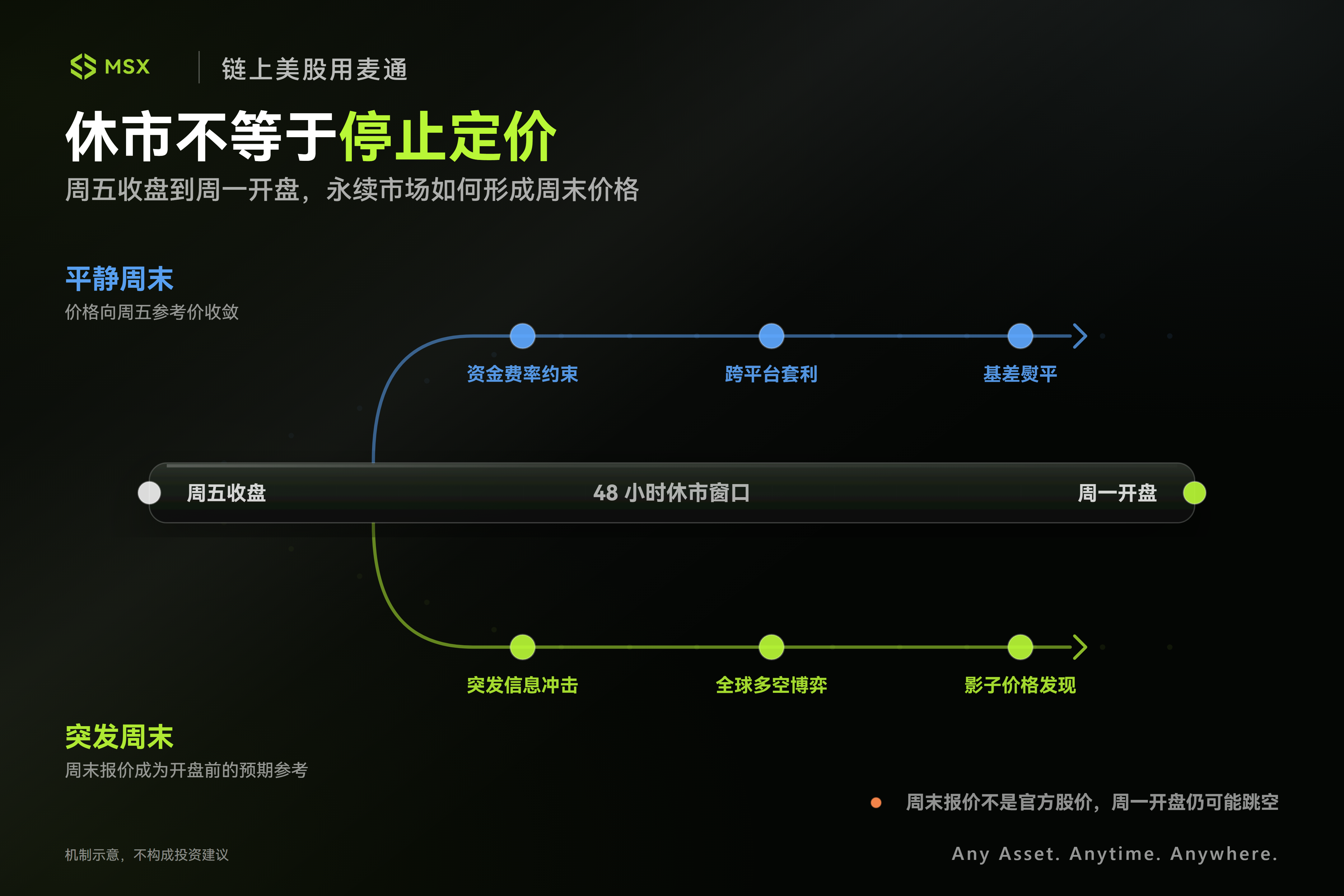
f. U.S. stock perpetual contracts are forming a weekend "shadow price discovery" mechanism, maintaining continuous pricing during traditional market closures through funding rates, cross-platform arbitrage, and multi-source indices.
g. Supporting developments: The SEC approved Nasdaq's 23/5 trading schedule (launching December 6) and issued innovation exemptions for tokenized securities; the CFTC will hold a roundtable on round-the-clock derivatives markets on December 15.
As the U.S. midterm elections rattled global markets, a bombshell development capable of rewriting Wall Street's trading history went largely unnoticed.
On November 3, CFTC Chairman Mike Selig announced: Single-stock perpetual contracts have been approved for the first time to trade on regulated U.S. exchanges, falling under a dual CFTC and SEC regulatory framework.
This means that perpetual contracts—a product largely popularized by cryptocurrency trading platforms—have finally crossed into the regulatory framework of traditional U.S. securities markets.
Put plainly, Wall Street is starting to learn from crypto, borrowing its most successful financial invention of the past decade—perpetual contracts (perps).
What's more interesting is that this shift isn't entirely Wall Street-driven. Over the past six months, crypto trading platforms have been experimenting with bringing U.S. equities like Apple, Nvidia, and Tesla on-chain, reorganizing how these assets trade through perpetual contracts, stablecoin margin, and even 7×24 order books.
Now, even ICE—the parent company of the NYSE—is considering bringing Hyperliquid's perpetual contract infrastructure to the United States.
A year ago, we were discussing whether U.S. stocks could trade "around the clock" like crypto; a year later, the market is asking whether U.S. stocks can directly adopt crypto's trading rules.
I. From "the Last Hour" to "Never Expiring": Why Wall Street Finally Embraced Perps
To grasp the significance of this CFTC breakthrough, one must first understand what perpetual contracts actually changed.
Few realize that perpetual contracts are one of the few genuinely "native financial innovations" to emerge from crypto. They were first created in 2016 by BitMEX, the crypto derivatives exchange that just announced its closure this year.
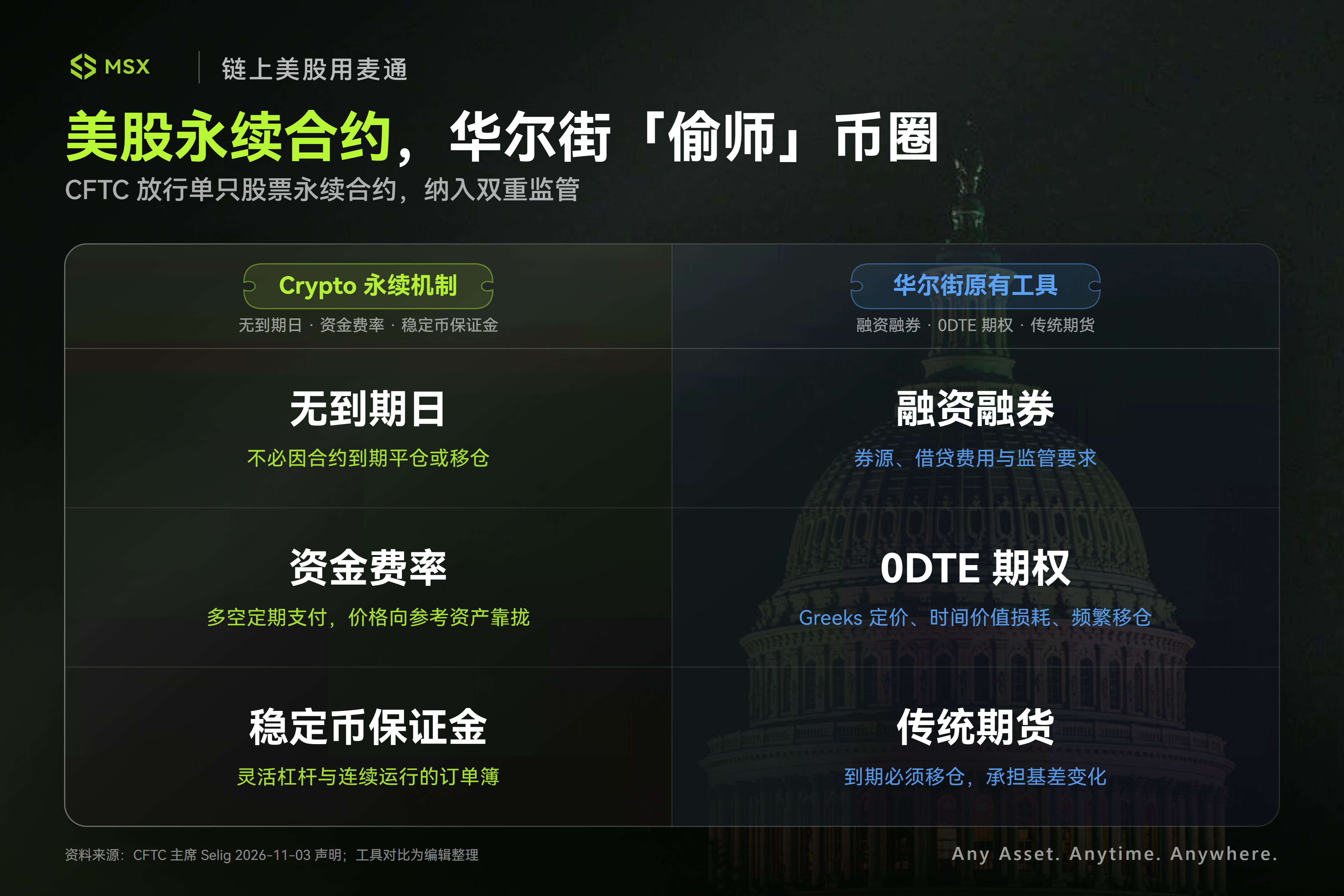
Generally speaking, in U.S. equity markets, investors seeking leveraged or short exposure to individual stocks (like NVDA or TSLA) face limitations with each mainstream option:
• Margin financing and securities lending: Relies on brokers to provide financing and borrowing services. Capital costs can be high, short selling is constrained by available shares, borrowing fees, and regulatory requirements, and it's difficult to establish a globally unified, round-the-clock trading mechanism.
• Options, especially the recently booming 0DTE (zero days to expiration) options: While offering explosive upside, complex Greeks pricing, time value decay (Theta Decay), and frequent rollovers raise the barrier for retail investors and fragment liquidity across different expiration dates and strike prices.
• Traditional futures: Have fixed expiration dates. Investors seeking sustained exposure must roll over periodically, incurring additional trading costs and basis risk.
The biggest innovation of crypto perpetual contracts is the elimination of the expiration mechanism entirely.
Investors can hold long or short positions indefinitely without being forced to close or roll over due to contract expiration. The platform uses periodic funding rate payments between longs and shorts to keep contract prices aligned with the reference asset price, combined with flexible leverage and continuously running order books—creating a trading experience fundamentally different from traditional securities trading.
This mechanism has been an absolute juggernaut in crypto markets.
Over the past few years, BTC and ETH perpetual contracts have become the most dominant derivative trading instruments in crypto, underpinning the massive trading ecosystems of Binance, OKX, Bybit, and other platforms. According to The Block, perpetual contracts contributed roughly 75% of total trading volume on centralized crypto exchanges in 2025, with cumulative annual volume approaching $49 trillion—far exceeding spot and options markets.
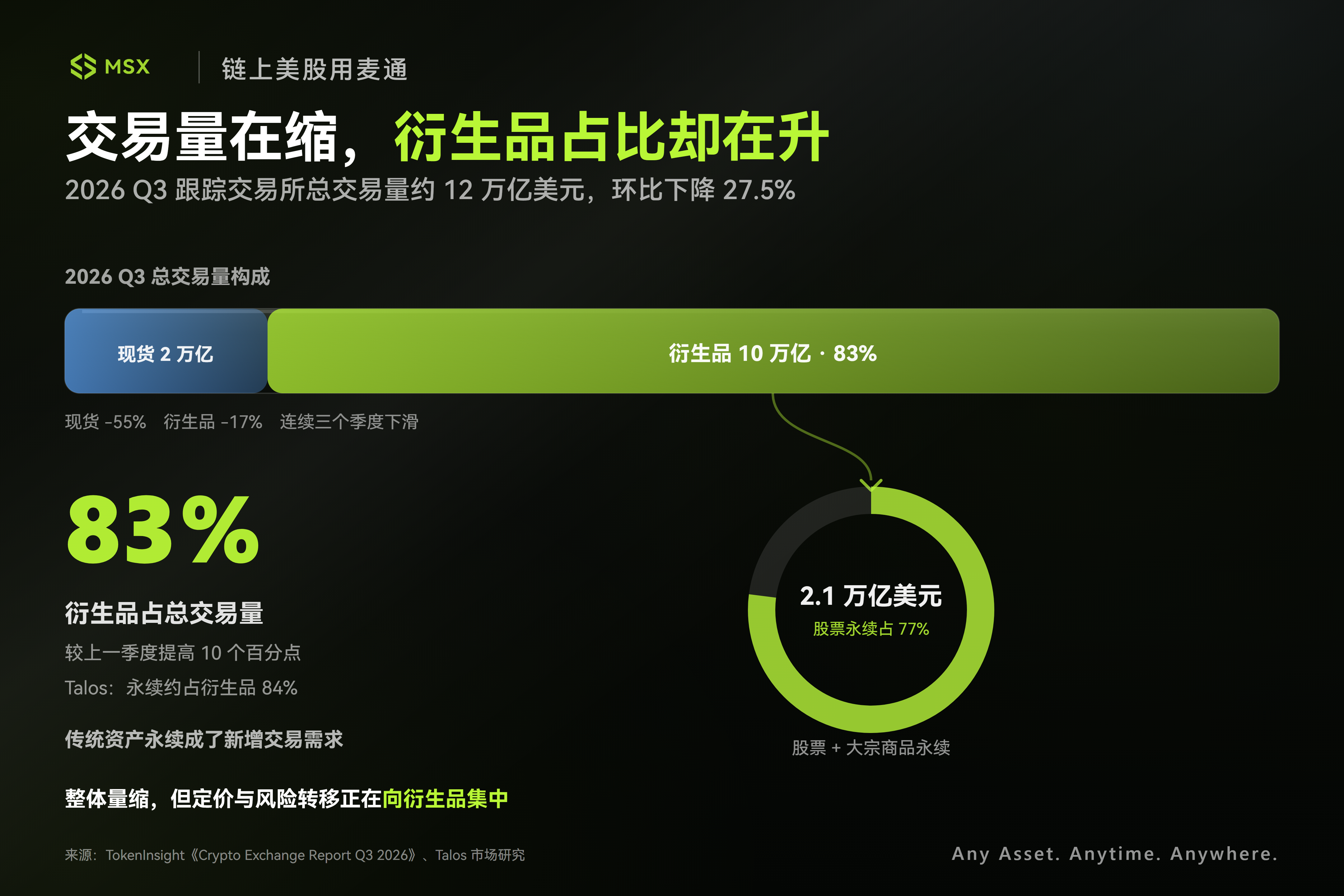
This trend continued into 2026. TokenInsight's latest Q3 exchange report shows that derivatives now account for 83% of total trading volume on major crypto trading platforms.
In other words, perpetual contracts have long been the core infrastructure supporting the entire industry's trading liquidity, price discovery, and risk transfer.
But as this highly efficient trading method extends to traditional assets like stocks, gold, crude oil, and stock indices, a pointed question emerges: Why can global investors seamlessly trade Nvidia and Tesla 7×24 on crypto platforms, yet struggle to access similar products within the U.S. domestic regulatory system?
Behind this lie both technical constraints of underlying infrastructure and long-standing jurisdictional barriers in the U.S. regulatory system.
On the technical side, as we previously noted in "U.S. Stocks Sprint Toward 'Never Closing': Why Is Nasdaq Launching a '5×23-Hour' Trading Experiment?", traditional U.S. equity spot trading is a precision gear system where every component is interconnected. Even if Nasdaq extends front-end matching to 23 hours a day, the back-end brokers, custodians, and clearing agencies (DTCC) remain constrained by centralized ledger end-of-day batch processing, reconciliation, and margin transfers.
The forced "one-hour daily downtime window" and "48-hour weekend closure" are precisely the real-world problems that traditional financial infrastructure must solve on the path to round-the-clock operations.
On the regulatory side, stock perpetual contracts use individual stocks as reference underlying assets but employ a crypto-native perpetual derivative structure, placing them squarely at the intersection of two regulatory regimes—the CFTC (responsible for commodities and derivatives) and the SEC (responsible for securities markets). The resulting uncertainty over jurisdictional authority and product classification has kept such products in regulatory limbo.
Since the start of this year, the situation has begun to change substantively:
• On March 11, 2026, the SEC and CFTC signed a Memorandum of Understanding (MOU) to strengthen coordination on financial innovation, market oversight, and investor protection.
• Subsequently, on May 29, the CFTC approved KalshiEX's BTCPERP—the first Bitcoin perpetual contract—marking the first time a true Bitcoin perpetual contract entered a regulated U.S. exchange.
• The November 3 announcement extended this progress into traditional securities. According to CFTC Chairman Selig, single-stock perpetual contracts are recognized as security futures products under the Commodity Futures Modernization Act of 2000 (CFMA) framework, subject to both the Commodity Exchange Act and U.S. federal securities laws, and supervised by both the CFTC and SEC.
Specifically, trading venues offering such products must hold both CFTC-registered Designated Contract Market (DCM) status and national securities exchange status with notice registration to the SEC for trading security futures products.
More notably, regulatory changes have already translated into actual products.
On November 3 itself, Kalshi began offering perpetual contracts on four U.S. stocks—Amgen (AMGN), McDonald's (MCD), Qualcomm (QCOM), and Costco (COST)—with maximum leverage of approximately 4.9x.
For the U.S. market, this means not just one more stock trading instrument, but that trading mechanisms first established by crypto platforms are now gaining recognition within the traditional financial regulatory framework.
II. Looking Back at the Past Year: The "Three-Way Convergence" of Regulators, TradFi, and Crypto Platforms
If the CFTC's action represents the traditional financial regulatory system beginning to embrace perpetual contracts, then over the past year, crypto-native platforms have actually completed considerable product exploration.
Tracing this timeline reveals that U.S. stock tokenization has been gradually building toward a more complete trading system encompassing spot, perpetual contracts, leveraged trading, and cross-asset margin.
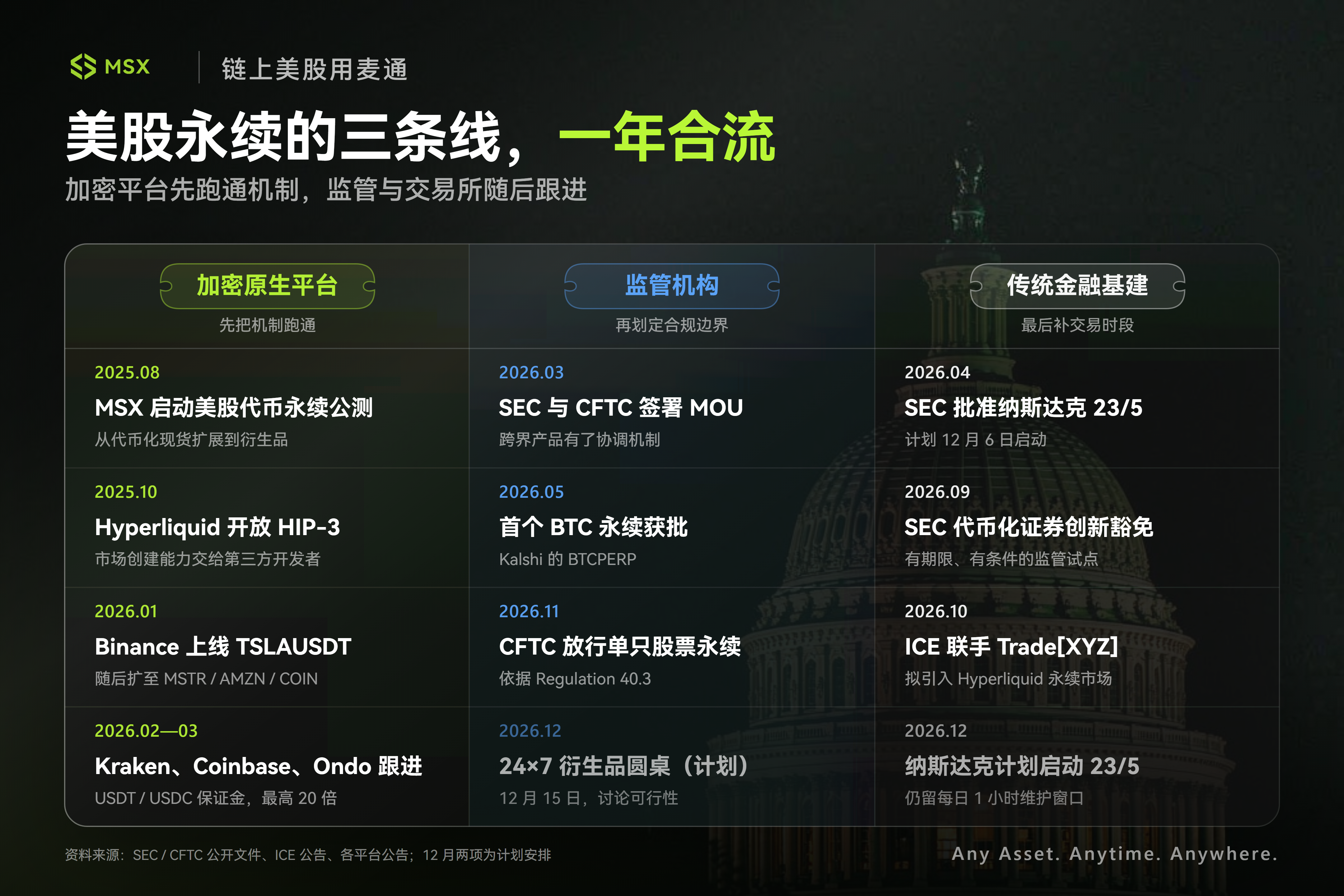
As early as August 11, 2025, MSX launched public beta testing for tokenized U.S. stock perpetual contracts, extending its existing tokenized U.S. stock spot trading into the derivatives market.
Shortly after, in October 2025, leading on-chain derivatives platform Hyperliquid launched the pivotal HIP-3 mechanism, opening perpetual contract market creation to third-party developers. Trading instruments thus broke free from the BTC and ETH boundaries, rapidly expanding to stocks, indices, commodities, and forex.
Entering 2026, the U.S. stock perpetual space saw concentrated follow-through from more mainstream trading platforms:
• On January 28, Binance listed the TSLAUSDT stock perpetual contract. On February 9, it further launched perpetual contracts on MSTR, AMZN, CRCL, COIN, PLTR, and other stocks, using USDT margin and settlement with 7×24 trading support.
• On February 3, Ondo Finance announced its Ondo Perps plan, aiming to bring stocks, ETFs, commodities, and other traditional assets into the perpetual contract market, and further exploring the use of tokenized securities as margin. The platform officially launched in July.
• On February 24, Kraken launched tokenized stock perpetual contracts based on xStocks, offering eligible non-U.S. users in over 110 countries and regions 24×7 leveraged trading on Nvidia, Apple, Tesla, and other stocks, with maximum leverage up to 20x.
• On March 20, Coinbase also officially launched stock perpetual contracts, allowing eligible non-U.S. users to trade U.S. stocks and crypto assets within the same derivatives trading system, settled in USDC.
• Bitget also incorporated Stock Perps into its product lineup, covering Nvidia, Apple, Tesla, Microsoft, and other U.S. stocks and ETFs. These contracts are settled in USDT and support near-round-the-clock trading.
Notably, this expansion coincided with a sustained decline in crypto-native market trading volume.
According to a TokenInsight report, the exchange sample it tracks recorded approximately $12 trillion in total trading volume in Q3, down 27.5% quarter-over-quarter—the third consecutive quarterly decline. Spot trading volume fell 55% to $2 trillion, while derivatives trading volume dropped 17% to $10 trillion.
But another telling data point: despite the overall volume decline, derivatives' share of total trading volume actually rose to 83%, up 10 percentage points from the previous quarter.
Meanwhile, trading volume in traditional financial asset perpetual contracts is expanding rapidly. Among the nine exchanges tracked in the report, Q3 stock and commodity perpetual contract trading volume totaled $2.1 trillion, with stock perpetuals accounting for approximately $1.61 trillion (77%) and commodity perpetuals approximately $491 billion.
This data sends a clear signal: as growth in native crypto trading markets comes under pressure, traditional financial assets are becoming a key direction for crypto platforms seeking new trading demand.
Of course, one cannot simply attribute platforms' expansion into TradFi to declining crypto trading volume. More importantly, leading trading platforms already possess mature derivatives engines, stablecoin settlement systems, margin management, and global user bases. Expanding into stocks, indices, gold, and crude oil doesn't require building a trading system from scratch.
For them, rather than limiting themselves to competing for finite BTC and ETH trading flow, it makes more sense to replicate their already-mature trading infrastructure across more asset classes.
Moreover, these platforms' products have already diverged into two structural paths:
• The first is "synthetic perpetual contracts" anchored to stock prices, such as Binance's USDT-margined contracts and Coinbase's USDC-margined contracts. Investors gain long/short exposure to stock price movements, with no actual stock delivery involved at the underlying level.
• The second is perpetual and portfolio systems built on "tokenized stocks", such as MSX, which established a closed loop between spot and contracts early on; Kraken, which integrates xStocks; and Ondo, which supports tokenized securities as collateral.
The two paths are not entirely identical, but both are pushing traditional assets beyond simple price exposure toward richer trading and financial use cases.
And just as crypto-native platforms continue to expand, traditional financial giants are entering the fray.
On October 29, Intercontinental Exchange (ICE), the parent company of the NYSE, announced a partnership with Trade[XYZ] to bring a Hyperliquid-based perpetual contract market to the United States.
Under the plan announced by both parties, ICE will operate the new regulated trading venue and clearing architecture while making a strategic investment in Trade[XYZ]. Trade[XYZ] will handle market design and product technology, with future plans to cover stocks, indices, cryptocurrencies, commodities, and forex.
Notably, the new marketplace is designed around U.S. regulatory requirements, establishing a dedicated trading and clearing system, and still requires regulatory approval.
The symbolic significance is substantial.
In the past, crypto platforms sought to bring traditional assets on-chain, challenging traditional exchanges' control over asset liquidity and trading access. Now, the NYSE's parent company is doing the reverse—partnering with a crypto-native perpetual contract market and even directly investing in the relevant participant.
Crypto has more flexible trading mechanisms, stablecoin settlement, and a global user base; traditional finance has mature regulatory systems, clearing infrastructure, and institutional resources. Both sides are realizing that what will truly matter going forward is who can integrate the strengths of both systems.
III. Pricing U.S. Stocks on Weekends: Is Round-the-Clock Liquidity Finally Here?
If the first two sections discussed trading products and regulatory frameworks, the most profound impact of this transformation lies in the quiet transfer of market pricing power.
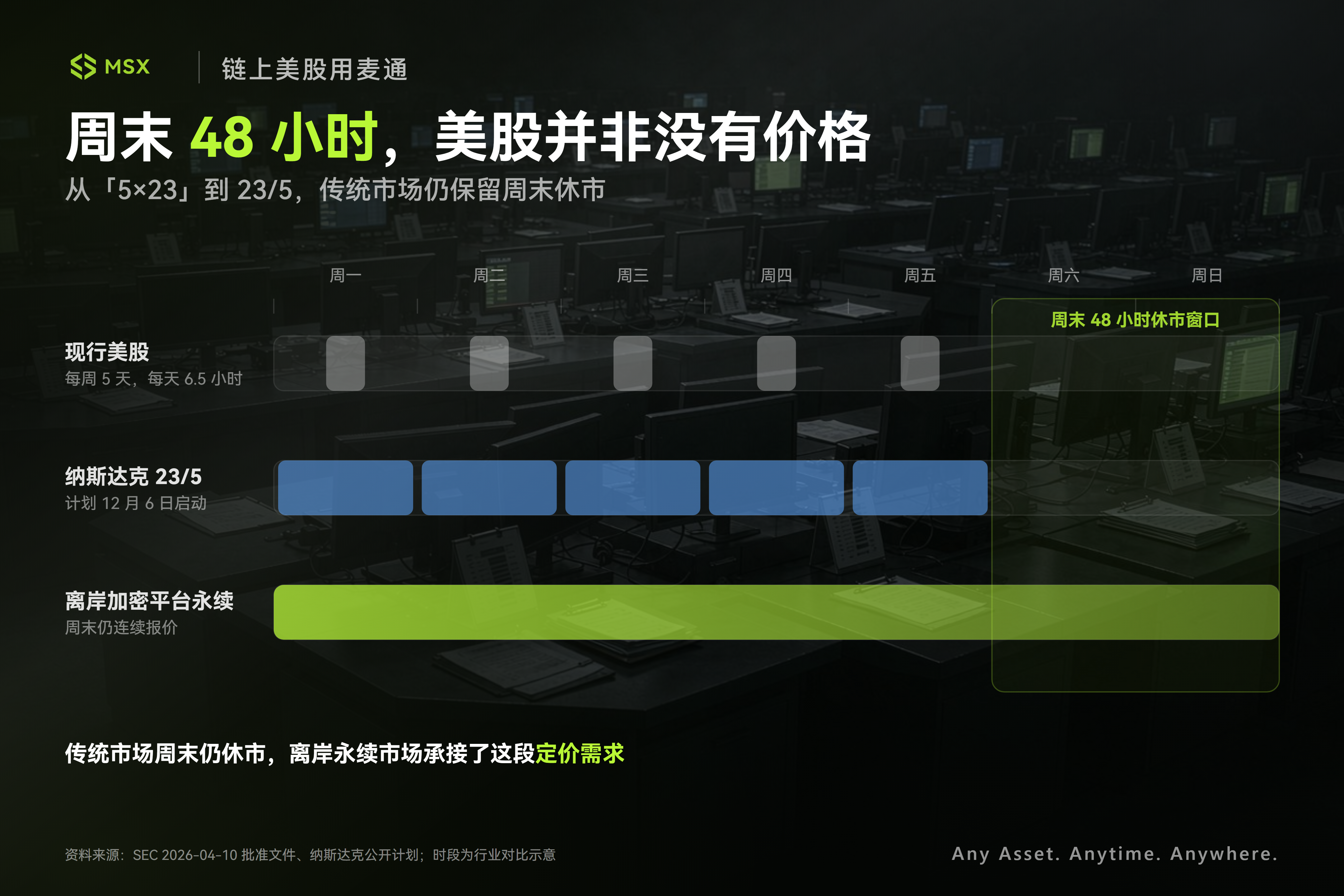
Historically, U.S. stock price discovery has been concentrated within the trading hours of traditional venues like Nasdaq and the NYSE. Even as pre-market and after-hours trading became more widespread, weekends and holidays remained market vacuums lasting 48 hours or more.
But the closure of traditional U.S. stock markets doesn't mean investors' demand to trade U.S. stocks disappears.
The emergence of U.S. stock perpetual contracts is changing this.
Now, even after Wall Street rings the closing bell on Friday, global investors can still trade Nvidia, Apple, and Tesla perpetual contracts around the clock on crypto platforms or on-chain protocols. Global breaking events, corporate news, macroeconomic data, and even weekend market sentiment can all be translated into continuous price movements through these trading markets.
It's fair to say that U.S. stock perpetual contracts on crypto platforms—especially during weekend market closures—have gradually evolved from pure speculative quotes into continuous price discovery markets with meaningful reference value.
1. From "Basis Smoothing" to Cross-Platform Arbitrage: How Are Weekend Prices Formed?
Many might wonder: since Nasdaq and the NYSE are closed, why can Nvidia and Tesla on crypto platforms still generate real-time prices?
Taking Coinbase's stock perpetual contracts as an example, prices are continuously formed through internal price indices, perpetual contract order books, tokenized stock quotes, and cross-platform trading to estimate the underlying asset's value:
• During normal trading hours, index prices are primarily constructed from external stock data sources such as Pyth and Blue Ocean ATS.
• During weekends and certain market closure periods, the system switches to internal indices, combining the EMA of perpetual contract mark prices with available tokenized stock quotes to form new price references.
• The platform also employs price deviation limits and transition mechanisms when reconnecting to external data feeds to minimize abnormal volatility during price switching.
This mechanism demonstrates at least one thing: weekend U.S. stock pricing is no longer simply freezing Friday's close until Monday. Instead, a continuously operating price discovery system is forming through multiple data sources and market mechanisms.
What truly matures this system are two forces.
First is the funding rate mechanism inherent to perpetual contracts. When contract prices persistently exceed the reference index, funding rates typically turn positive, requiring longs to pay funding fees to shorts—raising the cost of holding high-premium long positions. Conversely, when contract prices fall below the reference index, negative funding rates raise the cost of holding short positions.
This provides both longs and shorts with ongoing incentives to adjust positions, but cannot alone guarantee price accuracy—especially when external spot markets are closed and the reference index itself may lag.
More important is the participation of cross-platform quantitative arbitrage capital. As Hyperliquid, Binance, Coinbase, and other platforms gradually form multiple competing trading venues, the same stock may show price discrepancies across different perpetual contract markets.
For example, suppose Nvidia's perpetual contract quotes at $200 on Platform A on a Saturday while Platform B quotes $203. If the reference assets, contract specifications, settlement mechanisms, and liquidity are sufficiently similar, arbitrageurs might buy on the lower-priced market and sell on the higher-priced one, waiting for the spread to converge.
It's important to note that this trading is more akin to basis trading between cross-platform derivatives and does not equal risk-free hedging through buying and selling actual U.S. stock spot. Especially on weekends, traditional stock markets cannot provide continuous spot hedging channels, and traders still bear funding rate, margin, liquidity, and Monday opening gap risks.
However, as participants and trading venues increase, price discrepancies across markets become easier to identify and trade, and weekend prices are no longer determined entirely by a handful of orders on a single platform.
From funding rates to cross-platform arbitrage, to multi-source market data and market-making mechanisms, what was once a relatively isolated weekend trading market is forming a more mature price correction system.
2. From "Shadow Price Discovery" to Round-the-Clock Markets: Why Can't Wall Street Afford to Miss Out?
Even more noteworthy than routine weekend basis convergence is the price discovery capability during major breaking events.
In the past, whether it was sudden weekend geopolitical tensions, macro tariff policy statements, or major product and regulatory news from tech giants on non-trading days, traditional U.S. stock markets typically lacked a unified marketplace where continuous trading could fully express bullish and bearish views before reopening.
But in 7×24 U.S. stock perpetual markets, the situation is different.
Global macro traders, quantitative funds, and information arbitrageurs can, through real money long/short battles on Saturdays and Sundays, reflect the potential impact of breaking events into perpetual contract prices in real time.
This means that when traditional U.S. stock markets reopen, the price changes already formed in weekend crypto markets can serve as important references for gauging market expectations. In some major events, weekend perpetual contracts may even front-run traditional stock markets in reflecting the market's repricing of new information.
Of course, this doesn't mean Monday's U.S. stock opening price will necessarily match weekend perpetual contract prices exactly—weekend liquidity, information veracity, market-maker risk appetite, and real buying and selling after the open can all cause new deviations.
Moreover, weekend perpetual contract prices are essentially market quotes within specific trading venues, not official stock prices recognized by Nasdaq or the NYSE. But this is already enough to change how markets are observed: during traditional stock market closures, U.S. stock perpetual contracts on crypto platforms are becoming a new "shadow price discovery" channel.
This isn't simply price following—it's global traders expressing expectations about future market movements in advance through continuous trading.
Understanding this, we can see why the CFTC's approval of single-stock perpetual contracts on regulated U.S. trading venues carries such significance:
When "weekend pricing" and "round-the-clock derivatives liquidity" have already taken shape in the crypto world, Wall Street naturally doesn't want this portion of price discovery to remain outside its regulatory system for the long term.
Once regulated U.S. exchanges also begin offering similar stock perpetual contracts, traditional market makers like Citadel Securities, Jane Street, and Virtu will have the opportunity to participate in price discovery and risk hedging across different trading venues under regulatory compliance. At that point, liquidity linkages between traditional finance and crypto markets are expected to deepen further.
Placing these changes alongside last year's discussion of Nasdaq's 23-hour trading plan reveals a more complete evolutionary picture.
At the time, we offered a judgment in "Nasdaq Puts the Pedal to the Metal: From 'Scraps' to 'Steak'—Is Tokenized U.S. Stocks Entering the Decisive Round?": Nasdaq's push for 5×23-hour trading was about retrofitting infrastructure in advance for future stock tokenization, round-the-clock liquidity, and on-chain settlement.
Looking back now, that direction is steadily materializing.
• On April 10, 2026, the SEC officially approved Nasdaq's rule change to extend U.S. stock trading to 23 hours a day, five days a week, expected to launch on December 6.
• On stock tokenization, the SEC also issued temporary, conditional innovation exemptions on September 17 this year, allowing eligible tokenized securities trading venues to trade certain National Market System (NMS) stocks through permissioned automated market makers (AMMs) and liquidity pools under a specific regulatory framework.
• More notably, regulators have begun extending discussions to true 7×24 markets: On October 28, the CFTC announced it will hold an industry roundtable on December 15 specifically to discuss the feasibility of round-the-clock derivatives trading, covering market structure, tokenization, infrastructure, staffing, and operational readiness.
As Nasdaq advances 23/5 trading, the SEC provides new regulatory arrangements for tokenized securities trading, the CFTC discusses round-the-clock derivatives markets, and ICE prepares to bring in Hyperliquid's perpetual contract infrastructure, several originally independent industry trajectories have effectively begun to converge.
Traditional finance is extending its trading hours; crypto is expanding its asset boundaries. What both sides are ultimately competing for is the ability for global investors to trade any asset, anytime, anywhere.
Final Thoughts
Over the past year, the narrative around U.S. stock tokenization has undergone several important shifts:
• Initially, the discussion was about mapping traditional stocks like Apple and Nvidia onto the blockchain, allowing investors to trade these assets using stablecoins.
• Subsequently, the discussion extended to how tokenization could enable round-the-clock circulation, on-chain settlement, and asset composability.
• Now, as stock perpetual contracts gradually enter regulated U.S. markets, the trading instruments themselves are beginning to change.
For crypto-native platforms, the 7×24 trading experience, stablecoin settlement capabilities, and global user networks accumulated over the past few years are their key advantages. For traditional financial institutions, regulatory credentials, asset custody, institutional liquidity, and clearing networks are barriers that cannot be easily replicated.
The two systems are converging, not simply replacing each other.
Looking back at those two articles from last year, we once discussed a question: Why is Nasdaq in such a hurry to advance stock tokenization? Because if the future of financial markets truly moves toward round-the-clock trading, traditional exchanges cannot simply guard their existing trading hours and matching business—they must rethink their position in the asset issuance, trading, and settlement system.
Now, this question has a new answer.
As U.S. stocks begin trading perpetual contracts, as weekends can now form relatively continuous price discovery, and as traditional exchanges proactively bring in crypto's trading infrastructure, competition in financial markets is no longer about whether TradFi or crypto will replace the other—it's about who can build the next-generation round-the-clock trading network faster.
In the past, crypto learned from traditional finance. In the next phase, it may be traditional finance's turn to learn from crypto.