





Source: ChainCatcher
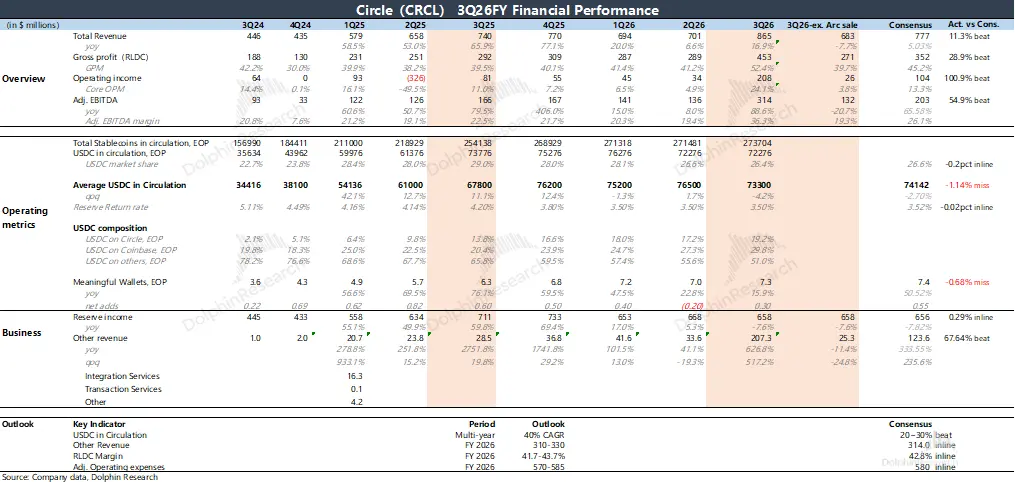
Circle released its Q3 earnings before market open on November 4 (US Eastern Time). Overall, the "beat" in this quarter's results was primarily driven by ARC token sales revenue. Strip that out, and the underlying performance was rather ordinary—confirming pre-earnings concerns about the stock.
Here's the breakdown:
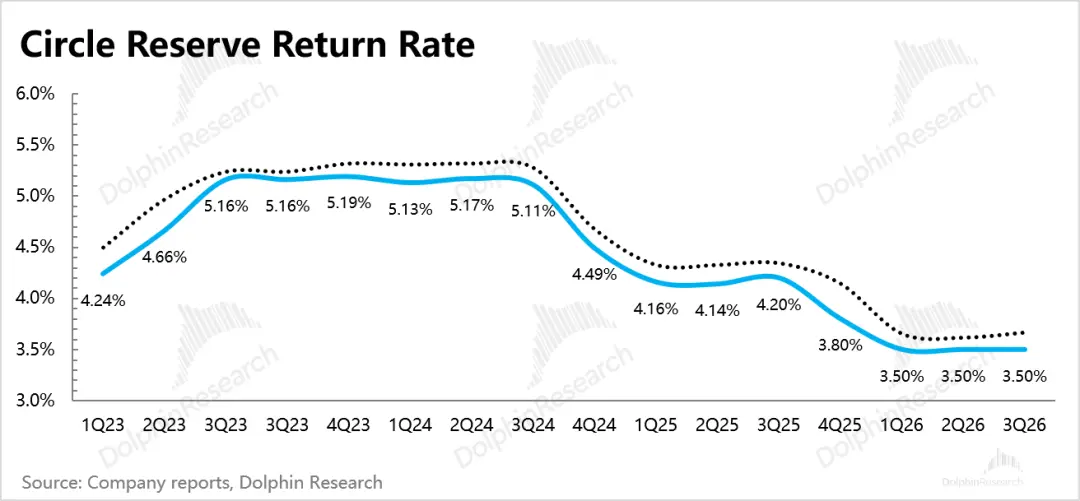
1. Reserve interest income declined as expected
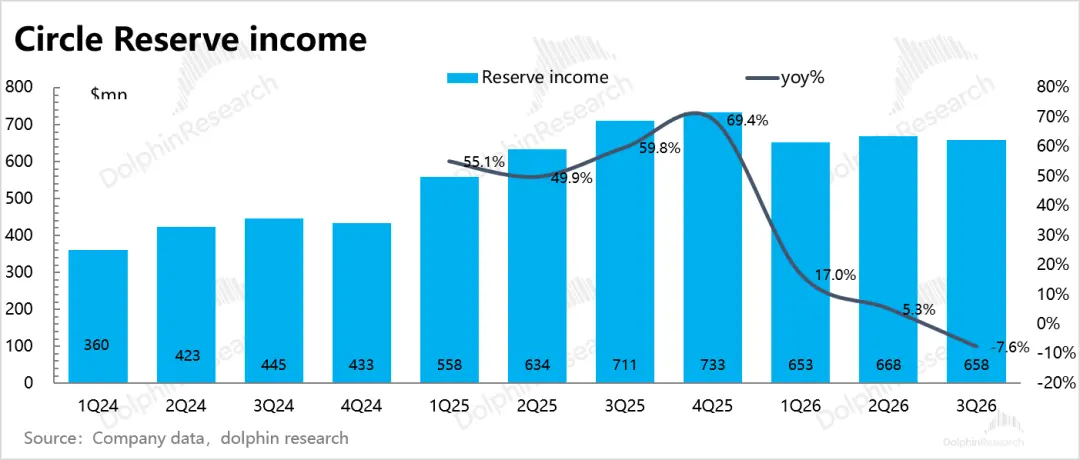
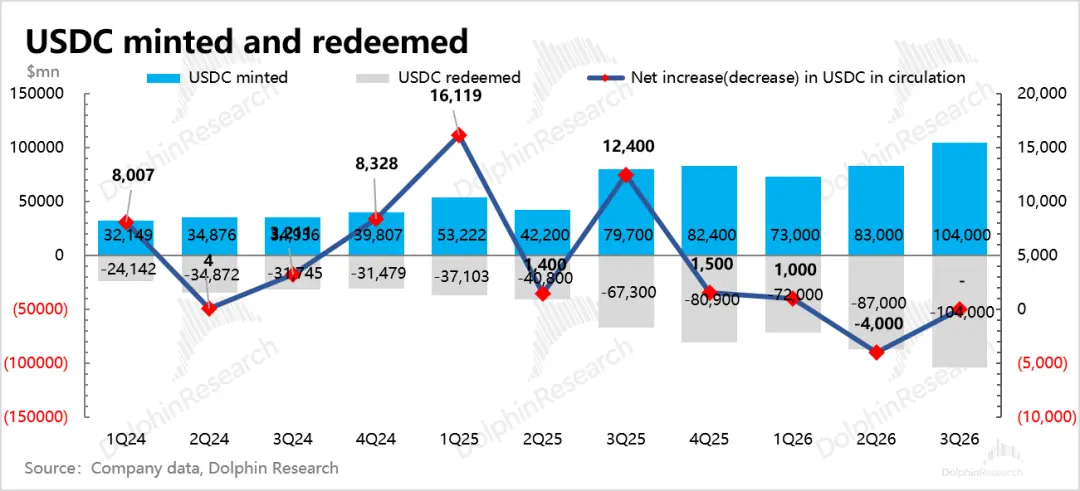
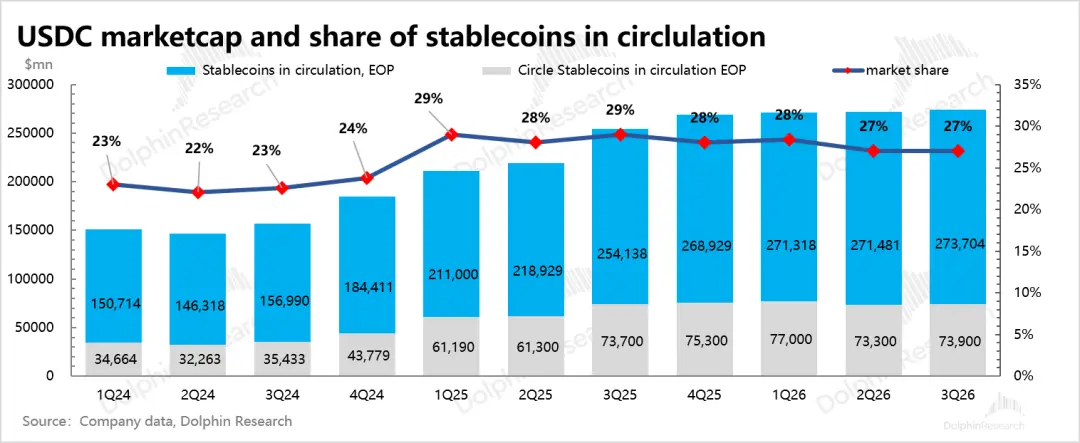
Q3 reserve interest income came in at $660 million, in line with expectations. Despite USDC market cap growing 8% year-over-year, reserve interest income fell 8% YoY due to lower interest rates. On a sequential basis, USDC's average circulating supply in Q3 was $73.3 billion, down 4% from Q2.
2. ARC token sales were recognized faster than expected
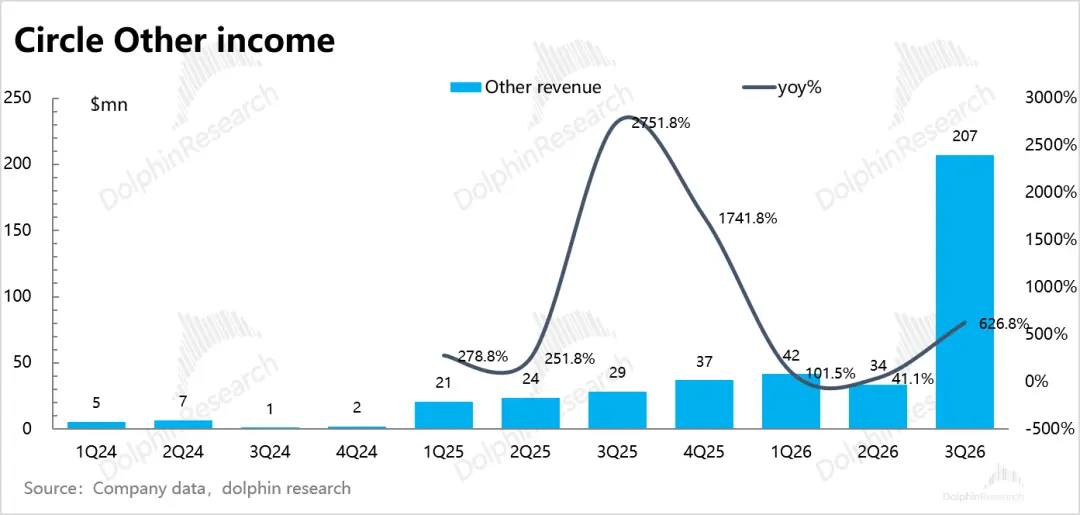
Q3 other revenue exceeded $200 million, of which $180 million came from ARC token sales—a recognition pace that beat both market expectations (~$90 million) and the original full-year guidance of $180 million.
However, this revenue is neither stable nor recurring—it's essentially one-time in nature. Given that full-year other revenue guidance remains unchanged at $310–330 million, we expect no such revenue in Q4. The two presale rounds this year totaled $224 million; after recognizing $180 million in Q3, the remaining $40 million will be recognized next year.
The ARC token presale attracted significant institutional capital. But this is essentially an "equity subscription" for future returns from the ARC public chain—yet Circle first records it as deferred revenue, then recognizes it as revenue based on ARC chain product development milestones.
Equity subscription proceeds = revenue is inherently bizarre and doesn't lend itself to reliable forecasting. Unless the company keeps issuing tokens to "raise capital," this is one-time revenue with no stable, recurring business characteristics.
Truly recurring revenue won't materialize until 2027, from ARC transaction fees, staking income, and CPN payment network fees. The ARC presale merely monetized a portion of future value upfront.
3. Big-channel "pushback" adds pressure on future interest-sharing
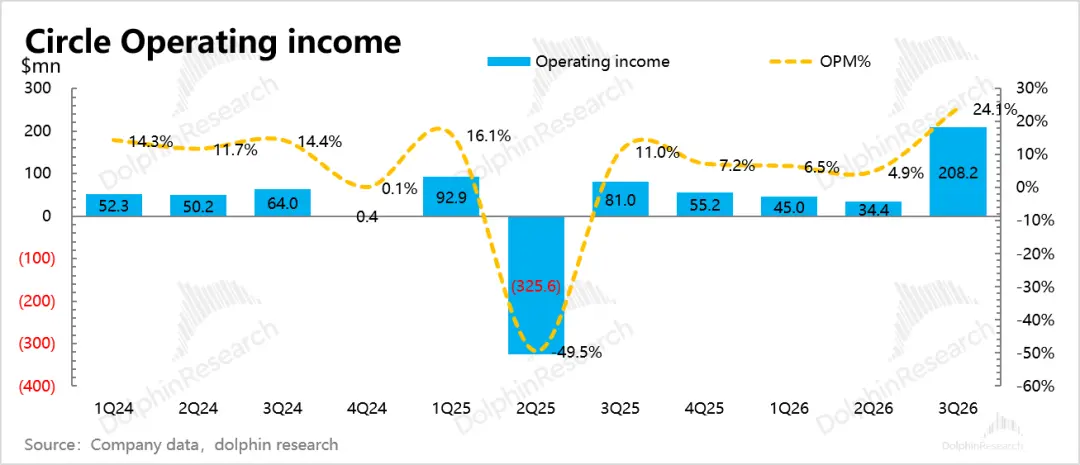
Since ARC token sales carry essentially zero cost, the $180 million amounts to pure profit—inflating Q3 earnings. Strip that out, and the true profitability trend is downward: with revenue declining and costs relatively rigid, GAAP operating margin fell 1 percentage point sequentially to 3.9%.
That said, Q3 results also reflect cost optimization from layoffs. Nearly half of Circle's expenses are personnel compensation, so adjusted operating expenses (excluding severance costs) fell 5% sequentially, reflecting a 5% headcount reduction during the quarter.
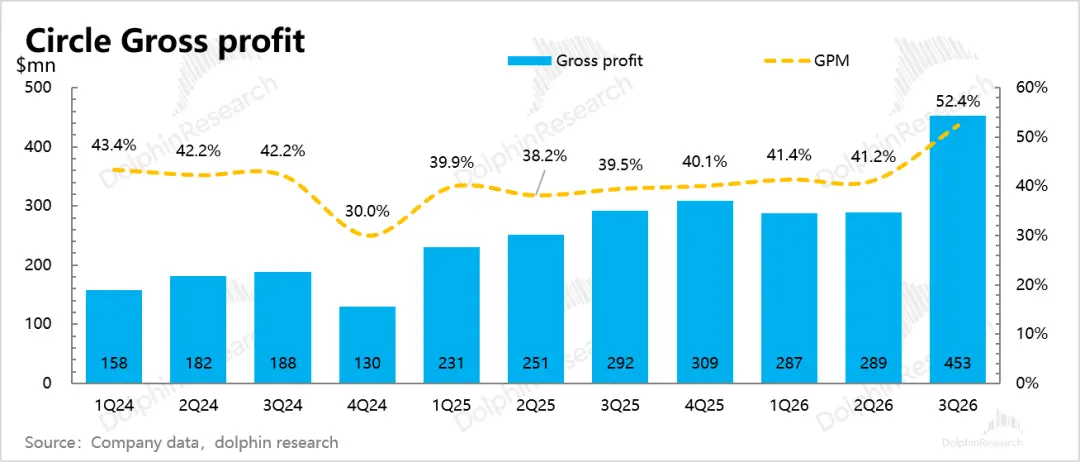
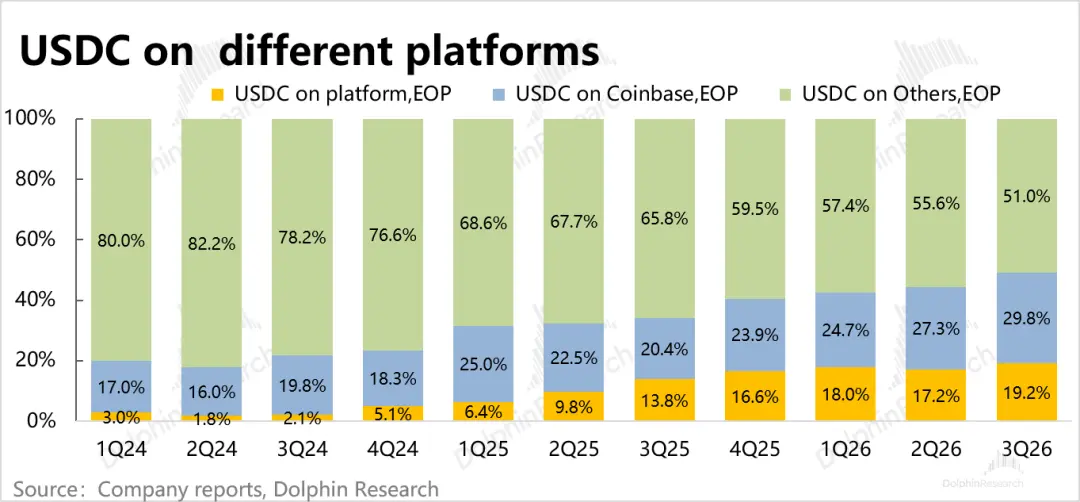
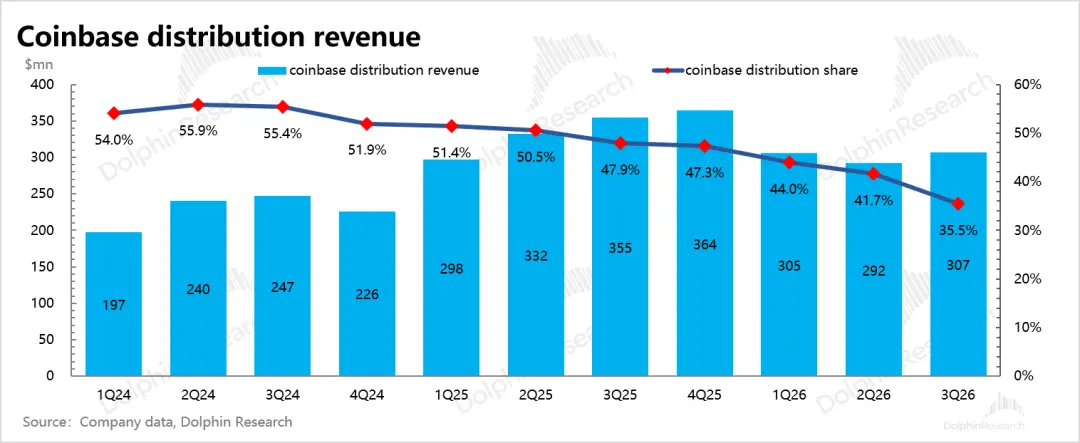
Notably, starting Q3, the profit line will gradually reflect the impact of Hyperliquid's interest-sharing arrangement. According to our rough calculations, Circle stands to lose nearly $100 million in gross profit annually, with the pressure from this channel pushback becoming clearly visible as early as Q4:
Hyperliquid is the largest on-chain perpetual futures exchange and operates its own public chain. Users must deposit USDC as margin before trading, so the platform holds a substantial pool of USDC—roughly $6 billion. For Circle, this is one of the few large USDC pools outside of exchanges.
Amid the tug-of-war among stakeholders over the CLARITY Act, Hyperliquid began demanding in September that Circle return the reserve interest earned on its USDC. However, Circle has a revenue-sharing agreement with Coinbase—Coinbase takes 100% of interest on USDC custodied on its platform, and 50% of interest on USDC custodied elsewhere.
So to meet Hyperliquid's interest-return demand, the arrangement has to go through the Coinbase channel. The result:
(1) Hyperliquid gets back the vast majority of interest (estimated 90%);
(2) Coinbase and Circle each lose 50% of their interest share but gain this 90% of USDC platform custody volume (AUC), with Circle retaining 10%;
Currently, USDC on Hyperliquid totals $6.3 billion. At 3.5%, that generates $228 million in annual reserve interest, of which Hyperliquid takes 90%—about $200 million. The remaining less than $30 million in interest is split between Coinbase and Circle.
In other words, what was originally $228 million in recognizable interest income and $100 million in gross profit (after deducting issuance costs and the 50% share previously allocated to Coinbase) ends up as just $10 million in gross profit.
Q3 gross margin was 52.4%. Excluding the $180 million in pure profit from ARC token sales, gross margin was 39.5%—already showing some impact on a sequential basis versus Q2.
Meanwhile, USDC's share on Coinbase rapidly rose to 30%, yet distribution income as a share of Circle's distribution costs actually fell sharply to 35%—further confirming the impact of Hyperliquid's "pushback."
4. Key metrics at a glance
Dolphin Analyst's Take
Q3 results were merely "inflated" by timing differences in revenue recognition—no genuine surprise here.
On guidance, neither revenue nor profitability outlook changed. The RLDC margin (revenue minus distribution costs, akin to gross margin) is expected to hold around 42% for the full year, implying Q4 gross margin drops to the low 30s—showing Hyperliquid's impact deepening further.
That said, since the Hyperliquid situation was disclosed in September and its impact is quantifiable, the market should have largely priced it in. The real risk is: will there be a second Hyperliquid?
Beyond that, stablecoin competition is intensifying. USDC's advantages lie primarily in Treasury backing and regulatory compliance, plus its tight integration with Coinbase—the leading US centralized crypto exchange with strong regulatory ties.
But the dynamics among financial institutions are shifting. USDC is growing closer to Binance—Binance invested $100 million in Circle equity, expanding and renewing their strategic partnership.
While the Binance partnership focuses on emerging markets, it inevitably complicates the Coinbase relationship. Meanwhile, the Open USD alliance coin—launched by Coinbase alongside a group of traditional finance and payment chain players—went live on September 30.
That said, we believe USDC still holds a significant edge over alliance coins (aside from USDT). Alliance coins may actually struggle to form effective synergy due to too many conflicting interests. By contrast, the more likely risk to Circle comes from large channel partners like Hyperliquid demanding interest returns.
So while management maintains an aggressive long-term guidance for USDC circulation growth (40% CAGR), the near-to-medium term depends on the broader crypto market's prosperity (USDC's primary use case) and USDC's ability to break through amid competition.