






Author: BIT, Odaily
Key Takeaways: After the U.S. midterm elections, Democrats control both chambers while the White House remains in Republican hands, creating a divided-government policy landscape. Market pricing should shift focus from the election results themselves to the actual pace of policy implementation. Over the next year, opportunities will come more from sector divergence than from broad-based rallies.
Key Points:
a. Democrats control the congressional agenda, appropriations, and oversight powers, but Trump retains executive authority over tariffs, immigration, and foreign affairs, as well as veto power. Fiscal expansion space is constrained—bullish for long-end Treasuries.
b. The December 11 expiration of stopgap funding, combined with the renewal of Defense Production Act authorities, makes healthcare subsidies and defense key bargaining chips—the first hard deadline before the power transition.
c. A Republican president with Democratic control of both chambers has historically produced the weakest S&P 500 returns among all power configurations, averaging about 4.9% annually. But the 2018 playbook shows a 11.7% gain in the 12 months post-election, with a maximum drawdown of 14.7% in the first 3 months.
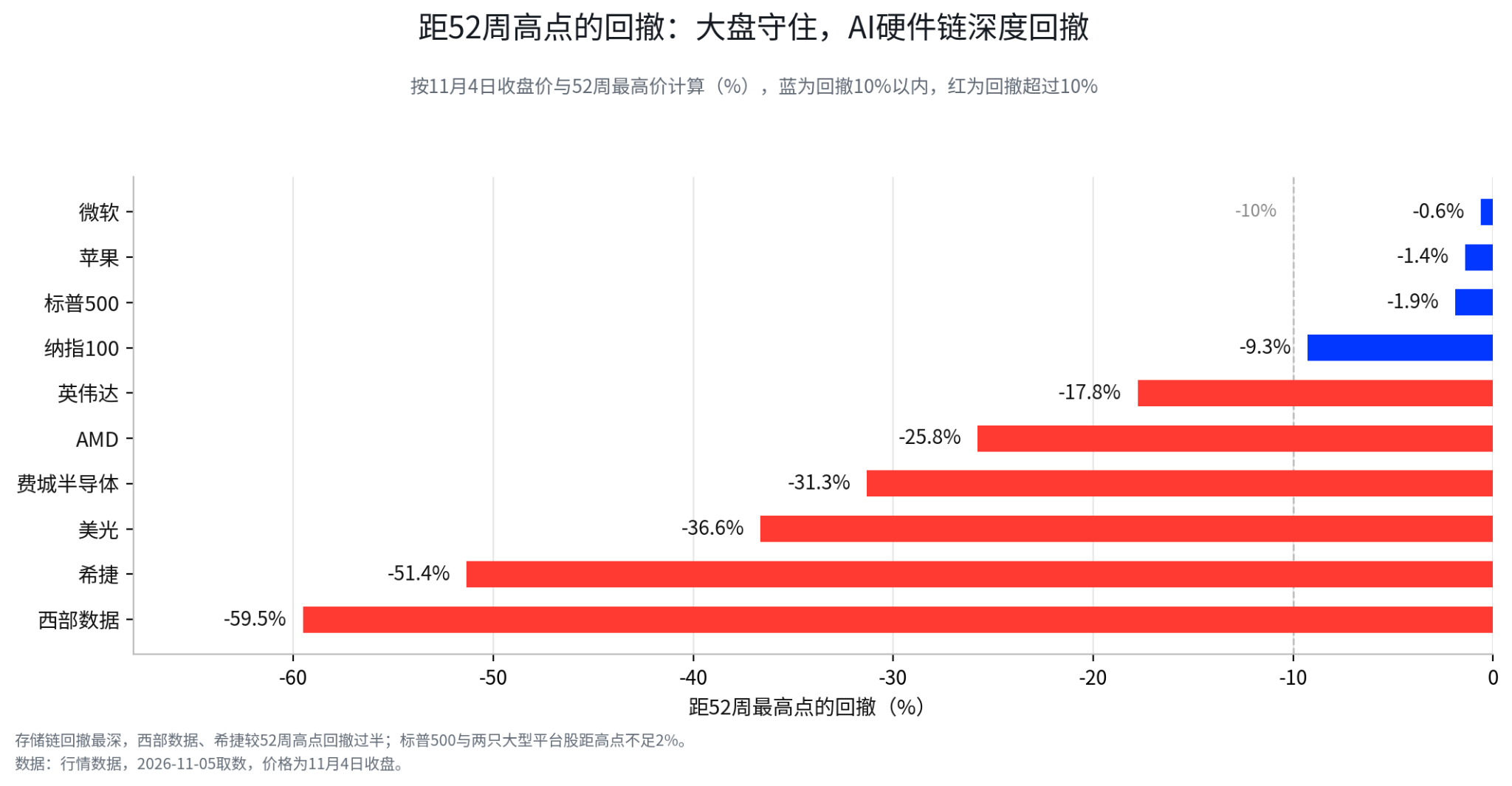
d. AI hardware names diverged sharply: the Philadelphia Semiconductor Index fell 3.14%, Nvidia dropped 3.17%, while large cloud providers like Microsoft and Amazon rallied against the trend. The pricing logic has shifted toward scarcity of existing compute capacity and easing capex pressure.
e. Data center approval authority devolves to state governments. Gubernatorial changes in Texas and Georgia could affect roughly 45% of planned projects. Texas accounts for about one-quarter of expected U.S. compute capacity by 2030.
f. WTI crude fell 8.4% in a single day, pricing in de-escalation of Iran tensions and oil & gas regulatory pressure. The 178 Section 301 tariff exemptions on Chinese goods were extended to November 10, giving the export chain its first policy answer.
g. Upcoming key dates: November 10 tariff exemption deadline, November 17 Nvidia earnings, December 8–9 Fed meeting, January 3, 2027 new Congress sworn in, and the debt ceiling before next fall.
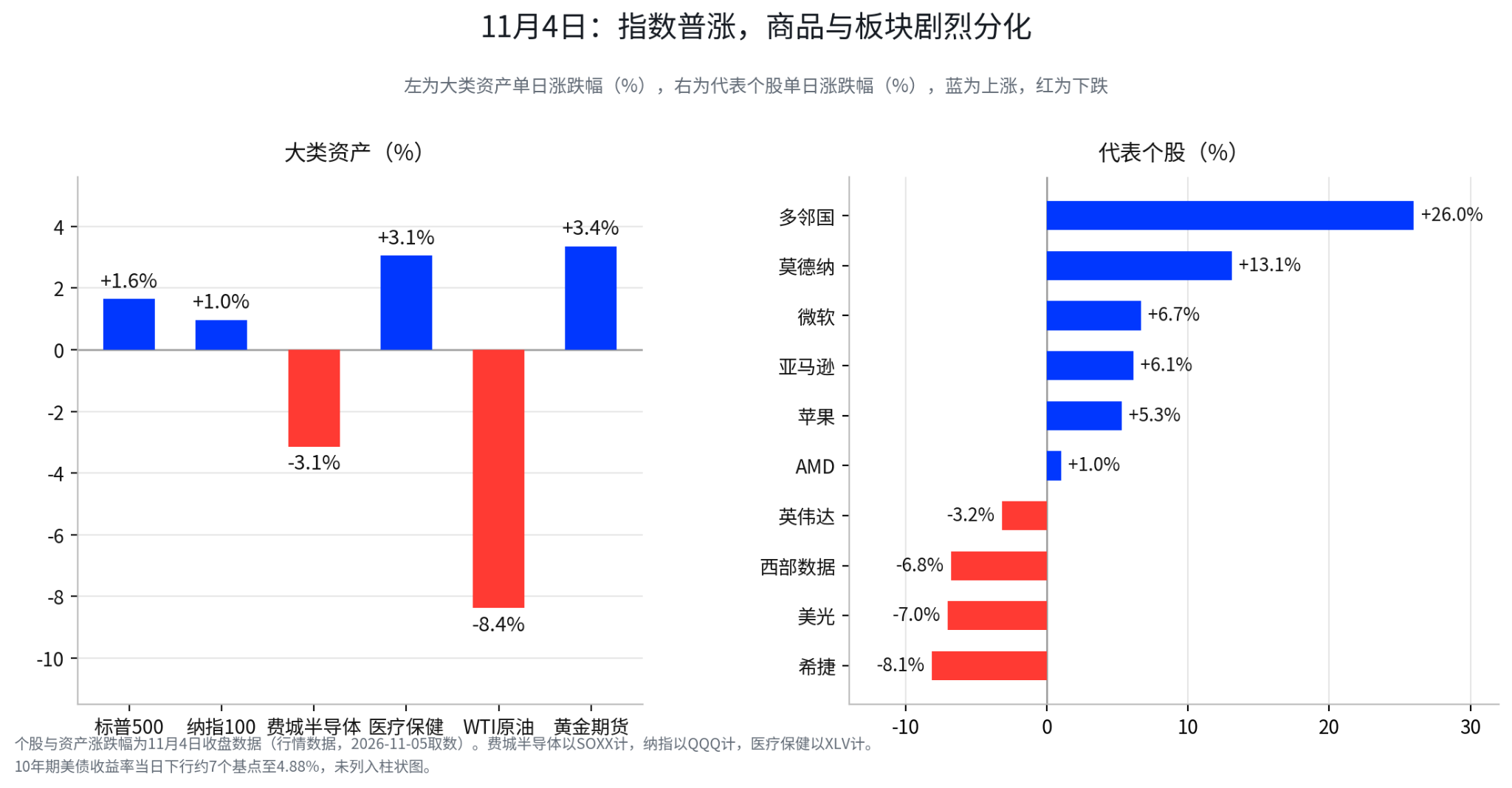
The midterm election results have essentially landed. For markets, after Washington's power structure shifts, the more worthwhile questions are: which policies can still move forward, which cannot, and where the president will redirect more policy energy—these matter more than the index's daily move. Election-day price action offered only a footnote: on the same day the Dow rose 3.03% and the S&P 500 gained 1.65%, the Philadelphia Semiconductor Index fell 3.14% and WTI crude dropped 8.4%. The seeds of divergence were planted before the results were even announced.
I. Democrats Take Both Chambers, but Trump Still Holds the Steering Wheel
What Democrats Actually Won: Agenda, Appropriations, and Oversight
The new Congress convenes on January 3, 2027. Democrats will then decide which bills enter the legislative process and will strengthen oversight of the executive branch through committee investigations and hearings. A Senate majority also means the president's senior nominees and judicial picks will face tougher confirmation pressure (as reported by SPDB International and various foreign media).
Gubernatorial flips in Texas and Georgia transmit this shift directly to AI infrastructure. Both states are key hubs for U.S. data center and power investment, and state governments hold real decision-making power over land, energy, environmental rules, tax incentives, and project permits. Projects already under construction face limited impact; those that have not yet locked in power supply, permits, and local tax incentives face significantly higher policy uncertainty.
Trump Lost Congress, but Still Holds Tariffs and Executive Power
Republicans still control the White House, and Democratic seats in both chambers fall short of a veto-proof majority. Executive powers over tariffs, immigration enforcement, foreign affairs, and military action remain largely intact (as reported by Axios and the Associated Press). Trump has publicly said he will be "Mr. Veto" (per DW). Even with Congress in hand, Democrats will struggle to translate their full agenda into law.
Democrats won Congress but not the full direction of policy. Trump lost Congress but not executive power.
The First Hard Fight After the Election: December 11
Before the new Congress is sworn in, there is a lame-duck session that is easy to overlook. The old Congress still handles appropriations from November through December, and the December 11 expiration of stopgap funding is the first hard deadline before the power transition. The old Senate still needs Democratic votes, making a short-term extension to avoid a shutdown highly likely (per J.P. Morgan Asset Management analysis, as reported). This also means healthcare and defense issues will likely be bundled into the same negotiating package.
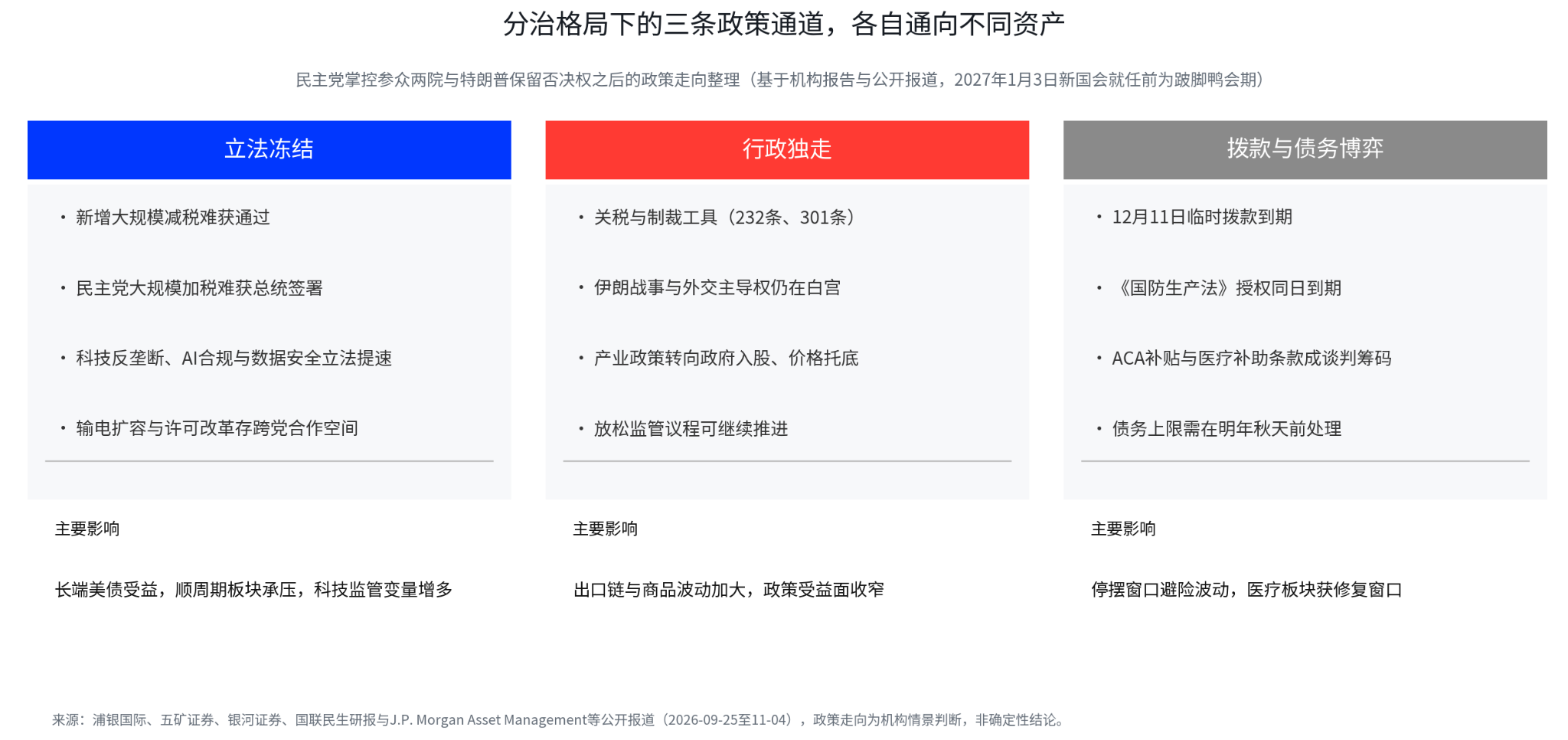
II. Congress Can't Control All Policy—Three Channels Determine Asset Direction
Legislative Freeze: No More Fiscal Stimulus, Treasuries Benefit First
Democratic control of Congress does not mean Democratic tax hikes will pass—the president has veto power. Trump's push for another round of large-scale tax cuts will also struggle to replicate the passage efficiency of unified government. J.P. Morgan Asset Management and others point to the same conclusion: divided government will constrain new fiscal expansion, while already-enacted tax and spending arrangements continue (as reported). This is a relatively direct positive for long-end Treasuries. Over the past few years, the biggest pressure on Treasuries has come from fiscal deficits and sustained increases in long-term Treasury supply. With Congress divided, the space for further deficit expansion is limited.
Tech regulation is another line along this channel—antitrust, AI compliance, and data security may accelerate (per Guolian Minsheng scenarios). What really matters is whether specific bills emerge and whether regulation moves from principle discussions to enforcement. Transmission expansion and permitting reform have room for bipartisan cooperation (per SPDB International)—for U.S. data centers where power has become a bottleneck, this is one of the few areas where policy consensus may form.
Executive Unilateralism: Tariffs and Industrial Policy Remain Trump's Cards to Play
Under existing authorities such as Section 232 and Section 301, the White House retains considerable room to adjust tariffs without going through Congress each time. The coming year may produce seemingly contradictory outcomes on China policy: stronger congressional oversight, yet tariffs can still be moved quickly by the executive branch. SPDB International even flags the possibility that Trump may intensify his use of tariff tools after losing congressional control.
Industrial policy is also becoming increasingly executive-driven. Over the past year, the White House exchanged $8.87 billion in CHIPS Act funding for roughly 9.9% equity in Intel, invested $400 million in MP Materials preferred stock with a ten-year price floor commitment, and provided $2.23 billion in loans to Lithium Americas (per Minmetals Securities). Policy support is increasingly concentrated in a handful of strategic companies, while broad industry-wide subsidies are shrinking.
Appropriations Battle: December 11, Healthcare and Defense as Bargaining Chips
The stopgap funding expires December 11, and the Defense Production Act price-floor authority faces renewal the same day. Democrats may attach oversight conditions (per Minmetals Securities). Enhanced ACA premium tax credits and Medicaid restrictions are the two areas Democrats most want in the negotiations (per SPDB International). They may not be fully restored, but could enter the appropriations bill as temporary extensions, partial adjustments, or attached provisions. The debt ceiling is a further tail risk that must be addressed before next fall—whether congressional confrontation escalates into a hard financial-market risk will depend on whether both sides truly use the debt ceiling as a negotiating tool.
III. Don't Be Spooked by 4.9%—2018 Is the More Relevant Playbook
The 4.9% Historical Average Includes Recessions and Crises
A Republican president with Democratic control of both chambers has produced average annual S&P 500 gains of about 4.9%, the worst among all power configurations (Stock Trader's Almanac, as reported by Bloomberg and others). This number cannot be used directly to forecast 2027. There are few historical years matching this configuration, and many coincided with recessions, financial crises, or cyclical downturns. Low returns may stem from political gridlock or from the poor macroeconomic environment of the time.
What 2018 Tells Us: A Drop Before a Rally Is Entirely Possible
2018 also featured a Republican president facing a Democratic takeover of the House, compounded by Fed rate hikes and trade tensions. According to Minmetals Securities, the S&P 500 rose 11.7% in the 12 months after the election, with a maximum drawdown of 14.7% in the first 3 months, not bottoming until December 24. Across 20 midterm elections since 1946, the S&P 500 has averaged about 14.4% gains in the 12 months post-election (per Minmetals Securities), suggesting the longer-term market environment after midterms is not pessimistic.
"A rally in the year after the election" and "a significant drawdown in the months after the election" can both be true. History favors a generally bullish but choppy path.
IV. Treasuries and Healthcare: The Two Asset Classes That First Reflect Election Results
Treasuries: Fiscal Freeze Opens Room, the Fed Sets the Ceiling
The core formula for Treasuries: fiscal expectations open the space, and the Fed determines how far it can go. After the election, the 10-year Treasury yield fell from around 4.96% to around 4.88%, as markets began pricing in constrained fiscal stimulus and reduced deficit expansion expectations.
This logic cannot be separated from the Fed. Ahead of the December 8–9 FOMC meeting, markets were still pricing roughly a 77% probability of a rate hike (CME data, as reported). The November 6 nonfarm payrolls (market expectation: roughly 50,000–65,000) and mid-November CPI (September headline 3.7%, core 2.6%) directly influence this expectation. Weaker employment and falling inflation would give the rate side room to cooperate with lower yields. If inflation picks up again and the Fed stays hawkish, the fiscal-freeze tailwind could be offset by rate pressure. Morningstar's cited analysis adds a caveat: government borrowing will remain elevated, so don't expect too much downside room in long-end yields.
Healthcare: The Election Was Just the First Trade—December Appropriations Is the Real Test
Democrats need appropriations power to advance ACA subsidies and Medicaid issues; Republicans need to avoid a government shutdown. Both sides have incentives to compromise. On November 4, the healthcare sector rose 3.06%, the biotech ETF gained 2.67%, and Moderna jumped 13.11%.
Election-day gains were only the first layer of pricing. The next catalyst is the specific terms of December's appropriations negotiations. If relevant subsidies are extended, healthcare, biotech, and medical services could continue to benefit. If the final package falls well short of expectations, November 4's gains could face profit-taking pressure. The verification point is the bill text around December 11.
V. The Biggest Variable for AI Hardware Has Moved from Washington to State Capitals
Why AI Hardware Sold Off: From "Who Buys GPUs" to "Who Makes Money"
On the same day the S&P 500 rose 1.65%, the Philadelphia Semiconductor Index fell 3.14%. Nvidia dropped 3.17%, Micron fell 7.00%, CoreWeave plunged 9.90% to a record low since listing, IREN dropped 11.24%, Hut 8 fell 23.23%, and Cipher Mining lost 19.95%. Microsoft, Amazon, and Apple rose 6.68%, 6.12%, and 5.31% respectively; Google gained 3.18%, Meta rose 1.44%, and Duolingo surged 25.99%. The five mega-caps added roughly $850 billion in market cap in a single day. Power and equipment suppliers were sold off alongside: GE Vernova fell 9.30%, Constellation Energy dropped 6.71%, and Vistra lost 13.83%. The market is no longer trading simple AI bullish/bearish narratives—it's distinguishing between those who still need to keep spending on infrastructure and those who are already profiting from AI investments.
Compute Scarcity Is the Other Half of This Divergence
The rally in large platforms against the trend needs an explanation—they happen to be the market's biggest AI buyers. John Flood of Goldman Sachs' trading desk (as cited by media) said the most prominent theme on the desk that day was "buy large cloud, sell semis." Constrained new capacity means compute supply is scarcer, allowing existing suppliers to sell services at higher prices, while slower buildout frees up capital for buybacks. Art Hogan, Chief Market Strategist at B. Riley Wealth, offered the other side of the same logic: large cloud providers' data centers are already built, the pace of new construction is slowing, existing assets are more valuable, and capex growth can decline accordingly.
Adding this logic makes the day's price action coherent. Platform gains priced a re-rating of existing compute scarcity plus expectations of easing capex pressure. The original framework explains why Nvidia and Micron fell; the scarcity framework explains why Microsoft and Amazon rose. Together, the two frameworks complete the pricing picture.
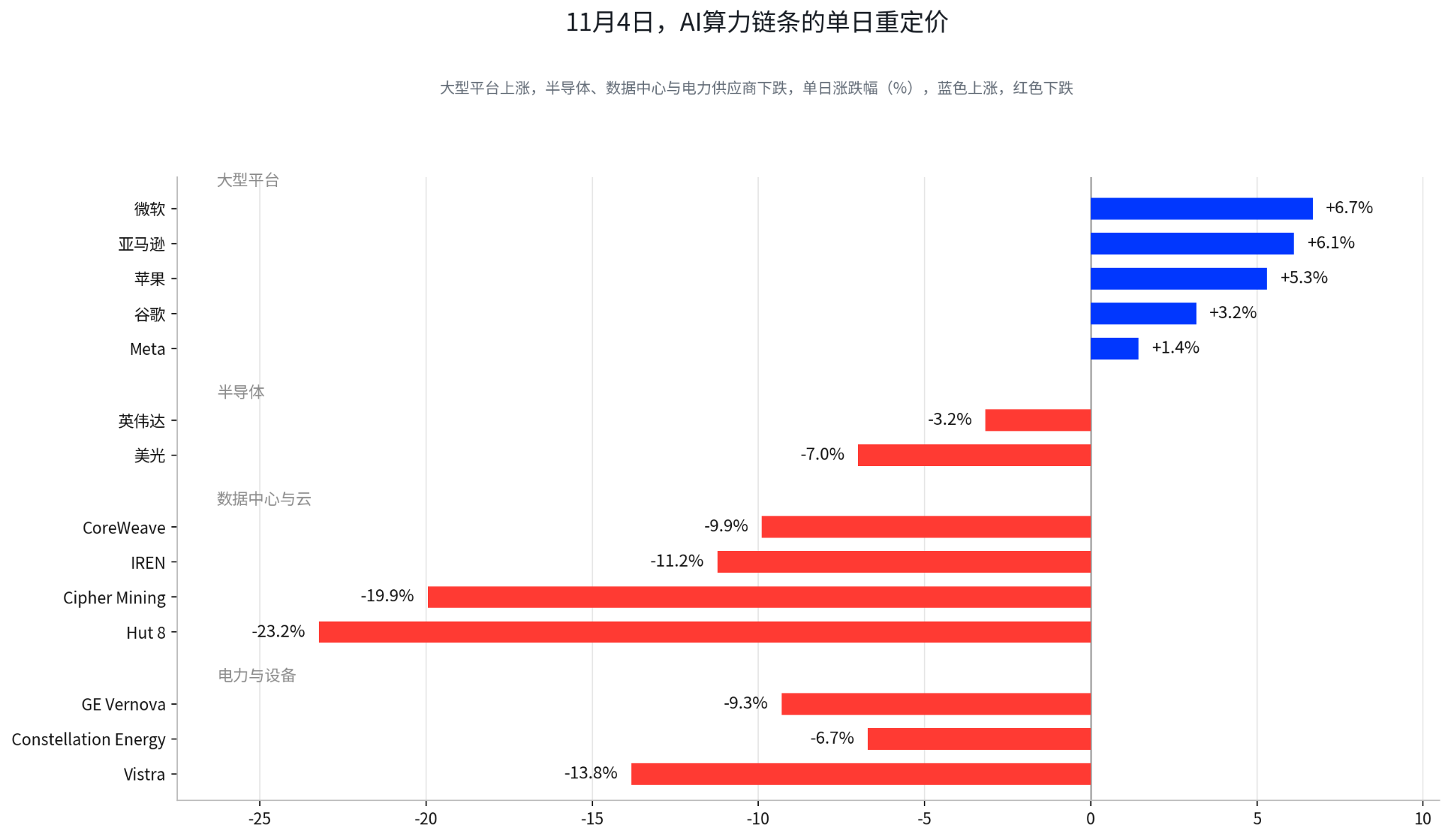
The cost-side story is equally clear. Siebert Financial's investment director (as cited by media) believes AI infrastructure won't disappear, but tax incentives may shrink, companies will bear more power and water costs, construction will get more expensive, returns will be compressed, and the most vulnerable are companies heavily reliant on financing. This corroborates the deep drawdowns in CoreWeave and IREN.
Counterarguments are also worth noting. Adam McCarthy of LO:TECH (as cited by media) cautioned that the sharp selloff in data center concept stocks may be overdone—the Trump administration has consistently supported AI development, and administrative tools like permitting and federal land remain in the White House's hands. UBS's strategy team (as cited by media) points to state governments: exit polls show voters strongly oppose data centers being built in their communities, and the biggest near-term variable is state-level regulatory tightening. Evercore ISI shares a similar view: a tougher development environment will further weigh on sentiment toward AI infrastructure-related stocks.
The Next Hurdle for Data Centers: Power, Permits, and Tax Incentives
Whether data centers can secure power, land, tax incentives, and environmental permits is increasingly important. Goldman Sachs Chief Economist Jan Hatzius's estimate has been cited by multiple media outlets: state and local election results could trigger data center construction pauses affecting roughly 45% of planned U.S. projects, with Texas alone accounting for about 25%–27%. Projects that have secured permits, locked in power supply, and broken ground face limited impact from policy changes; those that haven't completed these steps face higher delay risk. SPDB International's assessment is consistent: data center projects that haven't locked in power supply, permits, and tax incentives by 2027 are more likely to be delayed.
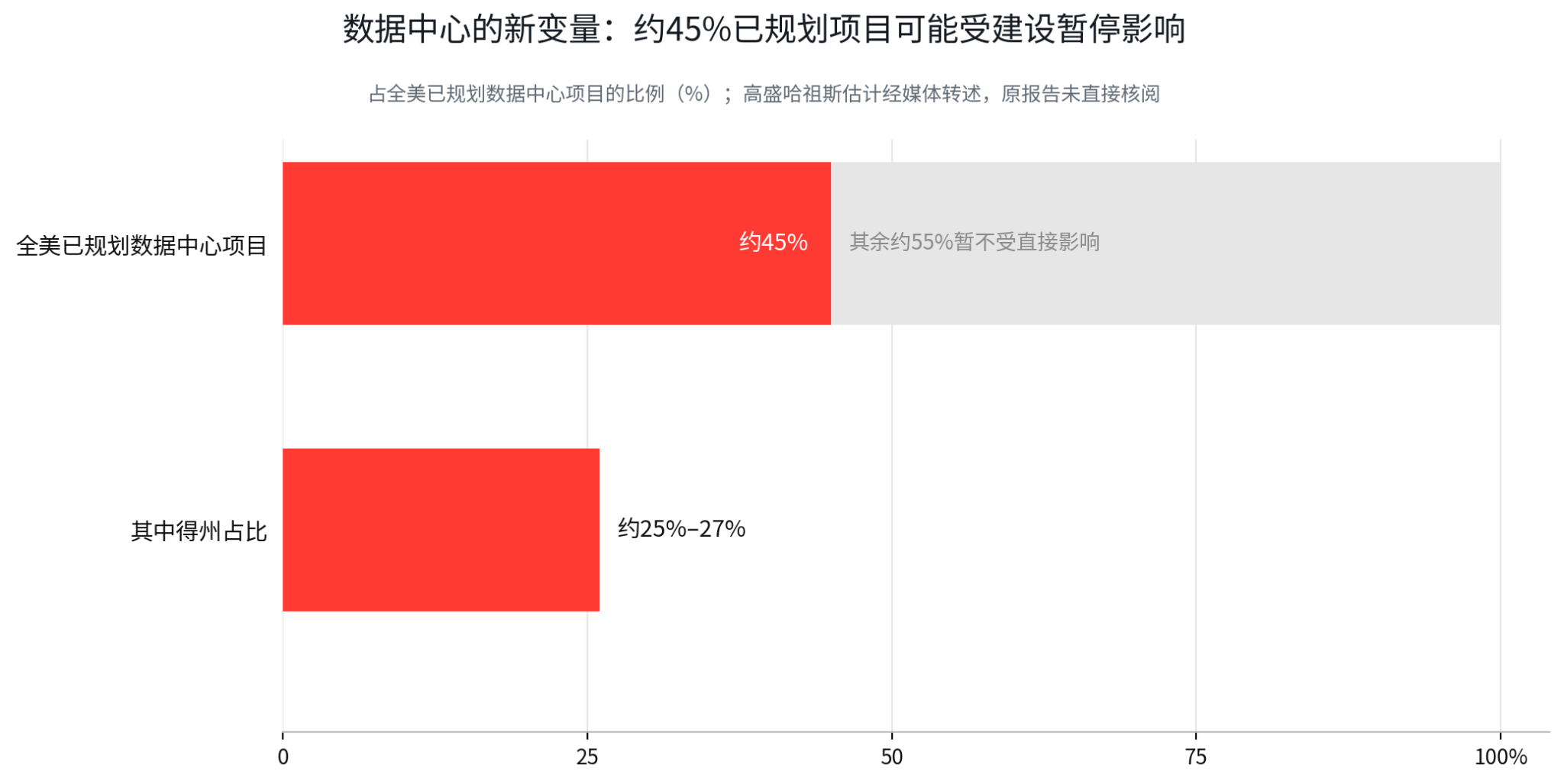
Two additional data points clarify Texas's weight. Research firm SemiAnalysis (as cited by media) estimates that Texas accounts for about one-quarter of expected U.S. compute capacity in operation by 2030, corroborating Hatzius's range. There are also pause calls at the federal level: Democratic Representative Yassamin Ansari advocated on social media for including a moratorium on advanced AI development and a ban on artificial superintelligence in the party caucus's first-day agenda. This is currently only an individual lawmaker's statement with no legislative path—worth monitoring only.
November 17, Nvidia Earnings: The Market Wants More Than Revenue Growth
AMD previously reported Q3 revenue of $13.377 billion, up 45% year-over-year, with data center revenue up 97% year-over-year and Q4 guidance of about $17 billion—yet the stock rose only 1.01% that day. The numbers were still strong; the stock reaction shows the market demands more than revenue growth itself, shifting to whether orders can be sustained, whether capex can convert to cash flow, and whether infrastructure buildout can proceed smoothly.
Evidence from the application layer is accumulating on the other side. Duolingo cut its per-call AI cost from about $0.30 to about $0.01, pushing gross margin to around 73%—cost reductions are already flowing into corporate income statements. The market may gradually shift from "who buys the most GPUs" to "who can generate more revenue at lower cost."
VI. Two Executive-Power Trades: Crude Oil on Iran, Export Chain on Tariffs
Crude Oil: The 8.4% Plunge Prices In Iran De-escalation
With Democrats controlling Congress, regulatory pressure on traditional oil and gas development may increase. If Iran tensions continue to de-escalate, the geopolitical risk premium will keep compressing—these two factors together explain WTI's 8.4% single-day drop. Crude cannot simply be viewed bearishly: diplomatic and military initiative remains with the White House, and if negotiations fail or conflict escalates, oil prices could quickly reverse. Over the coming months, crude is better tracked as an event-driven asset, trading around Iran negotiation progress and inventory data.
The energy policy that truly deserves attention is actually on the grid. Transmission expansion and permitting reform have room for bipartisan cooperation (per SPDB International), and traditional energy and grid equipment could see completely different policy treatment.
Export Chain: November 10—178 Tariff Exemptions Give the First Answer
The 178 Section 301 tariff exemptions on Chinese goods were extended to November 10; renewal, adjustment, or cancellation will be decided by the White House (per Galaxy Securities). Galaxy Securities' assessment: after a Democratic sweep, Congress may push to constrain the president's broad tariff authority, but it is not soft on China regarding industrial security and forced labor—enforcement and investigations will become more institutionalized. The U.S. launched a public comment process in June on tariff reductions for about $30 billion in goods (low-controversy categories), covering chemicals and plastics, industrial components, and textiles/apparel. If the list is finalized, relevant tariff rates could return to MFN baseline levels (per Galaxy Securities).
For the Hong Kong and A-share export chain, the period around November 10 is more worth watching than the election itself. The Hang Seng Tech Index rose 1.77% on November 4. The tailwind for Asian assets lies in the dollar and Treasury yields; the risk lies in the executive branch's use of tariff tools.
Gold and Crypto: Ultimately Still About Rates
Reduced fiscal expansion expectations favor lower long-end rates. Gold has rebounded from $3,898.9 on October 30 to around $4,132 in Asian trading on November 5. As long as inflation and the Fed remain hawkish, gold is unlikely to form a one-way trend; the future is more likely to be range-bound trading driven by macro data.
Crypto faces dual variables of accelerated regulatory legislation and congressional oversight, and was roughly flat on election day. Bernstein cut price targets on AI compute-pivoting miners by up to 54%.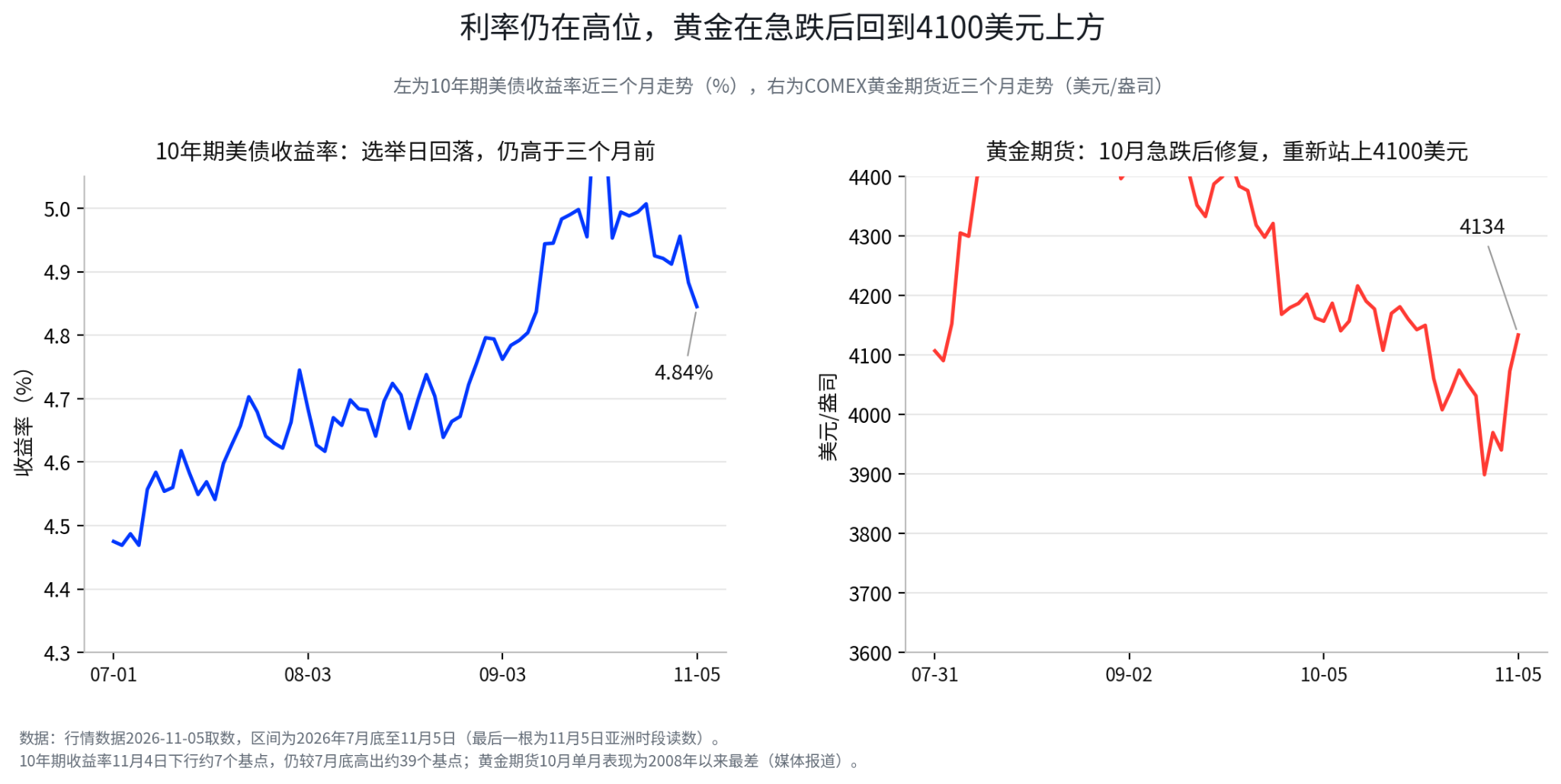
VII. From November 10 to the Debt Ceiling: Just Watch These Dates Over the Next 12 Months
The election is over. Market pricing power will quickly shift to a few specific dates.
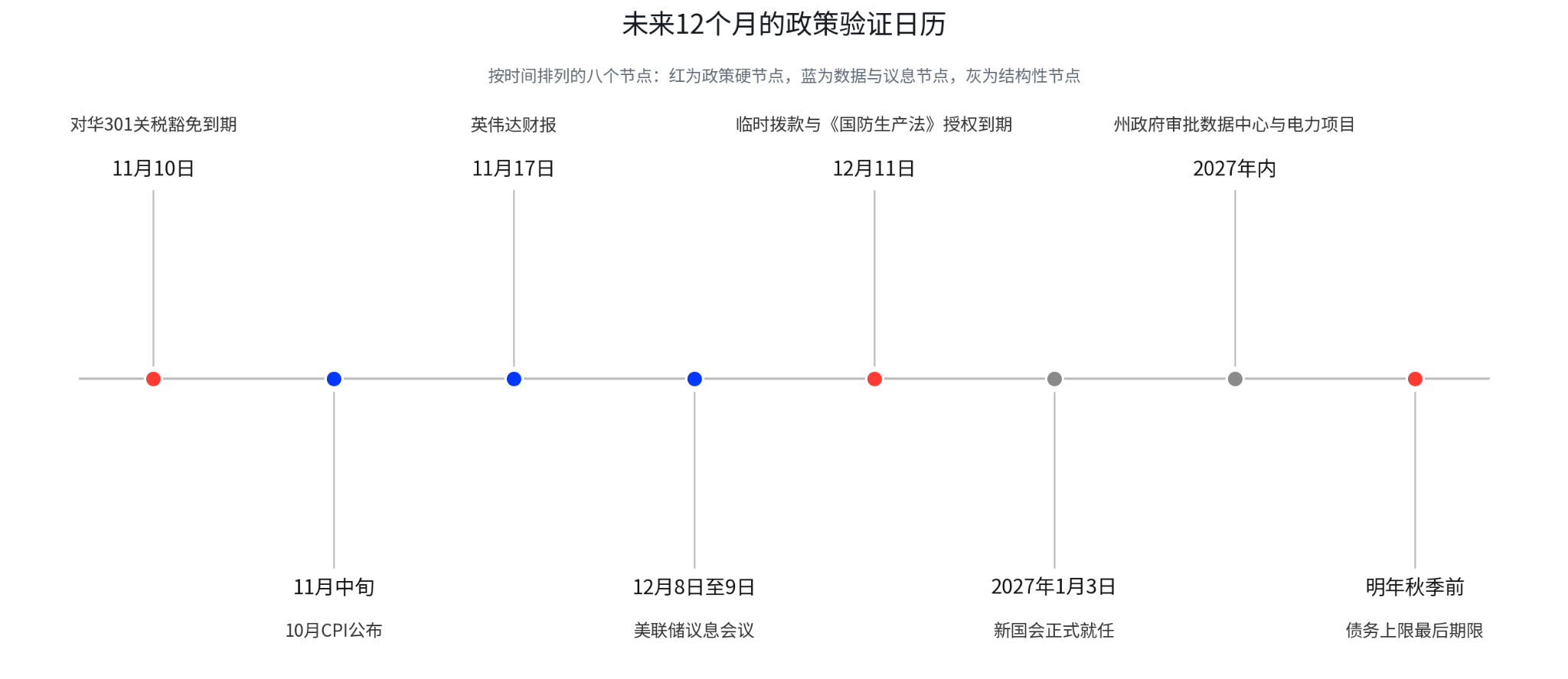
• November 10: Section 301 tariff exemptions on China. Renewal or cancellation is up to the White House—the first answer for the export chain, and it also moves the dollar and global inflation expectations.
• Mid-November: October CPI. Whether inflation continues to fall determines whether the Fed has room—the most direct macro verification point for Treasuries and gold.
• November 17: Nvidia earnings. Watch data center demand, order visibility, and capex—not revenue itself.
• December 8–9: FOMC meeting. The master switch for Treasuries, gold, the dollar, and growth stock valuations. Employment and inflation data set the direction.
• December 11: Stopgap funding plus Defense Production Act authorization. The most important political trading window over the next few months—healthcare subsidies, defense, and shutdown risk all converge.
• January 3, 2027: New Congress sworn in. Democrats take over the congressional agenda; tech regulation, AI compliance, and executive branch investigations enter the enforcement phase.
• 2027: State governments determine the next round of AI infrastructure supply. For compute, data centers, and power equipment, actual approvals matter more than rhetoric from Washington.
• Before next fall: Debt ceiling. A further tail risk that determines whether long-end rates and risk assets face a second policy shock.

Conclusion: Don't Trade the Election Outcome—Trade Policy Delivery
Market focus will likely shift from the election results themselves to the actual implementation of various policies. Treasuries hinge on the fiscal freeze and rate direction; healthcare on the December appropriations text; AI infrastructure on state and local approvals; crude on Iran negotiations; the export chain on the November 10 tariff decision. Every asset has its own policy timetable.
Indexes can be viewed with a bullish tilt, but don't mistake that for a broad rally. The 2018 experience already showed that a 12-month post-election gain and a significant drawdown in the first few months are not contradictory. Opportunities over the next year are more likely to come from divergence across sectors and assets—not from a simple post-election bounce.