






Author: Planet Jun's friends, Odaily
Key Takeaways: Democrats swept both chambers of Congress and key gubernatorial seats in the U.S. midterm elections, triggering fears of tighter regulation on AI data centers. The shockwave rippled through South Korean markets, dealing a heavy blow to semiconductor and power equipment stocks, with both major indices triggering circuit breakers on the same day.
Key Points:
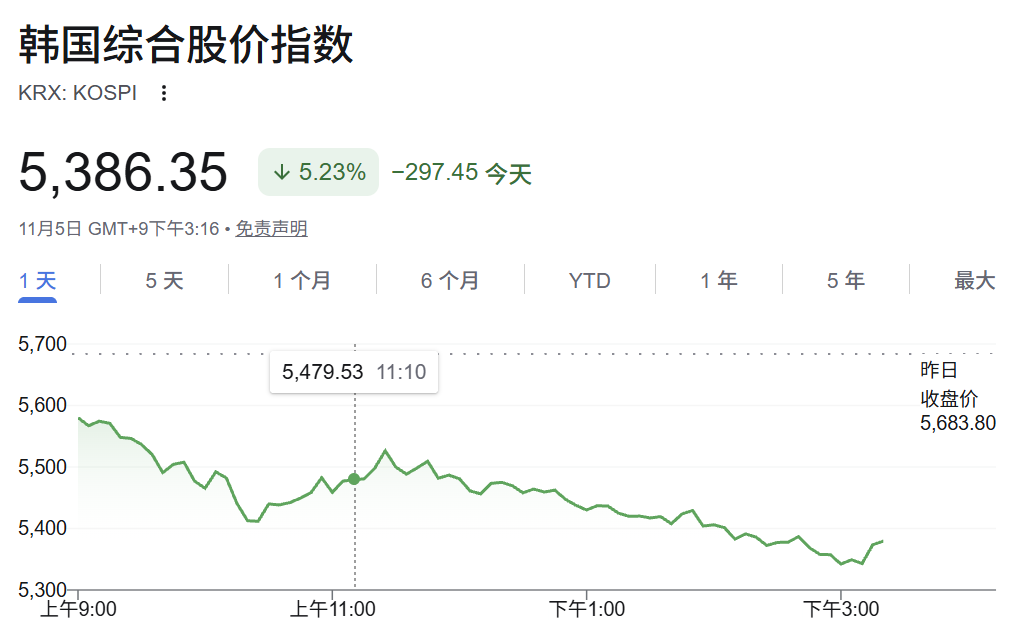
a. The KOSPI fell as much as 5.50% intraday to 5,371.41 points, while the KOSDAQ dropped 5.11%. The two indices rarely trigger the sell-sidecar mechanism on the same day. Samsung Electronics and SK Hynix plunged 7.8% and 9.81%, respectively.
b. The trigger was the Democratic Party's victory in gubernatorial races in data center heavyweights such as Texas, Ohio, and Georgia. Texas's governor-elect vowed to pause all new data center approvals. Among 74 gubernatorial candidates across 36 states, 43% support a moratorium or ban on new data center construction.
c. U.S. semiconductor stocks also weakened in tandem. The Philadelphia Semiconductor Index fell 3.1% to a near six-month low, with Nvidia and Micron dropping between 3% and 8%. CoreWeave plunged 9.9%.
d. South Korean power equipment stocks came under pressure as well. Hyosung Heavy Industries, HD Hyundai Electric, and Sanil Electric fell 10.10%, 7.53%, and 12.84%, respectively, on concerns that delays in data center construction would compress demand for transformers.
e. Some analysts believe the impact may be limited: Democrats are unlikely to secure the two-thirds majority needed to override a presidential veto, restricting their policy headroom. Renewable energy stocks bucked the trend, benefiting from rising policy expectations.
The Democratic sweep of both chambers in the U.S. midterm elections has reignited fears of tighter regulation on AI data centers, and like a stone dropped into calm waters, the shockwave quickly reached Seoul's stock market. Both of South Korea's benchmark indices triggered sell-side circuit breakers on the same day, with semiconductor bellwethers taking a heavy hit. This "blue wave" is now testing the export engine at the very core of South Korea's economy.
On November 5, the KOSPI opened down 1.82% and continued to widen losses, triggering the sell-sidecar mechanism before noon as program selling was temporarily halted. As of 2:25 p.m. that day, the KOSPI had fallen 5.50% from the previous session to 5,371.41 points, while the KOSDAQ dropped 5.11% to 678.4 points. It was a rare occurrence for both indices to trigger market stabilization mechanisms on the same trading day. Samsung Electronics and SK Hynix shares plunged 7.8% and 9.81%, respectively.
The immediate trigger for the selloff was the Democratic Party's victories in gubernatorial races in data center hubs such as Texas, Ohio, and Georgia, which sharply heightened market fears that approvals for new data centers could be blocked. With Samsung Electronics and SK Hynix together accounting for more than half of the KOSPI's market capitalization, any shift in semiconductor sentiment is amplified across the benchmark index.
Democratic Sweep Sparks Data Center Regulatory Fears
The Democratic Party achieved a historic "blue sweep" in this midterm election, winning control of both the Senate and the House, while also capturing governorships in several states with high data center density.
Among them, Texas governor-elect Gina Hinojosa pledged during her campaign to immediately pause all new data center approvals upon taking office. According to DataCenterWatch analysis cited by the Texas Tribune, a regional newspaper, 43% of 74 gubernatorial candidates across 36 states have expressed support for a moratorium or ban on new data center construction.
Market reaction was also directly transmitted from the previous trading day's U.S. stock moves. Although major U.S. indices rose overall on November 4 — the S&P 500 gained 1.58%, the Dow Jones jumped 3.03%, and the Nasdaq rose 1.44% — the internal structure was sharply divided.
Large tech stocks such as Apple, Microsoft, and Amazon each rose more than 5% on the day, while semiconductor names including Nvidia, Micron, SanDisk, and Intel broadly declined, falling between 3% and 8%. AI compute leasing upstarts CoreWeave and Nebius plunged 9.9% and 6.7%, respectively, while the Philadelphia Semiconductor Index fell 3.1% to a near six-month low.
Korean Semiconductor and Power Equipment Stocks Under Broad Pressure
Losses in the Korean market were concentrated in semiconductors and power equipment sectors closely tied to AI infrastructure. Samsung Electronics fell 5.39%; SK Square dropped 6.56%; Samsung Electro-Mechanics plunged as much as 10.31%. Semiconductor equipment companies on the KOSDAQ also took heavy hits, with Jusung Engineering down 10.23%, Simmtech down 13.90%, and EO Technics down 11.72%.
Transformer and other power equipment companies were not spared either. The market fears that delays in data center construction will directly compress demand for transformers. Hyosung Heavy Industries, HD Hyundai Electric, and Sanil Electric fell 10.10%, 7.53%, and 12.84%, respectively.
Mirae Asset Securities analyst Seo Sang-young said, "Democrats also won elections in key data center regions such as Texas and Georgia, sharply raising concerns about tighter regulation of grid connections, approval processes, and electricity costs. Companies that have taken on heavy debt to build new data centers will face higher financing costs and greater profitability pressure if project timelines slip."
Kim Seok-hwan, a senior researcher at Mirae Asset Securities, noted that "tighter AI regulation could disrupt capital expenditure plans at large tech companies. These companies need to build data centers to deliver on compute commitments made to customers like OpenAI and Anthropic, and ultimately convert those commitments into cloud revenue. Delays in data center construction would push back the revenue realization window, prompting hyperscalers to reassess the pace of future investment, which would in turn weigh on demand expectations for high-bandwidth memory and other advanced chips."
Policy Path Has Limits; Some Analysts See Short-Lived Impact
The Bank of Korea's New York office said in a report that the election results are unlikely to drive a major shift in the overall policy direction of the Trump administration, but "may have a limited impact on AI regulation and related investment pacing."
Yang Jun-seok, an economics professor at the Catholic University of Korea, said that even with Democrats controlling both chambers, they would struggle to secure the two-thirds majority needed to override a presidential veto, which fundamentally limits their actual policy room for maneuver. Therefore, the election results alone are unlikely to produce a direct, substantive shock to AI investment.
He noted, however, that if Democrats further clarify a policy stance favoring tighter AI development and investment, combined with other pressures already facing the industry — including public concerns about AI displacing jobs, driving up energy bills, and consuming large amounts of water, as well as debt burdens on large tech companies from heavy borrowing to invest in AI — this could become "a meaningful additional suppressing factor."
NH Investment & Securities researcher Jo Yeon-ju took a more optimistic view, saying: "Democrats also understand the strategic importance of AI leadership and will not recklessly impose large-scale delays. Instead, they are likely to offer compensation to local residents to facilitate data center construction. The real impact on large tech companies may prove to be a tempest in a teapot."
Researchers at iM Securities also noted that while regulatory fears over AI data center approvals are weighing on semiconductor investment sentiment, expectations of cost savings from falling crude oil prices are spreading to sectors such as aviation and transportation, which merit continued attention.
Renewable Energy Sector Benefits Against the Tide
Even as the broader market came under pressure, some sectors are seen as potential beneficiaries of the "blue wave." With Democrats consolidating their majority, expectations are rising for a revival of renewable energy support policies, with solar, wind, nuclear, and energy storage system (ESS) related stocks widely cited as beneficiaries.
DS Investment & Securities researcher Ahn Joo-won said, "As Democrats gain stronger bargaining power in future legislation thanks to their landslide election advantage, demands in renewable energy areas such as solar and wind will be fully reflected, and wind power and fuel cell related stocks stand to benefit."
Yuanta Securities researcher Lee Jae-won cautioned, "With Democrats controlling Congress and winning key governorships, the probability of stricter regulation on AI data centers rises. Approval restrictions and grid cost pressures in major data center construction regions such as Texas could delay AI capital investment, which would in turn depress memory semiconductor demand and weigh on prices."