






Author: Azuma, Odaily
Key Takeaways: Variational has become the second-largest Perp DEX by weekly volume with its order-book-free OLP quoting model, but the $1.5 billion OTC valuation already prices in high expectations. Post-incentive volume retention and OLP risk are the core variables.
Key Points:
a. Weekly volume trails only Hyperliquid, with 570+ markets spanning stocks, crude oil, gold, and other RWA assets, all with zero fees.
b. The founding team comes from Genesis, where they previously ran a quant market-making fund; the project has raised approximately $62 million from investors including Dragonfly and Bain Capital Crypto.
c. The treasury holds roughly $11.8 million in USDC, with about $2.5 million inflows in September, all planned for buyback-and-burn; annualized revenue is approximately $30 million.
d. RWA volume accounts for more than half of total platform volume, representing roughly 36% of combined Variational and trade.xyz volume in September, up from about 14% in July.
e. The initial TGE circulating supply is expected to come entirely from the airdrop, representing 32% of total supply—approximately $480 million in tokens unlocking immediately at a $1.5 billion valuation.
f. Key risks: toxic order flow once the public API opens, OLP P&L opacity, and a potential 30%–60% volume decline after points mining subsides.
g. The Pro product targets the institutional OTC derivatives market, with a planned 2027 launch, but the revenue model has not yet been disclosed.
Source: Duldul (@Duldul_Capital)
Compiled by Odaily Planet Daily (@OdailyChina); Translator: Azuma (@azuma_eth)

The first time I opened Variational, I didn't understand why anyone would want to use an exchange without an order book. I was used to order books, used to seeing who my counterparty was.
Months later, I came back—this time to execute a delta-neutral trade on Variational against Lighter. As a result, I changed my mind.
You just click to place an order, the system quotes you a price for your entire trade size, the trade fills, and that's it. On top of that, the cost of this trade was noticeably lower than my first attempt.
By weekly trading volume, Variational is now the second-largest Perp DEX after Hyperliquid. The platform offers over 570 trading markets covering assets like stocks, crude oil, and gold—all with zero fees.
Variational's native token VAR is scheduled to launch in Q4, with OTC pre-market trading currently implying a valuation of approximately $1.5 billion.
The question this article seeks to answer is—is this pricing reasonable?
First, I'll introduce the team behind Variational and how it works, then discuss what impressed me, what concerns me, and what I think it's actually worth.
Who runs Variational?
Variational was founded by two quant traders. Since 2017, they've been doing exactly what they now want to bring on-chain—market making and OTC (over-the-counter) trading.
Two alumni from neighboring dorms
Lucas Schuermann (CEO) and Edward Yu met as freshmen at Columbia University, living in the same dorm reserved for entrepreneurs—in rooms right next to each other.
Schuermann is something of a prodigy—he began studying mathematics at the University of Oklahoma at age 12, then went on to Columbia for computer science and interned at Goldman Sachs and Google X.
Yu graduated from Columbia with a degree in applied mathematics, worked at Facebook, and has published papers on Bayesian statistics.
In 2017, the two co-founded Qu Capital, a fund focused on cryptocurrency statistical arbitrage that raised money from institutional investors. In 2019, the fund was acquired by Barry Silbert's Digital Currency Group (DCG).
That brought them into Genesis, then one of the largest OTC trading platforms in crypto. Schuermann served as VP of Engineering, building the OTC trading platform's infrastructure; Yu served as Head of Quantitative Research, running market making for linear contracts and options.
Both left Genesis in 2021. Two years later, in 2023, Genesis collapsed—long after they had departed.
This detail is worth mentioning because having Genesis on a résumé inevitably raises some questions these days.
Trading first, protocol second
Variational didn't start as a DEX.
Before officially launching a product, the team operated in stealth mode for about two years as a proprietary market maker active across major centralized exchanges (CEXs) and decentralized exchanges (DEXs).
That experience yielded three lessons that directly shaped the current product design:
• Building an order book from scratch is extremely slow—every new trading pair requires separate negotiations with market makers;
• Exchanges surrender a substantial portion of value to market makers, and that value ultimately leaks out of the ecosystem;
• OTC derivatives trading is still bogged down by lawyers, endless back-and-forth, bank wires, and armies of operations staff. In Schuermann's words, that's just how it is.
Omni (Variational's current core product) solves the first two problems, while Pro (the planned upcoming product) targets the third.
Team size
As of May 2026, Variational has 24 employees, up significantly from 7 in 2024. Its developers and quant researchers come from Google, Meta, Virtu, IMC, Jane Street, and other firms.
The company is incorporated in the Cayman Islands, with the team based in New York.
Interestingly, the team's attitude toward profitability stands out. Schuermann says revenue is their most important metric. The reason is simple: unlike competitors sitting on massive VC war chests, they can't afford to lose money for years on end to compete for users.
That's also why, before the TGE, Variational's treasury has already accumulated nearly $12 million.
Investors
Variational has raised approximately $62 million across three funding rounds. The investor list isn't long, but it's a solid lineup.
The seed round was a standard equity raise with 1:1 token warrants attached, meaning investors receive tokens proportional to their equity stake.
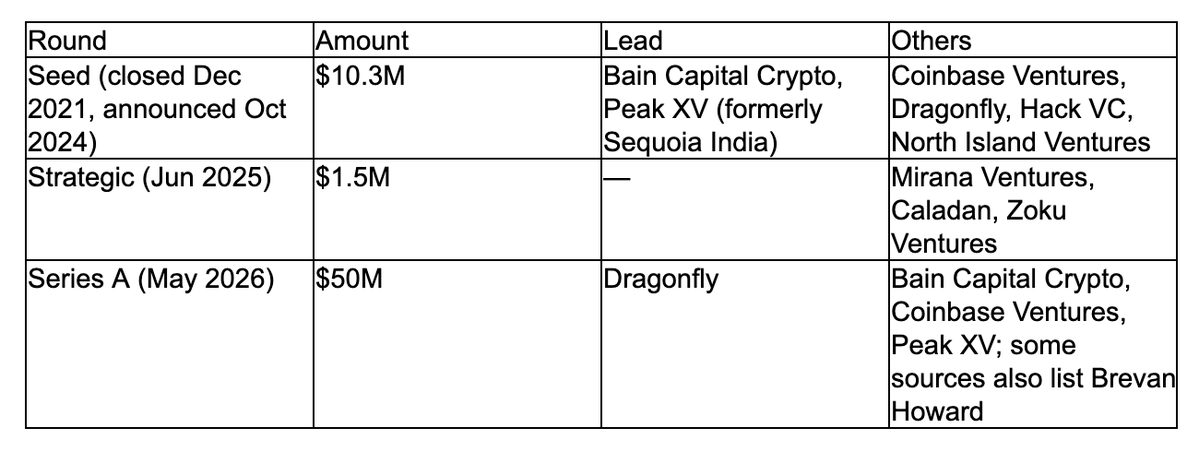
A few things stand out:
• Dragonfly is the most notable. It led Variational's Series A from a new $650 million fund. Schuermann has also publicly stated that Dragonfly can help him open TradFi partnership and integration channels.
• The same group of investors previously backed dYdX. Dragonfly and Bain Capital Crypto also participated in dYdX's 2018 Series A. dYdX was once the king of perpetuals, but its token is now down 97% from its all-time high. Great investors don't guarantee great token performance.
• Brevan Howard is a signal of TradFi pedigree. The firm is one of the world's largest macro hedge funds. Its presence fits Variational's narrative of connecting with TradFi market makers, though not all sources confirm this investment.
• The JPMorgan relationship has not been officially confirmed. According to unofficial reports, Variational has a direct credit line with JPMorgan. But I couldn't find any public information to verify this.
How does Omni work?
Omni is more like a currency exchange counter than a traditional exchange.
On a traditional exchange, you post an order into a shared order book and wait for someone to fill it. At an exchange counter, you simply ask for a price, the counter quotes one, and you can take it or leave it.
In Omni, that counter is the Omni Liquidity Provider (OLP)—a market maker owned by the protocol itself.
The flow for each trade goes roughly like this:
• You input the asset you want to buy or sell and the trade size;
• The OLP quotes a price for your entire trade size;
• You accept the quote, and the OLP becomes your counterparty;
• The OLP then hedges its position wherever liquidity exists—Binance, Hyperliquid, or traditional bank dealers.
Omni charges no fees. Its revenue comes from the spread between the quoted price and the actual hedge price, with roughly 20% of that currently flowing to the protocol treasury.
This means Omni doesn't need to build liquidity from scratch for every market. It can list perpetuals on Apple stock or Brent crude because liquidity for those assets already exists in other markets.
That's also why Variational can offer over 570 trading markets, with RWA volume now accounting for more than half of total platform volume.
Schuermann says he doesn't see Hyperliquid as a competitor but as one of his liquidity sources. Compared to traditional exchanges, Variational's positioning is actually closer to Robinhood.
What impressed me?
No one can hunt your orders
On a traditional order book, large orders and stop-losses are visible, and market makers can use that information to trade against you.
In Omni, no one except the OLP can see your order. For anyone trading large positions, that's a real advantage. To be fair, though, the OLP sees everything—your positions, trade sizes, even your liquidation price.
It's more of a broker relationship than a fully anonymous dark pool.
Convenient and cheap
The entire order requires accepting just one quote—no need to split it into multiple small orders filled piece by piece.
Currently, ETH spreads are around 1.3 basis points, and spreads on index and crude oil markets are even below 1 basis point.
Real money already in the treasury
As of October 28, Variational's treasury held approximately $11.8 million in USDC, with about $2.5 million flowing in during September alone.
Per the team's plan, all treasury revenue will be used for token buybacks and burns.
By comparison, Lighter had no similar funding support on its TGE day. It began buybacks about a week after TGE, when its treasury held roughly $1.35 million.
TradFi resources are more than just talk
When stock and index perpetuals launched, TradFi dealers committed to providing over $1 billion in open interest (OI) capacity.
Within a week of launch, volume on those contracts reached $2.8 billion.
Every trader has a separate pool
Each trader's position sits in a separate contract with the OLP. If the trader next to you gets liquidated, their losses don't propagate to your account.
This contrasts with what happened on some other trading platforms during the October 10, 2025 market crash.
Audited smart contracts
The protocol has passed security audits by Zellic and Spearbit, with no hacks to date.
However, Variational runs on Arbitrum, so it also bears Arbitrum-related risks.
Who are Variational's competitors?
RWA is not an uncontested blue ocean, and Variational isn't the largest player in this market.
After Hyperliquid opened external market deployment (HIP-3), RWA accounted for more than half of its total volume for two consecutive weeks in July, with trade.xyz being one of the largest deployers.
According to DefiLlama Research data for September, trade.xyz's volume was roughly 3x Variational's—$255 billion versus $80 billion.
However, Variational is catching up fast. In late July, Variational accounted for about 14% of combined volume across the two platforms; by September, that share had risen to approximately 36%.
There's also Ostium (also on Arbitrum), Lighter's independent deployment on Robinhood Chain, and a growing number of regulated brokers offering perpetual products.
So Variational's real edge isn't RWA itself—it's how it sources liquidity. Hyperliquid and trade.xyz must attract market makers for every new market, while Variational can plug directly into dealers that already have the relevant liquidity.
If this model can be replicated across hundreds of markets, the advantage could persist—but if TradFi dealers start quoting directly on Hyperliquid, that edge could evaporate.
What concerns me?
A potential sell-off after the airdrop
At TGE, the entire initial circulating supply is expected to come from the airdrop—32% of total supply, fully unlocked from minute one. At a $1.5 billion valuation, that means roughly $480 million in tokens going directly into the hands of "points farmers." For many, that's life-changing money, and they'll likely sell.
By comparison, the roughly $11.8 million in treasury funds represents just 2.5% of that circulating supply. Buy-side pressure at TGE will have to come from exchanges, funds, and market narrative—not from the protocol itself.
Historical data offers some comfort. After Lighter's TGE, about two-thirds of airdropped tokens remained in holders' wallets. But conversely, a year later, 50% of team and investor tokens will begin unlocking.
Worth noting: actual circulating supply post-TGE could exceed 32%. Excluding the airdrop, investor, and team allocations, the remaining 18% belongs to the ecosystem reserve held by the Variational Foundation, which can decide how to use it—no specific release schedule has been published. If some of that is allocated to market makers at TGE or used for exchange listings, actual circulating supply would exceed what the airdrop alone implies.
Some airdropped tokens may also be burned. Variational's terms exclude users from the U.S., Canada, Taiwan, and sanctioned countries. Users must sign VAR terms when claiming; unclaimed tokens will be burned. If some points belong to ineligible users, actual circulating supply would be smaller. That said, I don't think this number will be particularly significant—after all, everyone uses a VPN.
We don't know how concentrated the points are. I couldn't find public data on points distribution concentration. A few dozen whales holding half the airdrop creates a very different sell pressure profile than tens of thousands of small farmers each holding tokens.
Currently, VAR has only one announced utility: using treasury revenue to buy back tokens. It has no governance, staking, or fee-discount functionality, with more details expected before TGE. So buying VAR now is essentially buying a buyback expectation backed by roughly 20% of OLP spread revenue.
How much volume will remain after points end?
A significant portion of Variational's current trading activity comes from points mining.
Based on how other perpetual DEXs performed post-launch, volume typically drops about 54% on average in the first month after TGE. I expect Variational's OI and volume could decline 30%–60%.
That said, I believe the product has found product-market fit (PMF), and users will continue farming points on other perpetual DEXs, so a meaningful share of volume should stick around, using Variational as a hedging venue.
On traditional exchanges, volume declines typically trigger a vicious cycle—fewer traders, wider spreads, more traders leaving. Omni can avoid this to some extent because the OLP hedges in other markets, and that cost doesn't depend on Variational's own volume.
The real problem lies elsewhere. Points farmers are actually the ideal customers for a market maker because their trading behavior tends to be irregular. After TGE, the users who stay will mostly be more sophisticated traders. The OLP will make less money from them—or even lose money. Ultimately, spreads for everyone could widen as a result.
API and toxic order flow
This is my biggest concern.
Variational has announced it will open a public API before TGE. There will always be participants faster than the OLP—institutions like Jane Street, for example. They may have already spotted an opportunity after a price move on Binance before the OLP has had time to update its quote.
I don't believe this can be 100% prevented. The real question is whether the resulting losses are manageable.
Deliberately adding latency before order execution (e.g., 200 milliseconds) doesn't help much here. Research shows such artificial speed bumps only mildly curb the speed race among participants. However, Variational does have a more powerful tool—the so-called "Last Look."
If the price moves adversely before execution, the OLP can reject the order. It can also quote worse prices to accounts that consistently profit at its expense. FX brokers have used this mechanism for years. It works, but it comes at a cost.
If the OLP starts rejecting orders every time the market moves, what was a convenient exchange counter becomes a counter that only sells when it feels like it. In FX markets, abuse of Last Look has led to fines for banks.
I've worked at a zero-fee exchange, so I don't buy the "our algorithms will be better" argument. There will always be someone faster and better than you. The real question is whether the losses the platform ultimately has to absorb from toxic flow are acceptable.
When the OLP loses money, who pays?
The OLP is the counterparty to every trade on Omni, meaning all platform risk is concentrated in one place. If the OLP goes bankrupt, trader profits accrued from that point onward cannot be paid out. The protocol documentation explicitly states this.
But we don't know how the OLP is actually performing—it doesn't disclose its positions, hedging results, or historical P&L.
I also couldn't find data on how it performed during previous major market swings. Currently, OLP capital is provided by the team, but Variational plans to open deposits to external capital in the future, similar to HLP on Hyperliquid.
If that happens, some of the risk—including toxic order flow risk—will transfer to depositors.
Additionally, there's a rarely discussed conflict of interest: the protocol itself is the counterparty to its own users—when users pay the spread, the protocol makes money; when users profit, the protocol may lose money. This is normal for a broker, but it's worth keeping in mind when you see Omni advertising "zero fees."
Pro: The 2027 wildcard
Omni is the product for traders, while Pro is the product for banks and funds, planned for a 2027 launch.
The Variational team believes Pro will eventually surpass Omni in scale over the long term.
Pro targets exactly the market the founding team knew well at Genesis: OTC derivatives trading, including options, interest rate swaps, FX swaps, and structured products. This is a market worth hundreds of trillions of dollars, yet it still largely runs on phone calls to bank trading desks, Telegram group chats, and manual bank wires.
On Pro, institutions would simply send a quote request for a structured product to multiple market makers simultaneously, and market makers would compete on price and terms. Once a quote is accepted, both parties deposit collateral into a shared contract, and the protocol itself handles margin monitoring, settlement, and liquidation.
Pro is an important upside factor in Variational's valuation logic, because there's currently no data to reflect the value it might generate.
A few caveats are also worth noting:
• Pro has been called "the next step" since 2023. A demo existed three years ago, but the official launch has been repeatedly delayed—now pushed to 2027.
• Institutional finance runs on credit. Banks that have already signed ISDA agreements typically won't want to lock up 100% of collateral in stablecoins.
• Competitors already exist. Paradigm and Deribit have been offering similar services in crypto options for years.
• How Pro will generate revenue for VAR holders remains unclear. In Omni, the OLP earns through spreads; in Pro, the OLP is not the counterparty, and the team hasn't disclosed a revenue model.
If the JPMorgan credit line rumor is true, that resource may be most valuable for the Pro business.
What is Variational actually worth?
The $1.5 billion OTC valuation implies the market assumes Variational will lose about one-third of its trading activity after TGE. If you factor in a premium for Pro, the market is effectively pricing in a roughly 44% decline in business activity.
My approach is to value Variational the same way the market valued Lighter on its TGE day. Specifically, I apply Lighter's valuation multiples at that time to three Variational metrics:
• Open interest (OI);
• Daily trading volume;
• Total value locked (TVL).
OI carries the highest weight because, compared to volume and TVL, it's the hardest to artificially inflate through points mining. I deliberately excluded revenue from the valuation model—not because revenue doesn't matter, but because before TGE, revenue is also distorted by points incentives, just like volume.
That said, for reference, Variational's treasury currently generates about $30 million in annual revenue, versus roughly $64 million for Lighter and about $694 million for Hyperliquid. At a $1.5 billion valuation, Variational trades at roughly 50x annual revenue. By comparison, the average valuation multiple for perpetual DEXs at TGE has been about 6x.
As of October 15 data, Variational's total open interest was $1.98 billion, daily volume was $4.14 billion, and total value locked was $241 million. Below is my valuation calculation based on that data.

The above calculation incorporates an assumption of approximately 10.5 million total points, with the airdrop representing 32% of total token supply.
Note that DefiLlama only counts one-sided OI, so all valuation results under its methodology would be about 40% lower—but under either methodology, $1.5 billion isn't cheap.
Why I might be wrong
The strongest evidence against my judgment is Lighter's historical performance.
Lighter's listing price was initially about 23% below its OTC pre-market price, yet days later, about two-thirds of airdropped tokens remained in holders' wallets—some airdrop recipients even chose to buy more. Points farmers don't always dump the way we fear.
Second, my valuation model is built on a single precedent. If Variational demonstrates a strong commitment to buybacks, or increases the treasury's share of spread revenue, the market might be willing to grant it a premium beyond the model.
Investors like Dragonfly and Coinbase Ventures are also capable of helping on these fronts. It's also worth noting that Variational has already raised $50 million in prior funding and could theoretically deploy that capital to support such initiatives.
As for whether it can list on major exchanges on TGE day, I don't care. Major exchanges always have all sorts of maneuvering, and I'd actually prefer Variational not pay the equivalent of 1% of total token supply just to list on Binance.
The third factor is market timing. In mid-October, U.S. inflation rose to 3.7%, and the market began pricing in rate hikes. At that time, HYPE was about 17% below its all-time high, and LIT had fallen 29% in a month.
If Variational happens to TGE when sentiment is better, the valuation could rise even without any change in fundamentals; conversely, if sentiment deteriorates further, a 60% downside scenario could become the base case.
Final verdict
Variational is one of the most noteworthy perpetual projects in recent years, but its token has already been assigned a fairly optimistic valuation before launch.
The team knows how to run a business, the investor lineup is strong, and the product has real users—but the current OTC valuation effectively assumes two-thirds of trading activity will remain after points end. In my view, the eventual attrition could be larger—I estimate about 40% of trading activity will leave.
After TGE, I'll be watching four metrics closely.
First, OI 30 days after launch. This is the key data point that will ultimately determine who's right. If OI stays above roughly $1.35 billion, the OTC market's valuation call was correct; if OI drops to around $1.1 billion or lower, the token valuation should gravitate toward a $1.2 billion FDV.
Second, trading spreads. Variational's public API will publish quotes for $1,000, $100,000, and $1 million order sizes. If spreads widen after TGE, it means the hard-to-handle order flow is still on the platform.
Third, buyback activity. Focus on buyback size, frequency, and whether the treasury's share of OLP revenue rises above the current 20%.
Fourth, Pro's first named clients. Until the first public clients actually appear, Pro remains just a blueprint on paper.