






Author: MEXC Learn, Odaily
Key Takeaway: Sherrod Brown's victory in Ohio's special Senate election does not really matter because of which party holds the majority — it matters because the CLARITY Act needs 60 votes to overcome the filibuster, and Brown's return makes rounding up those votes even harder.
Key Points:
a. The election was a special election for the unexpired term of a Class III seat. Brown defeated incumbent Republican Husted and will serve the remainder of the term.
b. Industry spending breaks down into three tiers: Fairshake's $30 million pledge, $46.67 million disclosed by its affiliated committee to the FEC, and over $68 million across the entire industry per AdImpact.
c. This cycle's spending was 3.89x to 5.67x the roughly $12 million spent in the same state in 2024, yet the result was the opposite — showing there is no stable linear relationship between spending and outcomes.
d. The CLARITY Act failed a Senate cloture vote on September 15, 2026, by 49 to 50. Republicans already held the majority but still fell 11 votes short, with three Republican senators voting against.
e. During his tenure as Banking Committee chairman, Brown repeatedly blocked stablecoin legislation from advancing. A committee chairman holds procedural control, which carries more influence than simply voting no.
f. No committee assignments have been confirmed. The Democratic ranking member slot on Banking is still expected to go to Warren; the real key indicator for crypto legislation is who takes the Senate Agriculture Committee.
Overview
The real impact of this result is not about which party controls the Senate majority — it is that the CLARITY Act needs 60 votes to advance, and that threshold must be met with bipartisan support regardless of which party holds the majority. The Associated Press has called the Ohio Senate race. The Block reports that former Democratic Senator Sherrod Brown defeated incumbent Republican Senator Jon Husted on November 3. The election was a special election for the unexpired term of the state's Class III seat. Brown led the crypto agenda during his time as Senate Banking Committee chairman and repeatedly blocked stablecoin legislation from moving forward, so his return directly changes the difficulty of rounding up those 11 votes.
Industry spending in this race needs to be viewed at three levels, otherwise the figures cited across different reports will appear contradictory. Fairshake itself pledged $30 million on September 21. Its Republican-affiliated committee, Defend American Jobs, disclosed cumulative Ohio spending of $46.67 million in FEC filings — 55.6% more than that pledge. And by AdImpact's measure, total industry spending in this race exceeded $68 million.

Key Points
The Associated Press has called the race. Election Day was November 3, 2026. Exact vote counts and percentages are per the AP's published results. The three tiers of industry spending are: $30 million publicly pledged by a single super PAC, $46.67 million disclosed by its affiliated committee to the FEC, and over $68 million across the entire industry. In 2024, industry spending in the same state was about $12 million in support of Bernie Moreno, who won. This time, spending by different measures was 3.89x to 5.67x that amount, and the result was the opposite. Across the 2026 cycle, industry spending in over 100 congressional races totaled roughly $176 million, of which Fairshake and its affiliates accounted for about $150.8 million, or 85.7%. No committee assignments have been confirmed. The Democratic ranking member slot on the Senate Banking Committee is still expected to remain with Elizabeth Warren under seniority rules.
The Nature of the Ohio Election
This was not a regular six-year cycle election but a special election for the unexpired term of a Class III seat. The seat originally belonged to JD Vance; after he became vice president, the seat became vacant and Governor appointed Husted to fill it, so the 2026 election determines who serves the remainder of the term. Understanding this is useful for assessing the timeline: the winner serves the remainder of the term, not a fresh six-year term.
The Associated Press has called the race. Election Day was November 3, 2026. Specific vote counts, percentages and margins are per the AP's published results and are not repeated here. For a full overview of the broader midterm landscape and state-level issue distribution, MEXC previously laid out a complete rundown in its 2026 midterm crypto agenda analysis. This article only addresses the results and aftermath of this particular race.
How Much Did the Industry Spend: Three Tiers Must Be Counted Separately
This is where reporting on this race most easily goes wrong. Figures cited for the same election range from $30 million to $68 million. The discrepancy is not because someone got it wrong but because they cover different scopes. Break the tiers apart and the contradictions disappear.
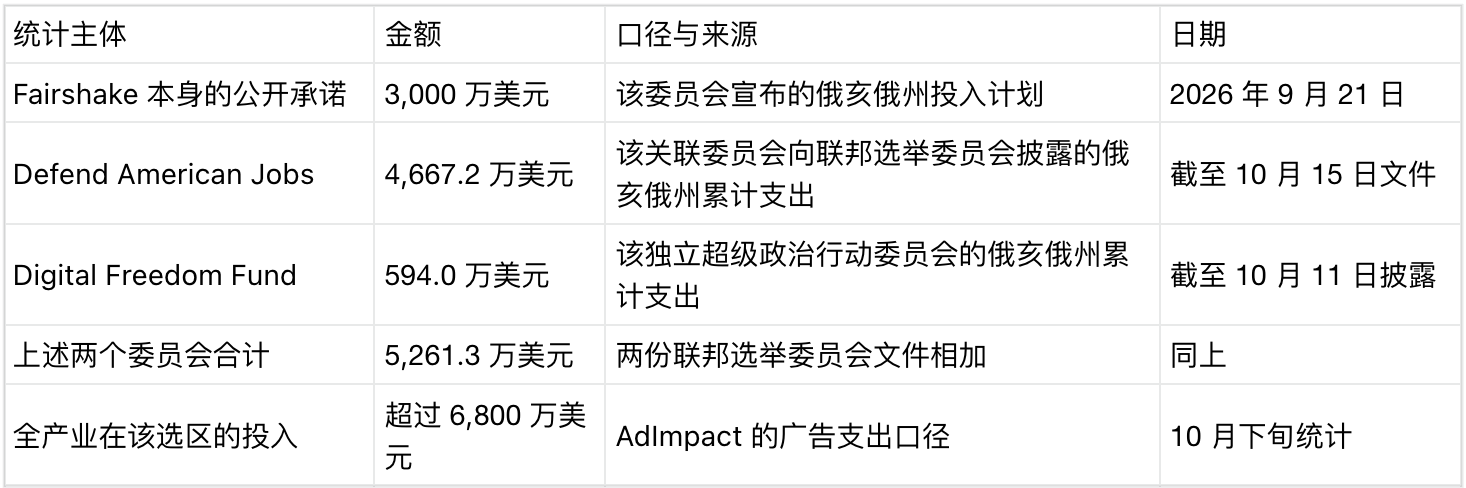
According to crypto.news's review of FEC filings, Defend American Jobs is Fairshake's Republican-facing affiliated committee, not Fairshake itself. Its cumulative Ohio spending was $46,672,296.18, including nearly $11 million in media buys through Main Street Media Group. That figure is $16.67 million, or 55.6%, more than Fairshake's $30 million pledge — which itself shows that "how much a committee pledged" and "how much was actually spent in a given race" are two different things. Digital Freedom Fund, another super PAC founded by the Winklevoss brothers, had cumulative spending of $5,940,397.25, of which the most recently disclosed $2,970,198.58 breaks down by purpose into $990,066.19 supporting Husted and $1,980,132.39 opposing Brown — opposition spending accounting for 66.7% of that amount.
Zooming out to the full cycle, the tier structure is equally clear. According to an October 27 tally based on campaign finance filings through October 20, the digital asset industry spent roughly $176 million across more than 100 congressional races, of which Fairshake and its affiliates accounted for about $150.8 million (85.7%) and other industry-related organizations about $25 million (14.2%). Fairshake's FEC filings for the 2025–2026 cycle show about $138.2 million in receipts and about $169.5 million in disbursements through October 14, including $139 million in transfers to affiliated committees — 82.0% of disbursements — with about $33 million in cash on hand. In other words, the structure is designed for the parent committee to raise funds and then transfer them to party-specific affiliated committees for execution, so counting only the parent committee's own spending systematically understates actual investment.
The concentration in Ohio deserves separate mention. The $68 million AdImpact figure equals 38.6% of the industry's $176 million total and is 6.2x the roughly $11 million spent in Nebraska, the next-highest race. This was not an ordinary battleground but the single most resource-concentrated battlefield of the entire cycle.
Brown's Policy Record
To judge the impact of this result, what matters is not labels but his actual actions at specific legislative junctures.
Brown served as Senate Banking Committee chairman, where he set the crypto-related agenda and called for cracking down on the use of crypto assets to finance terrorism and evade sanctions. More specifically at the legislative level: according to Bloomberg Law, an executive at a crypto trading firm said Brown repeatedly blocked attempts to advance stablecoin legislation. A committee chairman has procedural control over whether a bill reaches the agenda, whether hearings are scheduled, and whether it gets a committee vote — that is what "blocking" actually means, and it is a different tier of influence from voting no.
The 2024 comparison offers another clue. That year the industry spent about $12 million in Ohio supporting Republican candidate Bernie Moreno, and Brown lost. This time, spending by different measures was 3.89x to 5.67x that amount, and the result was the opposite. What this comparison shows is not that "money doesn't work" — election outcomes are determined by many factors — but that there is no stable linear relationship between industry spending and election results. Inferring outcomes from spending levels would lead to the wrong conclusion in this case.
Committee Assignments: All Currently Conditional
This section must use conditional language because no arrangement has been confirmed, and different arrangements carry very different implications for crypto legislation.
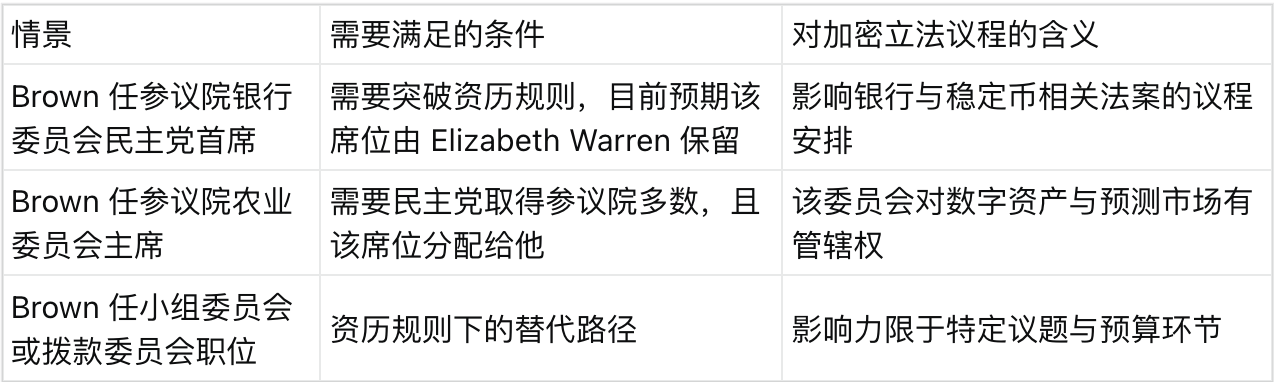
The Block's reporting notes that if Democrats win the Senate majority, Brown could become chairman of the Senate Agriculture Committee, which has jurisdiction over digital assets and prediction markets — and according to its sources, he would be unlikely to proactively introduce crypto legislation as chairman. Separately, Bloomberg Law reported on October 27 that under party seniority rules, the Democratic ranking member slot on Senate Banking is expected to remain with Warren, and Brown's alternative path could be a subcommittee on agriculture or finance, or a seat on Appropriations. On the House side, the Democratic ranking member slot on Financial Services is expected to remain with Maxine Waters, with Sean Casten vying for it and Bill Foster also considering.
It is important to note that none of these are confirmed arrangements. Senate majority control, committee seat allocations, and subcommittee assignments will not be settled until around January 2027, when the 120th Congress convenes. Until then, any analysis treating a specific position as a fait accompli goes beyond available information.
The Real Constraint Is the 60-Vote Threshold, Not Majority Control
This is the most underappreciated implication of this result. Markets habitually translate congressional election outcomes directly into majority control, then infer legislative prospects from majority control — but on crypto market structure legislation, the middle link in that chain is wrong.
The actual trajectory of the CLARITY Act, H.R. 3633, has already proven this. The bill passed the House on July 17, 2025, by 294 to 134, then stalled in the Senate. On September 15, 2026, the cloture vote on the motion to proceed failed 49 to 50 — 11 votes short of the required 60. The key point: Republicans already held the Senate majority when the vote occurred, yet the bill still could not advance, because the Senate cloture threshold is 60 votes, not a simple majority. The no votes included Republican Senators Collins, Hawley and Moran, and Senator Tillis voted no to preserve the procedural right to re-file for a vote.
Under U.S. legislative procedure, a bill not passed in the 119th Congress must be reintroduced and go through the entire process again in the 120th Congress, which convenes in January 2027. That means two things. First, regardless of which party holds the majority in the new Congress, market structure legislation will need bipartisan support to reach 60 votes — and that is precisely where the influence of lawmakers like Brown lies: his vote and his weight within the party directly affect the difficulty of assembling those 11 votes. Second, the bill starts from scratch; the House's 294-vote passage does not carry over automatically, and the entire process must be repeated.
The accurate way to frame this, therefore, is: this result raises the difficulty of bipartisan vote-wrangling, not that the prospects of any particular legislation depend on who holds the majority. Focusing on majority seat arithmetic misses the mechanism that actually matters.
Market Implications and What to Watch Next
From an asset pricing perspective, the impact of this kind of legislative process is slow and indirect and should not be equated with macro data or liquidity events. The reason is the time scale: the 120th Congress does not convene until January 2027, and rerunning the legislative process takes months to years, while bitcoin's pricing cycle is far shorter than that.
The current environment itself underscores this secondary importance. The Fed's target range is 3.75%–4.00%, with a 25bp hike in September, a 10–2 hold in October with both dissents favoring further hikes, and December hike probability ranging from 75% to 87.5% across various estimates. In an environment where the 10-year yield is near 5%, bitcoin and other non-cash-flow assets are far more sensitive in the short term to real interest rates than to legislative calendars. For a dedicated breakdown of why the statistical relationship between election cycles and bitcoin prices depends heavily on the choice of starting point, see the analysis of midterm elections and bitcoin's dip-then-rally pattern; the conclusion is that the sample size of such seasonal statistics is insufficient to support inferences about any single cycle.
Three specific milestones are worth tracking. First, the formal allocation of committee seats, expected around the convening of the 120th Congress — watch especially the Senate Agriculture Committee, which has jurisdiction over digital assets and prediction markets. Second, the reintroduction of market structure legislation in the new Congress — the key is not the reintroduction itself but whether 60 votes can be assembled, and whether Senator Tillis's preserved procedural path for re-filing a vote is used. Third, regulatory actions during the legislative vacuum — because with the bill stalled, transitional rules established by the SEC and CFTC under existing authority will actually take effect, and administrative rules are easier to challenge and revoke than legislation. Readers who want to compare actual market reactions around these milestones can mark policy event timestamps on the BTC price and market data page; tracked over time, the price impact of such events is typically smaller than that of contemporaneous macro data. MEXC's spot and futures markets typically see short-term changes in liquidity and spreads around major policy announcements.
MEXC Editorial Team's Exclusive View
What really matters about this result is that it validates once again a conclusion that has been repeatedly tested: in Ohio, industry spending was 3.89x to 5.67x the 2024 level in the same state, yet the result was the opposite. This does not mean political spending is ineffective — election outcomes are always determined by many factors — but it does mean that using spending levels to predict election results is methodologically unsound. The same logic applies in reverse: one cannot assume a district's policy direction is settled just because the industry spent heavily there, nor assume the entire legislative path is closed just because of one election loss.
The most likely market misreading is to translate this result into majority seat counts and then infer the bill's fate from those seats. The CLARITY Act's actual experience has already disproven that chain: when the September 15 cloture vote failed, Republicans already held the Senate majority, yet the bill still stalled at 49 to 50, 11 votes short of the 60-vote threshold — and three Republican senators voted against it. In other words, what constrains market structure legislation has never been majority control but the 60-vote bipartisan threshold. Under this mechanism, the return of a senior senator with a record of blocking stablecoin legislation manifests in the difficulty of assembling votes, not in seat arithmetic.
What to watch most closely next is who takes the Senate Agriculture Committee, not Banking. Under seniority rules, the Democratic ranking member slot on Banking is expected to remain with Warren, while Agriculture has jurisdiction over digital assets and prediction markets — and the existence of that jurisdiction means its weight in crypto legislation is widely underestimated. If that committee ends up led by a lawmaker uninterested in advancing crypto legislation, then even if the market structure bill is reintroduced in the new Congress, its progress at the committee stage will be materially affected. This milestone will not become clear until around January 2027; until then, all judgments should remain conditional.
The takeaway for cross-asset investors is about matching time scales. Legislative processes move in quarters and years, while crypto assets price in days and weeks. Directly linking the two produces persistent expectation gaps. In the current environment — December hike probability near 85%, 10-year yield near 5% — what determines short-term prices is the discount rate, not the legislative calendar. The value of the legislative variable is that it changes medium-term institutional certainty, and such changes are typically not priced the day after an election, nor should they be traded the day after an election.
FAQ
What was the result of the Ohio Senate election?
The Associated Press has called the race. Election Day was November 3, 2026. The Block reports that former Democratic Senator Sherrod Brown defeated incumbent Republican Senator Jon Husted. Exact vote counts, percentages and margins are per the AP's published results. The election was a special election for the unexpired term of a Class III seat; the seat originally belonged to JD Vance, and after he became vice president, the governor appointed Husted to fill it.
How much did the crypto industry spend in this election?
Three tiers must be distinguished. Fairshake itself pledged $30 million on September 21. Its Republican-affiliated committee, Defend American Jobs, disclosed cumulative Ohio spending of $46,672,296.18 to the FEC — 55.6% more than that pledge. Digital Freedom Fund, founded by the Winklevoss brothers, spent a cumulative $5,940,397.25. By AdImpact's ad spending measure, the industry spent over $68 million in the race. Any citation must specify which tier is being referenced.
Why do the spending figures cited in different reports vary so widely?
Because they measure different entities. Fairshake uses a structure where the parent committee raises funds and transfers them to party-specific affiliated committees for execution; its transfers to affiliates in the 2025–2026 cycle totaled $139 million, or 82.0% of disbursements, so counting only the parent committee's own spending systematically understates actual investment. In addition, ad spending measures and FEC filing measures cover different scopes — the former also includes industry-related spending not reported by a specific committee.
What is Brown's record on crypto policy?
He served as Senate Banking Committee chairman, where he set the crypto-related agenda and called for cracking down on the use of crypto assets to finance terrorism and evade sanctions. At the legislative level, according to an executive at a crypto trading firm cited by Bloomberg Law, he repeatedly blocked attempts to advance stablecoin legislation. A committee chairman has procedural control over whether a bill reaches the agenda, gets hearings, and receives a committee vote — a different tier of influence from simply voting no.
Which committee position will he take?
No arrangement has been confirmed. Under party seniority rules, the Democratic ranking member slot on Senate Banking is expected to remain with Elizabeth Warren, and Brown's alternative path could be a subcommittee on agriculture or finance, or a seat on Appropriations. The Block reports that if Democrats win the Senate majority, he could become chairman of the Senate Agriculture Committee, which has jurisdiction over digital assets and prediction markets. These arrangements will not be settled until around January 2027, when the 120th Congress convenes.
What does this mean for the CLARITY Act?
The bill, H.R. 3633, passed the House on July 17, 2025, by 294 to 134, but failed a Senate cloture vote on September 15, 2026, by 49 to 50 — 11 votes short of the required 60. A bill not passed in the 119th Congress must be reintroduced and go through the entire process again in the 120th Congress, convening in January 2027; the earlier House passage does not carry over automatically. The key constraint is the 60-vote bipartisan threshold, not majority control.
Isn't majority control the decisive factor?
Not for market structure legislation. When the September 15 vote failed, Republicans already held the Senate majority, yet the bill still could not advance, and the no votes included Republican Senators Collins, Hawley and Moran. The Senate cloture threshold is 60 votes, not a simple majority, so either party needs bipartisan support to assemble votes. Senator Tillis voted no at the time to preserve the procedural right to re-file for a vote — a path that technically still exists.
Will this result affect bitcoin's price?
Short-term impact is limited because the time scales don't match. The 120th Congress does not convene until January 2027, and rerunning the legislative process takes months to years, while crypto assets price on far shorter cycles. The Fed's target range is currently 3.75%–4.00%, December hike probability ranges from 75% to 87.5% across estimates, and with the 10-year yield near 5%, what determines short-term prices is the discount rate, not the legislative calendar.
What should be watched next?
Three milestones. First, the formal allocation of committee seats — watch especially the Senate Agriculture Committee, given its jurisdiction over digital assets and prediction markets. Second, the reintroduction of market structure legislation in the new Congress — the key is not the reintroduction itself but whether 60 votes can be assembled. Third, transitional rules established by regulators during the legislative vacuum — administrative rules are easier to challenge and revoke than legislation, so their durability differs.
Disclaimer
This article is for general informational purposes only and does not constitute investment advice, financial advice, legal advice, tax advice, or any trading recommendation. Prices of crypto assets, stocks and other related financial assets may fluctuate significantly. Campaign finance data, historical statistics and third-party analyses cited herein cannot guarantee future results. Election results and committee assignments may change with subsequent vote counting, certification and party procedures, and cited probability figures do not represent actual outcomes. Readers should conduct their own research and make independent judgments based on their own financial situation, investment objectives and risk tolerance, consulting appropriately qualified professionals where necessary. The MEXC Crypto Pulse team assumes no responsibility for any direct or indirect losses arising from the use of information in this article.