






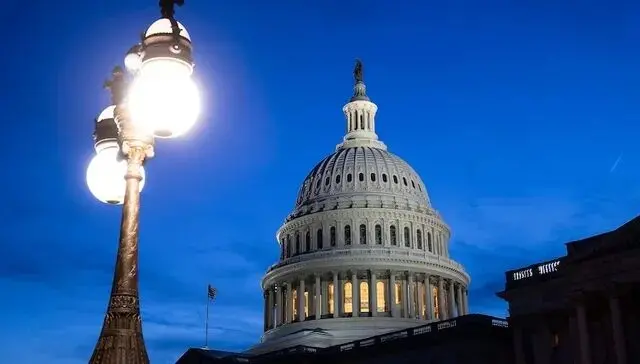
Washington, D.C., November 4, 2026 — The U.S. Capitol. Image source: Visual China Group
Original author: Liu Ting
Original source: Jiemian News
The 2026 U.S. midterm elections were held on November 3 local time. Vote counts show that the Democratic Party has won control of both the Senate and the House of Representatives. This divided government setup—Democrats controlling Congress while Republicans hold the White House—means that U.S. political uncertainty is set to rise further.
Analysts point out that the Democrats' landslide victory will affect U.S. policy in four main areas: major legislation faces gridlock, as Democrats control the congressional agenda but Trump holds veto power, making standoffs likely; congressional oversight and investigations will escalate, and impeachment proceedings against the president cannot be ruled out, though the Senate's conviction threshold is extremely high and a successful removal is highly unlikely; personnel and budget matters face substantive constraints, as the Senate can delay or block Trump's key nominations, and battles over government shutdowns and the debt ceiling may escalate; and foreign military policy becomes a new flashpoint, with Democrats potentially using their power over defense spending approvals to pressure an end to the conflict with Iran.
"Midterm Elections" are elections for members of Congress and local officials held between two presidential elections, and are often seen as a referendum on the sitting president's performance. The Republican defeat largely aligns with pre-election polling: Trump's approval rating fell from about 50% early in his term to about 39% in October 2026, with high prices and high gas prices being the main reasons for losing public support.
Official vote results will not be available until states complete counting, verification and certification, with certification typically occurring from mid-to-late November through December. Close races may be delayed by recounts or legal disputes. The new Congress will be sworn in on January 3 next year, and the election results will not formally take effect until about two months later.
Political Tug-of-War Escalates
Analysts point out that with Democrats controlling both chambers and Trump holding veto power, the remainder of Trump's term will be defined by a tug-of-war unfolding along three main lines.
First, legislation and budgeting: bills will struggle to pass, compromises will depend on deal-making, and pressure for government shutdowns will rise.
The U.S. Constitution requires that tax and appropriations bills originate in the House, giving Democrats control over the funding source for federal government operations. The current timeline is particularly tight: the fiscal 2027 budget has not yet passed, the federal government is running on a stopgap funding measure through December 11, and with the national debt ceiling at $41.1 trillion, only about two months of borrowing headroom remain at current levels. Democrats do not need to push sweeping legislation—they need only attach conditions to funding bills that Trump cannot accept, such as extending Medicare subsidies, restoring cut welfare spending, or restricting the president's unilateral authority to impose tariffs—and the government faces shutdown pressure.
Luo Zhiheng, chief economist at Yuekai Securities, told Jiemian News that while the government shutdown and debt ceiling battles may escalate, substantive fiscal tightening is unlikely. The reason is that the Republicans' new round of tax cuts will likely fail to pass a Democratic-controlled Congress, and the Democrats' proposals for tax increases and expanded welfare may also be vetoed by Trump. Both sides will most likely maintain the current revenue and expenditure framework, making a significant decline in the U.S. deficit ratio unlikely. In addition, after IEEPA tariffs were ruled illegal, the government was forced to refund tariffs to businesses, reducing tariff revenue and further constraining U.S. fiscal space.
Second, oversight and personnel: investigations will escalate while nominations face obstacles.
With Democrats controlling the House, all committee chairmanships will be held by Democrats. Subpoena power will no longer require coordination with the majority leader or bipartisan agreement—committee chairs can unilaterally compel government officials, presidential confidants and family business partners to appear at hearings and submit documents. According to Politico, Garcia and Raskin, who are expected to lead the House Oversight and Judiciary Committees, have already drafted investigation lists covering Trump family business interests, cryptocurrency profits, immigration enforcement controversies and the decision-making process behind military action against Iran. Compared with 2018, this round is better prepared, with greater emphasis on committee coordination and targeting the private sector for evidence.
Luo Zhiheng noted that under the U.S. Constitution, the House can pass articles of impeachment by simple majority, but the Senate requires a two-thirds majority to convict. No president in history has ever been convicted by the Senate, so impeachment is unlikely to succeed—but its significance lies in draining the president's political capital and building momentum for the 2028 election. On personnel, nominations for federal judges, cabinet members and regulatory agency heads require simple majority confirmation in the Senate, and Democrats can delay or even shelve nominations. Unlike 2018 when Republicans still controlled the Senate, Trump's executive effectiveness and institutional control in the second half of this term may be significantly weakened.
Third, foreign affairs and security: overseas wars and tariffs are expected to face more constraints.
Tariffs, immigration and foreign policy remain within presidential executive authority, and Congress cannot directly halt them. However, Democrats can push war powers resolutions, cut foreign military funding, invoke the War Powers Act to require presidential authorization or withdrawal, and attach funding conditions to limit Trump's room for unilateral military action. Specifically, the U.S.-Iran conflict is more likely to be forced toward a ceasefire and negotiations due to rising risk of defections within the party; tariff escalation faces dual constraints from domestic price pressures and Congress's intent to reclaim trade authority, reducing the probability of blanket tariff increases, though existing tariffs will not be abruptly removed but will trend toward being more rules-based and targeted.
Song Xuetao, chief economist at Sinolink Securities, told Jiemian News that looking at American public opinion, the war with Iran did not receive broad support within the Republican Party and was largely driven by Trump himself and a small group of pro-Israel figures around him. The reason there was previously little internal opposition was that Republican candidates did their best to avoid contradicting Trump before the midterms and losing party primaries. Now that the midterms are almost over and Trump will not have a third term, if he insists on pushing for a large-scale restart of the Iran war, he may face the risk of defections within the party, such as from establishment lawmakers.
Everbright Securities noted in a research report that, overall, the Democratic Party's general policy approach after the midterms is: prioritize cost-of-living and healthcare-related agendas, simultaneously launch oversight investigations into the Trump administration, and then use Congress's legislative and appropriations powers to check tariffs and the U.S.-Iran war. However, Democratic efforts to reverse healthcare cuts in the tax cut bill, change tariff authorization or pass legislation restricting the war could all be vetoed by Trump, and overriding a presidential veto requires two-thirds support in both chambers. This means that after the midterms, partisan disputes over these issues will intensify further, and political uncertainty will rise.
Where Do U.S. Stocks, the Dollar and Treasuries Go From Here?
For capital markets, the overall impact of the midterm results is a shift from "expansion pricing" toward "regulation + fiscal constraint pricing."
U.S. stocks will initially trade on "uncertainty removed," but the rebound should not be overestimated. Luo Zhiheng noted that since 1950, U.S. stocks have typically performed strongly in the year after midterm elections. However, as of November 3, 2026, the S&P 500 had already risen 10.6%, which is relatively strong among midterm election years, and future performance will depend more on oil prices, the Fed and AI delivery. Everbright Securities believes that after Democrats retake both chambers, regulatory scrutiny of AI data centers, model safety and antitrust will intensify, potentially pressuring tech giants' capital expenditure and valuations.
Treasury yields are expected to trend lower. U.S. Treasuries are the main beneficiary of the "fiscal constraint" logic: Democratic control of both chambers means new tax cuts and large-scale spending bills will struggle to pass, net Treasury supply expectations will be revised down, and long-end yields will tend to decline. After the election results became clear, the 10-year Treasury yield fell to around 4.9%, and the two-year yield briefly touched a two-month low.
The dollar may weaken modestly in the short term. Cooling expectations for fiscal expansion压低 real interest rates and the appeal of dollar assets, and the dollar index briefly fell to around 101.2 after the election outcome became clear. At the same time, expectations of tighter AI regulation weaken the support that the "U.S. tech premium" provides to the dollar. However, some strategists caution that if U.S.-Iran negotiations collapse and oil prices rebound, inflation and rate hike expectations could reheat, providing support for the dollar.
Analysts caution that new members of Congress will not formally take office until January 3, 2027, and the current Congress will continue to serve until then. This transition period is not a power vacuum—it may actually be the window with the most intense policy activity and the greatest potential for expectations to shift back and forth. Watch for "transition-period expectation gaps."
Everbright Securities gives an example: Trump may push the fiscal 2027 National Defense Authorization Act before the transition, using long-cycle, capital-intensive projects such as the "Golden Dome" missile defense system and the "Golden Fleet" naval expansion to consolidate the defense industry and his electoral coalition. Short-term expansion expectations would increase Treasury supply pressure, potentially interrupting the downward trend in long-end yields.