






Original | Odaily Planet Daily (@OdailyChina)
Author | jk
Key Takeaway: Quantum computing poses a real but not imminent threat to blockchain signature mechanisms. Industry readiness has improved compared with a year ago, but post-quantum protection available on mainnets remains extremely limited, and the overall picture is one of unpreparedness.
Key Points:
a. A Google white paper from March 2026 reduced the number of physical qubits needed to break secp256k1 to fewer than 500,000, with an attack window of about 9 minutes before transaction confirmation and a pre-emption success rate of roughly 41%.
b. The public keys of about 6.9 million BTC (about 32% of total supply) are already exposed, of which about 1.7 million are in early P2PK addresses and about 5 million stem from address reuse.
c. NIST published the FIPS 203/204/205 standards in August 2024, stipulating that algorithms vulnerable to quantum attack be deprecated in 2030 and disallowed in 2035; post-quantum signatures are 10 to 40 times the size of existing 64-byte signatures, and blocks could swell by as much as 38 times.
d. Progress varies markedly across chains: Algorand and NEAR have launched native post-quantum accounts, Ethereum targets around 2029 and XRPL 2028; Bitcoin's two BIPs remain drafts with no activation path.
e. Account abstraction is the key structural difference: networks that let accounts change their own signature schemes can migrate one by one, whereas Bitcoin depends on new address types and years of voluntary transfers.
f. Governance challenges remain unresolved: coordinated network-wide upgrades, the handling of lost assets (including about 1.7 million Satoshi-era BTC), and performance and cost trade-offs all lack consensus solutions.

Before You Read: Five Things to Understand First
This report does not assume the reader has knowledge of cryptography or quantum physics; if you only care about the conclusions, you can skip straight to "Key Findings"; before getting into the main text, we will first explain five key concepts using everyday analogies.
1. How "keys" work in cryptocurrency
Your bitcoin or ether is not stored in some file; it is registered on the blockchain under an address. To spend that money, you must present a "digital signature" proving to the whole network that you are the owner of that address. Generating a signature requires a private key, which only you know; verifying a signature uses a public key, which is public and can be checked by anyone.
Think of it as a signature sample kept at a bank: the bank holds your signature sample (public key), and when someone comes to withdraw money, the bank compares the handwriting against the sample (verifying the signature), but anyone looking at the sample cannot imitate an identical handwritten signature (derive the private key). This mechanism is reliable today because working backward from the public key to the private key is considered mathematically infeasible. The threat of quantum computers lies precisely in the possibility that they could make this "impossible thing" feasible.
2. What quantum computers change
An ordinary computer cracking a cipher is like a person holding a huge ring of keys and trying them one by one; no matter how fast, it would take astronomical time. A quantum computer does not try faster; it changes the way the problem is solved: for a certain class of mathematical problems, Shor's algorithm, proposed in 1994, can compress the time required from "on the order of the age of the universe" to "minutes to hours."
It must be emphasized that quantum computers are not omnipotent. For the vast majority of everyday computing tasks, they offer no advantage. Unfortunately, the class of problems they excel at is exactly the foundation on which the public-key cryptography (including RSA and elliptic curves) relied upon by today's internet and blockchains is built. By contrast, hash functions (think of a one-way meat grinder that churns any input into a fixed-length fingerprint) are only modestly sped up by quantum algorithms, so security mechanisms built on hashing are relatively solid. This also explains why most post-quantum schemes lean toward "hash-based" approaches.
3. Why "no need to panic, but cannot ignore it"
Today's quantum computers are still far from being able to threaten Bitcoin. Breaking a single Bitcoin key requires about 500,000 physical qubits, while the most advanced publicly available chips today have only about a hundred—a gap of several thousand times. So no one can steal your coins with a quantum computer today.
But there are two unsettling factors in the timeline. First, migration itself is extremely time-consuming: converting an entire blockchain to a new signature system requires writing code, auditing, testing, coordinating a network-wide upgrade, and then getting hundreds of millions of users to move their assets—an effort widely believed to take five to ten years. Second, the estimates are falling rapidly: a year ago it took millions of qubits (which can be simply understood as the computing power a quantum computer needs to break a blockchain), and this year it has dropped to fewer than 500,000. It is like needing ten years to build a bridge while the timing of the flood cannot be predicted; the sensible approach is to start now rather than wait for the water to rise.
4. Why some coins are more at risk
Whether the coins in an address are at risk depends on whether the public key has already been made public. Think of it as a sealed envelope: many addresses store not the public key itself but a hash fingerprint of the public key—equivalent to sealing the public key in an envelope, which is only opened when you spend the money. As long as the envelope is unopened, a quantum computer has no way in.
The problem is that some addresses have long since had their envelopes opened. A class of early Bitcoin addresses (including the Satoshi era) wrote the public key directly on-chain, with no envelope; and a large number of users reuse the same address, so the envelope is opened the first time they spend, and the remaining coins stay in the same address with the public key permanently exposed. These are the "exposed" assets repeatedly mentioned in the report, accounting for about one-third of total Bitcoin supply. In addition, even for a sealed envelope, the public key is broadcast during the brief window when you initiate a transfer and the transaction has not yet been confirmed—a fleeting but not impossible attack opportunity.
5. What "post-quantum" is actually solving
The solution is not complicated: switch to a new lock that even a quantum computer cannot pick. Academia has already proposed several candidates, such as hash-based signatures and lattice-based signatures, and the U.S. NIST completed standardization in 2024. The real difficulty lies in the next three things: the new locks are bigger and heavier, with signatures 10 to 40 times the current size, directly slowing transactions and raising costs; changing the lock requires network-wide agreement, and decentralized networks are precisely the hardest to reach consensus in; and for coins whose owners have gone missing and will never come to change the lock, whether to freeze, burn, or leave them as they are—no solution can satisfy everyone.
A few common misconceptions
One misconception is that "once quantum computers appear, all cryptocurrencies will go to zero." In fact, what is threatened is the signature step, and networks can respond by upgrading their signature schemes; progress varies across chains, and risks are not equal.
A second misconception is that "quantum computers will make mining meaningless." Mining relies on hash computation, and quantum algorithms provide only limited speedup and will not overturn proof of work.
A third misconception is that "this is science fiction and irrelevant to me." Today's quantum computers indeed cannot break Bitcoin, but regulators, custodians, and ETF issuers have already put it on their formal risk lists, and migration windows have been written into national policies.
Key Findings
The crypto industry's readiness for quantum attack has clearly improved compared with a year ago, but post-quantum protection that can actually be used on mainnets remains very scarce, and overall the industry is not yet prepared.
Blockchains rely on private-key signatures to prove asset ownership, and the security of signatures rests on the mathematical hard problem of elliptic-curve discrete logarithms. Classical computers cannot solve this problem in feasible time, whereas a sufficiently large, error-corrected quantum computer, using Shor's algorithm, could in theory derive the private key from the public public key and thereby transfer someone else's assets. Post-quantum cryptography refers to signature and encryption schemes considered secure even in the face of quantum computers.
"Elliptic-curve discrete logarithm" sounds abstract, but it can be understood through an everyday analogy. Imagine a grid of a special shape with a public starting point; starting from that point, you "jump" a number of times according to fixed rules and finally land at some position. Your private key is the number of jumps—an extremely large random number; your public key is the position of the final landing point, which is made public. Given the number of jumps, computing the landing point is easy and takes only a few hundred operations; conversely, seeing only the landing point and wanting to know how many jumps were made originally, there is currently no better way than trying every possible number one by one. The curve used by Bitcoin and Ethereum has about 2 to the 256th power possible values—an astronomical number that could not be exhausted even using all the computers in the world within the lifetime of humanity or even the universe. This is precisely why the private key cannot be derived from the public key by others.
Quantum computers pose a threat because they do not have to try one by one. Shor's algorithm exploits the properties of quantum superposition to examine a large number of possible values simultaneously and extract the hidden pattern in the jumping process, compressing a search that would otherwise require an astronomical number of steps into a manageable amount of computation. In other words, a classical computer is fishing for a needle in the ocean drop by drop, while a quantum computer finds the pattern governing where the needle is.
In a real attack, the process roughly has three steps: first, the attacker reads from the blockchain the public key already exposed for some address; second, uses a sufficiently large quantum computer to compute the corresponding private key; third, uses that private key to forge a valid signature and transfer the coins in that address to themselves. The network cannot tell whether the signature is genuine, because mathematically it is identical to one signed by the owner. This is also why the text repeatedly emphasizes "whether the public key has already been made public": if the public key has not been made public, the first step of the attack cannot even begin.
When will the threat arrive?
Over the past year, academic estimates of the quantum resources needed to break cryptocurrency have fallen sharply. A white paper published by Google Quantum AI in March 2026 (co-authored by Dan Boneh of Stanford University and Justin Drake of the Ethereum Foundation) presented two attack circuits against the secp256k1 curve, requiring no more than 1,200 and 1,450 logical qubits respectively. Logical qubits refer to error-corrected qubits capable of reliable computation; converted into actual hardware, on a superconducting route with an error rate of about one in a thousand, the required physical qubits are fewer than 500,000, and a complete run takes about 18 to 23 minutes. Because about half of the computation can be completed in advance, once a public key is disclosed when a transaction is broadcast, an attacker needs only about 9 minutes to derive the private key. CoinDesk noted in its report that this means the attacker has about a 41% chance of redirecting the funds before the original transaction is confirmed. Forbes considers this result to be about a 20-fold reduction from previous estimates of millions of physical qubits.
Qubits can be simply understood as the computing power a quantum computer needs to break a blockchain; correspondingly, Q-day refers to the day when a sufficiently powerful quantum computer appears.
In a preprint from May 2025, Craig Gidney pointed out that the number of noisy qubits needed to break RSA-2048 had fallen to fewer than 1 million, compared with the estimate of 20 million in his 2019 work with Ekerå. Another preprint submitted on the day the white paper was released by Caltech, Oratomic, and UC Berkeley claimed that using a neutral-atom route, 10,000 to 26,000 qubits might suffice, but this conclusion comes from simulation and has not been verified in hardware. In addition, Google did not disclose the attack circuit itself, using only zero-knowledge proofs to demonstrate that the circuit works—the first use of "responsible disclosure" in this field.
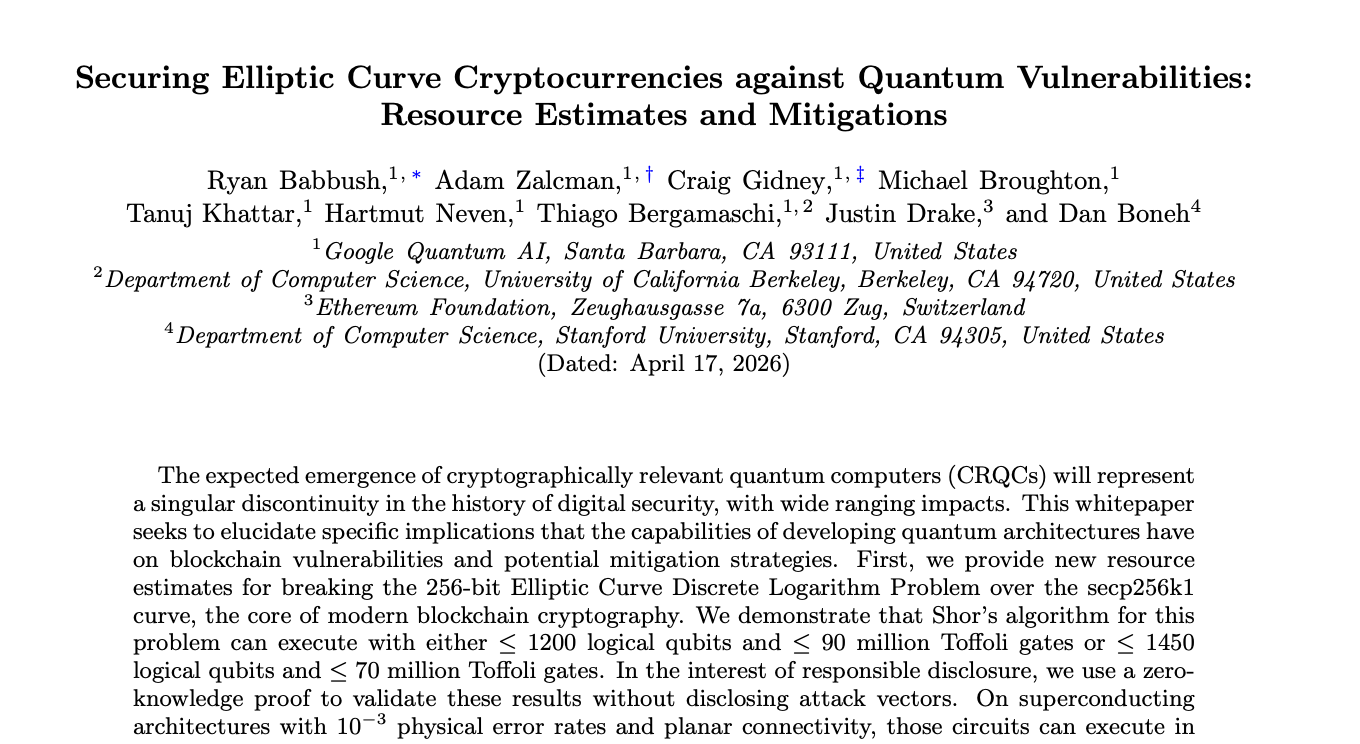
Screenshot of the Google paper, source: arxiv
However, the reason there is no need to panic is that there is still a large gap between the current state of hardware and the above estimates. Google's Willow chip has only 105 qubits, and the largest elliptic-curve key successfully broken in a public demonstration was only 15 bits, whereas Bitcoin uses 256-bit keys. The Q-Day Prize awarded by Project Eleven for this is also disputed; Bitcoin developers argue that the output is not significantly different from random guessing.
As for when a machine with real breaking capability will appear, expert judgments generally cluster around the early to mid-2030s, and there is risk before 2030 as well. The Coinbase advisory board stated that it cannot be confident that such machines will not exist by the NIST migration deadline of 2035. Charles Hoskinson believes the probability of a commercial-grade quantum computer appearing before 2033 is more than half, while Nic Carter estimates a 70% to 80% probability that Bitcoin will be vulnerable by 2035. Google has set its own post-quantum migration timeline for 2029.
The nature of the risk and the scale of exposure
For public ledgers, the main risk is signature forgery—that is, an attacker derives the private key on the premise that the public key is already exposed and steals assets—rather than the industry's commonly cited "harvest now, decrypt later." For addresses whose public keys already appear on-chain, their assets are in a state of "static exposure" from the day a large quantum computer appears; assets that use only a hash value as the address and have never been spent are exposed only during the brief window between transaction broadcast and confirmation. The "harvest now, decrypt later" threat falls mainly on privacy coins, because transactions recorded today may be retrospectively de-anonymized in the future. Hash functions themselves are not the weak link: SHA-256 and Keccak lose only square-root-level security strength against quantum algorithms, and proof-of-work mining and hash-based commitments remain broadly secure, which is also why most post-quantum schemes tend toward hash-based approaches.
The scale of exposed assets is considerable. The Coinbase advisory board estimates that the public keys of about 6.9 million BTC (about 32% of total supply) are already exposed on-chain, of which about 1.7 million are in about 20,000 early P2PK addresses and about 5 million stem from address reuse, including some large exchanges' cold wallets. The authors of BIP-361 give a slightly higher proportion, saying that as of March 1, 2026, it exceeds 34%. By contrast, Ripple says only 0.03% of XRP is held in dormant accounts with exposed public keys. The differences in figures across parties mainly stem from different statistical criteria for P2PK, address reuse, and Taproot outputs.
Progress and divergence across chains
In terms of actual progress, the chains have clearly diverged. QRL has run on native post-quantum signatures since 2018; Algorand launched native Falcon accounts in August 2026; NEAR launched ML-DSA accounts in July 2026; Starknet's Falcon accounts are already running on mainnet but have not been audited; Tezos's related code has entered mainnet with an upgrade but is disabled by default. Ethereum (around 2029), XRPL (2028), Sui (Q1 2027), Stellar, and Hedera (around 2027) have roadmaps with dates; Solana has chosen Falcon but set no timetable; Cosmos SDK has released support but each chain must enable it itself. Bitcoin's two related proposals remain in draft stage and lack an activation path; Cardano is still in the research phase; Monero, Avalanche, and BNB Chain have no formal plans.
Account abstraction is the most important structural difference. Networks where accounts can change their own signature schemes without requiring a network-wide fork (Starknet, Algorand, NEAR, Sui, Aptos, and Ethereum once EIP-8141 lands) allow users to migrate one by one; Bitcoin's account model lacks this flexibility, so migration can only rely on new address types and years of voluntary transfers.
The hard part is governance: how do you ensure everyone acts in unison?
The cryptographic schemes themselves already have standards to follow; what is truly unresolved is governance and engineering.
The first is how to coordinate a soft fork or hard fork so that the entire network upgrades in sync. The second is how to handle assets that never migrate, including about 1.7 million Satoshi-era BTC—whether to freeze, revoke, or leave them as they are—on which only a few chains have taken a clear position. Third, new signatures are 10 to 40 times larger than the existing 64-byte signatures, which will directly hurt transaction throughput and raise costs. Ripple notes that Dilithium signatures are about 40 times the size of existing signatures; the Coinbase advisory board warns that after the switch, block size could swell by as much as 38 times; Hoskinson cautions that switching Cardano too early could slow the network by about 10 times.
Standards and Regulation
Traditional finance and government agencies have already set clear migration timelines, and it is against this backdrop that blockchain networks are being pushed to act. The most critical is the U.S. NIST post-quantum standard, which both defines the signature schemes blockchains can choose and sets the deadline for retiring old algorithms.
The industry gold standard: NIST standards
NIST is the U.S. National Institute of Standards and Technology, part of the U.S. Department of Commerce, responsible for developing technical standards. Its standards in cryptography (such as AES and SHA hashes) are widely adopted globally. In August 2024, it published the first batch of post-quantum cryptography standards, so most blockchain post-quantum schemes follow them.
NIST officially released three post-quantum standards on August 13, 2024, with a fourth still in development. FIPS 203 (ML-KEM) is a key encapsulation mechanism used for encrypted communication, not a signature scheme. FIPS 204 (ML-DSA, formerly Dilithium) is a lattice-based signature with a signature size of about 2.4 to 4.6 KB, and is currently the most common default choice. FIPS 205 (SLH-DSA, formerly SPHINCS+) is a hash-based signature with the most conservative security assumptions, but its signature size reaches about 7.8 to 50 KB. The not-yet-finalized FIPS 206 (FN-DSA, formerly Falcon) is also lattice-based; Falcon-512 signatures are only about 0.7 KB, the most compact of the three, and Hedera's April 2026 analysis expects it to be completed around early 2027. For reference, Bitcoin's Schnorr signatures and Solana's Ed25519 signatures are both only 64 bytes.
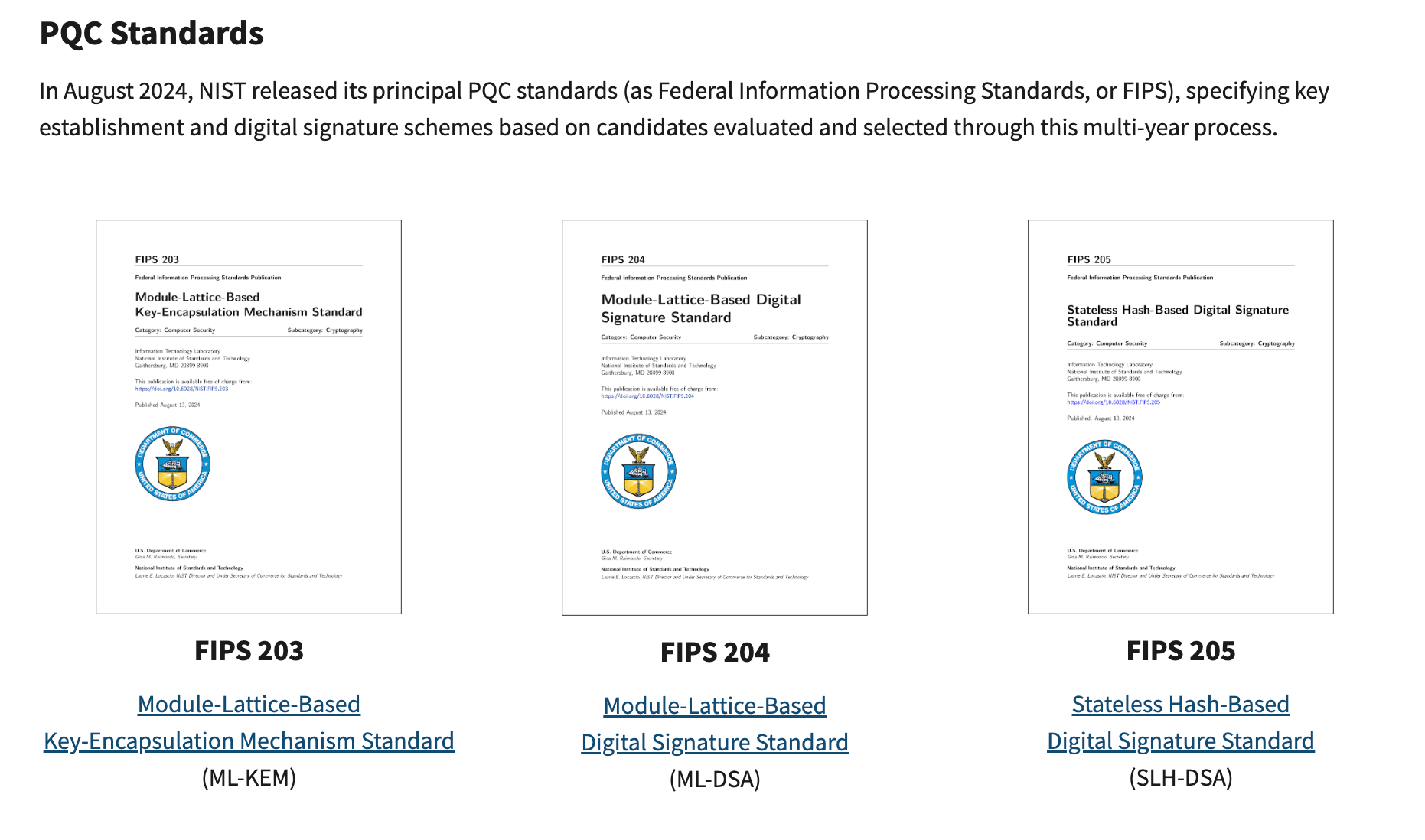
Standards released by NIST, source: NIST official website
NIST's transition guidance stipulates that public-key algorithms vulnerable to quantum attack will be deprecated in 2030 and disallowed in 2035. The "2035" deadline commonly cited in the industry comes from this.
Institutional disclosures
Institutions have begun writing quantum risk into formal documents. BlackRock expanded the quantum risk factors in the iShares Bitcoin Trust (IBIT) prospectus on May 9, 2025, and its Ethereum product has similar wording, warning that quantum computing could render Bitcoin's cryptography ineffective. VanEck's 2026 BNB ETF prospectus likewise includes a similar warning about BNB Smart Chain. Such disclosures are standard risk warnings rather than predictions about the future, but they show that quantum readiness has become part of due diligence for custodians and ETF issuers.
How Various Parties Are Preparing
Coinbase: using an independent advisory board to "set the tone" for the whole industry
Coinbase is one of the most important institutions in bringing the quantum issue into mainstream discussion in 2026. Its approach is to invite external experts to form an independent committee, publish analyses publicly, and call on chains to take a position early.
The Coinbase Independent Advisory Board on Quantum Computing and Blockchain was established in January 2026, and its first paper was published on April 21, 2026, running about 50 pages. Members include Scott Aaronson, Dan Boneh, Justin Drake, Sreeram Kannan, Yehuda Lindell, and Dahlia Malkhi. Boneh and Drake are also co-authors of the aforementioned Google white paper, so the judgments in the two documents echo each other.
The paper's basic judgment is that fault-tolerant quantum computers will eventually be built—the committee expresses high confidence in this—while emphasizing that no such machine currently exists. As for whether one will appear before 2035, the committee believes it cannot be guaranteed that one will not, and therefore argues that preparation should begin now rather than waiting for an urgent signal to appear. On the scale of exposure, the paper estimates that the public keys of about 6.9 million BTC are already exposed; a follow-up report released in June broke down this figure, with about 1.7 million in about 20,000 legacy P2PK addresses and about 5 million stemming from address reuse, mainly belonging to active users, including large exchanges' cold wallets. The paper also warns that switching to post-quantum signatures could swell block size by up to 38 times. Unlike the Google white paper, the committee is relatively less concerned about pre-confirmation front-running attacks, whereas Google's 9-minute attack window makes this type of attack a realistic concern.
The core recommendation for each chain is to decide and announce publicly as early as possible: for assets that never migrate to post-quantum signatures, whether to freeze, revoke, or leave them as they are. The committee itself does not take sides for networks such as Bitcoin, but believes that prolonged indecision is itself a risk.
The significance of this document is that Coinbase, as a public company and one of the largest custodians, both fulfilled its product responsibility and provided the industry with third-party analysis that can be cited, making quantum readiness a question that exchanges, custodians, and ETF issuers must answer. It should be noted that the committee was funded and established by Coinbase; its views carry weight, but readers should not regard it as a completely neutral arbiter.
Project Eleven: the leader in quantum security in the industry
Project Eleven is currently the most active security firm in this field, doing both research and prototyping while also playing the role of bringing the topic into the public eye. Its revenue and influence depend heavily on the judgment that the quantum threat will become real.
In January 2026, the company completed a $20 million Series A funding round. Its Q-Day Prize, with a bounty of 1 BTC, is awarded to the first person to break an elliptic-curve key using a quantum computer. On April 24, 2026, the prize was awarded to Giancarlo Lelli, who broke a 15-bit elliptic-curve key on IBM's cloud quantum hardware. Two points need to be seen clearly about this result: first, real Bitcoin keys are 256 bits long, and a 15-bit demonstration is still far from a real threat; second, Bitcoin developers believe the output is not significantly different from random guessing, and a community note was added under the relevant announcement.
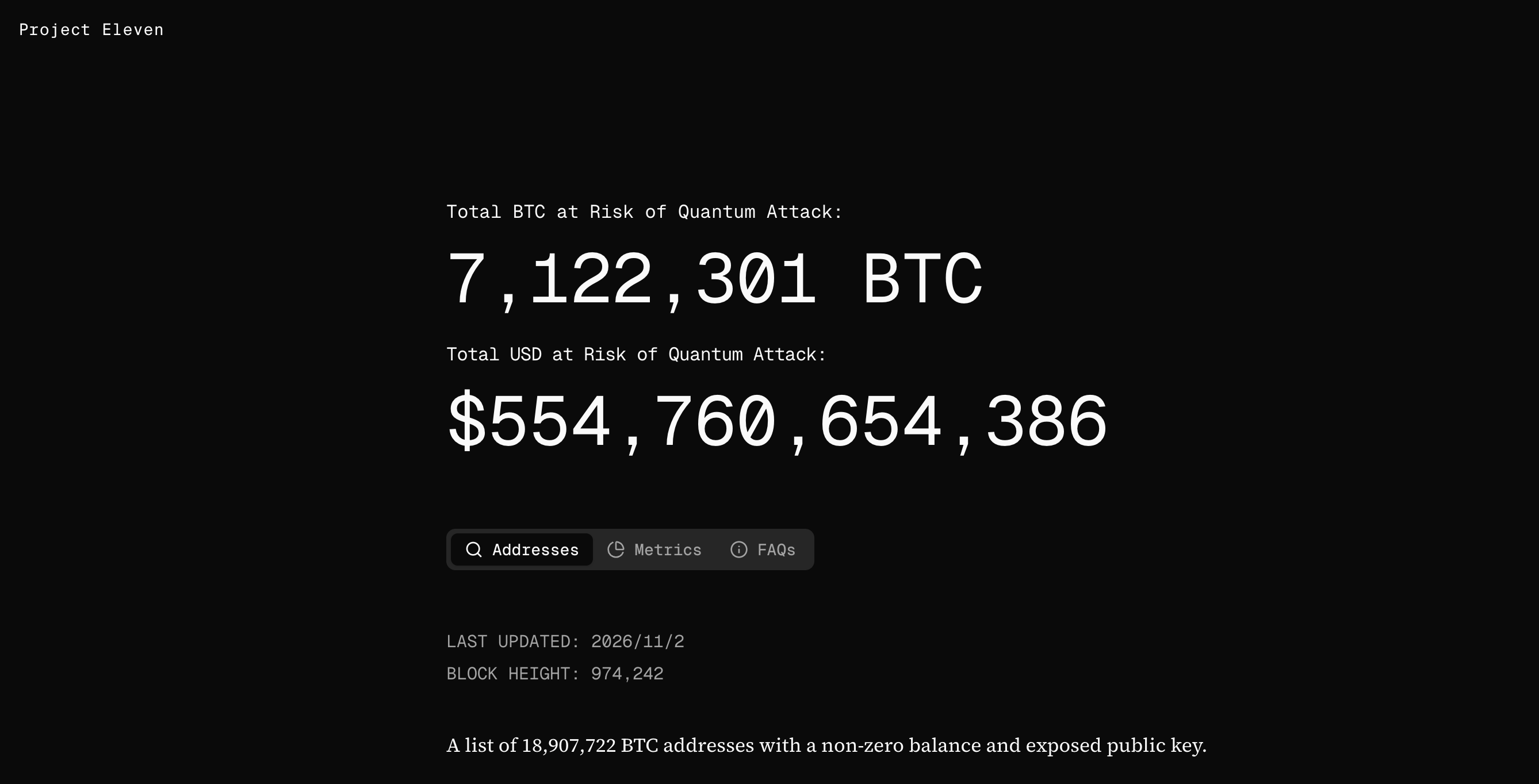
BTC at risk as estimated by Project Eleven, source: Project Eleven
Project Eleven is also working with Ripple and Solana on threat assessments and prototype development; for example, Ripple's Denis Angell worked with it to complete an ML-DSA prototype on XRPL's AlphaNet testnet. At the same time, the company provides an estimate that the public keys of about 7.1 million BTC are already exposed.
Overall, Project Eleven provides publicly discussable milestones and prototype code that foundations can test; at the same time, in terms of commercial interest, the company also tends to emphasize urgency.
Preparedness of Various Public Chains and Their Core Teams
The level of preparedness varies greatly across chains. Ethereum's project is the most completely organized, Bitcoin has the most debate and the least implementation, and Solana has chosen an algorithm but has no timetable. The following first looks at the three largest chains by market cap, then discusses other networks with relevant quantum preparations.
Bitcoin: proposals exist, but no activation path
Bitcoin has no foundation; any change must go through developer proposals (BIPs) and gain consensus from miners and the node community. There are currently two main quantum-related proposals, plus one emergency solution.
BIP-360 (Pay-to-Merkle-Root, or P2MR), written by Hunter Beast (MARA), Ethan Heilman, and Isabel Foxen Duke, was merged into the official proposal repository as a draft on February 11, 2026. It adds a Taproot-like output type but removes the key-path spending route, so that coins do not expose their public keys while dormant; addresses begin with bc1z. The proposal deliberately does not introduce any post-quantum signature scheme, leaving that to a subsequent soft fork; Heilman has already initiated a discussion on algorithm agility on the mailing list. BIP-360 also cannot defend against pre-confirmation front-running attacks.
BIP-361 (post-quantum migration and legacy signature sunset), written by Jameson Lopp and five others and published on April 14, 2026, advocates phasing out old signatures. About 3 years after activation, sending new funds to vulnerable address types would be prohibited; about 5 years later, legacy ECDSA and Schnorr spending would become invalid, and the corresponding assets would be frozen; afterward, a recovery path based on zero-knowledge proofs might be provided. Critics call the proposal authoritarian, and Lopp himself has said he does not hope it ever has to be used, and that it is not currently in a position to be adopted.
In plain terms, BIP-360 only adds a new address type that hides the public key; it cannot protect old addresses whose public keys are already exposed: those coins still rely on the original ECDSA/Schnorr signatures and can still be transferred by forged signatures once quantum computers appear. The only thing that can be done is for holders to move their coins into new P2MR addresses before Q-Day, after which the public keys are no longer exposed. For coins whose owners have gone missing and cannot transfer them (such as Satoshi-era P2PK), BIP-360 cannot help, which is also why BIP-361 proposes freezing.
In addition, Avihu Levy of StarkWare designed Quantum-Safe Bitcoin (QSB), whose first transaction was put on-chain via MARA Slipstream on August 26, 2026. It uses signature grinding to add a hash-based lock to transactions without requiring a soft fork, but each transaction costs hundreds of dollars, must be submitted directly to miners, and cannot do anything about already exposed keys—it can only be regarded as an emergency solution.
Even if BIP-360 were activated tomorrow, every holder would still need to move their assets to new addresses themselves, which would consume years of block space and would do nothing for Satoshi-era assets. In other words, if within the next 5 years Bitcoin still does not have a major proposal that has reached consensus, there will be a risk that all previous Satoshi-era addresses could be attacked. By then, it may take a consensus split at the level of a hard fork to resolve.
Ethereum: the most completely organized among large chains, targeting around 2029
The Ethereum Foundation has made post-quantum security a top priority, with a dedicated team, a dedicated website, and weekly interoperability testing. In January 2026, the Foundation established a post-quantum team led by Thomas Coratger and set up two cryptography prizes of $1 million each; pq.ethereum.org went live on March 25, 2026; and more than ten client teams run a post-quantum interoperability devnet every week.
According to ethereum.org's overview, four parts need upgrading: BLS consensus signatures, KZG data availability commitments, ECDSA account signatures, and the zero-knowledge proof systems that layer-2 networks rely on. At the consensus layer, the Lean Ethereum proposal replaces BLS with hash-based leanXMSS signatures and uses a minimal zkVM called leanVM to aggregate large numbers of signatures into very small proofs, mitigating the problem of oversized signatures. At the account layer, EIP-8141 (Frame Transactions), drafted by Vitalik Buterin and others starting January 29, 2026, gives accounts native account abstraction capabilities, allowing each account to decide how to verify signatures, including switching to post-quantum schemes; the proposal has entered the scheduled status for the Hegotá upgrade. Circle's Mira Belenkiy has also proposed a post-quantum path for ecrecover, in which frame transactions carry post-quantum signatures for contracts to read.
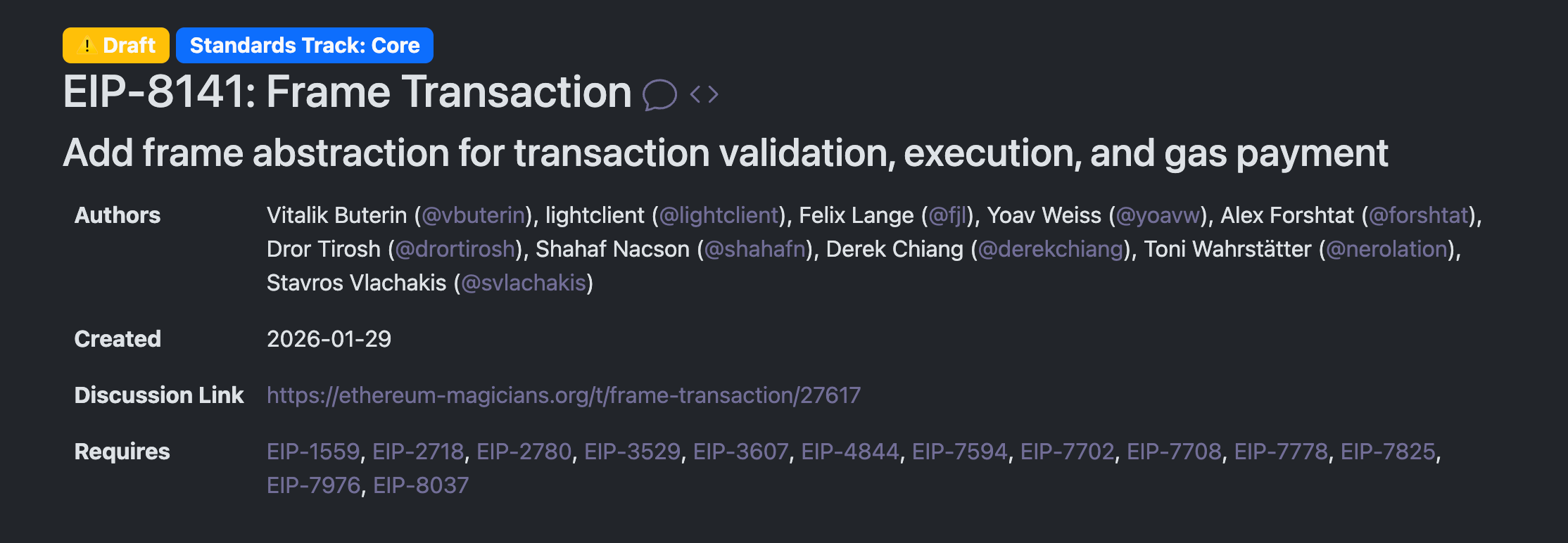
EIP-8141, source: Ethereum official website
On the timeline, the core post-quantum infrastructure target is around 2029, with some reports saying December 2029. Sources differ on the timing of the Hegotá upgrade itself: early materials said the second half of 2026, while ethereum.org's statement in July 2026 had changed to 2027.
Overall, this is the most advanced project among large networks. But until EIP-8141 is live and wallets support post-quantum signers, ETH holders have no protocol-native post-quantum option; old accounts with exposed public keys face the same predicament as Bitcoin. Overall, however, barring a black-swan-style quantum attack risk, the upgraded Ethereum network should not be affected by quantum attacks.
Solana: algorithm chosen, no timetable
Solana's protection currently remains mainly at the application layer. Blueshift's Winternitz Vault is a hash-based one-time signature vault that has been available for voluntary use since around January 2025; it is an application rather than a protocol upgrade.
At the protocol layer, the Solana Foundation released a preparedness plan on April 27, 2026, disclosing that the two client teams Anza and Firedancer had independently chosen Falcon, on the grounds that Falcon-512 has the smallest signatures among NIST schemes, and both teams already have early implementations. The plan has three phases: continue research; if the threat becomes credible, first provide post-quantum signatures for new wallets; then migrate existing wallets. On October 8, 2026, Vice President of Technology Jacob Creech further stated that the so-called bunker mode would not be enabled for now, nor would there be a large-scale migration.
The risk of this position is that Solana addresses are themselves raw Ed25519 public keys, so every funded account is exposed while dormant. The approach of acting only when the threat is credible is in effect a bet that it can get enough warning time.
At the same time, Solana and Project Eleven announced a partnership in December 2025, under which Project Eleven conducted a complete quantum threat assessment of Solana, covering core infrastructure, user wallets, validator security, and long-term cryptographic assumptions, and outlined mitigation paths and migration options. In addition to the assessment report, Project Eleven deployed a working post-quantum signature system on the Solana testnet to demonstrate that end-to-end quantum-resistant transactions are technically feasible. Solana Foundation Vice President of Technology Matt Sorg said the goal is to keep the network secure for decades to come.