






Source: Wall Street Journal
Democrats won a landslide victory in the U.S. midterm elections, oil prices plunged more than 8% in a single day, and the market is betting that a dramatic shift in Washington's political landscape will accelerate an end to the Iran war. However, from Iran's hardline stance to America's intricate political maneuvering, the prospects for a ceasefire are far harder to predict than oil price movements.
On Wednesday, news that Democrats swept both the Senate and the House in the midterm elections sent shockwaves through energy markets. WTI crude fell as low as $87.13 per barrel, a intraday drop of more than 9.3%; Brent crude dropped to $93.22 per barrel, a intraday decline of about 10%, the largest single-day drop since May. As of now, WTI has stabilized around $88 per barrel, and Brent settled near $95. Meanwhile, North Sea crude prices hit new lows, and European natural gas prices also fell sharply.
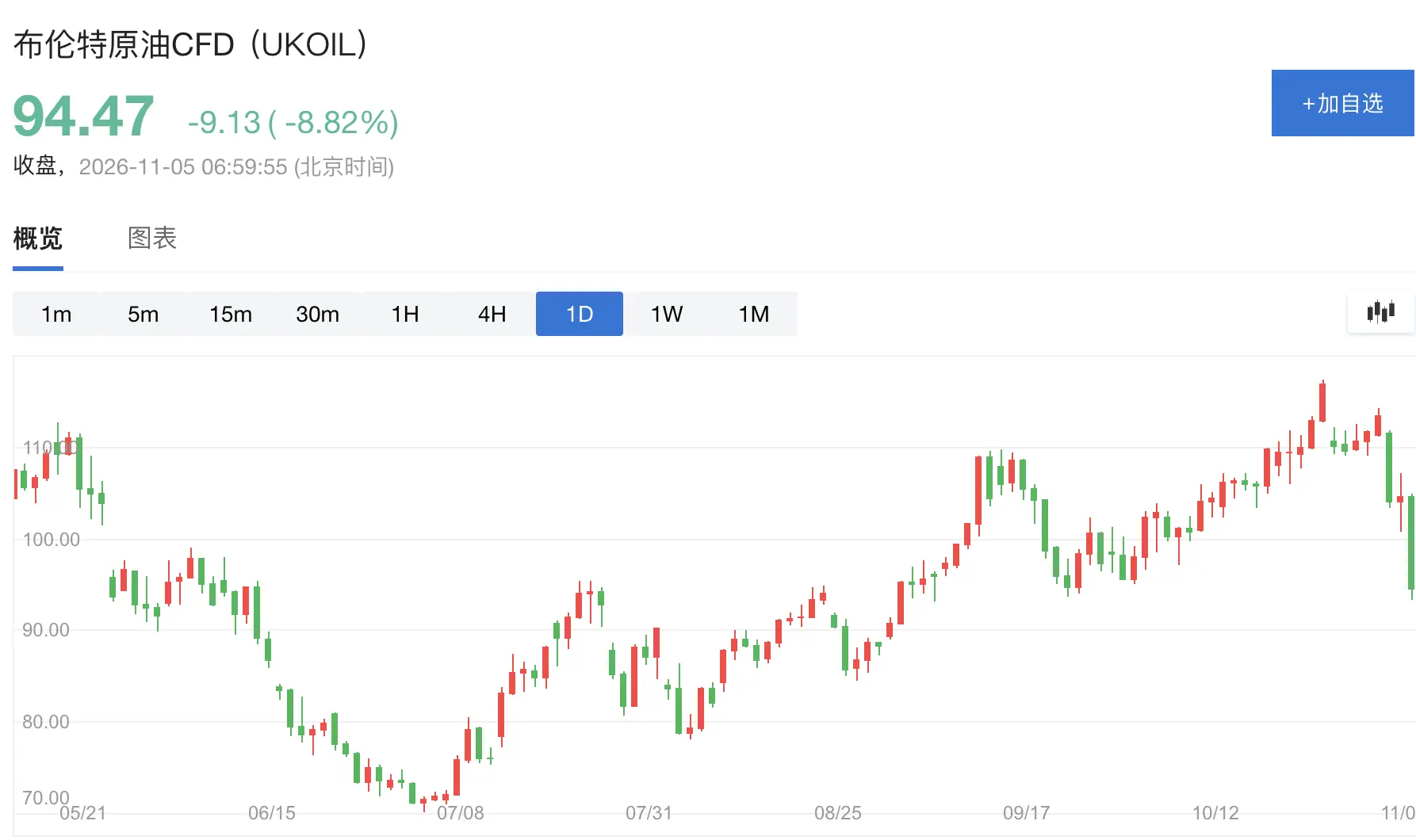
What drove the dramatic market reaction was a barrage of concentrated political signals. U.S. Vice President Vance publicly blamed the Republican rout on the Iran war, saying bluntly that "the reason we lost the election is this war," and noted that Trump himself acknowledged this on Tuesday night. Senate Minority Leader and Democrat Chuck Schumer immediately said he would push to end the war, which has lasted nearly nine months, and claimed that some Republicans have already joined the effort. House Democratic Leader Hakeem Jeffries also said Democrats will push legislation to block Trump's tariff policies and end the Iran war.
However, the market's "ceasefire expectations" carry a risk of being overestimated. Iran has issued a hardline statement, making clear that those who believe the U.S. midterm election results can change American hostility toward Iran are "gravely mistaken." Meanwhile, Trump currently faces three options: launch a new round of strikes, reach a deal as soon as possible, or maintain the status quo—each path is costly.
Political Landscape Upended, Trump's Room for Maneuver Narrows
Democrats won control of both the Senate and the House in this midterm election, capturing multiple traditionally Republican strongholds for the first time in decades, dealing a major political blow to the Trump administration. American public opinion widely holds that Trump's policy maneuvering space over the next two years will be significantly narrowed.
On the fiscal front, Democratic control of Congress means greater constraints on government military spending. Dennis Kissler, senior vice president of trading at BOK Financial Securities Inc., said: "Democratic control of Congress could tighten U.S. military spending and push for an earlier end to the war." He also noted that the recovery of Middle East crude exports and Trump's indication that he has no immediate plans for a new round of strikes on Iran are together the main factors weighing on oil prices.
On the diplomatic and military decision-making front, Trump still retains considerable autonomy. According to analysts, although Congress could theoretically restrict funding for military operations against Iran, the president still holds broad executive authority over military action, especially when operations are already underway. Trump has relied heavily on executive orders throughout his tenure, but such moves face the risk of Supreme Court challenges. Washington's hostile political environment is unlikely to directly force the president to change his stance on Iran.
Iran's Hardline Stance Casts Shadow Over Negotiation Prospects
Just as the market was betting on ceasefire expectations, Iran sent a diametrically opposite signal. According to CCTV News, Iran's Supreme Leader Mojtaba issued a statement on local time the 4th regarding Iran-U.S. relations, making clear that those who believe the U.S. midterm election results can change American hostility toward Iran are "gravely mistaken."
Mojtaba warned that any slight inclination toward yielding to the "hegemonic enemy" will only make it more reckless. He stressed that Iran's actions to control the Strait of Hormuz and destroy U.S. military bases in regional countries are a response to American aggression and a struggle against arrogance. He also said that if American aggression is repeated, Iran's response will be broader and the scale of war will be larger than before.
Earlier this week, Iran's Supreme Leader had given negotiators greater room to negotiate, and Brent crude had at one point fallen more than 14% cumulatively since Monday. But Iran then poured cold water on that, saying the two sides' positions remain far apart.
The core sticking point in negotiations is Iran's nuclear program. Trump has consistently insisted that Tehran must never possess nuclear weapons, but his position on whether to accept Iran developing a civilian nuclear program has been inconsistent. Iran has recently insisted that nuclear negotiations should be left to a later stage, with initial talks prioritizing the reopening of the Strait of Hormuz, the unfreezing of overseas Iranian funds, and the easing of sanctions.
In addition, reports indicate that Iran's guerrilla tactics have escalated. According to regional officials, security firms, and analysts, in recent weeks Iran has deployed bomb-carrying underwater drones, used rocket-propelled grenades, and sent personnel aboard ships to install magnetic mines, continuously disrupting oil transport through the Strait of Hormuz.
Three Paths, Each Fraught With Difficulty
According to analysts, Trump currently faces three options: launch a new round of strikes, reach a deal as soon as possible, or maintain the status quo—but each path is fraught with difficulty.
If he chooses a new round of military strikes, the U.S. has already deployed two carrier strike groups in the Middle East and nearby waters, with a third heading toward the Gulf. According to media reports, this would constitute one of the largest U.S. military deployments in the region in decades. A military buildup of this scale is costly and signals Trump's potential intentions. However, limited military action is unlikely to fundamentally shake the Iranian regime, while larger-scale operations could drag the U.S. into a deeply unpopular war quagmire. Given voters' strong opposition to the war, the possibility of large-scale action is extremely low, but small-scale operations could cause more casualties and further damage energy infrastructure, while barely changing either side's negotiating position.
If he chooses to quickly reach a deal, the risks are equally significant. If the agreement fails to effectively constrain Iran's nuclear program, Trump would face the political embarrassment of "admitting defeat"—something he is particularly unwilling to bear. If the agreement focuses only on reopening the Strait of Hormuz, it might压低 oil prices in the short term, but the core issues would remain unresolved, and Iran's regional influence would actually far exceed pre-war levels, damaging U.S. relations with Gulf allies and sowing the seeds of new conflicts.
If he maintains the status quo, uncertainty in energy markets will persist. Since the war began, energy flows through the Strait of Hormuz once fell to near zero, and in recent months have recovered to about 80% of pre-war levels under U.S. Navy escort, but oil prices remain about 40% higher than pre-war levels, reflecting a persistent risk premium on Middle East oil shipments. Meanwhile, U.S. domestic distillate inventories fell below 100 million barrels last week, the lowest since 2003, and national crude inventories declined for a fifth consecutive week. The structural tightness in fuel markets is unlikely to ease in the short term.
Market's "Ceasefire Expectations" Carry Overestimation Risk
Overall, the market logic reflected in this oil price plunge is built on a series of political assumptions that have yet to materialize. Democratic control of Congress does compress Trump's room for maneuver on military spending and legislation, but does not fundamentally strip him of his diplomatic and military decision-making power.
Iran's hardline stance shows that Tehran has no intention of voluntarily making concessions simply because of Washington's political upheaval. And after suffering a severe political blow, Trump's willingness to accept a deal unfavorable to his image may be lower, not higher. The weakening of Trump's political standing actually gives Tehran "no reason to quickly agree to a deal that works against its interests."
The market's bet on ceasefire expectations is essentially an optimistic judgment that Washington's political logic will override regional geopolitical realities. But based on existing signals, the real exit from this war is still far from arriving.
Risk Disclosure and Disclaimer
Markets carry risk, and investment requires caution. This article does not constitute personal investment advice and does not take into account the specific investment objectives, financial circumstances, or needs of individual users. Users should consider whether any opinions, views, or conclusions in this article are suitable for their particular circumstances. Investment based on this article is at the user's own risk.