






Original author: Li Dan, Wall Street See
After AI trading sentiment cooled and Intel's stock was hammered by weak guidance, AMD's earnings delivered exactly what the market wanted to see: not only did third-quarter revenue and profit comprehensively beat expectations, but fourth-quarter revenue guidance also came in well above Wall Street forecasts, signaling that the AI data center business is still accelerating.
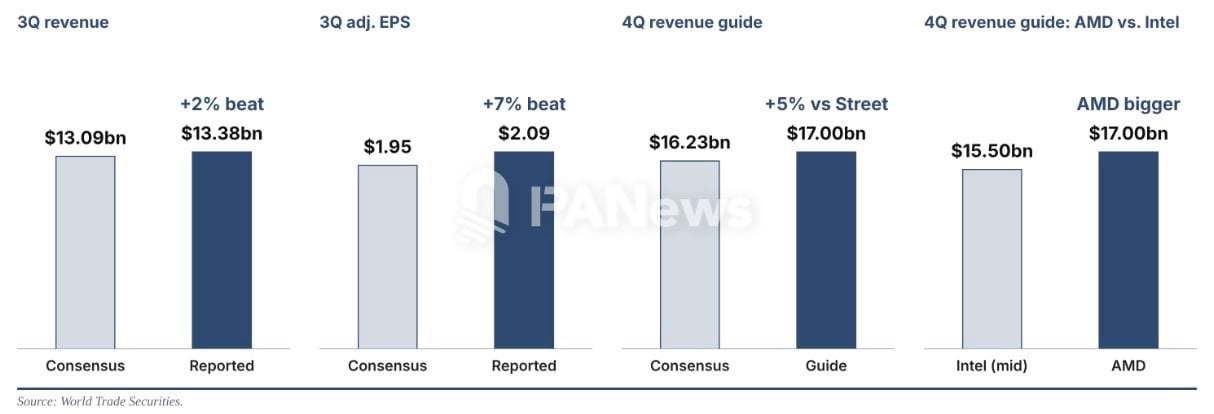
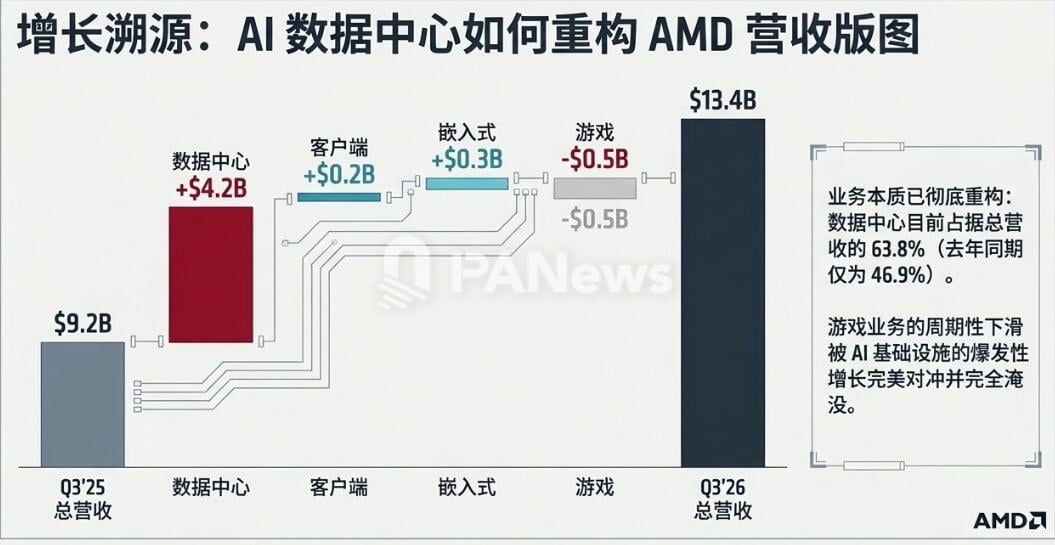
After the U.S. market close on Tuesday, November 3, AMD reported that in the third quarter of 2026, revenue rose 45% year-over-year to $13.377 billion, setting another quarterly record, about 2.3% above analyst expectations, and also exceeding the high end of the company's own guidance range of $13.3 billion. On a non-GAAP basis, earnings per share (EPS) rose 74% year-over-year to $2.09, more than 6% above analyst expectations; operating margin expanded 5 percentage points year-over-year to 29%, stronger than the market's expected 28%.
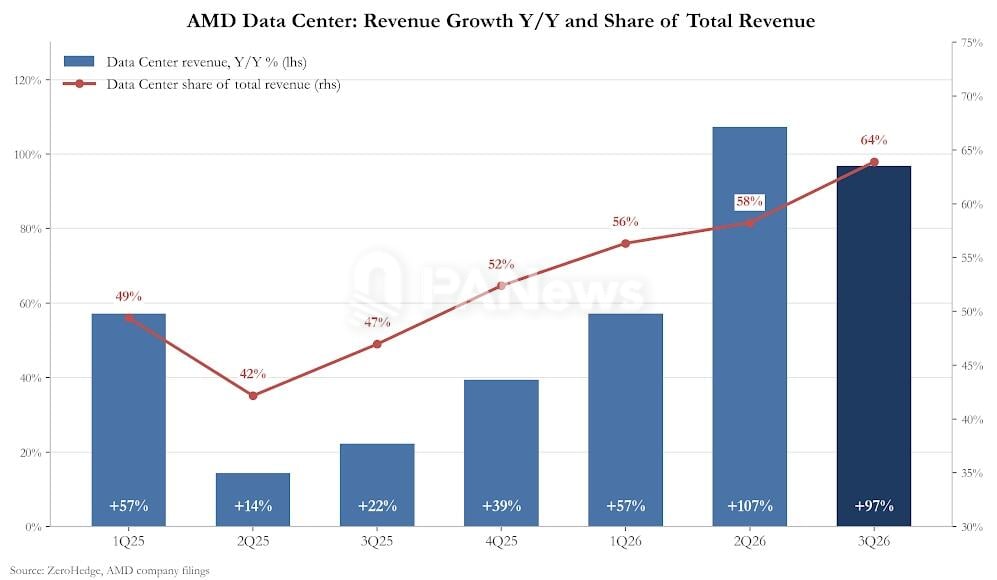
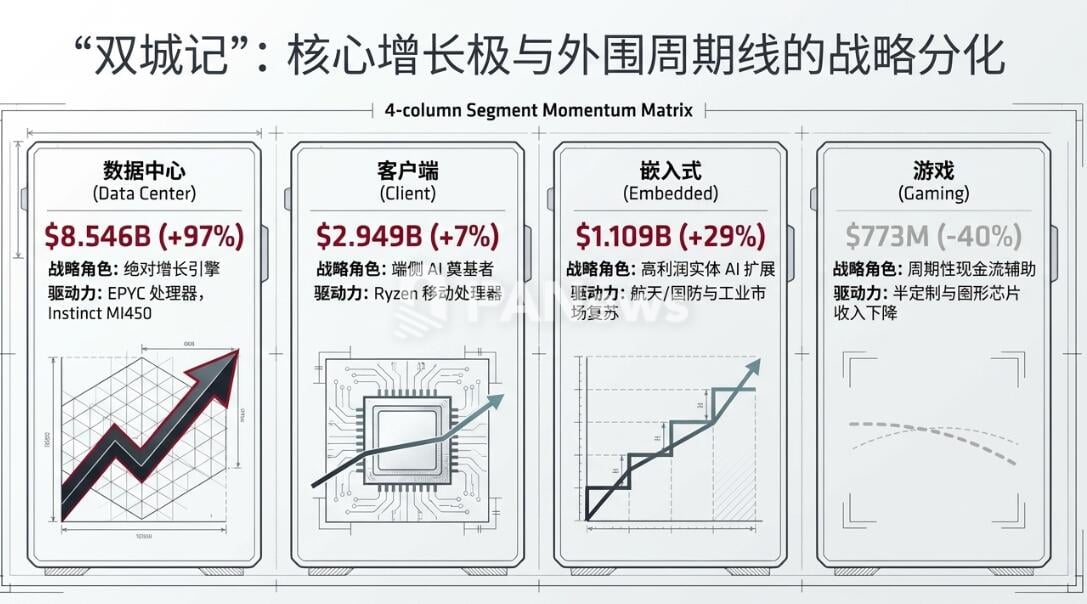
The core highlight of the report remains the data center business driven by AI demand. Third-quarter AMD data center revenue rose 97% year-over-year to $8.546 billion, about 3.3% above market expectations, and its share of total company revenue climbed from 47% a year earlier to 64%. AMD said the business growth was mainly driven by strong demand for EPYC server CPUs and record sales from the launch of the Instinct MI450 series GPUs.
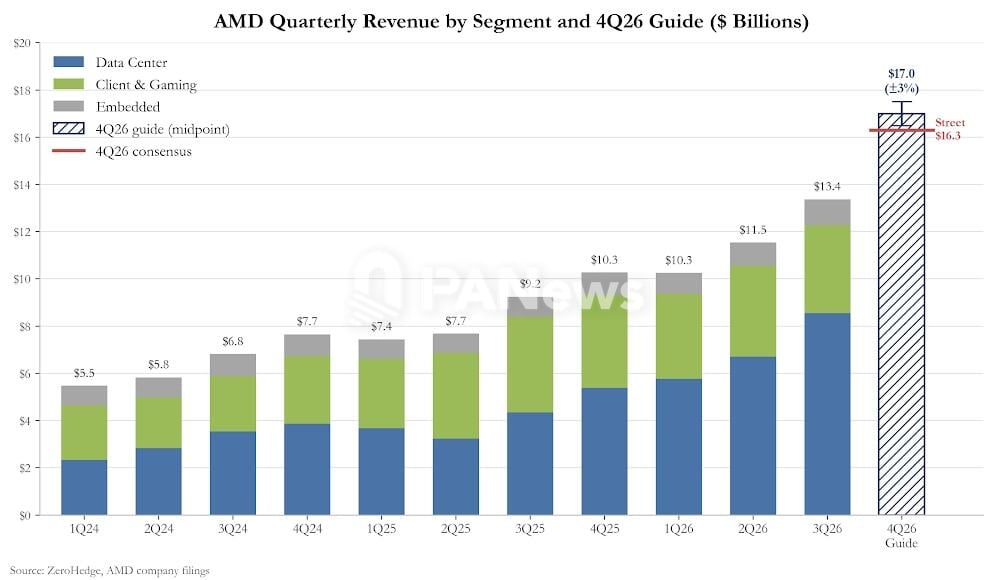
More importantly, AMD's fourth-quarter revenue guidance of approximately $17 billion, plus or minus 3%, implies at the midpoint that quarterly revenue will not only hit another all-time high but also accelerate, growing about 66% year-over-year and about 27% quarter-over-quarter, $700 million above the analyst consensus midpoint, or more than 4% higher.
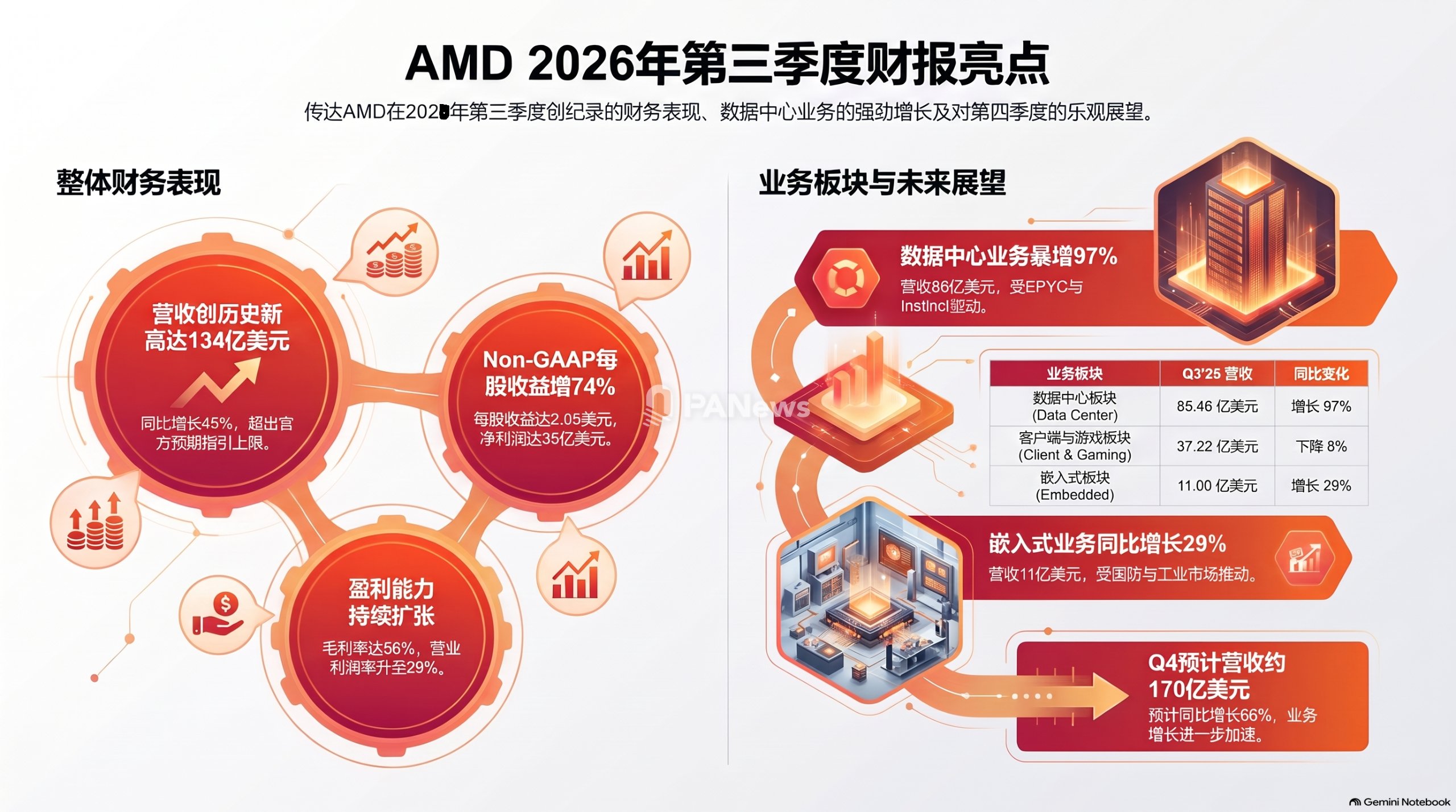
AMD CEO Lisa Su said demand for the company's Instinct and EPYC products continues to strengthen, and with ramping production of the rack-scale AI system Helios and the sixth-generation EPYC server CPU Venice, the company expects fourth-quarter revenue growth to accelerate further.
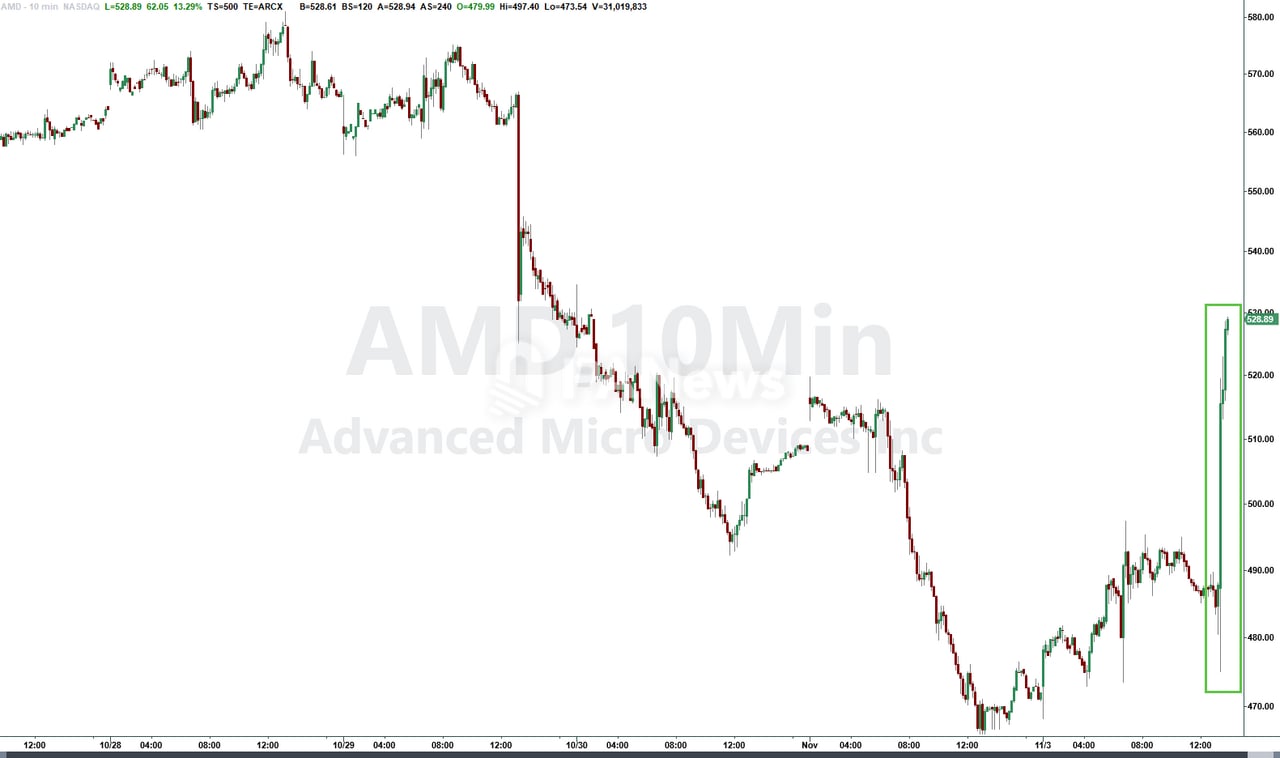
After the earnings release, AMD shares, which had closed up nearly 3.7% in Tuesday's regular session, shot higher in after-hours trading, at one point gaining nearly 10%.
Analysts attributed the after-hours surge to the report simultaneously satisfying several demanding market conditions: first, third-quarter results comprehensively beat expectations, showing that AI demand is translating into actual revenue and profit, with data center revenue nearly doubling and clear customer validation as OpenAI, Meta, Anthropic, Microsoft and other customers appear in the Helios ecosystem; second, given that the stock has already gained over 100% this year and the market feared a selloff if the beat wasn't large enough, guidance significantly above expectations provided strong enough upward revision momentum even against high expectations.
Third, the report further widens the narrative gap between AMD and Intel. AMD's fourth-quarter revenue guidance midpoint is nearly 10% higher than Intel's guidance for the same period. Intel has recently sparked market concerns over PC and cost pressures, while AMD used data center growth to prove it benefits more directly from AI infrastructure expansion. Even with client and gaming businesses under pressure, AI data centers have become the main engine capable of driving overall high-speed growth.
Finally, the impact of free cash flow missing expectations was temporarily overlooked by the market. During the AI capacity ramp-up phase, increases in inventory and capital expenditure are more easily interpreted by investors as stockpiling for fourth-quarter and future growth. As long as revenue guidance is strong enough, short-term cash flow volatility has relatively limited pressure on the stock price.
Third Quarter Comprehensively Beats: Revenue Sets Consecutive Quarterly Records, Profit Leverage Continues to Unfold
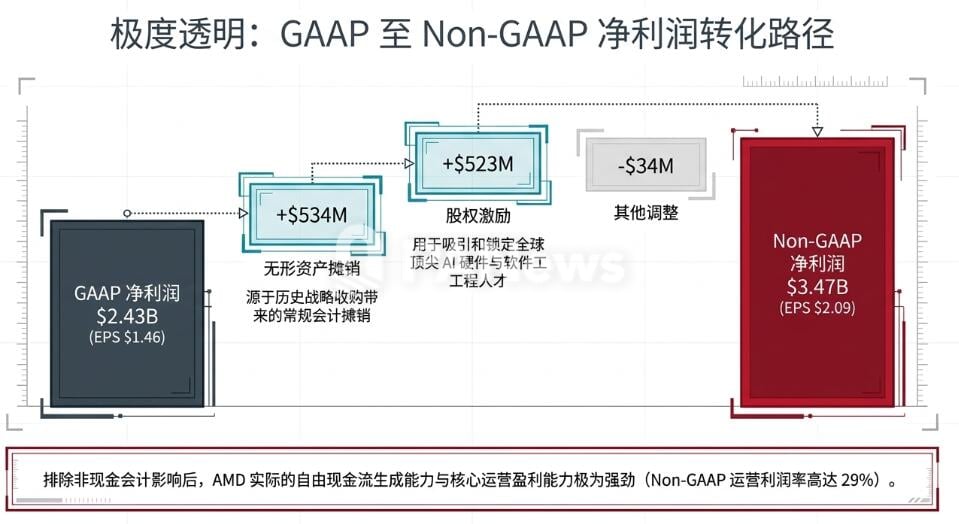
AMD's third-quarter revenue was $13.377 billion, up 45% year-over-year, slightly slower than the 50% growth in the second quarter but surpassing the quarterly record set in Q2 by 15.5%. On a GAAP basis, third-quarter gross margin rose 2 percentage points year-over-year to 56%; operating profit was $2.832 billion, up 123% year-over-year; net income was $2.428 billion, up 95% year-over-year; diluted EPS was $1.46.
On the non-GAAP basis that the market focuses on more, AMD's profitability improvement was even more pronounced:
a. Non-GAAP gross margin of 56%, up 2 percentage points year-over-year, flat quarter-over-quarter, in line with the company's own guidance;
b. Non-GAAP operating profit of $3.923 billion, up 75% year-over-year, above the market's expected approximately $3.67 billion;
c. Non-GAAP operating margin of 29%, up 5 percentage points year-over-year and 2 percentage points quarter-over-quarter;
d. Non-GAAP net income of $3.471 billion, up 77% year-over-year;
e. Non-GAAP diluted EPS of $2.09, up 74% year-over-year.
AMD Chief Financial Officer (CFO) Jean Hu said third-quarter revenue grew 45% year-over-year to a record level and non-GAAP EPS rose 74% year-over-year, demonstrating that AMD's operating leverage is emerging as the data center business scales.
On the expense side, AMD's third-quarter GAAP R&D expense was $2.803 billion, above analysts' expected $2.72 billion, up about 31% year-over-year. But because revenue grew faster, the expense ratio actually declined: non-GAAP operating expenses as a percentage of revenue were 27%, down from 30% a year earlier and 29% in the previous quarter.
Data Center Nearly Doubles: Driven by Both AI GPUs and EPYC CPUs
AMD's most critical business this quarter remains data centers.
Third-quarter data center revenue was $8.546 billion, up 97% year-over-year — slightly slower than the 107% growth in Q2 — and up 27% quarter-over-quarter, above the market's expected $8.27 billion. Along with strong growth, the business accounted for 64% of total revenue, about 1.4 times the year-earlier level. The segment's operating profit was $2.882 billion, about 2.7 times the $1.074 billion a year earlier, with a segment operating margin of about 33.7%.
AMD said data center growth is driven by two main lines:
First, strong demand for AMD EPYC server processors. As cloud providers and enterprise customers continue to expand AI infrastructure, CPUs are regaining importance in training, inference, AI agent orchestration and model-adjacent services.
Second, record sales of AMD Instinct GPUs, especially as the MI450 series GPUs begin contributing incremental revenue after launch. AMD said in its announcement that Anthropic, Meta, Microsoft, OpenAI and Oracle Cloud Infrastructure are already running models and workloads on the first AMD Helios rack-scale solutions, which are powered by MI450 series GPUs and sixth-generation EPYC CPUs.
This means AMD is trying to transform from a single-GPU supplier into a full-stack AI infrastructure provider offering CPUs, GPUs, networking, software and rack-scale systems. For the market, this is particularly important because it determines whether AMD can continue gaining share in the AI accelerator market dominated by Nvidia.
Fourth-Quarter Guidance Is the Biggest Surprise: $17 Billion Revenue Midpoint Massively Beats Market Expectations
If the third quarter was "better than expected," the fourth-quarter guidance is the part of this report that truly ignited the stock.
AMD expects fourth-quarter revenue of approximately $17 billion, plus or minus 3%, implying a range of roughly $16.49 billion to $17.51 billion. The midpoint implies about 66% year-over-year growth and about 27% quarter-over-quarter growth, significantly above the analyst consensus midpoint of approximately $16.3 billion.
Non-GAAP gross margin guidance is approximately 55%, slightly below the third quarter's 56%, possibly reflecting short-term effects from new product ramps, system-level product scaling and product mix changes. But at a $17 billion revenue scale, the market is more focused on revenue acceleration and operating leverage than on a slight decline in gross margin.
A more concrete comparison: AMD's fourth-quarter revenue guidance midpoint of $17 billion versus Intel's company-wide revenue guidance of approximately $15 billion to $16 billion issued last week. A few years ago, AMD was still seen as a challenger grabbing share from Intel's shadow; now, driven by AI data centers, AMD's quarterly revenue is poised to exceed Intel's entire company's quarterly revenue range.
Lisa Su said in the earnings release: "Demand for Instinct and EPYC products continues to strengthen, and as we ramp Helios and 'Venice' production, we expect fourth-quarter growth to accelerate further."
Jean Hu also said the fourth-quarter outlook reflects accelerating revenue and earnings growth, driven by strong demand for the data center product portfolio.
Client and Gaming Still a Drag, But No Longer Define AMD's Narrative
Compared with the high growth in data centers, client and gaming business performance was clearly divergent.
Third-quarter AMD client and gaming revenue was $3.722 billion, down 8% year-over-year and down 3% quarter-over-quarter. Within that:
a. Client revenue was $2.949 billion, up 7% year-over-year but below the market's expected approximately $3.03 billion;
b. Gaming revenue was $773 million, down 40% year-over-year but above the market's expected approximately $634 million.
Client growth was mainly driven by Ryzen mobile processor sales; gaming declined due to lower semi-custom chip and graphics card revenue. The segment's operating profit was $573 million, below the $867 million a year earlier and slightly down from the previous quarter.
This partly explains why the market had concerns about AMD before the earnings release. Intel had previously warned that the PC market was being hit by factors such as rising memory costs, and its stock suffered a sharp selloff, leading investors to worry that AMD might also be dragged down by the PC cycle. But AMD's latest report shows that although client and gaming are not strong, AI data center growth is already sufficient to dominate the overall performance direction.
In other words, AMD's core valuation logic has shifted from "gaining share in PC and server CPUs" to "AI infrastructure scaling."
Embedded Business Returns to Growth, Driven by Industrial, Automotive and Aerospace & Defense
Third-quarter embedded business revenue was $1.109 billion, up 29% year-over-year and up 14% quarter-over-quarter, above the market's expected approximately $1.07 billion.
AMD said the business growth was mainly driven by aerospace and defense, automotive, communications and industrial end markets. Third-quarter embedded segment operating profit was $453 million, above the $283 million a year earlier, with a segment margin exceeding 40%.
On the product front, AMD began sampling the Versal AI Core XQRVC1902 space-grade adaptive SoC this quarter, a chip designed for space missions of up to 15 years. In addition, Kodiak AI announced that its next-generation autonomous truck platform uses AMD EPYC processors, and AMD also launched the agentic tool AMD Ross for embedded system design.
Although the embedded business is smaller than data centers, its high margins and diversified application scenarios help AMD reduce dependence on any single end market.
Free Cash Flow Plunges Over 60%, Inventory and Receivables Tie Up Significant Cash
This earnings report is not without flaws. The most obvious shortcoming is free cash flow coming in significantly below expectations.
AMD's third-quarter operating cash flow was $1.202 billion, below the $1.788 billion a year earlier; capital expenditure was $648 million, up 151% year-over-year and roughly in line with the market's expected $647 million; free cash flow was only $554 million, below the market's expected approximately $1.05 billion, down 64% year-over-year, with the free cash flow margin falling from 14% in Q2 to 4%, compared with 17% a year earlier and 25% in Q1.
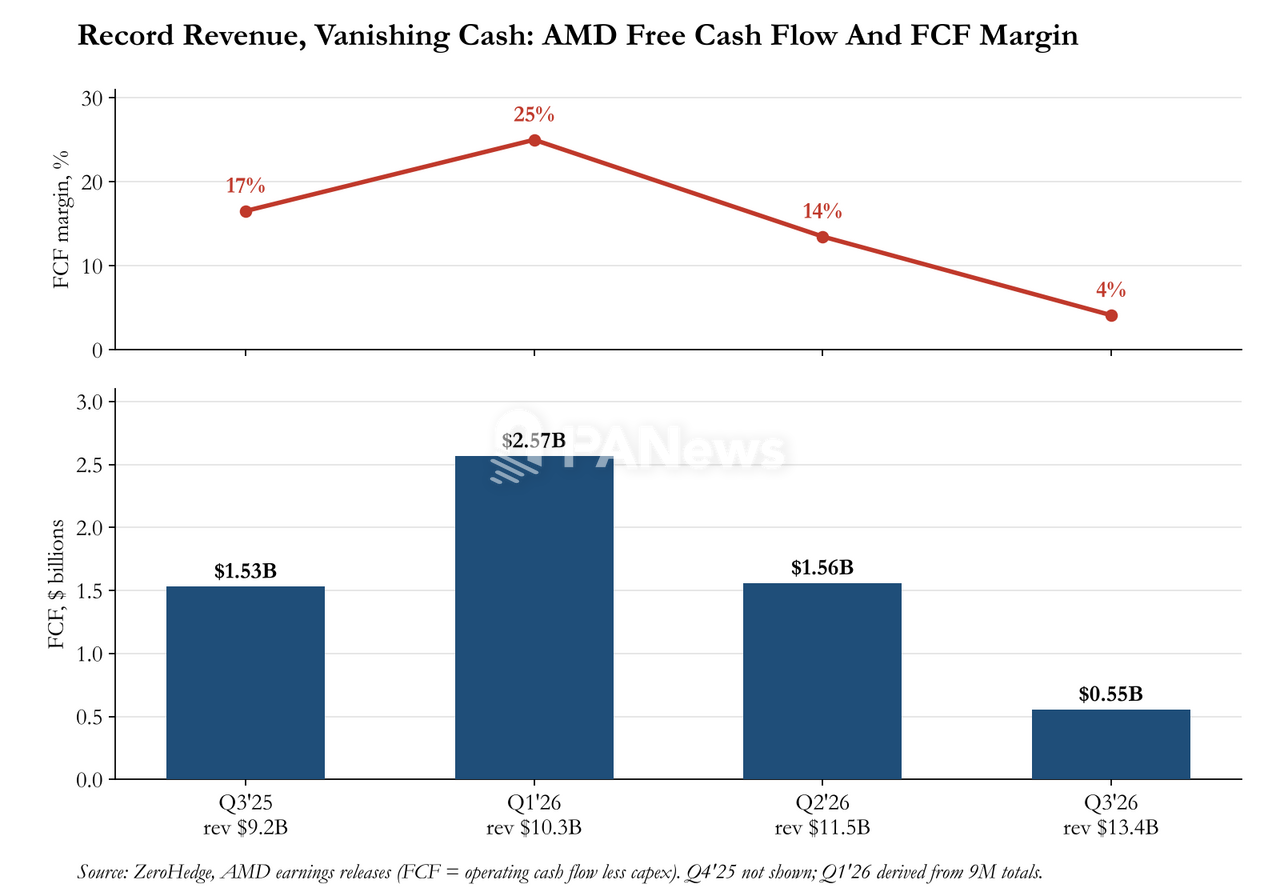
Cash flow pressure mainly came from working capital tied up:
a. Accounts receivable of $1.928 billion, up nearly 78% year-over-year;
b. Inventory of $2.995 billion, about 4.7 times the year-earlier level;
c. Prepaid expenses and other assets of $1.070 billion;
d. Meanwhile, accounts payable of $2.313 billion partially offset cash flow pressure.
As of the end of the third quarter, AMD's inventory reached $11.463 billion, a sharp increase from $7.920 billion at the end of last year. The market may interpret this as stockpiling ahead of AI product and system-level deliveries, especially as the company needs to lock in capacity, memory, substrates and supply chain resources ahead of Helios, MI450 and "Venice" ramps. But if future revenue conversion falls short of expectations, high inventory could also become a risk point for investors.
On the capital structure side, AMD ended the period with $15.776 billion in cash, cash equivalents and short-term investments, and total debt of $7.079 billion, leaving net cash still relatively ample.