






Author: CICC Insights
Overseas Macro: After the Sweep — Three Implications of the U.S. Midterm Results
The U.S. midterm elections have concluded, with Democrats retaking both the Senate and the House and achieving historic breakthroughs in multiple traditionally red states. The breadth and force of the "sweep" exceeded market expectations. Stubbornly high living costs, unfulfilled campaign promises, and a candidate-selection process that prioritized "loyalty" over electability were the main reasons for the Republican defeat — and this has sent a clear signal to the Trump administration. Looking ahead, Democratic control of Congress will strengthen checks and balances, and the risk of escalation in the U.S.-Iran conflict may decline; fiscal expansion space will be constrained, and the debt-ceiling standoff could cause periodic market disruptions; state-level regulatory uncertainty over data centers will rise, but a blanket restriction on AI development is unlikely. Overall, we maintain our prior view that the election outcome may reduce policy uncertainty and constitute a risk-clearing catalyst for markets (see "Potential Implications of the U.S. Midterm Elections").
1. Democrats Win Across the Board, Flipping Multiple Traditionally Red States
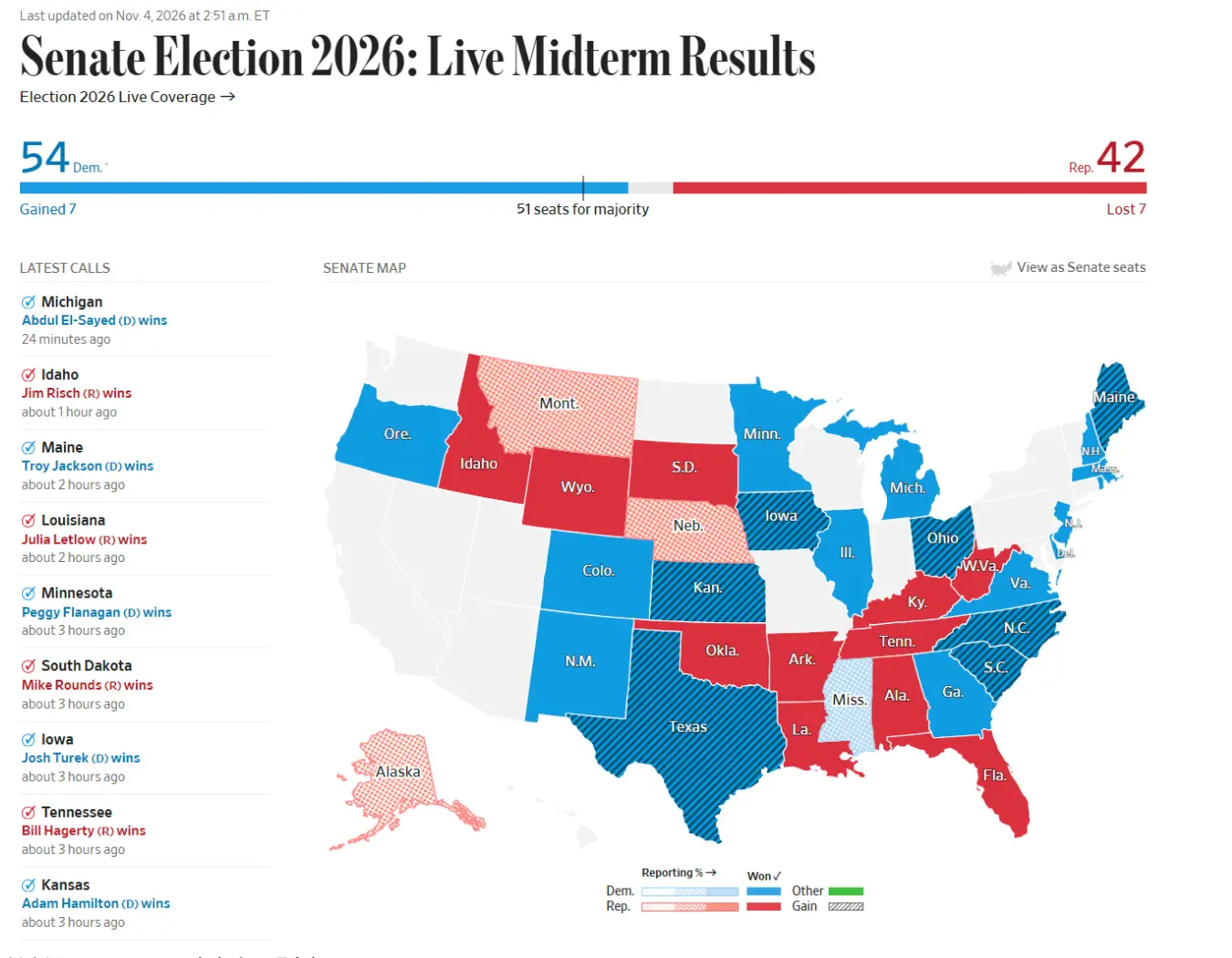
In this congressional midterm election, Democrats have retaken control of both the Senate and the House, achieving a "sweep." In the Senate, Republicans held 53 seats before the election, while the Democratic caucus held 47 (including 2 independents) [1]. According to the latest results, Democrats have flipped at least 7 seats (North Carolina, South Carolina, Texas, Ohio, Kansas, Iowa, and Maine [2]), reaching 54 seats and securing a majority.
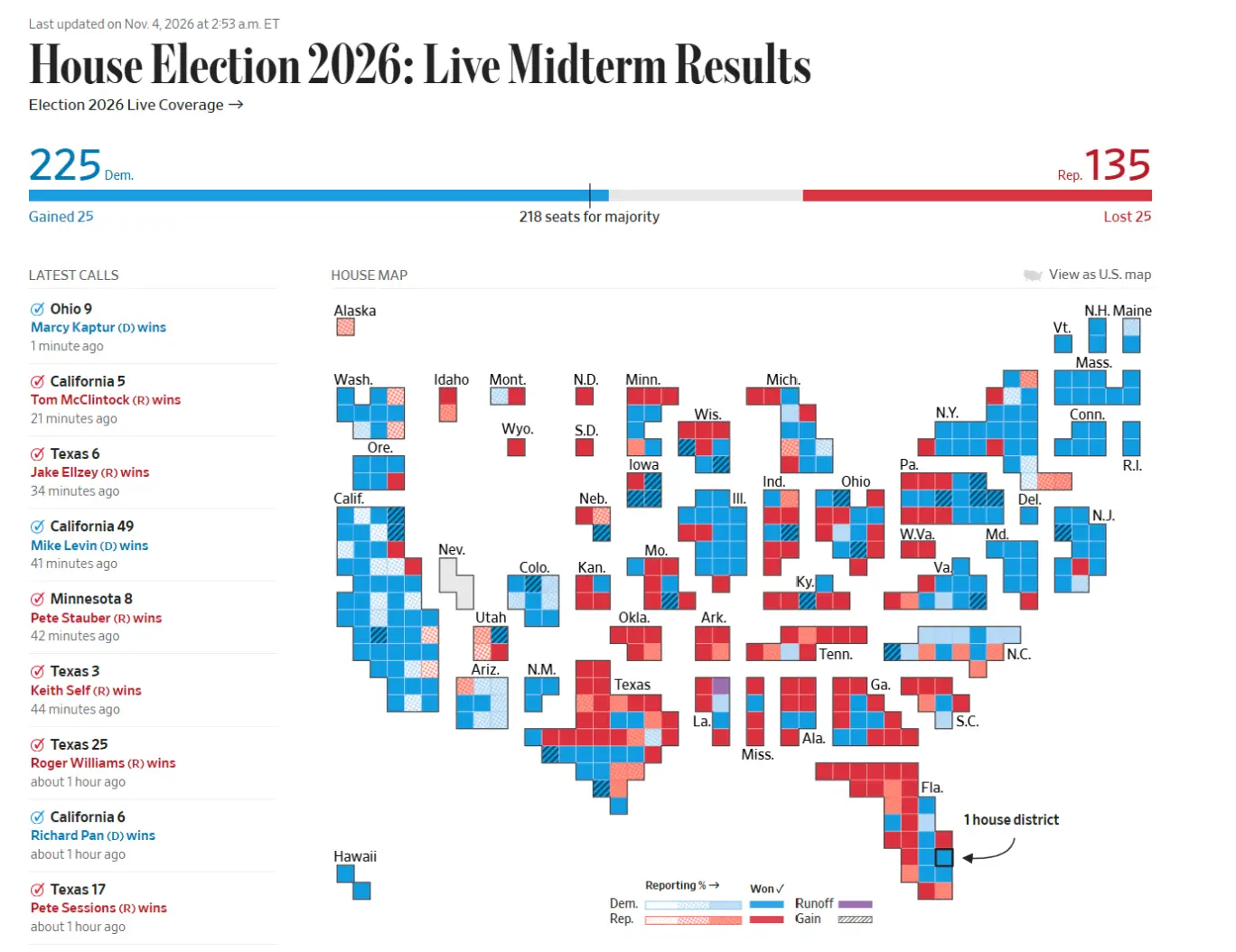
In the House, Republicans held 219 seats (including 1 independent) and Democrats 214 before the election, with 2 vacancies [3]. The latest results show that Democrats have flipped more than 24 seats from Republicans, spanning New Jersey, Pennsylvania, North Carolina, Iowa, and other states, with victories extending from traditionally competitive districts into Republican-leaning areas [4]. Media outlets including the Associated Press have projected that Democrats will retake House control [5], though the final seat distribution and margin of majority remain to be confirmed.
Moreover, the scope of Democratic victories exceeded expectations, with the party capturing multiple traditionally red states. In the 2024 presidential election, Trump held large leads in South Carolina, Texas, Ohio, and Kansas [6]; now all of these states' Republican Senate seats have flipped blue, and Iowa has also shifted from Republican to Democratic. South Carolina elected a Democratic senator for the first time since 1998 [7], Texas elected a Democrat to statewide office for the first time since 1994 [8], and Kansas elected a Democratic U.S. senator for the first time since 1932 [9].
Gubernatorial races also saw widespread flips. A total of 36 states held gubernatorial elections this cycle, with Republicans and Democrats each controlling 18 of the seats up for election beforehand [10]. The Associated Press has confirmed Democratic flips of Republican-held governorships in Georgia, Ohio, Texas, and Iowa, while Democrats held key states including Pennsylvania and Wisconsin. In Texas, Democratic candidate Gina Hinojosa defeated Republican Governor Greg Abbott, who was seeking a fourth term, becoming the state's first Democratic governor elected since 1990 [11]. In Georgia, Democratic candidate Keisha Lance Bottoms became the first Black woman elected governor in U.S. history [12].
These results indicate a comprehensive Democratic victory. While the market had anticipated a Democratic "sweep," the breadth of victories and the magnitude of the advantage still exceeded expectations.
2. High Living Costs and Candidate Controversies Weigh on Republicans
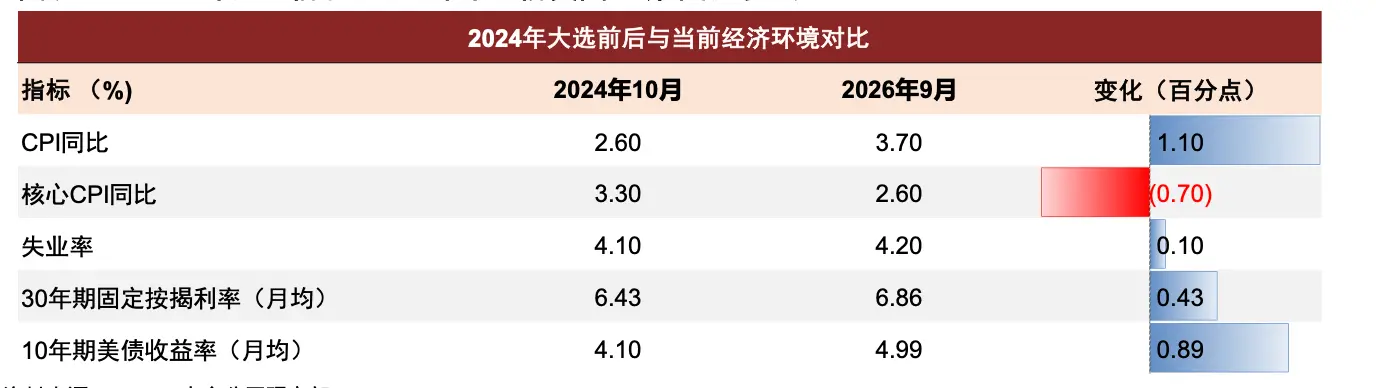
We believe the Republican defeat stems primarily from two factors: first, persistently high living costs and unfulfilled campaign promises. During the 2024 presidential campaign, Trump promised to lower inflation, energy, and housing costs, but household burdens have not improved noticeably over the past two years. Before the October 2024 election, U.S. CPI inflation stood at 2.6% year-over-year; it has since risen to 3.7%. Over the same period, the 30-year mortgage rate rose from around 6.4% to 7.3% [13]. Trump attacked the Biden administration over high inflation and interest rates, and some voters hoped a change in party would improve living costs. With promises unfulfilled, some voters have swung back to Democrats in search of a policy shift.
Second, candidate selection placed excessive emphasis on "loyalty" [14]. The traditionally deep-red state of Texas is most representative: Trump vigorously backed Attorney General Ken Paxton — mired in corruption allegations and personal controversies [15] — to replace long-serving Republican Senator John Cornyn [16]. But in the midterm results, Democratic candidate James Talarico campaigned on living costs and government corruption and ultimately won, flipping the traditionally red state blue [17]. Similar situations occurred in South Carolina and North Carolina. This shows that even with "highly aligned" backing, Trump's personal endorsement did not fully translate into local support for candidates. Some candidates carried significant personal controversies and weak local roots, further amplifying Republican electoral pressure.
3. Three Implications for the U.S. Economy and Policy
We believe the Democratic recapture of Congress will affect three areas: the U.S.-Iran conflict, fiscal space, and AI regulation.
First, voters expressed dissatisfaction at the ballot box, congressional checks will strengthen, and the risk of U.S.-Iran conflict escalation may decline. In this election, the U.S.-Iran conflict's upward pressure on oil prices was one of the key factors weighing on Republican midterm prospects. The election results sent a clear signal to the Trump administration: further conflict escalation would only make Republican prospects in the 2028 election more difficult, and Trump and his team cannot afford to ignore this.
From a political logic perspective, a Democratic win of both chambers means Trump faces stronger domestic institutional constraints. On the fiscal side, the Pentagon's previously requested $80 billion in emergency funding remains stalled in Congress, and Democrats can constrain further military action by restricting the scope of fund usage and requiring periodic reports to Congress. On the oversight side, Democrats may use hearings, subpoenas, and document requests to investigate the Trump family's business interests, government procurement contracts, cryptocurrency ventures, and corporate-government relationships, leaving Trump with little bandwidth for external affairs [18]. Of course, Trump could choose to escalate military action during the 60-day congressional transition period, but voters are already deeply dissatisfied with high oil prices, raising questions about how meaningful such a move would be.
Second, fiscal expansion space will be constrained, and the debt-ceiling standoff could cause periodic market disruptions. With Democratic control of Congress, the party will be better positioned to block Republicans from advancing a new round of large-scale fiscal plans through budget reconciliation, and Trump's previously proposed defense funding plan will also face headwinds. This means new fiscal stimulus space will narrow over the next two years, and the deficit path may gradually converge toward the existing policy baseline. For Treasuries, greater constraints on conflict escalation and fiscal expansion would help ease long-term inflation and rate-rising pressure, enhancing the allocation value of U.S. Treasuries.
However, the partisan standoff over the debt ceiling may intensify, potentially bringing periodic market volatility again in 2027. As of October 20, 2026, federal debt subject to the statutory limit stood at approximately $40.24 trillion. According to projections from the Congressional Budget Office (CBO) and other institutions, the federal government may hit the statutory debt ceiling around mid-2027. After reaching the ceiling, the Treasury can still rely on cash balances and extraordinary measures to sustain operations for a period, avoiding an immediate payment crisis, but it could still disrupt economic activity. In October–November 2025, the U.S. experienced the longest federal government shutdown in history, temporarily resolved by a Continuing Resolution; during the shutdown, economic data releases were delayed and market liquidity tightened marginally. Similar situations could recur around Q2 next year.
Third, uncertainty over AI regulation will rise, but a blanket restriction on AI development is unlikely. As we noted earlier, as data center construction drives up electricity prices in some areas, Democrats may strengthen oversight of data center approvals, with regulatory risks concentrated more at the state and local levels. In this election, Democratic governors flipped Texas, Georgia, and Ohio, and the Democratic governor of Pennsylvania won re-election — all states that are important markets for U.S. data center construction.
Georgia Governor-elect Keisha Lance Bottoms proposed during her campaign that new data center development and construction should be paused until the economic and community impacts of data center projects are reassessed [19]. Texas's Gina Hinojosa opposed high-energy-consumption data centers, emphasized energy costs and resident interests, and advocated removing certain data center tax incentives [20]. Ohio's Amy Acton supported a conditional moratorium on new data centers, requiring developers to bear the full utility costs [21]. This suggests that state-level oversight of data center construction may strengthen, affecting the pace of U.S. AI computing investment.
But we believe the actual policy implementation remains to be seen, and excessive pessimism is unwarranted. First, the data center controversy is not a core Democratic priority; governors' statements are more about requiring tech companies to bear the social costs of data center construction rather than abandoning AI investment. Combined with the fact that data center construction can drive local employment and tax revenue, this leaves considerable room for compromise, and the actual implementation of state policies remains to be observed.
Second, a slower pace of data center construction does not mean demand disappears — it is more a matter of "delayed fulfillment," which could lead to differentiation within the AI supply chain rather than broad-based negative impacts. Since supply cannot increase quickly, the scarcity and pricing power of existing data centers will strengthen further, allowing owners of operational data centers to raise rents and boost revenue. Large cloud providers that secured power and land resources early can also continue serving customers amid capacity constraints, reinforcing their competitive advantages.
Third, markets tend to price in worst-case scenarios initially, which conversely leaves room for subsequent recovery. If the actual policy actions of new governors prove milder than what the market had priced, sentiment and valuations could both see marginal improvement.
In summary, we maintain our prior view: the election outcome may reduce policy uncertainty and constitutes a risk-clearing catalyst. In the pre-election period, markets repeatedly traded around issues including the U.S.-Iran conflict, the Russia-Ukraine conflict, and AI regulation, with all parties seeking to maximize the value of their leverage before the election, creating significant uncertainty. Once election results are settled, these dynamics will converge, and policy direction will become clearer: military action constrained by Congress, fiscal policy turning neutral, and AI regulation broadly restrained. Therefore, the midterm elections are more likely a risk-clearing catalyst that could have an overall positive effect on markets (see "Potential Implications of the U.S. Midterm Elections").
Chart: Senate Election Map
Source: WSJ, AP, CICC Research
Chart: House Election Map
Source: WSJ, AP, CICC Research
Chart: Comparison of U.S. Economic Indicators Before the 2024 Election and Before the 2026 Midterms
Source: Wind, CICC Research
Commodities: What Do the U.S. Midterm Elections Mean?
On November 4, the U.S. midterm election results were announced. As of the report's publication, Democrats have gained a significant advantage and are highly likely to sweep both chambers and take congressional control [22]. We believe the impact of the midterm results on commodity markets operates through three transmission channels: foreign policy, fiscal policy, and trade policy. On foreign policy, constraints on unilateral military escalation will cool the Middle East geopolitical risk premium. On fiscal policy, large-scale new stimulus bills will be constrained, weighing on U.S. domestic demand expectations. On trade policy, resistance to the president's ad hoc tariff increases will rise, and unilateral trade friction risks will recede. We judge that after the midterms, the three risk premiums previously traded in commodity markets — fiscal stimulus, trade friction, and geopolitical conflict — may decline, and the commodity market narrative may return to fundamentals.
Oil: Diplomatic Constraints Lower Middle East Conflict Escalation Risk, Geopolitical Premium Declines
Price volatility has increased markedly over the past two weeks. Last week, market concerns that the U.S.-Iran conflict could see a new round of escalation after the midterms dominated sentiment, pushing oil prices to $120/barrel. This week, as midterm results approached, geopolitical developments remained choppy. On November 2, the U.S. and Iran indicated they had restarted indirect negotiations [23], with Iran saying it would "try to resolve issues through dialogue" and the U.S. saying it "prefers a diplomatic solution," causing oil prices to plunge 7% in a single day. On November 3, the U.S. launched airstrikes on Iran's Qeshm Island [24], signaling a resumption of limited military operations, leaving the geopolitical trajectory unclear. Currently, the U.S. midterm results may reduce the risk of Middle East conflict escalation in 2027.
Global oil inventories have continued to decline since the U.S.-Iran conflict began, with OECD oil stocks having drawn down 260 million barrels cumulatively, a 6% depletion. By end-September, inventory levels were about 7% below the five-year seasonal average. With SPR releases nearing their end, destocking pressure has shifted further toward commercial inventories since September, which will provide greater elasticity for crude oil risk premiums. On fundamentals, although Middle East oil exports have recovered somewhat under high-risk trade modes such as ship-to-ship transfers, upstream production remains constrained by regional conditions and transportation risks. The physical shortage may persist at least through Q1 2027, and we caution that Brent crude may struggle to fall below the $90/barrel high over the next 3–6 months. Looking further ahead, the U.S. midterm results may increase the likelihood of Middle East geopolitical de-escalation in 2027. If Middle East supply returns, it could drive the oil market back into oversupply, and we judge that in this scenario Brent could return to the $80–90/barrel range in the second half of next year.
Gold: The Core Driver Remains the Direction of Interest Rates
The core pressure behind gold's decline since Q2 this year has come from the Fed's monetary policy shift from rate cuts to rate hikes. Since the resumption of rate hikes in September, speculative net-long positions in COMEX gold futures have been liquidated by 17% cumulatively. We believe this has already priced in 2–3 rate hikes, i.e., expectations of the fed funds upper bound rising to 4.5% (4.0% after one hike), representing fairly full pricing of the hiking space. The recent further adjustment in gold prices may stem partly from liquidity pressure amid sharp U.S. equity volatility (e.g., SPDR Gold ETF saw a single-day reduction of 12 tonnes on October 22) and partly from expectations that oil prices could surge again amid geopolitical back-and-forth. Looking to next year, the medium-term impact of the midterm results on the gold market may depend on how they affect Middle East geopolitics, U.S. fiscal intensity, and AI regulatory risk, which in turn transmit through energy inflation and growth expectations to the direction of U.S. monetary policy. If geopolitical risks from unilateral conflicts and trade frictions decline marginally next year, high-rate pressure may ease, leaving room for price recovery in gold at current levels. Under our baseline scenario of the Fed pausing rate hikes next year (fed funds upper bound at 4.25%), we expect a reasonable 2027 annual average COMEX gold price center around $4,300/oz.
Base Metals: Short-Term Uncertainty Over Copper Tariffs Rises, Long-Term Impact Likely Limited
The impact on copper is mainly concentrated in rising short-term tariff uncertainty. In the near term, after the U.S. midterms conclude, the market expects that the U.S. Section 232 tariff investigation — which has significantly affected copper prices since 2025 — may change. However, tariff authority still rests with the president, and we expect existing tariffs on copper semi-finished products will most likely not be directly revoked. But as congressional checks strengthen, we judge that further inclusion of refined copper in tariff scope will become more difficult, and the tariff-related risk premium may decline. Longer term, given that U.S. domestic copper demand is rising and both parties hold broadly consistent views on copper as a strategic metal, if tariffs remain unresolved, we expect the market may still price constructively, and the likelihood of high COMEX copper inventories weighing on prices is low. In addition, Democratic long-term support for power grids, new energy, and other emerging industries could also create incremental demand for copper.
Agricultural Products: Bioenergy and U.S.-China Agricultural Trade Policy May See Changes
The impact on agricultural markets is mainly in trade and industrial policy. First, the RVO 2026/2027 final rule [25] was already settled by the EPA in March–April 2026, and 45Z was extended to 2029 via the OBBB [26]. These are existing policies unaffected by the midterms, but there may be changes to E15 and ILUC policies, creating medium- to long-term disturbances for corn and soybean oil consumption. Second, the flip list includes traditional agricultural states like Iowa and Kansas, which constitutes a political constraint on Trump's trade policy. Currently, we expect the probability of U.S.-China agricultural trade easing in 2027 has increased. For U.S. soybeans, this is the most direct marginal positive from the election, but in the medium to long term, what changes is trade flows and basis, not the global balance sheet. Overall, this election is likely only a marginal disturbance, and the 2027 pricing narrative remains weather, costs, and global supply-demand.
FX: Democratic Control of Both Chambers — Some Medium-Term USD Support May Gradually Weaken
Democrats achieved a clear victory in this midterm election, winning control of both chambers of Congress, and the Trump administration will face significantly stronger congressional checks over the next two years. We believe this election overall increases the likelihood that medium-term USD support weakens. Fiscal expansion and tariff policy face more constraints, potentially reducing additional upward pressure on U.S. demand and inflation; military action abroad faces more checks, potentially lowering the energy risk premium. At the same time, AI investment support for U.S. growth and asset returns will continue, but its marginal boost to the dollar may gradually diminish. Specifically, the election's impact is mainly reflected in four areas: fiscal and trade policy, AI investment, U.S. asset risk pricing, and geopolitical energy.
Fiscal and Trade Policy: New Fiscal Stimulus Space Constrained, Resistance to Further Tariff Expansion Rises. Trump's major prior tax cuts have already been enacted through the "One Big Beautiful Bill Act," and the space for new large-scale tax cuts and fiscal spending over the next two years is inherently limited. With Democratic control of both chambers, Republican efforts to push further partisan tax cuts and spending expansion will face greater resistance. Congressional oversight and review of tariff policy may also strengthen, raising the political cost of further tariff expansion. If new fiscal stimulus and tariff measures fall short of prior expectations, additional upward pressure on U.S. demand and import prices may weaken, and market pricing of U.S. growth, inflation, and further rate hikes may moderate, potentially reducing short-end rate support for the dollar.
AI Investment and Cross-Border Capital: AI Investment Still Supports U.S. Growth, but Regulatory Uncertainty May Weaken Marginal USD Support. With Democratic control of Congress, regulatory scrutiny of large tech companies may intensify. Meanwhile, data center approvals, power supply, and infrastructure support depend more on state and local governments, and policy orientations and pace may diverge across states, increasing uncertainty for companies regarding project approvals, construction costs, and investment returns. Rising uncertainty may affect market risk appetite and tech company valuations, prompting overseas investors to reassess the risk-reward of U.S. tech assets. If overseas capital slows new allocations to U.S. tech assets as a result, cross-border capital inflows supporting the dollar may also weaken. However, CICC Overseas Macro believes the likelihood of a federal-level blanket AI moratorium is low, and local regulation is not yet sufficient to change the industry's overall investment trend [27]. Direct AI capex from the top five cloud providers is expected to continue growing, and demand for equipment, power, and construction from earlier investments is expected to continue diffusing into manufacturing, supporting U.S. growth and corporate earnings. But as the investment base rises, direct capex growth may slow from prior levels, and new investment's boost to U.S. relative growth advantage may gradually diminish. Overall, AI investment will still provide growth and capital inflow support for the dollar, but rising regulatory uncertainty and slowing investment growth may cause its marginal contribution to gradually decline.
Treasury Supply and Fiscal Risk: New Supply Pressure May Ease, Debt Ceiling Still a Disturbance. With Democratic control of Congress, it will be harder for the Trump administration to push further tax cuts and fiscal spending expansion, and the risk of new fiscal deficits and Treasury supply expanding beyond expectations may ease, reducing upward pressure on Treasury term premiums. This helps alleviate market concerns about further accumulation of U.S. fiscal risk, but the impact on the dollar may be relatively indirect and still depends on changes in relative Treasury yields and overseas capital allocation. At the same time, the burden of existing U.S. debt and interest expenses remains heavy. CICC Overseas Macro expects the U.S. may hit the debt ceiling again around mid-2027 [28]. At that point, partisan brinkmanship over the debt ceiling, government funding, and fiscal arrangements may intensify, increasing risks of government shutdown and market liquidity disruptions. If negotiation deadlocks further raise market concerns about U.S. fiscal governance capacity and debt repayment arrangements, overseas investors may demand higher risk compensation or increase FX hedging ratios on dollar assets, putting pressure on the dollar.
Geopolitics and Energy: Congressional Constraints on Military Action Strengthen, Oil Risk Premium May Gradually Decline. With Democratic control of Congress, the Trump administration will face more constraints in requesting additional military funding and expanding military action against Iran, and congressional investigations and war powers oversight may increase the political cost of further conflict escalation. If the risk of U.S.-Iran conflict escalation declines, the geopolitical risk premium in oil prices may fall, easing U.S. inflation pressure and reducing the need for the Fed to maintain high rates. At the same time, trade conditions for energy-importing economies such as Europe and Japan may improve, and the dollar's prior energy relative advantage and safe-haven support may also weaken. However, the new Congress will not formally take office until January 3, 2027, and short-term military action and oil prices still carry reversal risks.
Overall, after Democrats won both chambers of Congress, the dollar has broadly weakened against major currencies, as markets begin to focus on the impact of narrowing fiscal expansion space and rising AI regulatory uncertainty on U.S. growth prospects. The decline in Treasury yields has further added downward pressure on the dollar. In the near term, election results may still trigger further adjustments in market expectations for U.S. policy and growth, but the dollar's subsequent trajectory will also be influenced by economic data and Fed policy expectations. Medium term, constrained fiscal and trade policy expansion, weakening marginal boost from AI investment to growth, and declining energy risk premiums may all erode some of the dollar's prior support. However, U.S. growth and asset return advantages will still provide some offset. We believe this election increases the likelihood that medium-term USD support gradually weakens, with subsequent impact depending more on how policy changes actually affect U.S. relative growth and rate advantages.