






Author: Zhou, ChainCatcher
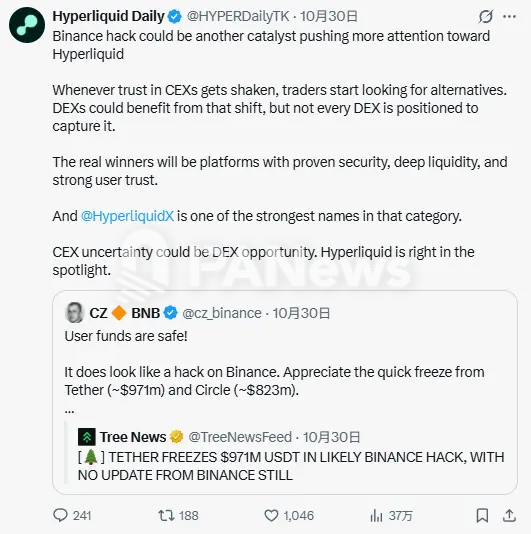
After the Binance hack, the debate over CEX versus DEX competition has heated up. Among those weighing in, Hyperliquid community account Hyperliquid Daily posted that whenever CEX trust is damaged, traders look for alternatives, DEX stands to benefit, and Hyperliquid is in the spotlight.
The tweet quickly sparked controversy. Some users criticized it as "kicking someone when they're down," arguing that using an industry-wide loss as a marketing opportunity shows poor judgment. Others pointed out that the account is not Hyperliquid's official account and its remarks do not represent the project's position. Setting the controversy aside, the question itself is worth examining.
1. How much of the capital leaving Binance did DEX actually capture?
On November 1, Binance began restoring withdrawals in phases, and outflows followed. According to Binance's official disclosure, in roughly the first nine and a half hours after withdrawals resumed, the platform saw net outflows of about $3.64 billion, or about 2.1% of total platform assets.
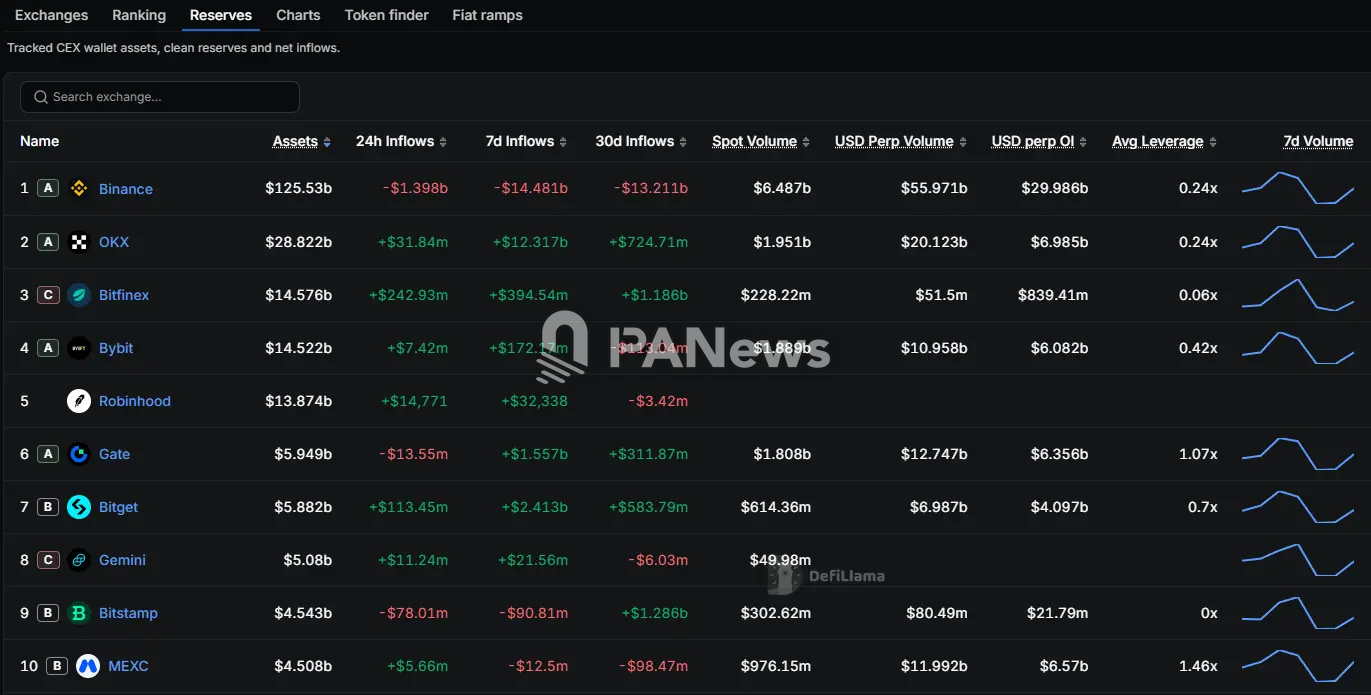
DefiLlama data shows that on November 2, Binance's 24-hour net outflow peaked at about $6.3 billion, then gradually slowed.
Capital leaving Binance typically goes several places: other centralized exchanges, ETFs, DEXs, and users' own self-custody wallets.
First, other CEXs. DefiLlama data shows that during the same period, combined net inflows to major exchanges such as OKX, Bybit, and Bitget amounted to only about one-tenth of Binance's net outflow.
To compete for this capital, Binance and Bitget rolled out high-yield offerings, with USDC annualized yields reaching as high as 10% or more.
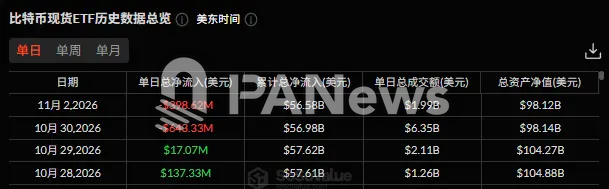
As for ETFs, in the two trading days after the hack, U.S. spot Bitcoin ETFs saw net outflows of about $640 million and $400 million, respectively.
Next, DEXs, which was the core claim of the Hyperliquid Daily tweet. Geoffrey Kendrick, global head of digital asset research at Standard Chartered, also said the incident could accelerate the shift of trading to DEXs, with Uniswap benefiting over the long term.
Looking at the data, Uniswap's trading volume over the past seven days was about 20% higher than its 30-day weekly average, but overall DEX volume across the market also rose by about 20% during the same period, meaning Uniswap did not see any extra capital inflow.
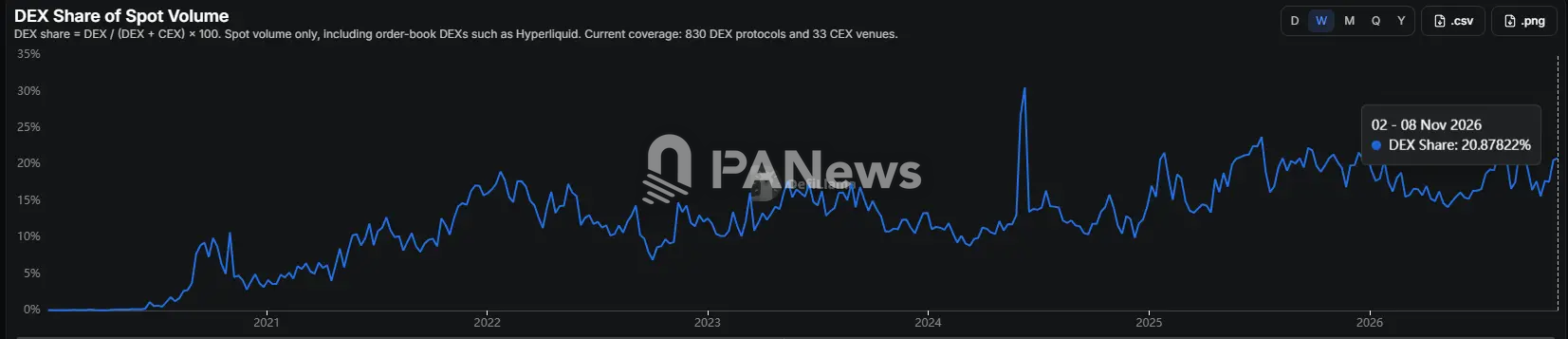
Hyperliquid's situation was similar. According to DefiLlama data, net inflows to Hyperliquid on November 2 were about $125 million, less than one-tenth of Binance's net outflow during the same period. Zooming out to the entire DEX market, DEX spot trading accounted for about 20.6% of volume during the week of the hack, up somewhat but still below this summer's peak.
Since other CEXs, ETFs, and DEXs each captured only a small portion, where did most of the capital go?
Multiple Binance users I spoke with said that after withdrawals resumed, they converted some assets into BTC and moved them to their own hardware wallets.
On-chain data shows that most of the capital leaving Binance indeed flowed to addresses not labeled as exchanges, a significant portion of which are likely users' self-custody wallets. However, DefiLlama data shows that Binance's USDT balance fell far more than its BTC balance after the hack, suggesting more funds were withdrawn directly in stablecoin form.
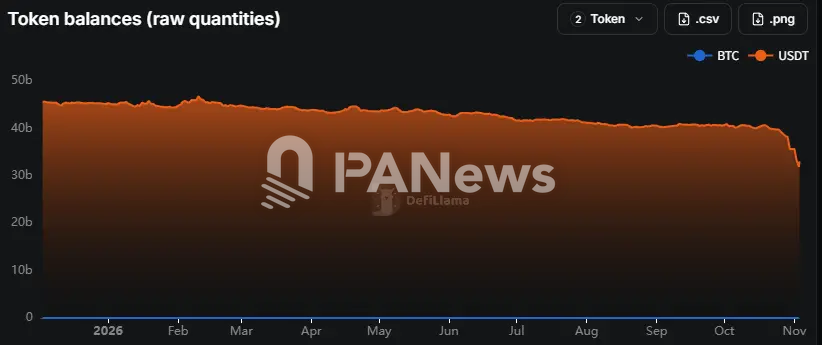
Overall, DEXs did not become the primary destination for this round of capital outflows. Most of the money leaving Binance returned to users' own hands, and migration between exchanges was limited.
2. What is DEX market share, and what drives its long-term growth?
Over a longer time frame, DEX market share has been rising steadily. In the spot market, according to CoinGecko's 2025 annual report, DEX spot volume was only about 6% of CEX volume in early 2021, rising to about 21% by November 2025.
The Block data shows that after entering 2026, this ratio continued to climb slowly, reaching about 23% in October this year. Uniswap remains the clear leader, with about $64 billion in volume over the past 30 days, nearly three times that of second-ranked PancakeSwap.
The perpetual futures market has followed a more uneven path. In 2025, driven by new platforms such as Hyperliquid and Lighter, perpetual DEXs saw explosive growth. But much of that growth depended on points incentives across platforms, and over the past year the volume ratio of perpetual DEXs to CEXs fell from about 21% to about 12%.
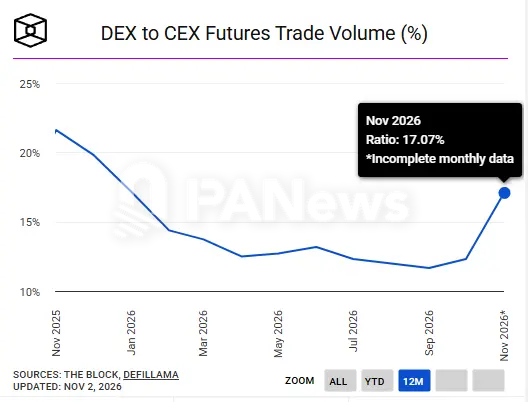
Hyperliquid was the exception. In October this year, its perpetual volume was about $245 billion, equivalent to about 14% of Binance's, up from about 11% a year earlier.
Whether spot or perpetual, changes in DEX share show no clear correlation with CEX security incidents. After FTX collapsed in November 2022, the DEX-to-CEX spot ratio did not rise; it only returned to 10% in March 2023 when U.S. regulatory pressure intensified. After this Binance hack, DEX share similarly fluctuated only slightly.
Looking at changes over the past two years, at least three threads help explain what has been driving DEX share higher.
The first comes from CEXs themselves. In May 2025, Binance launched Binance Alpha, routing user trades to PancakeSwap. According to CoinGecko, in June of that year the DEX-to-CEX spot ratio hit a historic high of 37.4%, and PancakeSwap briefly overtook Uniswap with a market share of 64.5%. But as incentives faded, PancakeSwap's August volume plunged 44.7% month-over-month, and Uniswap reclaimed the top spot.
In April this year, PancakeSwap integrated with Coinbase's Base App. The two largest centralized exchanges are both actively directing user trades on-chain. Such channeling can drive explosive short-term growth, but whether it translates into lasting share depends on real demand beyond incentives.
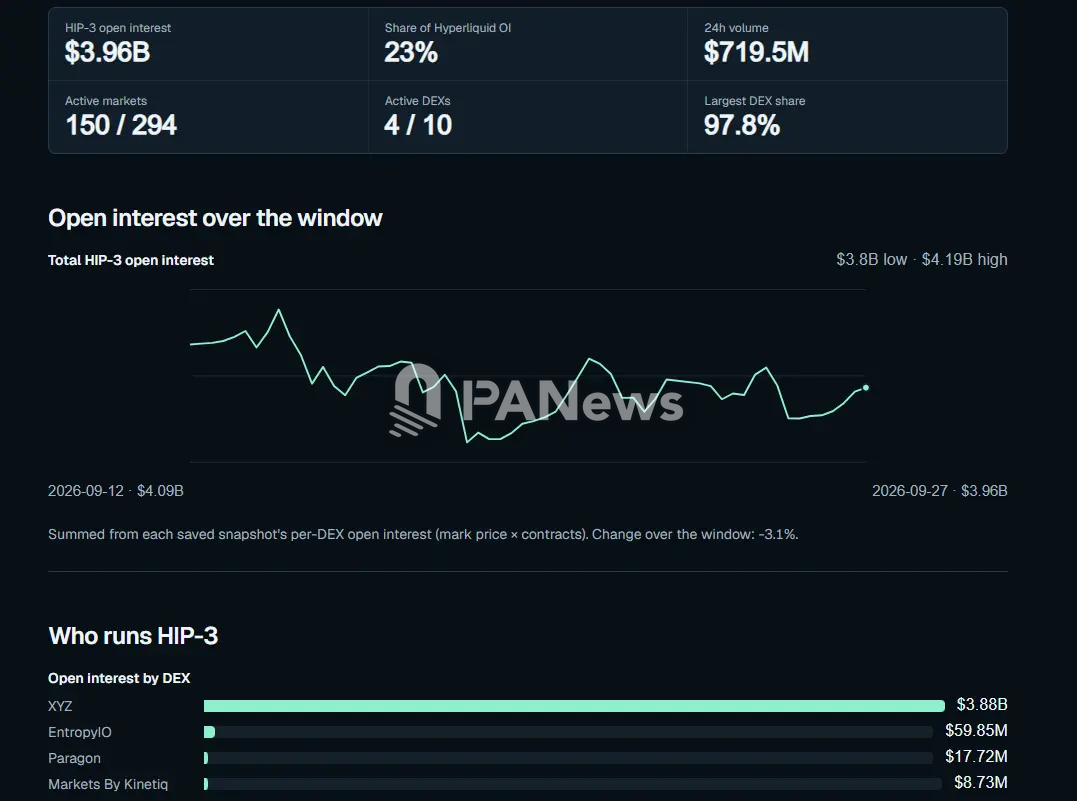
The second thread is the migration of tradable assets on-chain. In early 2025, the meme coin frenzy on Solana pushed DEX spot volume to new highs, with the ratio breaking above its multi-year range for the first time. Now Hyperliquid, through its HIP-3 mechanism, allows third parties to deploy perpetual contracts on traditional assets such as equities, commodities, and foreign exchange.
According to HypeBasis, as of the end of September, HIP-3 markets had about $4 billion in open interest, roughly 23% of Hyperliquid's total. Equity contracts accounted for about $2.5 billion, followed by commodities and indices, with the single largest contract being the S&P 500 perpetual. This is one reason Hyperliquid has been able to grow against the broader pullback in perpetual DEXs.
The third thread is a broader narrative. Crypto blogger Barker Intern argues that throughout financial history, every crisis has been met by finding a bigger backstop, whereas Hyperliquid tries to make the system require no backstop at all as it grows larger. That view remains debatable, but it represents what a significant share of on-chain users expect from DEXs.
Viewed through these three threads, changes in DEX share stem more from trading access points, tradable assets, and market narratives.
3. Where might DEX reach a turning point?
Based on the data in the first two sections, the Binance hack itself is unlikely to be a turning point for DEXs. Capital did not flow on-chain at scale, and DEX share fluctuated only slightly, similar to the aftermath of FTX's collapse.
If a turning point exists, it may more likely come from another direction.
On the same day as the Binance hack, ICE, the parent company of the New York Stock Exchange, announced it had signed a definitive agreement with TradeXYZ and made a strategic investment in the company. TradeXYZ is the largest HIP-3 deployer on Hyperliquid, accounting for about 98% of HIP-3 market open interest.
Under the agreement, the two plan to build a Hyperliquid-based trading and clearing system in the United States, offering 24/7 perpetual contracts on equities, indices, commodities, foreign exchange, and crypto assets. ICE will serve as the exclusive operator of the market, with distribution channels including the ICE-OKX joint venture. The plan still requires regulatory approval.
Yet, as Bloomberg reported in May this year, executives at CME and ICE had expressed concerns to CFTC officials and lawmakers that rapidly growing crude oil perpetual contracts on Hyperliquid could distort global oil benchmark prices, and demanded that it register with the CFTC. More than five months later, ICE chose to step in directly and become the compliant U.S. operator of on-chain perpetual contracts.
On the regulatory front, CFTC Chairman Michael Selig said in a CNBC interview that the Binance hack vindicated the crypto market regulatory rules the CFTC proposed this month. He argued the root problem is that offshore exchanges lack the safeguards of U.S. financial markets, and proposed a federal option requiring such platforms to register with the CFTC and comply with U.S. cybersecurity standards. He also argued that on-chain trading is traceable, which actually gives regulators more enforcement room.
If this path works, DEXs would gain access to a market previously out of reach: retail users and institutional capital under U.S. regulatory protection. The impact of this variable could far exceed that of any single CEX security incident.
Returning to the original question: will DEXs be the winners?
When traditional finance builds markets on-chain, regulators begin to acknowledge on-chain transparency, and CEXs also prove themselves through on-chain verifiability, it may no longer be possible to distinguish winners simply as CEX or DEX.