






Original Source: David Christopher, Bankless
Original Compilation: Bitpush
Less than a week after hackers stole roughly $6.3 billion from Binance, the crypto industry is confronting yet another potential shock: if Democrats win big, some of the industry's most stubborn critics will take control of congressional oversight.
But unlike the hack, this threat has been building in plain sight.
As of Tuesday evening ET, Kalshi priced Democratic control of the House at about 94% and the Senate at about 75%. That doesn't mean the market has fully priced this outcome into crypto asset valuations, but a shift in congressional control no longer seems surprising.
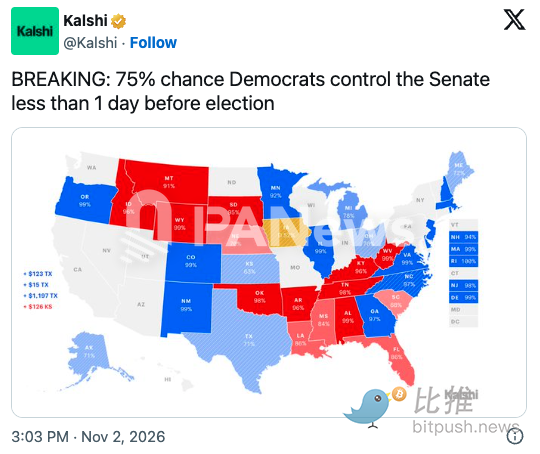
Perhaps more important is how Democrats would use that power—and whether the Iran situation could completely overshadow the political narrative.
From Letters to Subpoenas
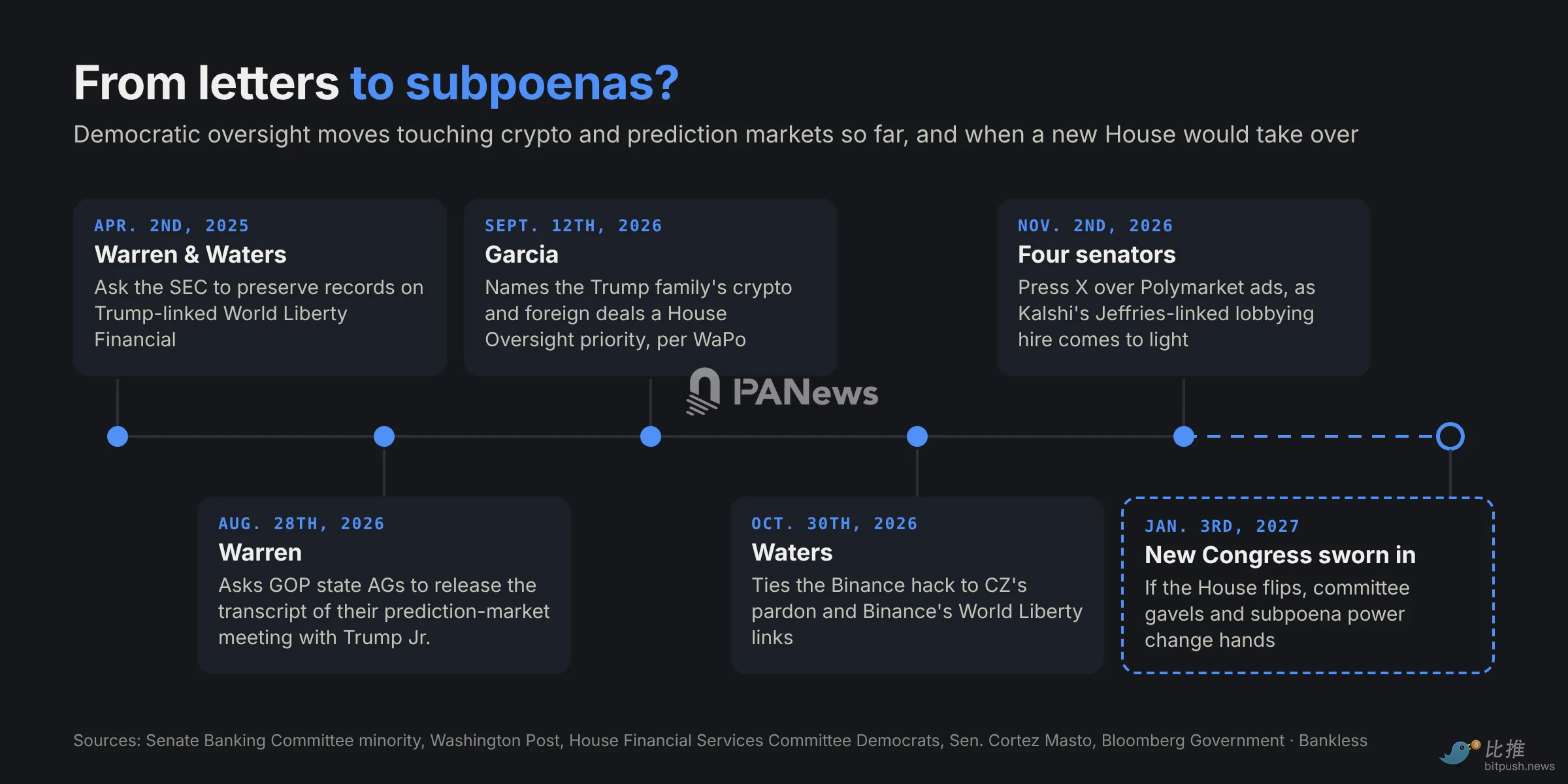
If Democrats win the House, they will gain control of committee investigations, with the power to hold hearings and subpoena documents or testimony. And they have already signaled where their focus lies.
Elizabeth Warren and Maxine Waters, a notoriously anti-crypto duo, began laying groundwork as early as April 2025, demanding that the SEC preserve records related to Trump's World Liberty Financial and potential conflicts of interest. Other lawmakers have sought to scrutinize Trump's $TRUMP meme coin, and Robert Garcia, the top Democrat on the House Oversight Committee, has made the Trump family's crypto business and overseas commercial dealings an investigative priority.
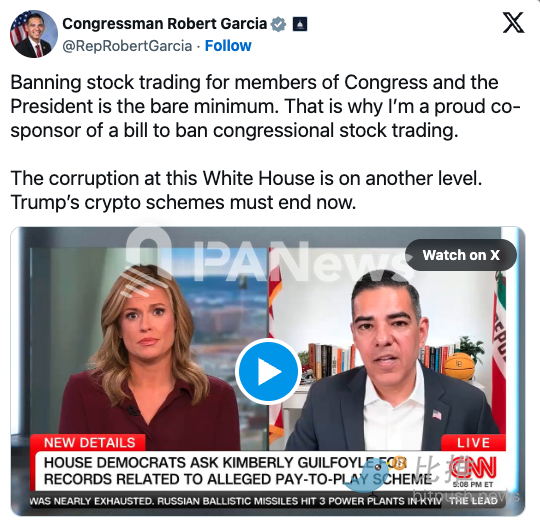
The Binance hack gave them another opening.
In an October 30 statement, Waters linked the breach to Trump's pardon of Binance founder Changpeng Zhao (CZ) and Binance's ties to World Liberty Financial. While these connections have no established link to the hack itself, the breach gave Democrats another opportunity to push for stricter cybersecurity, financial crime safeguards, and exchange accountability.
Perhaps that's not entirely a bad thing.
Given the massive sums the crypto industry has lost in recent hacks, additional oversight of exchange security might even help (please don't make me eat my words). My concern is how far that scrutiny could spread. Ideally, investigations should focus on specific transactions rather than dragging unrelated businesses into the crossfire. But prediction markets themselves are tied to the Trump family and could also find themselves in the spotlight.
Donald Trump Jr. serves as an advisor to Kalshi and sits on Polymarket's advisory board after his firm 1789 Capital invested last year.
After The New York Times reported that Trump Jr. urged Republican attorneys general not to pursue prediction markets, Warren pressed Republican attorneys general to release a transcript. On Monday, four Democratic senators sent a letter to X asking whether Polymarket's advertising received favorable treatment.
Democrats have also introduced the STOP Corrupt Bets Act, which would ban contract trading on elections, sports, government actions, and war. This would strike at the core of Kalshi's business: sports and parlay trading account for about 84% of its volume this year, while elections make up just 0.5%. And all of this is unfolding amid a growing battle between states and the federal government over who has the authority to regulate these platforms. As Dustin Gouker of The Event Horizon put it, compared to what could emerge once Democrats control Congress, congressional hearings to date might "look like an ice cream social."
Kalshi appears to be preparing for this possibility, having just hired a lobbying firm tied to Hakeem Jeffries, who could become House Speaker. And as the CFTC defends prediction markets against state regulator intervention, congressional scrutiny of these platforms could extend to the agency itself.
Regulation Presses On
But increased congressional scrutiny doesn't necessarily mean the regulatory process grinds to a halt.
Although the CLARITY Act failed to advance in September, the SEC and CFTC are still using their existing authority to keep forging a path forward.
Just two days after CLARITY stalled, the SEC granted a temporary exemption allowing qualifying venues to trade tokenized U.S. equities on-chain.
In October, the CFTC sought comment on rules for leveraged crypto trading and federally registered crypto markets.
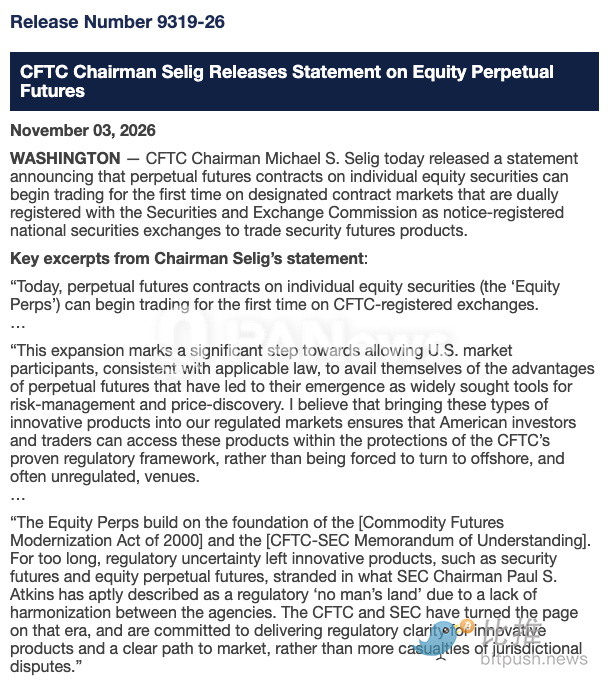
And today brought more concrete signs of progress: CFTC Chairman Michael Selig announced that equity perpetual contracts can begin trading on qualifying U.S.-regulated exchanges. Platforms still need to complete relevant SEC and CFTC registrations, product filings, and clearing arrangements, but the regulatory pathway has opened. Payward has filed an application to offer these perpetual contracts through Bitnomial, while Lighter and ICE-backed Trade[XYZ] are also advancing their own regulatory paths.
That said, this progress is not immune to political pressure. Warren has already questioned the CFTC's enforcement record and staffing cuts, and with Democrats controlling Congress, the agency's decisions could face stricter scrutiny. But congressional control won't erase regulators' existing authority. Investigations may accelerate, while regulatory approvals continue.
The Bigger Unknown: Iran
For those concerned about their positions, the more unpredictable force may be Iran.
A report last week by Axios suggested Trump is considering resuming large-scale strikes after the midterms, raising the possibility of higher oil prices, stubborn inflation, and another pullback in risk assets.

Monday briefly offered a glimmer of relief. Trump said he was in no rush to resume major operations, and diplomatic hopes drove oil prices sharply lower. But the Associated Press reported late Monday that U.S. forces carried out limited strikes on Iranian targets near the Strait of Hormuz. A U.S. official described the strikes as defensive in nature, with negotiations still actively underway. The question now is: will these strikes stop here, or escalate into a larger conflict?
That distinction may ultimately determine where the crypto industry goes next. Investors have had weeks to prepare for Democrats controlling Congress, but the Iran situation remains far more unpredictable, and its market impact could be greater than domestic U.S. politics.
Hopefully this will settle down soon—not just for the coins in our portfolios.