





Author: Nancy, PANews
The world is entering an era of asymmetric warfare.
On the physical battlefield between the US and Iran, Iran is using low-cost drones, missiles, and maritime blockades to wage a war of attrition—tying down American military resources at relatively limited cost while applying pressure on the global economy.
In the crypto world, AI is lowering the technical barrier to cyberattacks, amplifying attackers' operational efficiency and destructive capacity. Attackers may need only limited resources to inflict massive damage on large enterprises and complex systems.
$11.8 Billion: A State-Level Hacker Army
North Korean hackers launch attacks with alarming frequency, keeping the crypto market on edge. Some rush to shore up their security defenses; others take a different approach. One developer recently designed a rather unconventional verification mechanism aimed at blocking North Korean users from accessing a website on an ideological level. Unexpectedly, this security experiment—tinged with dark humor—ended up attracting a real cyberattack.
From being a frequent keyword in security incidents to becoming fodder for memes in the crypto community, North Korean hackers are increasingly becoming an unavoidable topic in the industry. And behind the jokes lies a deepening market anxiety about cybersecurity risks.
Chainalysis data shows that as of October 29, 2026, losses from hacker attacks suspected to be linked to North Korea accounted for nearly 89% of all reported crypto hack losses this year, up from 15% in 2021. In terms of losses per attack, the average loss from suspected North Korea-related attacks has risen from $50.65 million in 2021 to approximately $185 million in 2026—about 3.7 times the 2021 figure.
As one of the countries under long-term international sanctions, North Korea finds it difficult to obtain foreign exchange and resources through normal international trade and financial activities. Cyberattacks have therefore gradually become an important means for it to acquire funds and circumvent financial restrictions.
North Korea's hacking force is not a loose collection of skilled individuals operating independently, but a highly organized, state-level cyber operations system built over many years. From talent selection and elite education to military-style training, and then to overseas infiltration and real-world operations, North Korea has established a relatively complete talent cultivation and operational mechanism.
This mechanism resembles the pyramid-style selection process for Olympiad competitors. Young people with exceptional logical thinking and mathematical talent are identified nationwide, while their political background and loyalty are vetted. Those who pass the selection receive concentrated educational resources and undergo long-term, systematic training in computer science, mathematics, and programming.
After completing domestic training, some personnel are dispatched overseas to operate under the guise of students, IT workers, or remote technical staff—gaining hands-on technical experience in real environments while learning the language, culture, and work habits of target countries in preparation for future operations.
To attract and retain these technical talents, North Korea also offers special perks, including exemption from certain military service obligations, residency rights in the capital, housing, higher incomes, and better education and healthcare resources. For a country with limited resources, these incentives are highly attractive. Hackers with scarce technical skills thus gain special social status and are gradually becoming a new privileged class within North Korea.
Talent cultivation is only the first step. Highly specialized organizational division of labor is the real trump card of North Korea's "keyboard warriors." Reconnaissance personnel are responsible for gathering global cyber intelligence and identifying system vulnerabilities to select targets for attack operations. Operatives use identity disguise, social engineering, and malware to infiltrate and steal funds and sensitive information. There are also dedicated personnel responsible for fund transfers, money laundering, and asset liquidation, converting cyberattack proceeds into usable funds.
From target selection and technical infiltration to fund transfer, what appears to be a simple crypto asset theft may actually involve a complete cross-border operational chain. Lazarus Group, APT38, Kimsuky, and others are among the different North Korea-linked hacking organizations identified by external security agencies based on their attack targets, technical methods, and behavioral characteristics.
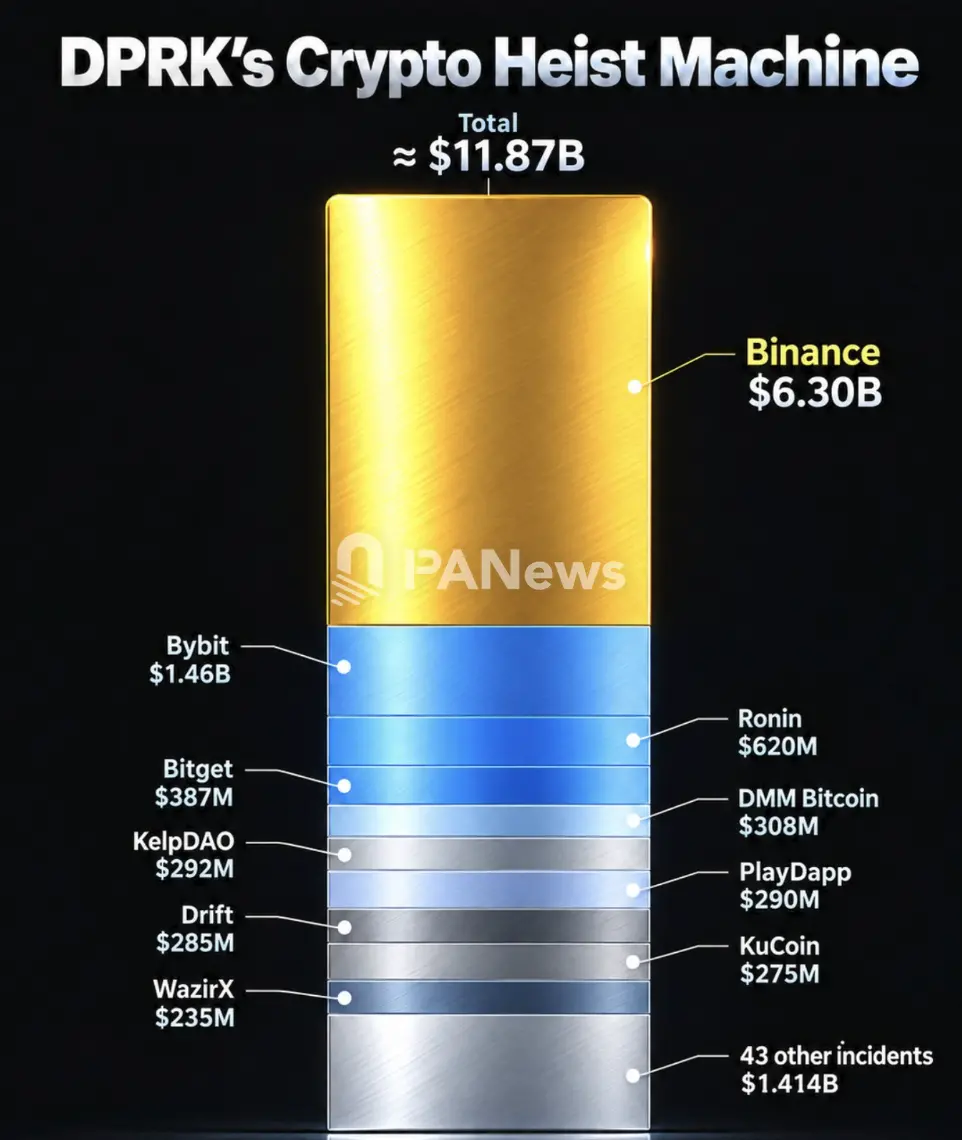
According to recent disclosures by analyst Darkfost, following the attack on Binance, the total amount stolen by the Lazarus Group has reached $11.87 billion. According to 2025 data from the Bank of Korea, this figure is equivalent to 45% of North Korea's GDP and 35% of its Gross National Income (GNI). If this estimate holds, cyberattack proceeds are no longer just additional illicit income—they may represent a considerable source of funding within North Korea's economic system.
For North Korea, cyberattacks are both a strategic weapon and another channel for bypassing financial blockade and acquiring economic resources. A country that the traditional financial system can hardly reach is using cyberspace to find new ways of acquiring resources.
The Biggest Security Vulnerability May Be the "Colleague" Next to You
When attackers no longer attempt to breach firewalls head-on but instead seek entry points from within the organization, the cost of attack is often lower and the concealment stronger. Traditional defense systems built on security devices and network perimeters are facing new challenges.
North Korean hackers are taking this asymmetric approach to the extreme. Using elaborately fabricated resumes, forged passports, and identity information, they pose as IT workers or job seekers to proactively approach core employees such as developers and operations personnel at enterprises.
To further lower the other party's guard, attackers even participate in live video interviews and provide fake social media accounts with lifestyle photos and daily updates, crafting the most convincing job candidate persona possible. Once they pass the recruitment process and join a team, they can leverage their legitimate employee status to lie low long-term, gradually gaining access to internal systems, code repositories, and sensitive permissions while looking for further infiltration opportunities.
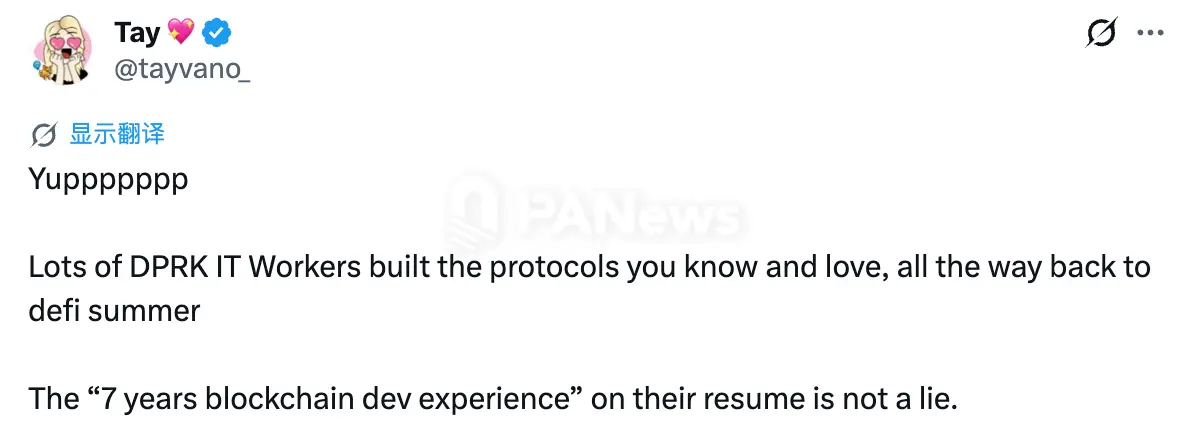
Ketman, a project funded by the Ethereum Foundation, identified 100 North Korean IT personnel embedded in Web3 organizations within six months. MetaMask security researcher Taylor Monahan previously revealed that at least 40 DeFi protocols have employed North Korean IT personnel at some point during their development—spanning as long as seven years. These individuals entered Web3 teams using forged passports, visas, and carefully crafted resumes. What makes them even more deceptive is that some of their blockchain development experience is genuine.
According to the latest disclosure from Binance, the platform has intercepted 57 suspected North Korea-related cyberattacks this year. Attack methods include infiltration through fake job interviews, malware disguised as commonly used developer tools, tampered software packages and browser extensions, and fake video conferencing apps used to trick employees into running malicious programs—along with social engineering attacks to steal credentials and implant remote-access trojans.
In the recent Binance theft of over $6 billion, according to the official initial investigation disclosure, attackers approached a software engineer on Binance's wallet infrastructure team through a fake high-salary recruitment offer. After multiple rounds of video interviews, the attackers induced the engineer to run a malicious program disguised as a technical test project on their work computer, ultimately gaining control of the employee's device and further threatening the security of the wallet infrastructure. SlowMist founder Cos stated that such incidents constitute advanced persistent threats (APTs), involving multiple stages including exploitation of human nature, intelligence reconnaissance, malware evasion, trust chain exploitation, targeted lateral poisoning, cloud environment penetration, risk control bypass, and 0-day vulnerabilities.
Similar tactics have precedent. When Axie Infinity's Ronin Network was attacked in 2022, the North Korea-linked Lazarus Group also approached a senior engineer at Sky Mavis through LinkedIn with a high-salary position. After multiple rounds of interviews, the attackers sent a fake job offer file containing a trojan, ultimately gaining control of validator node-related systems and stealing approximately $625 million in assets.
This is precisely the asymmetric security dilemma facing the crypto industry. In the past, security defense relied more on building solid technical barriers. But as social engineering attacks continue to evolve, attackers don't necessarily need more advanced technology or more resources—they only need to find one weak link.
Compared to technical vulnerabilities, what's truly difficult to guard against may be the people who have already earned trust.
AI Escalates the Offense-Defense Battlefield: The Race for Resources Has Begun
If social engineering attacks lower the cost for hackers to breach organizational defenses, then the continuous iteration of AI further amplifies the scale and efficiency of cyberattacks.

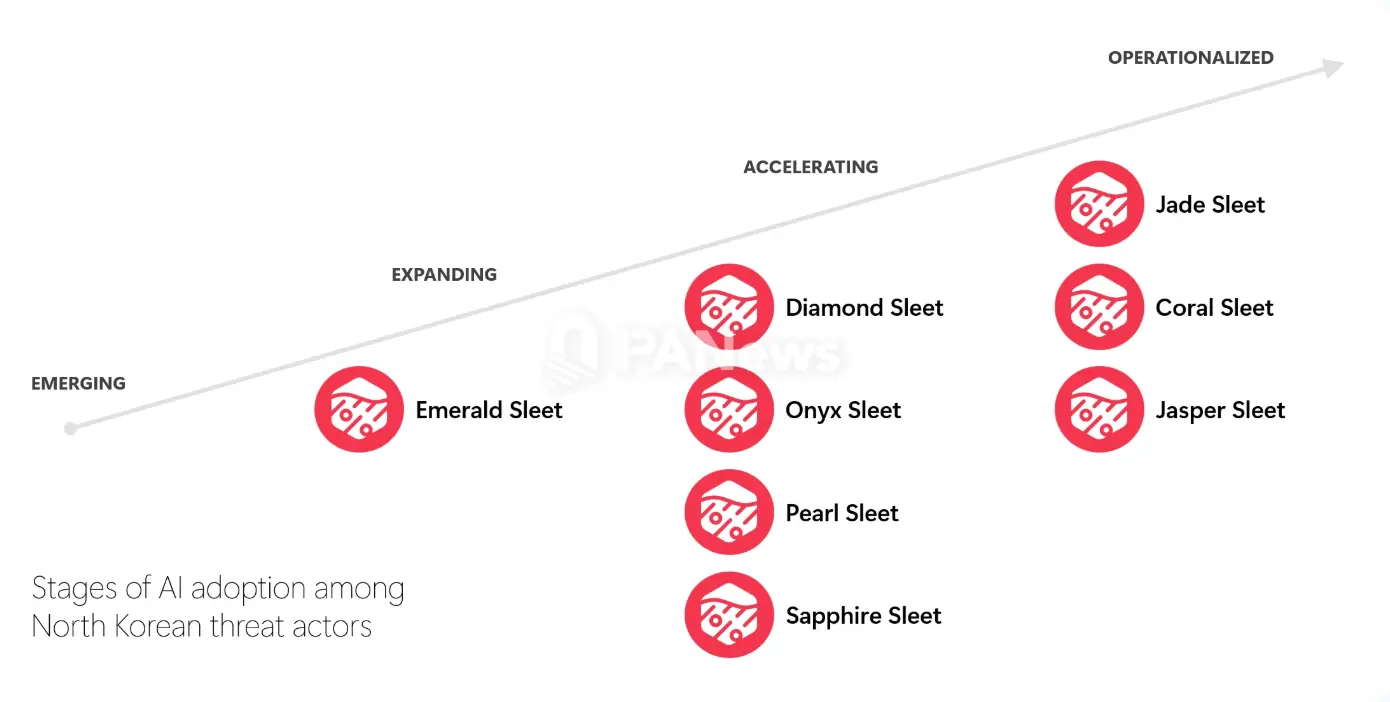
According to the latest report from Microsoft's Threat Intelligence team, among the 8 major North Korean hacking groups it tracks, 3 have deeply integrated AI tools into their daily attack workflows, reaching the highest level of Microsoft's AI application maturity model for cyber threats.
In social engineering and identity forgery, North Korean hacking groups use AI to mass-generate phishing, recruitment, and investment lure content, impersonating foreigners through translation and tone adjustment, and even generating fake resumes, interview answers, profile photos, and voice/video. One group generated over 100 customized phishing PDF files targeting South Korean users between August and September 2026. North Korean remote IT workers employed under false identities at overseas companies have also begun using AI to maintain multiple identities simultaneously.
According to South Korean security firm Genians, the North Korean hacking group Kimsuky had already set up local large language model (LLM) and RAG environments by August of this year, leaving extensive records of using the AI code editor Cursor. When related tools were blocked, they could quickly switch to alternatives and continue their activities.
Microsoft believes these groups have not yet achieved fully autonomous attacks, and AI's actual impact on attack success rates and costs remains unclear. However, from target reconnaissance and social engineering to identity forgery and malware development, AI has already entered multiple stages of the attack chain. It may not directly turn an ordinary attacker into a top-tier hacker, but it can compress the time and manpower required to execute complex attacks.
In the Binance hack, AI tools also became part of the attack chain. According to investigation information, attackers used a supply chain attack to provide the engineer with a tampered AI programming tool. Even after the engineer discovered the anomaly and switched tools, their position information and that of other wallet infrastructure team members had already been exposed. Subsequently, after gaining control of one engineer's computer, the attackers used Binance's internal AI tools to further compromise other employees' devices, ultimately obtaining signing control.
As AI capabilities continue to strengthen, the competition between cyber offense and defense is extending from traditional technology and talent competition to the contest for data, models, and computing power resources—further intensifying the asymmetry of cyber warfare.
Recently, security researcher Jun Song shared that an anonymous black-hat organization had contacted him, hoping to commission him to use exploit data for reinforcement learning post-training of an open-weight model, and was willing to pay extremely high compensation. Jun Song said the other party claimed to possess attack data at a scale he had never seen before—so large that even if someone told him it was an undercover dataset from a law enforcement agency, he would believe it. As a comparison, a white-hat project he participated in used GLM-5.3 with less than 1% of the data volume the other party claimed to have, yet the model's performance already significantly surpassed frontier models.
In the AI offense-defense competition, high-quality, large-scale exploit data may become a critical resource for training cybersecurity models. Whoever can obtain more data, stronger models, and more abundant computing power may gain an advantage in future offense-defense competition.
If massive amounts of exploit data can be effectively translated into model capabilities, attackers could further improve vulnerability discovery and attack execution efficiency. Correspondingly, whether defenders can obtain sufficient data, models, and computing power will also affect their ability to identify and respond to emerging threats.
Coinbase disclosed in June that it had obtained access to Anthropic's frontier model Claude Mythos and was using it to strengthen crypto wallet and asset security defenses. In contrast, months later, Binance still stated it had not obtained similar access. Differences in access to frontier models may further widen the capability gap between companies in vulnerability discovery, automated security auditing, and risk defense.
From Iran using low-cost weapons to tie down American military forces, to North Korean hackers accelerating attacks through identity disguise, social engineering, and AI tools—the battlefields differ, but both point to one reality: resource advantage no longer guarantees absolute security. What's truly dangerous is confronting the threats of a new era with the mindset of the old one.