






Original Title: The most lucrative AI business to start in 2027
Original Author: Dan Koe
Original Translation: Boss Liu
The most lucrative skill has always been attracting attention.
The reason is simple.
If your goal is to make more money, then no matter how good the software you build is, no matter how many drafts you overturned over 3 years writing a book, and no matter how hard you work or how much you improve yourself to chase more career opportunities—none of it matters.
If nobody knows who you are or what you offer, how exactly are they supposed to pay you?
This means that whatever work you do or whatever business you start, attracting attention and acquiring customers will always be the primary factor determining your success.
This applies to your own business and to other people's businesses.
And others are willing to pay good money for you to do this for them.
As job security declines, people face 3 choices:
Complain that life is unfair and do nothing.
Upgrade your skills, relearn, and look for better job opportunities.
Start the business you've always wanted to build.
A shockingly large number of people will choose the third path.
As you've probably guessed—just as everyone on social media is loudly proclaiming—they'll start this business by building a personal brand.Why?
Because attention is a finite resource, and it will only become scarcer. People can earn more money, but they can never get back the attention they've already spent.
In this letter, I'll teach you how to master the ability to attract attention on social media. That way, you won't have to worry about making money for at least the next few years.
With this knowledge, you can start your own business and use social media to grow it—or become a "one-person creative team" for other companies and command high pay for your skill set.
I. You Either Become a Creator, Pay Creators, or Get Paid to Work for Creators
These numbers are hard to ignore.
Goldman Sachs predicts the creator economy will nearly double, from $250 billion in 2023 to $480 billion by 2027.
In 2025, creators generated approximately $185 billion in ad revenue. It was the first time they surpassed traditional media.
In 2021, US brands spent $13.9 billion on creators. The Interactive Advertising Bureau (IAB) projects that number will reach $43.9 billion by 2026—roughly a 3x increase in 5 years.
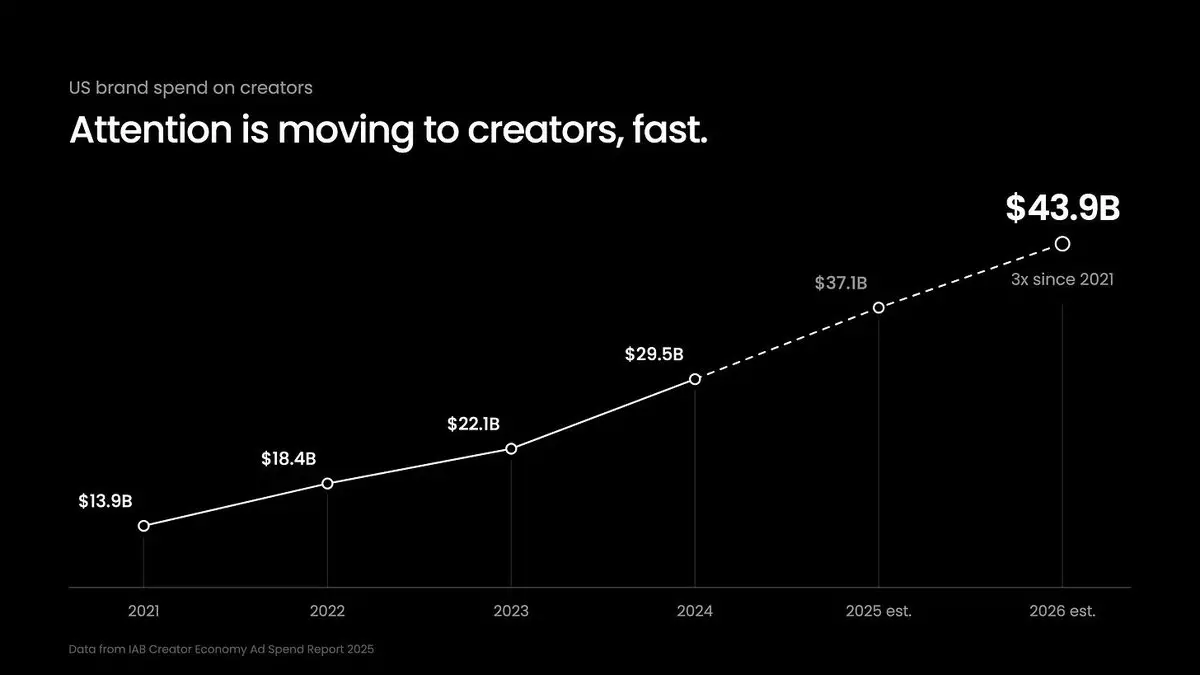
Absolutely wild.
I've been a creator myself, worked for creators, and paid creators. From my experience, the rates people charge are indeed staggering. Massive amounts of VC money get poured in—thousands of dollars for a single Reels short or a 60-second ad slot in a YouTube video, and 90% of the time those placements don't even drive results.
The key point is that attention now concentrates on social media, not on broadcast, TV, or news media. When you want to build any kind of business—whether it's a small passion-driven venture serving an ideal lifestyle or the next unicorn startup—publishing content has become virtually mandatory for attracting a paying audience.
When companies want to scale, they pour millions into affiliate marketing and influencer partnerships. I keep seeing Hormozi's ads saying they pay creators over $1 million a month to promote Skool. Not to mention that Hormozi himself is a creator, which has enormously helped Skool's growth.
"Founder-led marketing" has become the buzzword in startup circles these days. It basically means: the hottest new way to grow your startup is… you guessed it, building a personal brand and publishing content. And by the way, most of them are terrible at it. You should probably start using Eden to do research, build differentiation, and publish content.
What does this mean for you?
Whether you plan to work for yourself, already have a business, or want to work for other companies, the most valuable skill to learn and the most lucrative one is attracting attention. Translated into the digital world, the most lucrative skill is creating content—quality content, not an endless stream of garbage.
Unfortunately, just because you can learn how to attract attention doesn't mean you've actually captured it.
If one tweet or short gets 1 million views but every other post gets 1,000 views, that viral hit is useless. It means your content is decent, but your brand hasn't been built at all. You need both.
You can chase viral hits. That's what most people do, and that's why most people fail miserably. Or you can build a content world that makes people want to keep exploring.
I'll teach you how.
II. The One-Person Creative Team
The content industry is undergoing a massive shift.
I'm the founder of Eden. It's a tool that creators and digital business operators use to research viral ideas, plan and schedule content, sell digital products, and run email lists.
I'm not saying this to pitch—I'm pointing out that we have access to data almost no one else has. Across billions of posts, we know which topics, hooks, and content styles work.
Freelancers and agencies also use it to run their clients' personal brands—covering content, email marketing, digital product launches, and marketing funnel builds.
When we talk to these content agencies and media teams, we hear the same things over and over. Here's the gist:
"We haven't laid anyone off, but we can take on far more work without expanding the team because everyone's output has increased."
"Creators and founders hire us because they simply don't have the time to think about content. They're managing teams and running businesses—those require focus. AI can write content for them, but they still know they need a strategist or creative director who's better at using AI than they are. This still requires creativity and thinking."
"AI still can't write the best posts, and I don't think it ever will. But it can research what performs well, understand strategy, and produce drafts that are already pretty close. These days, my entire job is reviewing and rewriting drafts. It takes 4 hours a day now instead of 12."
In my view, there are two directions for the most lucrative AI business a single person can start.
First, become your own creative team. Build a personal brand, grow an audience, develop digital products, build an email list, and so on. Just focus on that. Trust me—even with AI, that's a full-time job. If you're a creator without a team, you probably can't also be building software on the side.
Second, become someone else's creative team. Help companies, founders, and even creators who lack the creative energy to produce irreplaceable content. Most founders are still posting "announcement-style" content and have no idea what it takes to build influence online.
In other words, become the creative director for your own brand or someone else's.
If you can do that, I don't see why you couldn't charge a fraction of what a full team would cost. Serving 1–3 clients and making $10K–$75K a month isn't far-fetched—provided you're good at it and you practice consistently. Don't let yourself think this is another get-rich-quick scheme. For business owners spending millions on marketing, that price won't even make them blink.
So what does this one-person creative team actually look like?
What skills do you need to learn?
Role 1: Brand Strategist
The brand strategist handles positioning and how people perceive the brand.
They'll be the first to tell you: don't just chase trends, and don't try to make every post a viral hit. Growth and engagement matter, but not at the expense of trust and authority.
By the way, I'll show you how to do all of this well below.
Role 2: Content Strategist
This is not the same as a brand strategist.
The content strategist researches what performs well across different topics and niches, and recommends what the creator should post next. They dig deep into post formats, YouTube thumbnail and title structures, audience retention, and content shareability.
They're great at growing accounts, but if brand strategy isn't considered, then once the creator stops posting, nobody will even wonder where they went.
Role 3: Content Writer / Social Media Manager
This person drafts tweets, YouTube or Reels scripts, X articles, and Substack newsletters, and handles planning and publishing.
They take the content strategist's ideas and the brand strategist's direction, and make sure the final content aligns with both.
You can probably already see why most people can't build anything lasting with AI. They still treat AI as a get-rich-quick tool. They think that by having Claude generate scripts endlessly—with no direction and no data—they'll magically connect with an audience.
Almost nobody considers brand strategy.
Some consider content strategy.
Most just turn random ideas into posts and pray they perform well.
These are your competitors. Standing out from them isn't hard.
III. If You Were My Client, Here's How I'd Build You an Irreplaceable Personal Brand
Let's do a fun exercise.
I'll pretend you're my new client going through the onboarding process.
This way, if you want to become a creator, you can run this process yourself. If you want to offer content services to others—like ghostwriting tweets or writing Substack articles for brands—this is also how you'd onboard a new client. Later, I'll also share an excellent strategy for landing your first client.
Step 1: Map the client's unique thought identity through a kickoff interview
To make a client's brand and content stand out, you need to understand a massive amount of context about them.
Once you land a client, schedule a call and use an interview to gather all the information you need. Record the call and save the transcript so you can reference it with AI later.
If you're doing this for your own brand, I've already prepared a questionnaire/prompt you can use, along with a 30-day creator sprint course. It combines what's currently going viral with what makes you unique to build your strategy. You can try it here.
Here are the questions you can ask a client—or ask yourself. You can also paste them into Claude and have it interview you to extract the information, then save it as a brand document you can reference with AI anytime.
All of these questions shape your brand.
They can generate content themes that will sustain your posting for the next 6–12 months. Some people looking at this will ask: "How am I supposed to cover all of this in one post?"
You can't. This is a long game, and that's exactly why most people fail miserably. They want attention and authority fast. Good luck with that.
Because the content is long, I've organized these questions and more into a complete prompt you can save or copy into your workspace.
Who You Help
Who do you most want to help? Describe a real person.
What does a bad day look like for them right now?
What do they say when they complain to friends? Use their exact words.
What have they already tried that didn't work?
Your Story
What are your audience's experiences that you've been through too?
What moment changed things for you? Even something small.
What have you accomplished, tried, failed at, and figured out? List everything from big to small—each one has value.
What results can you show—for yourself or for people you've helped?
Who Shaped Your Thinking
Whose books, posts, or videos do you never miss? List specific names and titles.
Which of their ideas do you keep coming back to? Why?
Who changed how you think, even if you no longer agree with them?
Content Pillars & Unique Perspectives
What could you talk about for hours? List everything, even if it seems unrelated.
Which 2–3 of those matter most to you?
For each one, how is your angle different from everyone else's? For example, "from a psychology perspective" or "as a former nurse."
What do people most often ask you for advice on?
What do you find yourself explaining over and over again?
Mission & Beliefs
In one sentence, what do you want to help people achieve?
What do you believe that most people in your field don't?
What common advice in your field do you think is wrong?
What You Stand Against
What kind of lifestyle is harming the people you want to help?
What kind of life do you want to help them escape? Answer in your own words.
If you could eliminate one misconception or habit, what would it be? Note: a habit or belief, not a person or a company.
Why This Matters Now
What just changed in the world that most people haven't noticed yet?
Where You're Taking Them
What will their daily life look like after following you for 5 years?
How will they proudly describe themselves in their bio?
What role do you play in their story? The guide, the person documenting the journey, or the one who's already been through it and came back with a map?
Rules & Language
What does your ideal reader believe and do every day? List 5–12 principles.
Have you ever named your viewpoints, methods, or problems? Write out each name and what it means.
Store all this information somewhere safe—like a brand board in Eden—so you can reference it every time you brainstorm posts.
Step 2: If the client is already publishing content, scrape their best-performing content
I think we can all agree that AI can't fully replicate a person's writing style.
Even when it gets close, there's always some subtle thing that feels off.
But that's not our goal. AI can handle corporate voice just fine, but a personal brand is "personal" for a reason. It needs that unique flavor.
We interview clients and collect their best content not to automate the entire process. We're building a knowledge base that captures everything unique or noteworthy about this person. When you use AI for brainstorming, drafting, or ideation, it's far easier to work from that than from scratch.
To collect a client's best-performing content across all platforms, you can connect Eden to Claude or ChatGPT via MCP so it can pull the client's posts or other people's viral posts. Provide the client's social accounts, then use a prompt like this:
markdown
Please pull the best-performing content from [@account list]. Extract 10–20 posts from each platform where they're active. Then document the core viewpoints that make them distinctive, the personally unique elements of their writing style, and infer what worldview or life philosophy they have that brings people together. In short, document everything that drives their growth and organize it into a document.
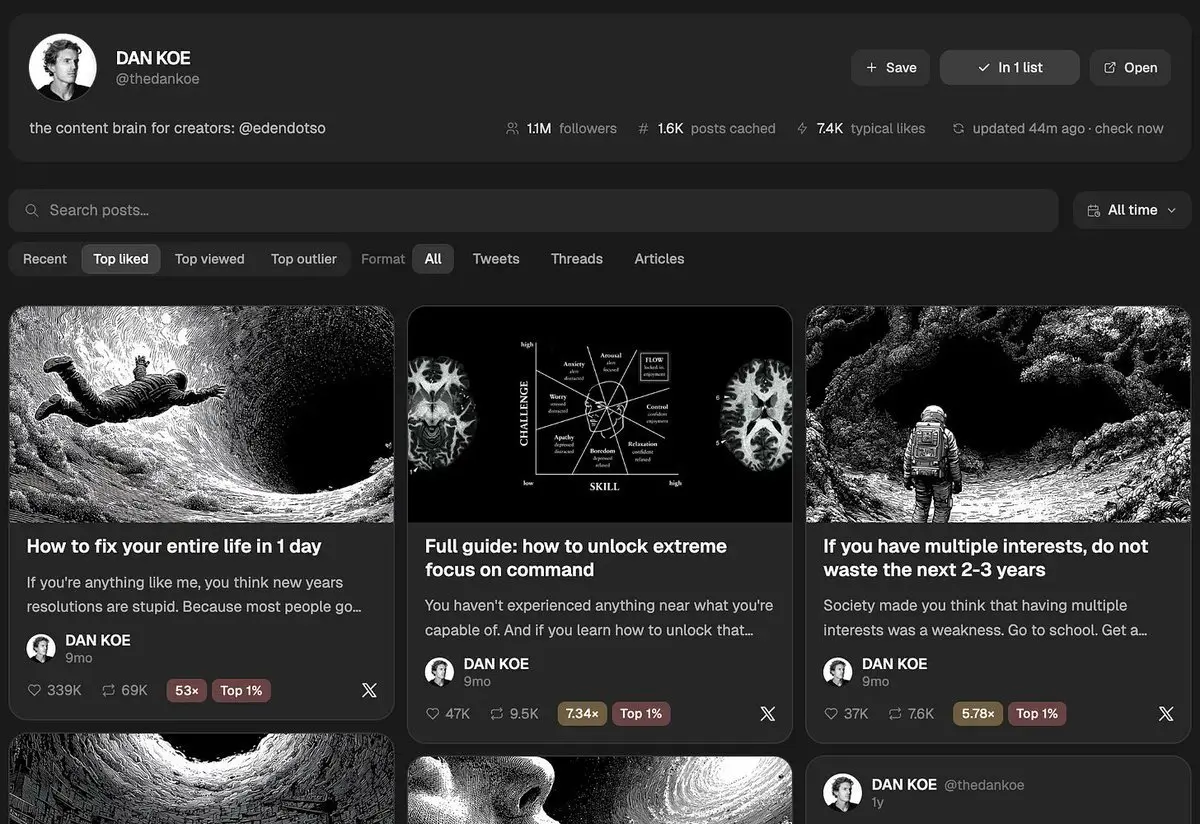
It's also worth looking at their best-performing posts across platforms yourself to identify reusable patterns.
Step 2.5: If you haven't started publishing content yet
For beginners, this might be the most valuable thing you can do.
You have to understand that your thinking has always been shaped by the people who influenced you most. Your best ideas—the ones that will drive your growth—come from how you interpret and make sense of the ideas you've absorbed from others.
It's a bit like "steal like an artist," except that's how thinking has always worked.
When you encounter a new idea, being able to replace the old beliefs and thoughts that dominated your thinking is a core expression of intelligence. Clinging to beliefs or ideas that don't produce favorable outcomes is a form of foolishness.
My thinking is largely a blend of ideas from Naval, Leo Gura, Mihaly C, Steven Kotler, Ken Wilber, and others. The interaction of those ideas in my mind, combined with my own life experience, is what makes my ideas "mine."
So if you haven't started publishing content yet, list the 5–10 people who've influenced you most.
If they're creators, even better. Organize them into a list so you can view all their content in one place or have AI conversations around it.
Then use the same prompt as above, just swap in their accounts. If they don't have social media accounts, have AI gather their best ideas from the web and their books. Save the results as a document and keep it safe.
Step 3: Create a research-backed content map
So far, we've:
Gathered enough brand context to create unique content.
Documented the best ideas that can be reused, repurposed, and recycled.
Now we need to switch to a marketer's perspective.
Actually, more accurately, switch to an artist's perspective.
Most "creative people" recoil at the idea of researching viral posts, top-performing YouTube titles, or creating based on what's more likely to perform well. But that's because your angle on the problem is obscuring what this actually is.
You're collecting references.
That's what artists do. They build mood boards, collect references, and use them to help shape their work. They don't copy 1:1—they extract patterns and principles to make their work more likely to perform well.
Because ultimately, you want your work to succeed. You just find looking at data slightly repulsive, as if it's not part of the creative process. Stop thinking that way.
Here's how to do it specifically.
(Note: I mention Eden multiple times in this letter because, frankly, nothing else can do this job. Social content scraping tools can't simultaneously check which content performs well across multiple accounts; apps like GrokBot are great but only work for X. And to get unique ideas, you're better off researching platforms where you don't publish content.)
The approach is simple: use the prompt below and provide the two documents you created earlier.
I want you to create a research-backed content map: set up 3–4 unique and broad content pillars, each branching into 5–7 themes. These themes should be built on proven ideas while incorporating my unique perspective from [@brand document] and [@content document]. Under each theme, branch out into 5–10 ideas likely to perform well; under each idea, branch out into 4–5 angles.
Read my brand document and content document, extract potential content pillars and my perspectives, then use Eden to research what content performs well on these themes across platforms. We need a unique content map that also incorporates patterns proven effective over the past 6–12 months.
Organize the results into an easy-to-read document.
Now you have roughly 6 months' worth of content ideas. You can have Eve or AI draft content based on the context you've organized, and reference high-performing content to validate post structures.
I think it's hard to deny that this process will produce results—and it will put you far ahead of those who aren't doing it.
As mentioned, here's a copyable document/prompt with the complete process. It might take some time to work through, but it's comprehensive.
IV. How to Land Your First Client
A few years ago, my friend JK Molina sent me a DM. He's basically the guy who kicked off the "Twitter ghostwriting" trend.
His message went something like:
"Dan, I know you don't want someone else writing your content, but I went ahead and wrote 10 posts for you anyway. Try posting them. If you like them, let me keep writing for you—or just give me a testimonial."
Before social media, I was a freelancer, and cold outreach was absolute hell for me. I hated it.
But after receiving that DM, I realized this has to be one of the best strategies for landing content clients paying $2,500–$5,000 a month. You can target busy creators, founders, or anyone struggling with growth.
You can take everything we've discussed and put it into a single prompt, run the process for a target client, have AI draft 10 posts, polish them carefully, and then send 10 DMs a day.
If you actually do this, I find it hard to believe you won't land a single client within a month.
This is the "Permissionless Apprentice" method.
You do free work for your ideal client first, then find a way to get them to see it.
If DMs don't work, showcase it publicly like this. You can basically do this on X, Substack, or any other platform.
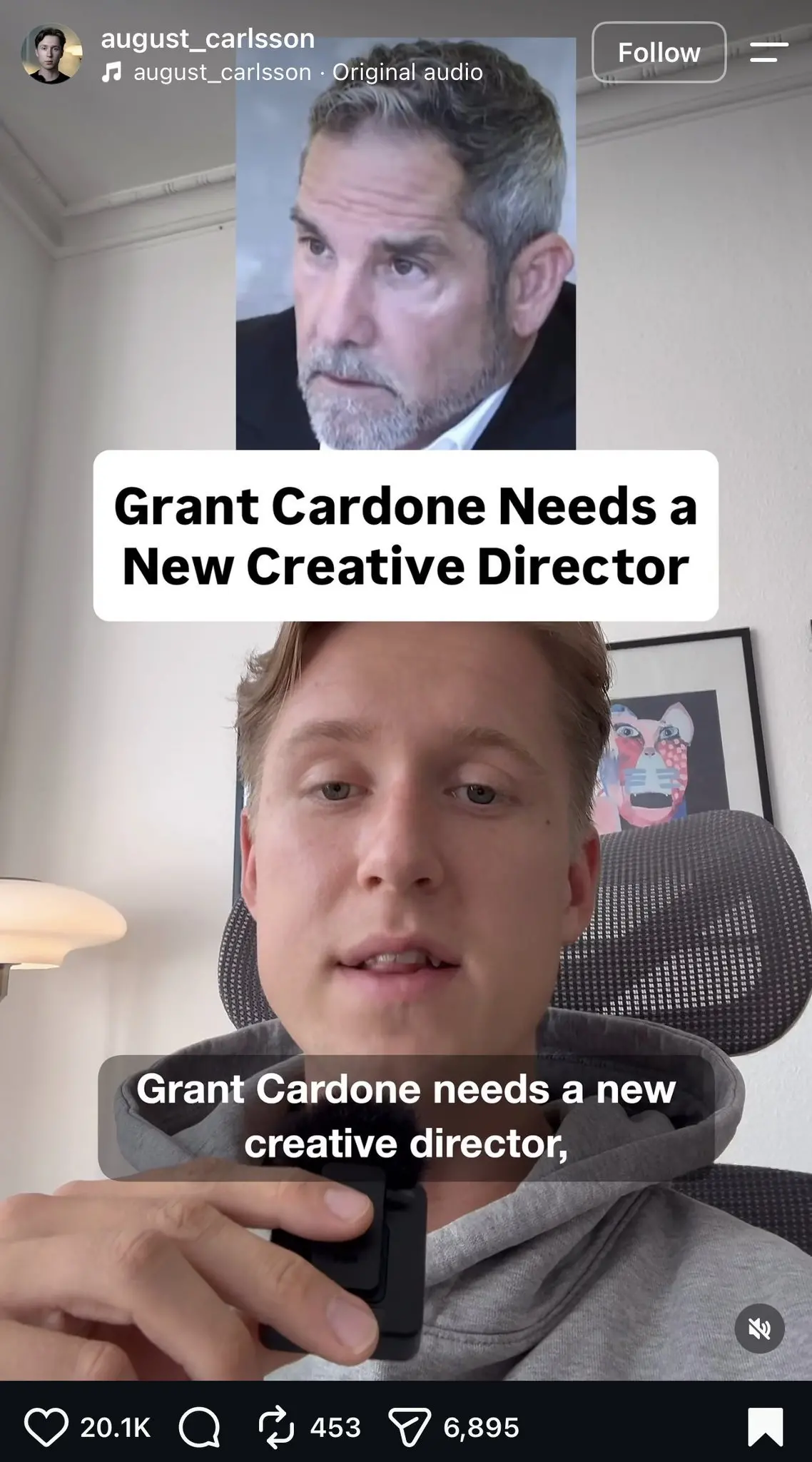
In that short video, he grabbed attention with this line:
"Grant Cardone needs a new creative director, and this is my job application. His content looks like it's still stuck in 2016."
Grant Cardone replied: "Hit me up, I'm definitely stuck." I think that reply, combined with the post's engagement, proves most of the points in this letter. Right now, this is a massive opportunity. And you already have all the tools you need to land these clients, kick off the partnership, and create outstanding content for them.
Hope this helps.
—Dan