





Original author: imToken
If a crypto product has never experienced a user private key leak, does that mean it's secure enough?
The answer is clearly not that simple.
As we all know, from late September to the end of October, the crypto industry went through a rather intense security stress test, with multiple far-reaching security incidents exposed in succession—from the world's leading centralized exchanges to established hardware wallet manufacturers.
If you look carefully at the official statements released after these incidents, you'll notice a recurring phrase: "no evidence that private keys were compromised," or "user private keys and seed phrases were not affected."
But the entry point attackers look for may not be the private key at all—when an exchange's internal permissions can be hijacked, when third-party security products become a springboard into management systems, when hardware devices are implanted with malicious modules, or even when users' real names, contact information, and home addresses are exposed through data breaches, simply emphasizing "private keys were not leaked" is clearly insufficient to cover all the risks users face.
After all, private key security is only the starting point of crypto asset security, not the end point.
This also means we need to re-examine a question: in today's crypto world, how exactly should we judge whether a product is truly secure and reliable?
I. How do attackers bypass private keys, and how are assets and data compromised?
As mentioned in the previous article, if you look at recent security incidents together, you'll notice an obvious trend: attackers don't necessarily need to directly break cryptography and private keys themselves—instead, they may look for breakthroughs across the entire "chain of trust."
From employee endpoints and third-party security products to the software supply chain, service containers, and even transaction authorization processes, a crack in any single link can render an otherwise seemingly rigorous security system useless:
a. In the Bybit incident, attackers used social engineering to compromise a Safe developer's device, obtained their access credentials, and then took control of front-end resources in Safe's wallet infrastructure;
b. In the Bitget incident, attackers exploited vulnerabilities in a third-party security product to obtain internal high-privilege credentials, then bypassed existing risk controls through forged withdrawal instructions;
c. In the latest Binance incident, the attack path likely began with the compromise of a DevOps engineer's laptop (though Binance later stated that further investigation uncovered additional breach points, and the full attack path remains to be confirmed);
Three incidents involving third-party wallet infrastructure, third-party security products, and internal development and operations environments, respectively.
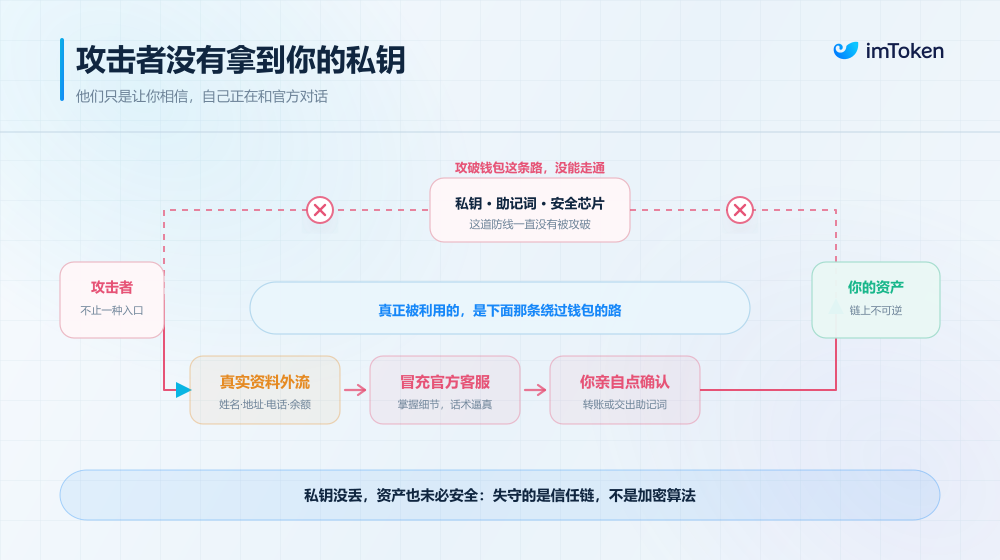
This also explains why traditional cold wallets and multi-signature mechanisms are not a cure-all—after all, what attackers actually exploit are precisely those trust links that can influence final transaction execution but have not been sufficiently independently verified.
Ultimately, in centralized asset management systems, attackers don't necessarily need to directly obtain user private keys—as long as they can control transaction instructions, approval workflows, or wallet execution systems, they may trigger unauthorized asset transfers.
Beyond the asset execution chain, another category of risk is more easily underestimated by ordinary users: data breaches.
In May 2025, Coinbase disclosed an insider data theft incident. Attackers bribed some overseas customer service staff, used their normal work permissions to access internal customer support systems, and stole some users' personal information, account details, and transaction-related information.
Coinbase stated that the incident did not result in the direct leakage of user passwords, private keys, or funds, but the attackers' purpose in obtaining this data was precisely to carry out targeted social engineering attacks later—impersonating official customer service to trick users into transferring assets.
The Keystone incident further demonstrates that user data breaches can also affect hardware wallet device authenticity verification.
On October 20, Keystone's official website was accessed without authorization. According to its subsequent disclosure, attackers exploited vulnerabilities in a third-party data monitoring tool on the website to obtain some users' purchase records and the WebAuth keys used to verify device authenticity.
This means that even if users' seed phrases and private keys were not directly leaked, attackers could still use stolen verification keys to create counterfeit devices that pass official certification, causing users to unknowingly use risky hardware wallets.
Not to mention the device and supply chain security issues exposed by Ledger, which also require manufacturers to ensure that during hardware production, certification, logistics, and sales, there is no possibility of devices being replaced, tampered with, or implanted with malicious modules.
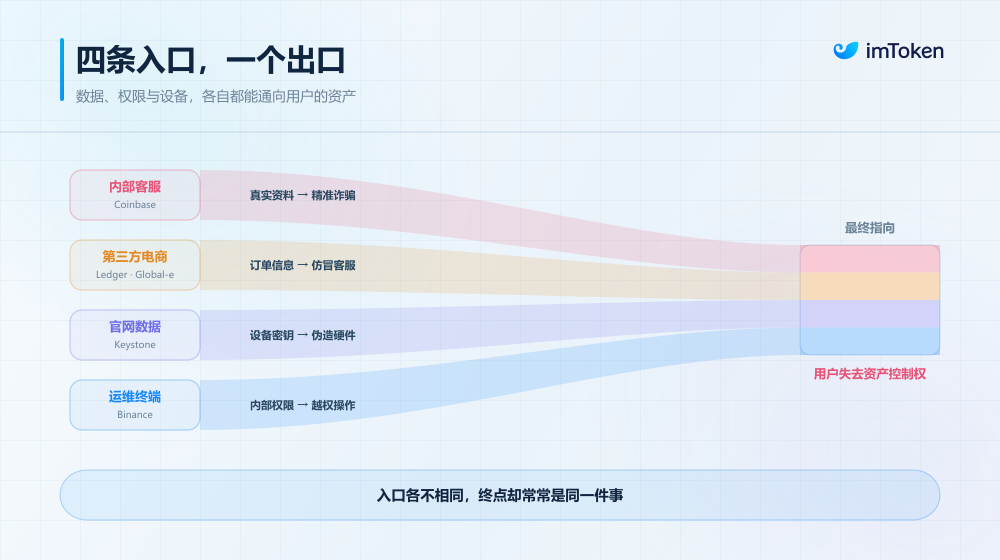
These problems may appear to occur in different parts of a product, but ultimately they can converge on the same outcome: users losing control of their own assets.
So, the fact that private keys were not directly leaked does not mean the product's overall security system has not been compromised—especially as the rapid development of AI is further amplifying this risk.
II. How do you judge whether a crypto product is secure and reliable?
With these incidents in mind, let's return to the question ordinary users actually face: if you want to choose a relatively secure and reliable crypto product, what exactly should you look at?
Compared to brand recognition, product features, and marketing hype, imToken believes there are at least three dimensions worth prioritizing.
1. Private key control: Who actually controls the assets?
This is the most fundamental and most important question when evaluating a crypto product's security architecture.
First, it's necessary to distinguish between two completely different models: custodial and non-custodial.
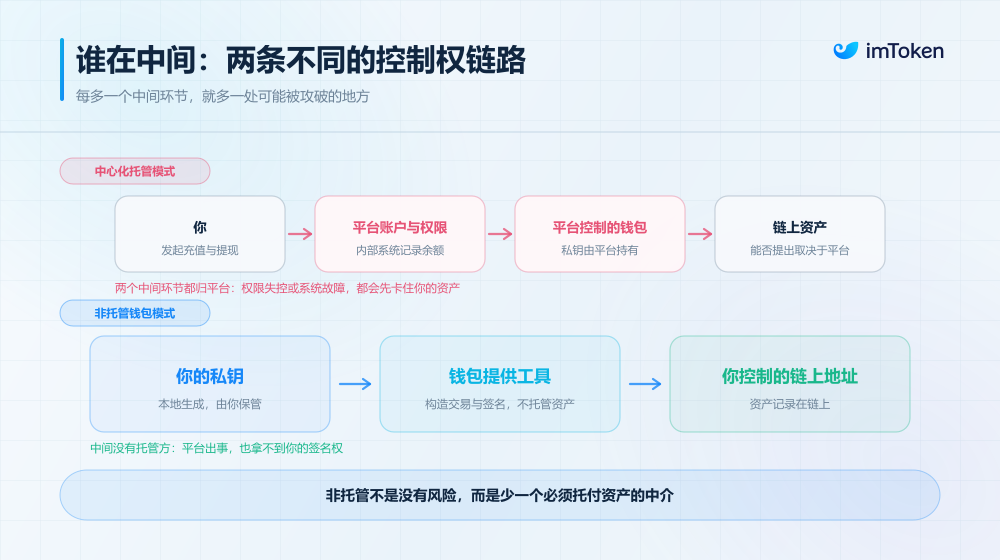
Take centralized exchanges as an example. Users typically manage their assets through an account system. After depositing, assets enter the exchange-controlled wallet system, and the platform records user balances through an internal account system and is responsible for withdrawals, risk control, and fund management.
The advantage of this model is convenience—users don't need to manage private keys themselves, but it also means users must trust the platform's asset custody, internal permissions, and operational management mechanisms. Once the platform experiences system failures, internal permission breaches, or fund management issues, users may be unable to normally access or withdraw their assets.
Non-custodial wallets are different.
When users create a wallet, the private key is generated in the local environment and kept by the user. The wallet mainly handles key management, transaction construction, and signing, while the actual assets are recorded on the blockchain.
Structurally, there is a clear difference between the two:
a. Centralized custody: User → Platform account and permission system → Platform-controlled wallet → On-chain assets;
b. Non-custodial wallet: User holds private key → Wallet provides management and signing tools → On-chain address directly controlled by the user;
This means the non-custodial model reduces the platform's role as asset custodian and reduces the steps where users must rely on a centralized platform to control their assets.
Of course, this doesn't mean non-custodial wallets are absolutely secure.
Users need to back up their seed phrases themselves, protect device security, and take responsibility for every transaction and signature. If the seed phrase is leaked, or if the user actively signs a malicious transaction, assets can still be lost.
Therefore, when choosing a wallet, you should at least clarify three questions: Is the private key generated on the user's device or on the server side? Will the private key and seed phrase be uploaded to the service provider's servers? Does the user truly hold signing authority, and can they recover their assets in other compatible wallets?
2. Data privacy: How much information about you does the product actually collect?
The second dimension is privacy protection, which many users tend to overlook.
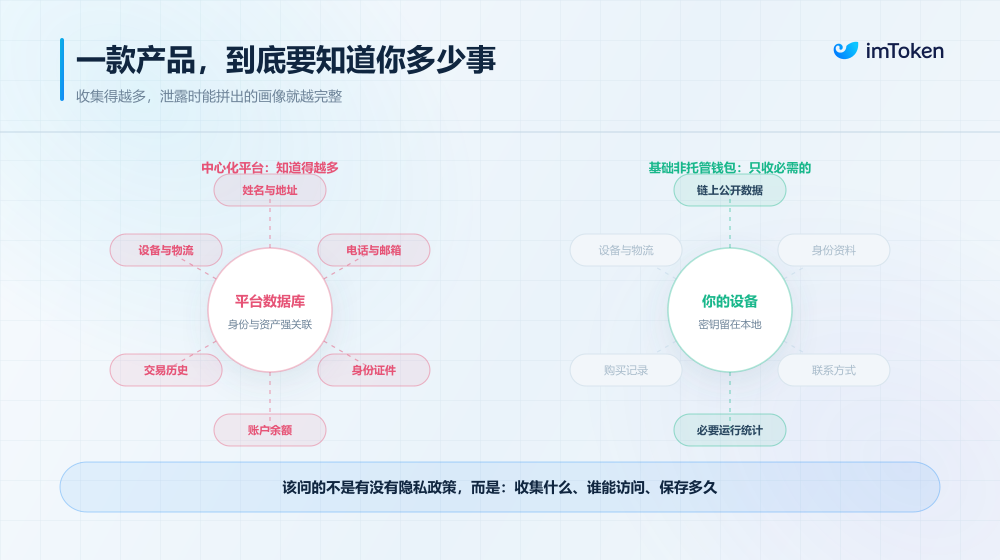
When using crypto products, users may leave behind a large amount of information, including email addresses, phone numbers, identity verification materials, device information, purchase records, shipping addresses, and even account balances and transaction history.
Not every product needs to collect all of this data.
For example, centralized exchanges typically require identity verification due to account systems and compliance requirements, while a basic non-custodial wallet's core function is locally managing keys and initiating on-chain transactions—it doesn't need to collect users' real identity information in the same way.
What's most worth paying attention to here is whether the product follows the principle of data minimization.
For example, is there unnecessary correlation between users' real identities, contact information, device information, and on-chain addresses?
Once this data is centrally stored, attackers can more easily build complete user profiles, leading to "$5 wrench attacks"—after all, no matter how strong the encryption algorithm is, it cannot solve the problem of attackers directly locating asset holders.
3. Security architecture: Are there security mechanisms that have been continuously verified?
The third dimension is the technical security capability behind the product.
For software wallets, focus should be on private key generation, encrypted storage, transaction signing, and code security; for hardware wallets, further attention should be paid to secure chips, firmware integrity, device authentication, and supply chain management.
But regardless of the product type, there are some universal criteria for evaluation.
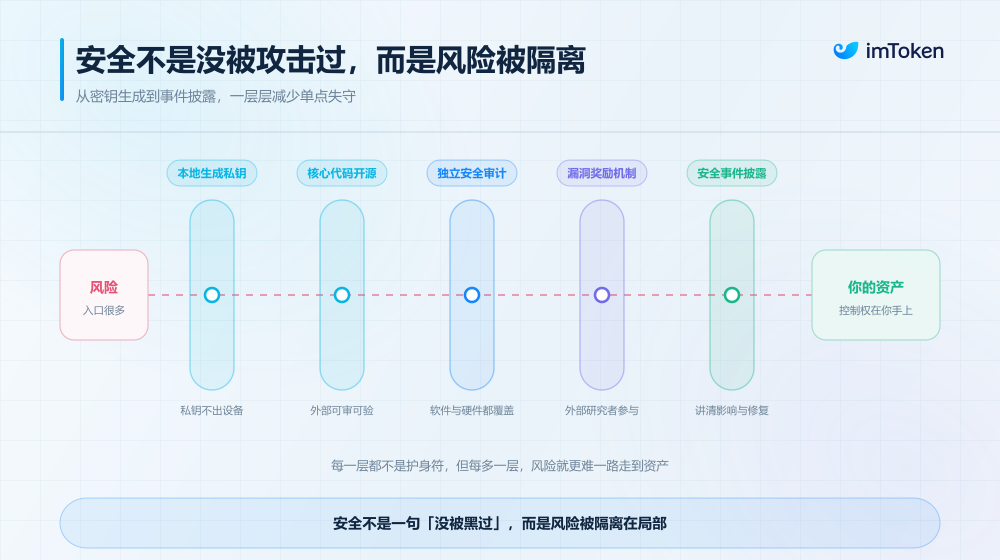
First, whether the core code is reviewable. Open source doesn't mean absolutely secure, but it at least gives external developers and security researchers an opportunity to review critical code.
Second, whether it has undergone independent security audits—you can check whether the product collaborates with professional security firms, which modules the audits cover, which versions they correspond to, and whether discovered issues have been fixed.
It's important to note that an audit report is only a security assessment at a specific point in time and within a specific scope—it doesn't mean the entire product is free of vulnerabilities from that point on.
Third, whether bug bounty and continuous testing mechanisms are in place. Security is not a one-time effort—as products are continuously upgraded and new chains and third-party components are integrated, the attack surface keeps changing. So whether there are public vulnerability feedback channels, bug bounty programs, and well-established version review and permission management mechanisms are all indicators worth watching.
Finally, whether the product has sufficient security transparency—such as whether it can promptly disclose the scope of impact, cause of the attack, user response measures, and remediation progress after a security incident occurs. This is also an important criterion for judging whether a product is worthy of long-term trust.
Ultimately, security audits, open source, hardware isolation, and bug bounties are not individual talismans.
A truly reliable security system should be able to isolate risk to the greatest extent possible—even if a problem occurs in one link, it should not easily escalate into a complete loss of user control over assets.
III. How can Web3 products build a long-term security system?
Returning to wallet products themselves, taking imToken's security philosophy as an example, the core is to let users hold asset control to the greatest extent possible, while reducing the possibility of private key and sensitive information exposure through product architecture and continuous security reviews.
1. Non-custodial architecture: Let private keys truly stay in users' hands
Unlike platforms that require centralized custody of user assets, imToken adopts a non-custodial wallet architecture.
In this model, when users create a wallet, the private key is generated locally and kept by the user. imToken does not store users' private keys or seed phrases, nor does it control on-chain assets on behalf of users through a centralized account system.
Currently, the imToken software wallet uses secure random number sources provided by iOS and Android systems to generate private keys locally, and the core code TokenCore has been open source since 2018.
For the imKey hardware wallet, seed phrases and private keys are generated through a true random number generator (TRNG) built into the secure chip, providing an independent hardware security foundation for key generation.
The significance of this design is not just giving users a seed phrase.
More importantly, it reduces, at the architectural level, the necessity for service providers to access and centrally manage user private keys, lowering the risk that problems with platform servers, internal staff permissions, or centralized custody systems directly affect users' control over their assets.
2. From data privacy to code audits: Security goes beyond private keys
The non-custodial architecture solves the asset control problem, but a wallet still needs to face security challenges brought by applications, servers, third-party components, and external interactions.
In terms of data privacy, imToken has publicly stated that the product uses development tools like Sentry and Firebase for error reporting and statistics, but does not collect sensitive data related to wallet security. This means that necessary product operation statistics and core security information such as user private keys and seed phrases need to maintain clear boundaries in product design.
In terms of technical review, imToken has long collaborated with professional security firms such as SlowMist to conduct security audits of software wallets, hardware wallets, and smart contracts.
At the same time, the product has a dedicated internal security team that reviews code permissions, version updates, and third-party dependencies, and conducts black-box and white-box security testing before product launches.
Together, these mechanisms form a continuous security management system covering the entire process—from key generation and storage to code updates, external audits, and vulnerability discovery and remediation—rather than relying on a single technology or a one-time security certification.
3. Security is not about never being attacked, but about making it impossible for risk to easily reach assets
For users who hold large amounts of crypto assets long-term, relying solely on everyday internet-connected devices may not be the most suitable approach to asset management.
In addition to using hardware wallets, imToken also supports transferring transaction information between an offline wallet and a watch-only wallet via QR codes.
Specifically, users can prepare an old phone that is no longer connected to the internet, install imToken and create an offline wallet, then use QR code connectivity supporting the ERC-4527 protocol to work in conjunction with a watch-only wallet on another internet-connected device.
When users need to transfer funds, the internet-connected device constructs an unsigned transaction and passes it to the offline device via QR code; the offline device verifies the transaction content, uses the local private key to complete the signature, and then passes the signed result back to the internet-connected device via QR code for broadcasting.
Throughout the entire process, the offline device's private key never needs to touch the internet—this is equivalent to adding a physical isolation layer to the daily asset management workflow, reducing the possibility of network attacks directly reaching the private key.
For users who want further hardware-level protection, the imToken ecosystem also offers the imKey hardware wallet.
imKey uses the Infineon SLE78 series security chip, whose underlying M7893 security controller platform has passed CC EAL6+ enhanced certification, supporting capabilities such as secure storage, secure boot, and true random number generation.
At the same time, imKey also provides verification mechanisms such as device binding codes, first-time activation processes, and device activation status queries to help users identify whether the device is in its expected usage state.
These measures are especially worth understanding in the context of the recent Ledger and Keystone incidents—hardware security is not just about the chip itself being reliable enough; it also requires consideration of device provenance, initialization processes, and authenticity verification.
Of course, device authentication mechanisms are not absolute anti-counterfeiting guarantees. Users should still purchase through official channels and carefully verify device status when using for the first time.
Final thoughts
Looking back at a series of security incidents involving Binance, Coinbase, Ledger, and Keystone, we can see that the security boundaries of crypto products are becoming increasingly complex.
What users need to protect is no longer just seed phrases and private keys, but also identity information, purchase records, device authenticity, and sensitive data that may be exposed throughout the entire usage process.
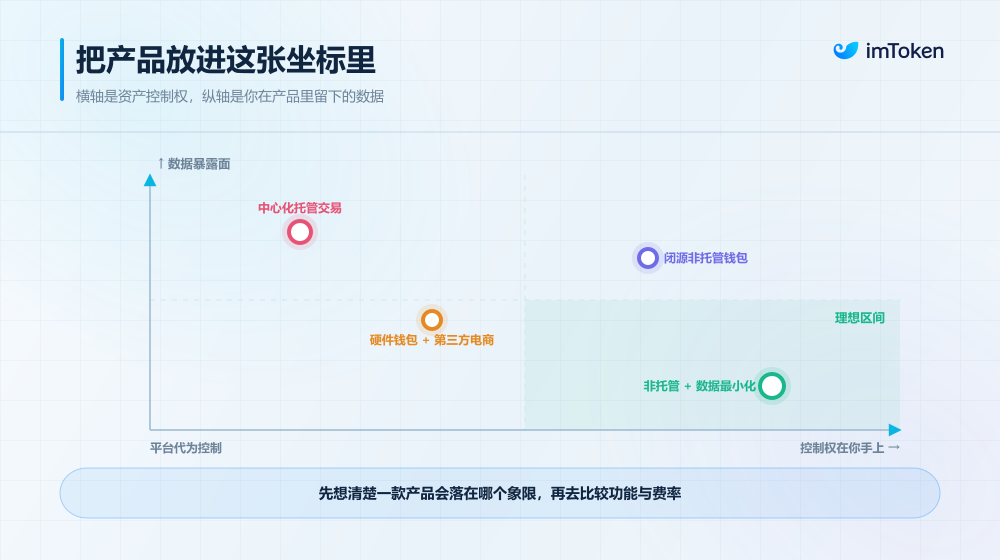
For ordinary users, when choosing a crypto product, you might first ask yourself three questions:
Who holds my private key? Do I truly have control over my assets? What data does the product collect about me? Will this information be over-collected, retained long-term, or handed over to third parties? How does it prove it's secure enough? Does it have reviewable code, independent audits, and continuous security response mechanisms?
No product can promise absolute security.
But a crypto product truly worthy of long-term use should at least reduce unnecessary trust links in its architecture, lower users' exposure at the data level, and continuously undergo review and verification at the technical level.
After all, in the crypto world, the ultimate goal of security is not to make users believe that a certain brand will never have problems, but to ensure that users always retain control over their own assets.