





Original author: golem
Key insight: The biggest obstacle to stock tokenization has shifted from regulators to the listed companies themselves. Fifty-six U.S. public companies have exercised their right to object to OKXICE launching tokenized stocks — a battle that is fundamentally about control and profit-sharing between traditional issuers and crypto platforms.
Key points:
a. Fifty-six companies (including Amazon, Tesla, and Nvidia) filed objections, representing 90% of the 62 companies initially proposed for inclusion, with a combined market cap exceeding $31 trillion — roughly 42% of total U.S. stock market capitalization.
b. Under the SEC's innovation exemption policy, OKXICE can ultimately list only 13 U.S. stock tokens, including Apple, Coinbase, Robinhood, and other companies that did not object.
c. Listed companies have three core concerns: fragmentation of pricing and liquidity undermining price discovery efficiency, reduced visibility into trading activity, and abnormal price swings in third-party tokens potentially damaging issuer reputation.
d. The fundamental conflict is a lack of incentive — third-party platforms monopolize control and fee revenue while issuers bear only the risk, which is why issuers prefer to pursue their own tokenization paths.
e. Nasdaq has withdrawn from the third-party framework and is instead pushing forward with Nasdaq Equity Token, which shares the same CUSIP and order book as traditional shares, preserves issuer control, and is slated for launch in the first half of 2027.
f. The competition extends to derivatives: after the CFTC approved U.S. stock perpetual futures, Citadel, CBOE, and other Wall Street players immediately filed lawsuits, intensifying the clash between traditional finance and crypto forces.
Original |Odaily Planet Daily (@OdailyChina)
Author|Golem (@web3_golem)
Today, the biggest obstacle to stock tokenization is no longer regulators — it's the listed companies themselves.
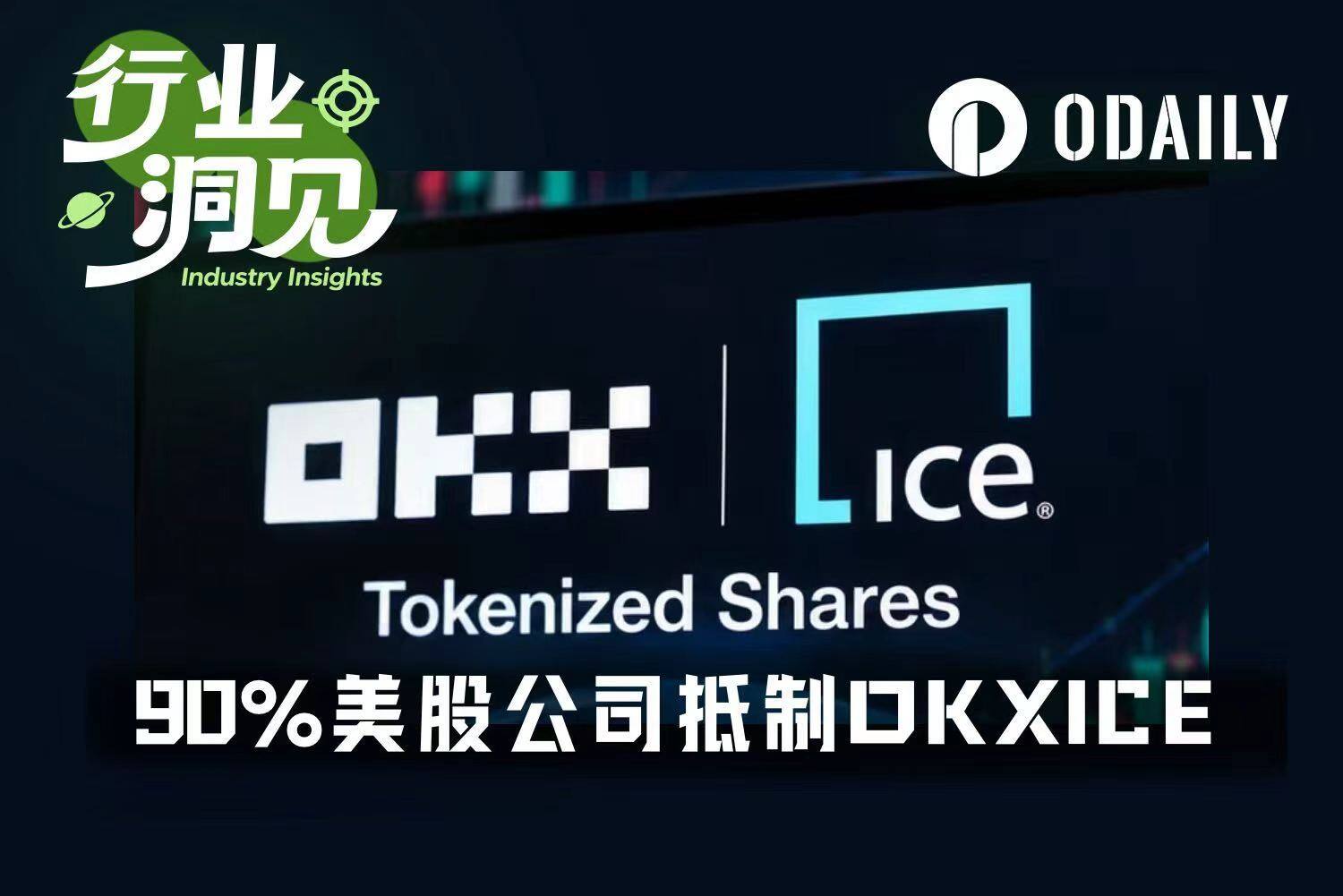
According to a November 2 announcement by OKXICE, the number of companies opposing OKXICE's listing of tokenized stocks has grown to 56, including popular U.S. stocks such as Amazon, Tesla, SpaceX, and Nvidia. The objecting companies account for 90% of the 62 firms initially proposed for inclusion. Together, these 56 companies represent a combined market cap exceeding $31 trillion — roughly 42% of total U.S. stock market capitalization.
As of press time, 13 companies have not filed objections with OKXICE, including Apple, Strategy, Robinhood, Coinbase, Palantir, Circle, Securitize, BitGo, ServiceNow, GE Vernova, Boeing, Home Depot, and Super Micro Computer. Securitize and BitGo have previously stated they do not plan to object.
OKXICE is a joint venture between crypto exchange OKX and Intercontinental Exchange (ICE), planning to launch stock tokens on X Layer. However, under the SEC's stock tokenization innovation exemption policy, listed companies have the right to object to third-party stock token platforms within 30 days.
OKXICE published its initial announcement on October 4. If OKXICE sent written notices to the 62 companies that same day, then by the deadline (November 3), only two companies had expressed clear support while 90% explicitly opposed — meaning under SEC rules, OKXICE can ultimately list only 13 U.S. stock tokens.
Although the 30-day objection window starts from the date each listed company receives written notice — meaning November 3 may not be the deadline for all companies — being able to list 13 stock tokens is already the best outcome OKXICE can achieve at this point.
What Are Listed Companies Worried About?
So why are these listed companies so resistant to third-party platforms trading their shares? After all, on the surface, stock tokenization offers listed companies a new trading channel that theoretically could expand their investor base, extend trading hours, and even bring more liquidity to their shares. This is also the main argument used by market proponents of stock tokenization.
But for issuers, more trading channels do not necessarily mean a better trading ecosystem.
From the perspective of third-party platforms like OKXICE, the more stock tokens they can list, the better — a richer selection of underlying assets satisfies diverse investor needs, creates economies of scale, and attracts more capital and traders. But from the perspective of listed companies/issuers, launching stock token trading on a trading system where they lack direct control and which operates relatively independently from traditional securities markets carries risks that far outweigh the incentives.
Based on the objections raised by listed companies so far, the core concerns center on three areas: fragmentation of pricing and liquidity, reduced visibility into trading activity, and the possibility that third-party trading outcomes could damage issuers' market reputation.
Pricing and Liquidity Fragmentation
In traditional stock markets, trading in a given stock is concentrated on its listing exchange and related securities markets, allowing investors to observe price, volume, and order book changes through a relatively unified market data system. But if third-party platforms also begin issuing and trading corresponding stock tokens, the same company could have multiple trading prices and volume data points simultaneously.
Even if stock token prices are anchored to the underlying share price, that doesn't mean quotes on both sides will always stay in sync. When differences arise in trading hours, bid-ask depth, and arbitrage efficiency across markets, price deviations between tokens and underlying shares can occur.
At the same time, for the U.S. stock market — the global leader in "capital dominance" — most listed companies and issuers are inherently skeptical of the argument that stock tokens will attract more investors. They tend to believe that stock liquidity won't automatically increase just because an on-chain trading channel is added — and that it could even have the opposite effect.
If trading demand originally concentrated in traditional securities markets gets diverted across multiple platforms, order book depth in each market could decline and bid-ask spreads could widen. For listed companies/issuers, this liquidity fragmentation could ultimately undermine price discovery efficiency.
Stephen Wink, global co-chair of Latham's Fintech Industry Group, has noted that if trading volume in such stock tokens is low, a major concern for listed companies is price dislocation, which could put pressure on the underlying share price and send misleading signals to the broader market.
Reduced Visibility into Trading Activity
Second, listed companies worry that their real-time understanding of stock trading activity will be compromised.
Traditional securities markets have relatively mature market data disclosure and trade reporting systems, allowing listed companies, investors, and regulators to observe stock prices and trading volumes through established channels. But when stock tokens trade independently on third-party platforms, that data may not be fully incorporated into the traditional market's consolidated market data system.
Stock token trading on third-party platforms cannot be directly integrated into the securities market data systems that issuers currently rely on. If liquidity does become dispersed across these platforms in the future, listed companies and issuers may be unable to accurately reflect their securities' overall trading activity across different venues within a single dataset — including trading scale, participant structure, and specific behaviors.
Nasdaq, as an issuer, has publicly stated its withdrawal from the TSV tokenization operating framework, arguing that the framework would impair issuers' ability to comprehensively, accurately, and promptly understand their own securities' prices and trading activity.
Increased Reputational Risk
Under the current innovation exemption policy, listed companies only have the right to object after receiving written notice from a third-party platform. If they do not object within 30 days, it is deemed tacit approval of the third-party platform listing stock tokens. This differs from the previous approach where crypto platforms listed U.S. stock trading through SPV structures or directly listed U.S. stock perpetuals — in those cases, if problems arose with U.S. stock tokens/contracts, listed companies could distance themselves by claiming ignorance or non-involvement. But if problems arise with tokens on TSV, listed companies as tacit approvers could very well bear partial responsibility.
For example, if a stock token experiences significant price deviation from the underlying share — or even abnormal volatility — due to insufficient liquidity, limited market-making depth, or the platform's own technical and operational issues, ordinary investors may not carefully distinguish between the legal relationship and trading mechanisms of stocks versus stock tokens. Instead, they may directly associate that price behavior with the listed company itself.
For listed companies with massive market caps and broad investor bases, they are clearly unwilling to assume additional reputational risk just to add a trading channel.
The Real Issue Is Still Conflicting Interests
That said, all of these problems could be solved one by one — if listed companies and issuers were willing to cooperate with TSV. But based on the current situation, they have no intention of cooperating, and the fundamental reason is a lack of incentive.
For listed companies and issuers, agreeing to let TSV platforms list stock tokens means bearing numerous risks while gaining only one incentive — a new trading channel (of uncertain effectiveness) — while control, revenue sharing (third parties may capture liquidity/fees), and other benefits are monopolized by TSV.
So rather than supporting TSV, listed companies would prefer to advance or support issuer-led tokenization paths themselves. The SEC innovation exemption policy's objection right applies only to tokens created by unaffiliated third parties; tokens created by the issuer itself or its agents do not trigger the 30-day objection window.
Nasdaq is a typical example. Although it withdrew from the TSV tokenization operating framework, it is aggressively pushing forward with Nasdaq Equity Token. Through partnerships with Kraken's parent company Payward and others, Nasdaq has achieved tokenization within the existing exchange framework, ensuring the same CUSIP and order book as traditional shares, settlement through a DTC pilot, and preserving issuer control over ownership, investor identity, and proxy processes. Nasdaq CEO Adena Friedman stated in the Q3 earnings report that the Nasdaq Equity Token is planned for launch in the first half of 2027.
Thus, in the stock tokenization arena, the traditional market forces represented by listed companies and issuers have effectively entered into competition with the emerging market forces represented by crypto companies. And under the SEC innovation exemption policy, listed companies and issuers will be both "players and referees." As long as listed companies actively exercise their objection rights against third-party tokenization, they can protect their control and interests while impeding the operations of third-party stock token trading platforms.
This confrontation is not limited to underlying shares — Wall Street and crypto companies are also engaged in fierce competition over derivatives. On November 3, the CFTC approved U.S. stock perpetual futures for trading on regulated U.S. exchanges. As soon as the policy landed, the traditional Wall Street camp — led by Citadel Securities and the Chicago Board Options Exchange — swiftly filed lawsuits in federal court, fundamentally out of concern that perpetual futures would disrupt the traditional options market.(Related reading: U.S. Makes Historic Move to Approve Stock Perpetual Futures, Wall Street Giants Panic)
With regulation no longer the biggest obstacle, the battle for dominance over stock tokenization and the traditional finance revolution may have only just begun.