





Original author: Xiaojing
Original translation/compilation: Xu Qingyang
On November 4, Tencent Hunyuan officially released its new-generation large language model, Hy4. Compared with the previous Hy4 preview, the new model further expands the scale of pre-training and post-training, introduces visual understanding capabilities for the first time, and places key emphasis on strengthening instruction following, long-text understanding, long-horizon Agent capabilities, and performance on real productivity tasks.
Hy4 has a total parameter scale of 770B, adopts a mixture-of-experts architecture, and supports Computer Use for the first time, enabling it to combine command-line and graphical interfaces to execute complex tasks.
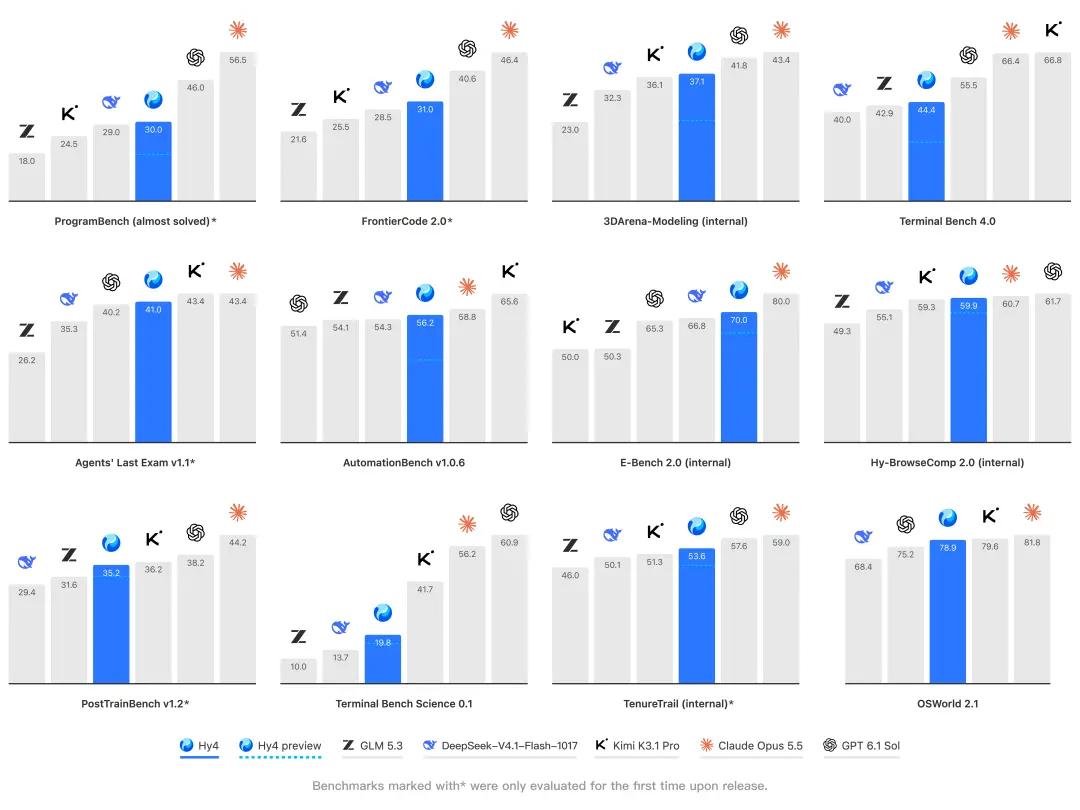
Judging from the evaluation results, Hy4 has already entered the ranks of the world's top-tier open-source models, and the model weights will also be open-sourced in the near future. The Hunyuan team stated that although Hy4 is already one of the strongest open-source models currently available, there is still a considerable gap between it and top closed-source models. Hunyuan will continue to steadily expand the scale of pre-training and post-training and strive to narrow the gap with top closed-source models.
In response to the potential security risks of the model in areas such as cyber and biology, Hunyuan is conducting training, open-sourcing, and release in a more responsible manner.
01 Joining the Ranks of the Strongest Open-Source Models
In terms of visual understanding, Hy4 can identify details in images, analyze complex charts, and combine reasoning capabilities to complete visual math tasks. The newly introduced Computer Use capability allows the model to operate graphical interfaces and command lines. Tencent Hunyuan has carried out specialized training for professional software such as Blender and CAD, as well as for long-horizon tasks that require cross-application collaboration.
At the same time, Tencent is improving the model's performance in real work through deep Co-Design between the model and products.
In the WorkBuddy office scenario evaluation, Hy4 achieved an average effectiveness score of 83.18 points, with a task pass rate of 96.15%, ranking first in China in 9 out of 12 scenarios. With the WeCom suite, the model can also correlate information such as chat records, emails, documents, schedules, and meetings, sort out the progress of multiple projects, identify to-dos, and help prioritize them.
Professional financial analysis is another key upgrade. Tencent has built thousands of workspaces and tens of thousands of high-quality training tasks for scenarios such as fund research, securities analysis, and quantitative strategies.
In a public test involving 213 financial experts and covering 579 real tasks, Hy4 scored 3.04, higher than Kimi K3.1 Pro (2.68), GLM-5.3 (2.68), and DeepSeek-V4.1-Flash-1017 (2.97), which were compared in the same session.
In response to the information accuracy requirements of scenarios such as finance, Hunyuan also carried out targeted optimization in time-sensitive retrieval, multi-source information integration, and factual consistency verification. Internal test results show that Hy4's hallucination rate dropped from 12.95% in the preview version to 7.2%, and the error rate caused by guessing dropped from 23.1% to 5.6%.
In front-end and game development, Hy4 further improved capabilities in complex interaction, business logic, and state management, and strengthened adaptation to mainstream game engines such as UE, Unity, and Godot. Compared with the preview version, the GameDev and GameLogic evaluation scores increased by 19.1% and 9.8%, respectively.
In the field of scientific research, Hy4 further combines complex reasoning, scientific programming, and long-horizon task execution capabilities. In the internal TenureTrail evaluation covering 7 major disciplines and 123 executable research tasks, the model demonstrated strong task-handling capabilities in directions such as mathematical construction, physics modeling, Earth environment, and systems engineering.
More notably, Hy4 has begun to participate in the R&D of AI models themselves. Tencent Hunyuan is preparing for Recursive Self-Improvement (RSI), using Hy4 together with the Hyra 2.0 R&D framework to collaboratively optimize the pre-training infrastructure of small models and automatically complete model training. Hunyuan has also open-sourced the single-cell representation foundation model HyCell and the physical field foundation model HyPDE, which were developed with the assistance of this system, in an attempt to turn AI-assisted scientific research capabilities into reusable tools.
In terms of cybersecurity, Hy4's training only includes defensive cybersecurity data related to PoC generation and vulnerability remediation, while excluding offensive training content such as vulnerability exploitation, reverse engineering, and penetration, in an effort to avoid improving potential offensive capabilities. Hunyuan organized security experts from Tencent Xuanwu and Keen Labs to conduct audits in areas such as cryptanalysis, reverse engineering, and vulnerability exploitation. The results show that Hy4 does not exhibit prominent risks in offensive capabilities such as reverse solving of encryption algorithms, adversarial binary obfuscation, and vulnerability exploitation.
In terms of biosecurity, there is a clear gap between Hy4's open-ended experimental design capability and frontier models (Hy-BioExperimentBench: 30.4/100). Hunyuan organized internal experts to audit trajectories and found that the model has a strong grasp of basic biological knowledge, but its ability to translate knowledge into executable experimental plans remains limited, and no evidence has been found that it can significantly lower the threshold for carrying out biochemical harmful behavior.
These upgrades also continue the R&D cadence of Tencent Hunyuan since 2026. Since rebuilding its infrastructure in February, Hunyuan has launched a major version on average every two months, first releasing a Preview and then iterating to an official version based on user feedback. From the Hy3 series with fewer than 300B parameters to the 770B Hy4 series, model scale and training investment have continued to expand. It is reported that the next generation, Hy5, will be further expanded in scale.
Tencent Hunyuan takes "model practicality" as its core principle, continuously pursuing the upper limit of intelligence while providing users with cost-effective services. While Hy4's model performance greatly surpasses that of Hy4 preview, pricing remains unchanged: 6 yuan per million input tokens, 18 yuan per million output tokens, and 0.3 yuan per million tokens for cache hits.
Hy4 flash will also be released soon. Building on Hy4's capabilities, Hy4 flash significantly reduces task costs and provides users with an extremely cost-effective model.
At present, Hy4 has already gone live in products such as Tencent Cloud Tokenhub, WorkBuddy/CodeBuddy, Yuanbao, the WeCom intelligent assistant Dayuan, and ima, and its API has also been connected to platforms such as OpenRouter, Hermes, and OpenCode. Tencent products such as QQ, Honor of Kings, Game for Peace, WeRead, and Tencent News are also continuing to integrate it.
To collect more user feedback and continuously improve model capabilities, WorkBuddy/CodeBuddy will provide users with a certain amount of free usage from November 4 to November 15. In addition, from now until December 31, 2026, Hy4 will be billed at 50% of the list price on Tencent Cloud TokenHub.
Judging from these technical upgrades and evaluation data, Hy4 is extending toward more complex real-world tasks. We also selected four different scenarios right away for hands-on testing.
02 Creating a Solar System with One Sentence
We first gave Hy4 a "wish-style" task: create an interactive solar system webpage for a 9-year-old child, so the child can click on planets, observe their movement, adjust orbital speeds, and understand why a year is different in length on different planets. That was the entire prompt—just one short sentence.
The model ultimately delivered an interactive webpage.
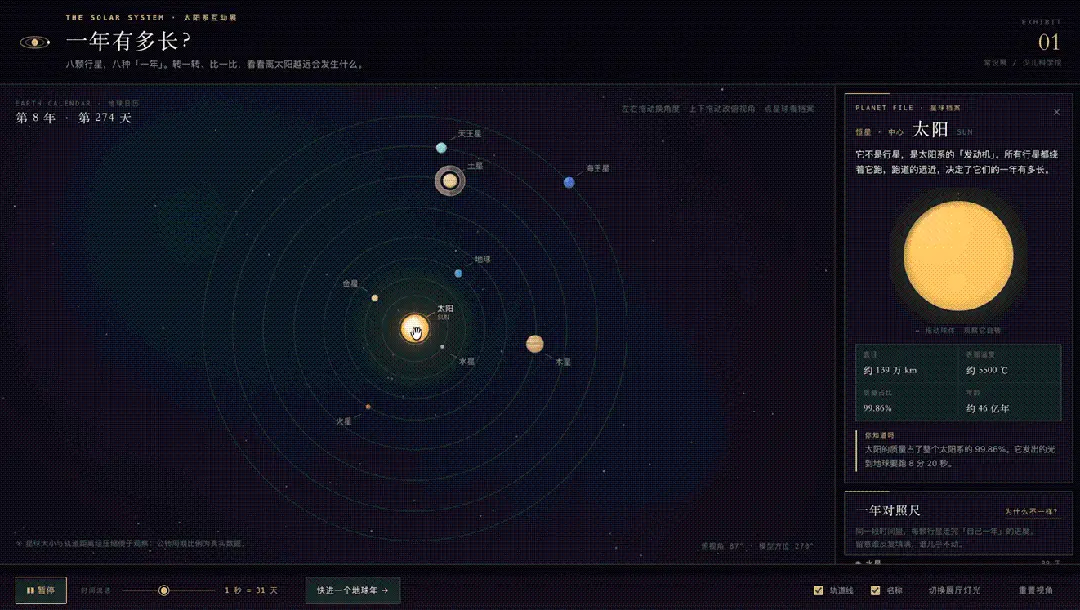
The page uses a deep blue starry background, with a glowing sun in the center and eight planets distributed across their respective orbits. The overall visual style resembles a digital interactive exhibit in a science museum.
As for "helping the child understand why a year is different in length," the model designed an intuitive comparison: as time progresses, by the time Earth completes one orbit around the sun, Mercury has already completed more than four orbits, while Neptune has only traveled a small segment of its orbit.
It also added interactive features such as Earth-year fast-forward, planet profiles, time-speed adjustment, and view switching. Clicking on different planets allows users to view diameter, distance from the sun, and rotation and orbital periods.
These details were not written item by item into the original instructions.
For example, to help the child understand orbital periods, the model added a set of progress bars on its own; to avoid scientific misleading, it also noted that planet sizes and orbital distances were compressed, and that orbital periods were set according to real astronomical data.
Judging from the completed page, the model was already able to transform a relatively vague educational need into a concrete work that balances visual effects, knowledge presentation, and interactive operation.
The execution record also shows that it used Chrome to conduct 15 interaction checks, involving operations such as clicking, dragging, theme switching, and time fast-forwarding.
What the user proposed was an educational goal, and the AI needed to think on its own about how to help a 9-year-old truly understand this knowledge point. This is also what makes "wish-style programming" most appealing to ordinary users: people can make requests in a way close to everyday conversation, leaving the model to take on more product design and technical implementation work.
03 A Cluttered Fridge, and Hy4 Directly Plans Future Menus
Tasks such as "making a solar system simulation webpage" still start from text. When users no longer provide clear verbal descriptions but instead directly show AI a problem from the real world in a photo, how much can it understand?
We also sent Hy4 a photo of a completely packed fridge and asked it to arrange nine meals over the next three days for a family of three, with an additional grocery budget of no more than 100 yuan, and each meal taking no more than 40 minutes to cook.
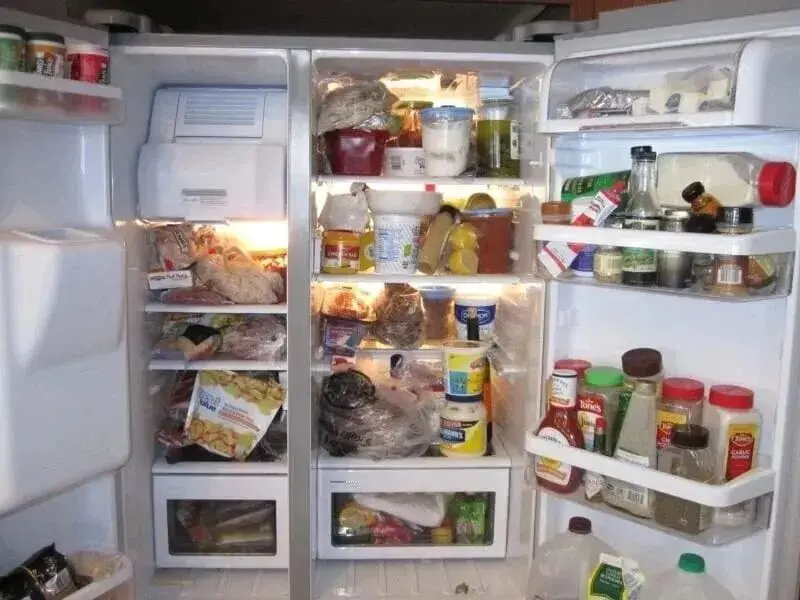
This test first challenges visual understanding. The fridge contains many overlapping, obscured, and opaque packaged items, and light reflections also increase the difficulty of identification. The model first zoomed in on the photo by area, inventoried the ingredients layer by layer, identified tomatoes, cucumbers, zucchini, frozen mixed vegetables, bread, condiments, and so on, and also made preliminary estimates of inventory quantities.
Interestingly, it did not pretend to see everything clearly.
For the pink vacuum-packed item on the middle-left shelf, the model judged that it could be chicken, pork chops, ham, or fish; whether the large white jar on the right door was yogurt, cream, or cheese sauce could not be confirmed either. It listed four visual uncertainties affecting menu planning, marked these ingredients as pending confirmation, and adopted a conservative approach in subsequent plans.
After that, the model continued to formulate a shopping list and a three-day menu based on the recognition results.
This task tested the model's ability to go from visual recognition to practical planning. It needed to determine, when the information provided by the photo was incomplete, which ingredients could be used and which needed further confirmation, while also taking into account budget, taste, time, and ingredient consumption.
Truly useful visual understanding is not only about what is seen, but also about knowing what has not been seen clearly and how those uncertainties affect subsequent decisions.
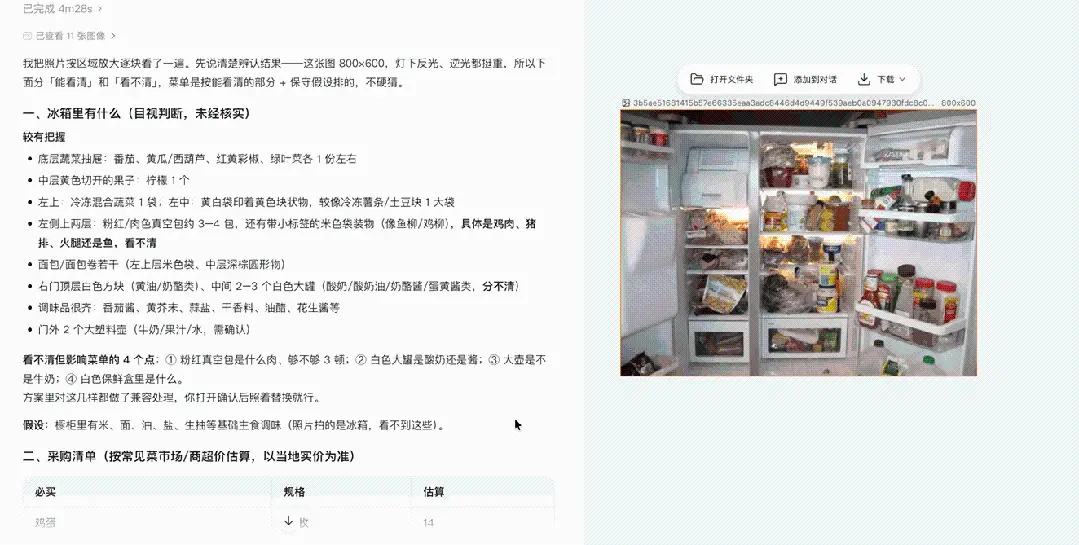
More complicated still, we added further requirements: two unexpected guests suddenly appear on the second evening, one of whom is vegetarian and the other allergic to peanuts. The budget cannot increase, and the food arrangements for the third day cannot be affected.
This kind of task requires the model to maintain a continuously changing inventory and budget state. It needs to remember what has already been consumed, rearrange subsequent ingredient allocation, and incorporate dietary restrictions into consideration. Hy4 even provided a fallback strategy to prevent waste.
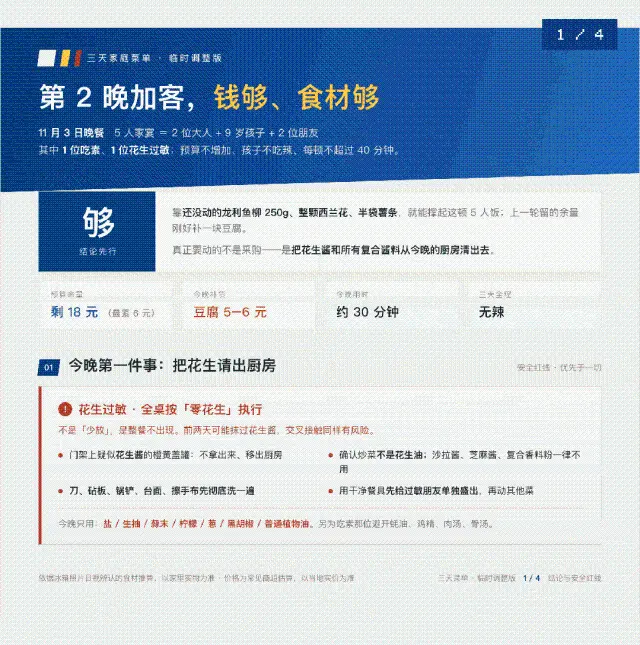
Many requirements in the real world are exactly like this. Users often describe only the goal, while the remaining constraints and details need to be proactively discovered, reasonably inferred, or further confirmed by the model.
04 Hy4 as an Editor, Daring to Question the Numbers Given by the User
Beyond creativity and planning ability, in real life we also often need models to provide references for independent judgment.
We gave Hy4 a performance promotional graphic for a fictional AI company, with the prompt: Please analyze this performance promotional graphic for a fictional AI company that I uploaded. You need to judge, like a rigorous financial editor, whether the promotional conclusions in the image are true.
Please complete the following tasks:
1. Fully extract all key financial figures and text from the image.
2. Independently calculate the revenue growth rate, operating profit, and profit change percentage.
3. Identify all obvious errors, exaggerated claims, or visual designs in the image that may mislead readers.
4. Explain why the setting of the vertical axis of the bar chart changes readers' intuitive perception of the magnitude of growth.
5. Provide a specific plan for how a more standardized chart should be modified.
6. Write a financial news verification conclusion within 150 words.
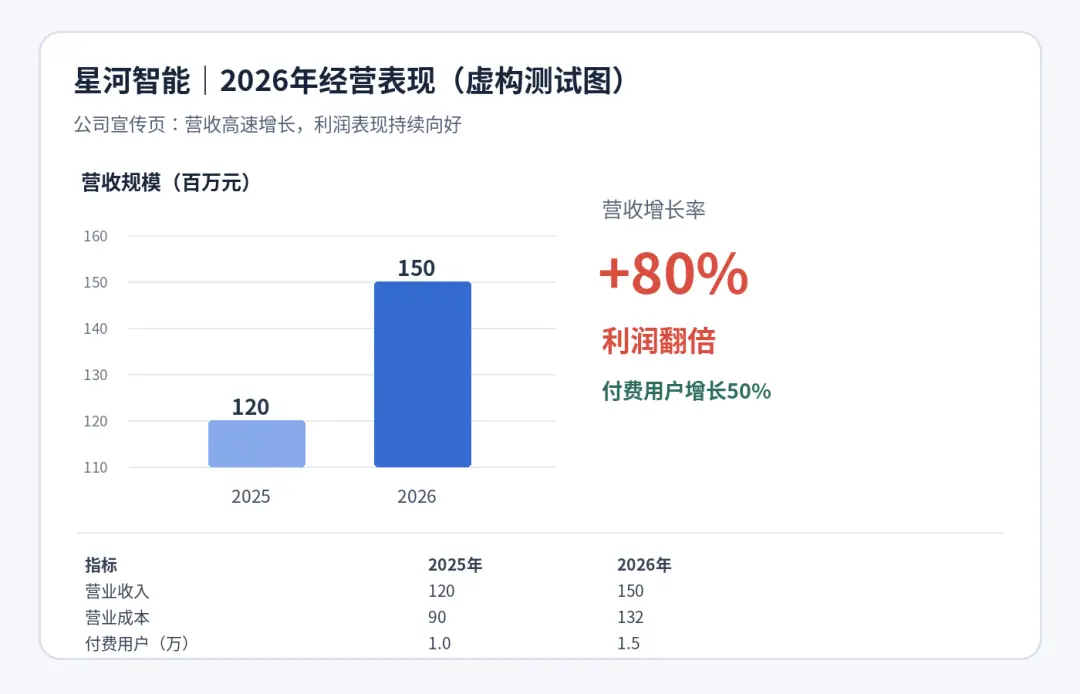
The model quickly found that two of the three conclusions in the promotional graphic had obvious problems.
The first was "revenue growth of 80%." The actual data increased from 120 million yuan to 150 million yuan. After recalculating, the model found that the real increase was only 25%, far below the 80% claimed in the promotion.
The second was "profit doubled." But the amounts listed in the image actually fell from 30 million yuan to 18 million yuan, a real decline of 40%, completely opposite in direction. There was no direct information here; it had to be obtained through reasoning and calculation.
The third, "paying users increased by 50%," was correct. However, the model continued to question the meaning behind this set of numbers: if the number of customers increased by 50% while revenue grew by only 25%, then the average revenue brought in by each paying user actually fell by about 16.7%.
It also found that the vertical axis of the chart started at 110 rather than zero, making the revenue growth in the bar chart appear especially exaggerated.
After that, the model provided two comparison charts and a standardized redrawn chart, setting the vertical axis to zero, supplementing the data definitions, and using concise 150-word text to explain where the problems lay.
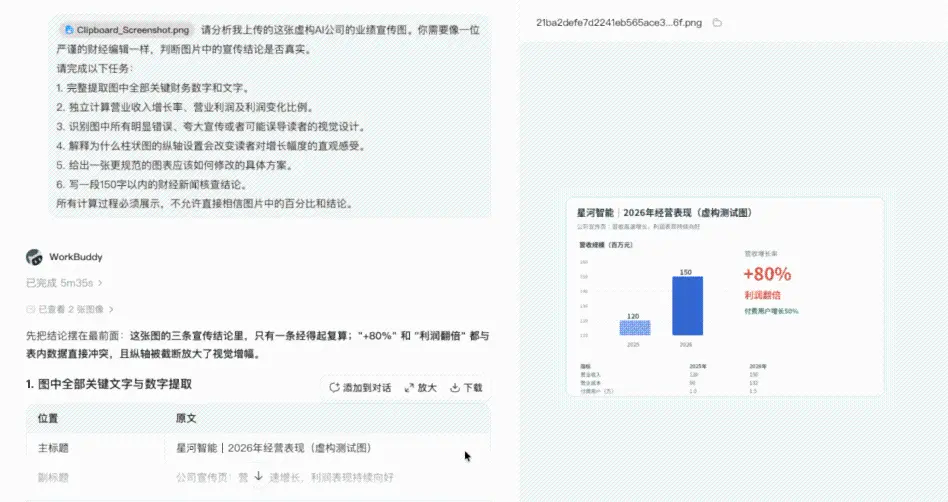
What is interesting about this case is that the model did not continue to package the data according to the logic of the promotional graphic, but instead proactively questioned the input material itself.
In fact, when users ask AI to "help me analyze this image," there is usually an implicit expectation: it should help me identify problems, not just reorganize the text in the image.
But this places higher demands on the model. It must know which data can be calculated directly and which conclusions require additional evidence.
For example, the promotional graphic did not provide complete cost and expense information, nor did it indicate whether the data had been audited. Based on this, the model pointed out that what could be calculated was only the relationship between the given numbers, and that this image alone could not confirm the company's true net profit.
This kind of boundary awareness is especially important for AI entering finance, law, healthcare, and other professional scenarios.
A model may be very good at generating explanations and may also complete calculations quickly. But if it makes overly certain judgments about incomplete information, a tool originally intended to improve efficiency may create new risks.
A truly valuable analytical assistant needs to know when to question the input and when to acknowledge that information is insufficient.
05 Three Bosses Assign Work at the Same Time, and Hy4 Finds the Best Solution Is to Have a Boss Delay the Deadline
For the final task, we deliberately set up an impossible requirement.
Suppose an AI company has only one operations employee but must work for three bosses at the same time. The CEO requires preparation of board materials and sending an investor summary; the product lead requires analysis of user feedback and output of an improvement plan; the marketing lead requires writing a launch release, designing accompanying visuals, and replying to partnership emails.
All work must be completed serially and cannot be executed simultaneously. The workday runs from 9 to 17, only 480 minutes. But when all task durations are added together, they require 555 minutes.
In other words, no matter how it is arranged, at least 75 minutes of work cannot be completed that day.
We asked the model to provide the most reasonable execution plan, and then added two temporary changes: the CEO moved the deadline for the board materials earlier, while the marketing lead required the launch release to start later.
In the end, the model did not provide a perfect schedule in which all tasks could be completed on time. Instead, it identified the conflicts inherent in the tasks themselves and proposed three allocation plans, each making a different boss bear the consequences of delay.
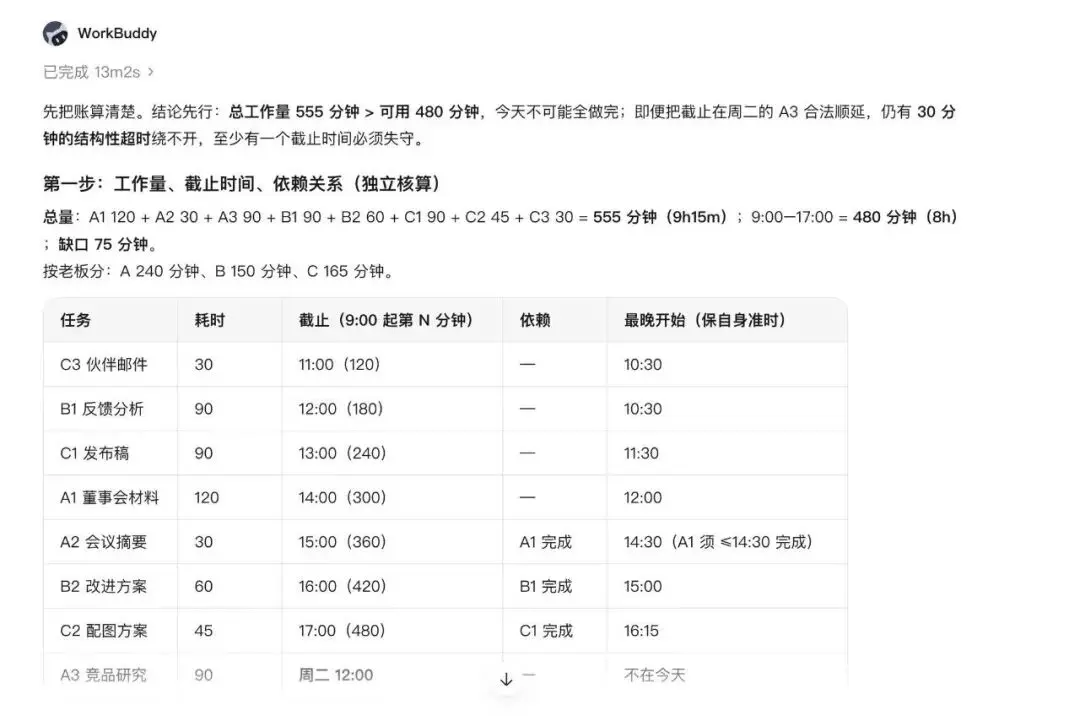
One plan had a total overtime of 300 minutes, while the other two were 360 minutes and 450 minutes, respectively.
The model tended to choose the plan with less total overtime and pointed out that if the task requirements were to be further met, the relevant responsible persons would need to actively approve the delay.
It even offered a rather interesting piece of advice: "Don't look for balance in sequencing—go turn the infeasible deadlines into feasible ones."
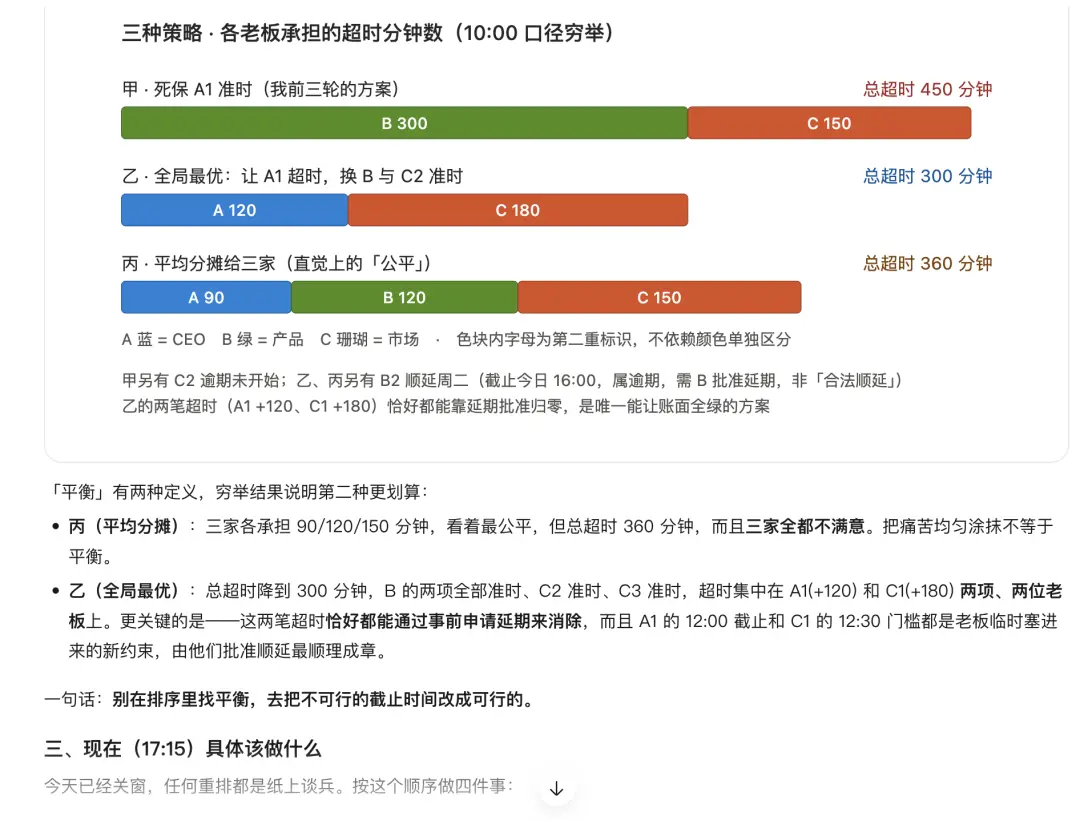
This result demonstrated a kind of judgment ability under complex constraints.
When tasks proposed by users cannot be completed simultaneously, AI needs to identify conflicts, explain the costs, and propose selectable solutions.
But a deeper question also emerged here. The "optimal" the model refers to—whose optimum is it?
For the company as a whole, the plan with the least total overtime may be more efficient; but for the CEO, a document that must be completed before the board meeting perhaps cannot be delayed under any circumstances.
The model can seek the optimal solution according to a set objective, but it may not know the real business consequences behind each piece of work. Moreover, if a delay requires a boss's approval, then even if the model gives a reasonable suggestion, it cannot treat "planning to request a delay" as "already approved."
This means that as AI increasingly participates in work scheduling, it needs to understand not only the logical relationships among tasks, but also goal priorities, real authority, and the costs each person is willing to bear.
An Agent that always agrees to user requests may instead be the least reliable.
Sometimes, AI needs to tell users: this request cannot be done right now. Further, it should also explain why it cannot be done and which conditions would need to change for it to be possible.
06 Understanding Wishes, and Also Knowing How to Refuse
From generating a solar system webpage and recognizing fridge ingredients to verifying financial data and arranging work tasks, the four cases demonstrated Hy4's capabilities in different scenarios.
These tasks share one thing in common: users often propose only the goal and do not spell out all the requirements.
When making a solar system webpage, the model needed to consider the child's level of understanding and the interactive experience; when arranging a three-day menu, it had to balance ingredients, budget, and taste, and even the guests' allergens; when verifying financial data, it needed to proactively identify errors; and when facing the conflicting demands of three bosses, it also had to judge which tasks simply could not be completed on time.
Users can express requests in natural language, but for the model to truly understand user intent, two capabilities are still required: initiative and judgment.
It must be able to think one step further when users have not explained clearly, and also raise questions when information is insufficient or requirements conflict, saying "no" when necessary. Especially when AI begins to arrange work and make choices for people, it also needs to know which decisions it can complete autonomously and which must be handed back to users.
Hy4's strengthening of visual understanding, long-horizon tasks, and Agent capabilities is also an exploration of this more complex form of human-machine collaboration.
As AI becomes increasingly good at turning a single sentence into concrete results, what may be most worth watching is whether it can understand the requirements that are not spoken and judge when to act proactively and when to remind users to change their minds.
Perhaps this is also the essence of human communication: what is left unsaid may be the most important.