






Original Author: Su Yang
Original Editor: Xu Qingyang
Original Source: Tencent Technology
Key Takeaways: Nomura Securities has initiated coverage on ChangXin Memory Technologies (CXMT) with a "Buy" rating and a target price of 116 RMB. Their bullish stance is based on capacity expansion, technology upgrades, and price increases, forecasting rapid revenue and net profit growth. However, investors should be wary of geopolitical risks and the strong cyclical fluctuations of the memory storage industry.
Key Points:
a. CXMT debuted on the STAR Market (Sci-Tech Innovation Board) on July 27, with an opening price surging over 470% from its IPO price. Its market cap exceeded 3.6 trillion RMB, surpassing ICBC to become the most valuable stock on the A-share market.
b. Nomura predicts CXMT's revenue will reach 773.3 billion RMB by 2028, with net profit attributable to shareholders hitting 393.1 billion RMB, representing compound annual growth rates of 63% and 74%, respectively, driven by capacity expansion and rising DRAM prices.
c. Apple has begun testing CXMT's DRAM chips, targeting them for entry-level iPhones sold in the Chinese market. If the partnership materializes, it would significantly boost CXMT's global customer recognition.
d. Nomura applies a 20x forward P/E multiple to CXMT, while Micron and SK Hynix trade at 10x and 5x expected P/E, respectively. This is attributed to the valuation premium typical of the A-share semiconductor sector.
e. Global AI demand is driving memory consumption growth, but supply expansion is constrained. Nomura expects CXMT's global DRAM market share to rise from approximately 10% to 18% by the end of 2028.
f. Key risks stem from equipment and material embargoes related to the US MATCH Act, among others. In the worst-case scenario, CXMT's revenue and net profit could shrink by 13%-14% and 30%-33%, respectively, in 2027-2028.

CXMT's IPO has become the hottest topic in China's tech sector.
On July 27, the domestic DRAM leader CXMT listed on the STAR Market. Its opening price of 49.50 RMB per share represented a surge of over 470% from its IPO price of 8.66 RMB. Simultaneously, with a market capitalization exceeding 3.6 trillion RMB, it surpassed ICBC to top the A-share market cap rankings, doubling the market cap of Kweichow Moutai and becoming the "King of A-Shares."
As the only IDM (Integrated Device Manufacturer) in China to achieve mass production of DRAM, CXMT's net profit for the first half of the year has already exceeded 50 billion RMB. Its global market share has climbed from 3% to nearly 8%, carving out a niche in a market dominated by Samsung, SK Hynix, and Micron for decades.
Alongside CXMT's hype, a report from Nomura also gained significant attention.
Before the market opened on July 27, Nomura, an international investment bank, released a report initiating coverage on CXMT with a "Buy" rating and a target price of 116 RMB. The implied upside of over twelve times from the opening price immediately thrust CXMT into the market spotlight. Nomura even described CXMT's DRAM chip industry value in its report title as the "Pearl on China's Crown."
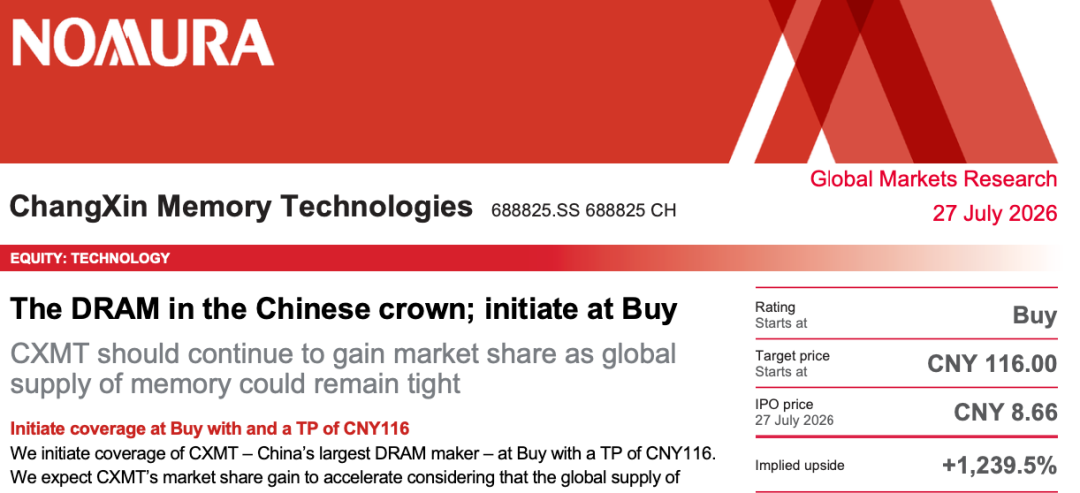
Nomura's research report on CXMT
"A target price above 100 implies a market cap of over 7 trillion RMB, which is somewhat aggressive," said an investor who has long followed China's semiconductor industry. "This possibility exists but requires exuberant market sentiment and would likely borrow from growth for at least the next three years."
So, what is the underlying logic behind Nomura's thirteen-fold bullish call on CXMT, and how does it assess the risks?
Projected Revenue of 560 Billion RMB by 2027
According to data disclosed in CXMT's listing press release, the company expects revenue of 110 billion to 120 billion RMB for the first half of 2026, a year-over-year increase of 612.53% to 677.31%. Net profit attributable to shareholders is expected to be between 50 billion and 57 billion RMB, soaring 2244.03% to 2544.19% year-over-year.
Regarding the performance growth, CXMT stated, "In recent years, driven by factors such as the recovery of the memory storage industry, product mix optimization, and release of scale effects, the company's operating performance has achieved rapid growth."
Nomura's projections in its report are even more optimistic than CXMT's own estimates. According to its model, CXMT's revenue will surge from 61.8 billion RMB in 2025 to 290.7 billion RMB in 2026, 560.8 billion RMB in 2027, and eventually 773.3 billion RMB in 2028.
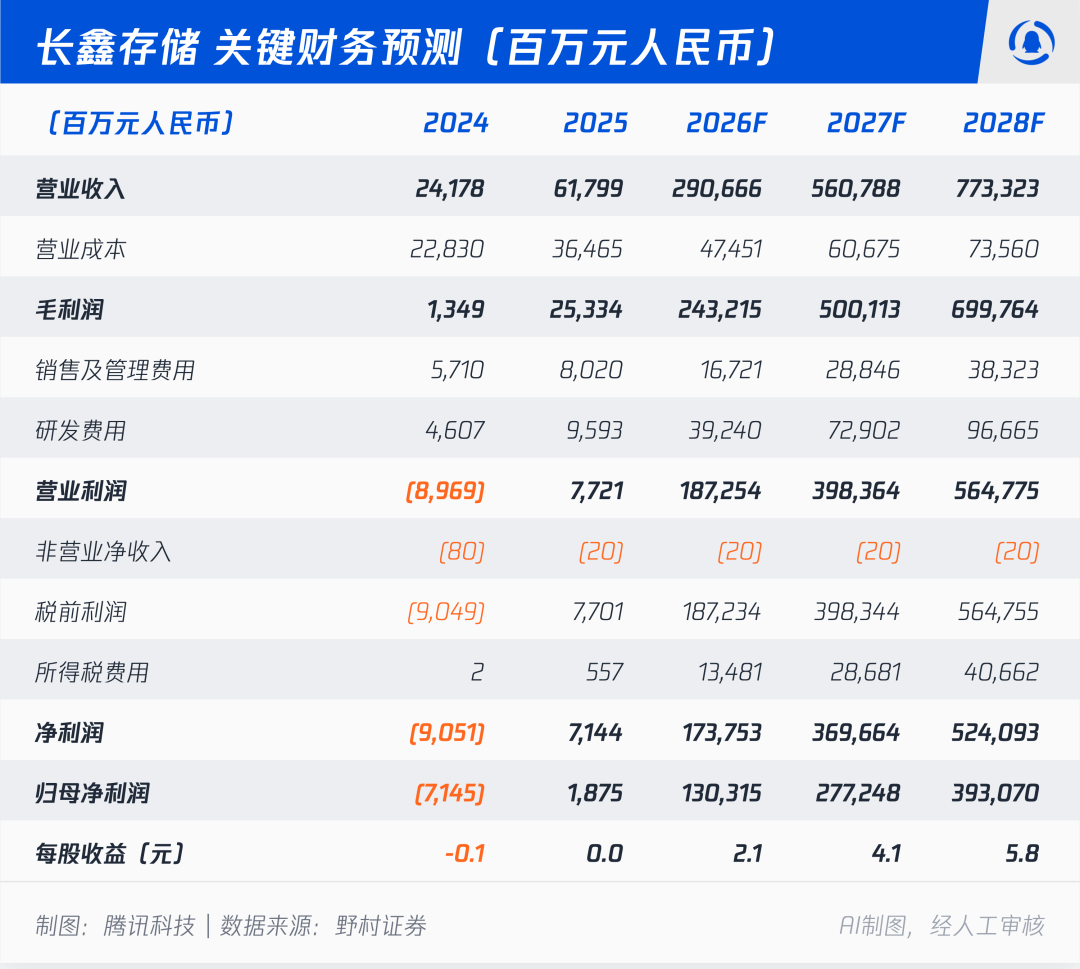
Nomura also predicts that CXMT's net profit attributable to shareholders will climb from less than 1.9 billion RMB to 130.3 billion, 277.2 billion, and 393.1 billion RMB in 2026, 2027, and 2028, respectively. The compound annual growth rates for these two metrics are projected at 63% for revenue and 74% for net profit.
The underlying logic for these performance forecasts centers on three dimensions: capacity expansion, technology upgrades, and price increases. The first two dimensions are strongly correlated with the use of funds stated in CXMT's prospectus.
Previously, CXMT disclosed in its prospectus that the funds raised would be mainly used for projects such as the technology upgrade and renovation of memory wafer mass production lines, DRAM memory technology upgrades, and research and development of advanced dynamic random-access memory technologies, to further enhance advanced manufacturing capabilities and innovation levels.
Notably, price increases primarily stem from two aspects: one is the rise in average selling price per wafer due to technology upgrades; the other is the general price increase of memory chips under the current super-cycle.
"Since the second half of 2025, the continuous increase in product prices has driven a rapid improvement in product gross margin and profit levels, leading to turning profitable in 2025," CXMT previously stated in the overview section of its prospectus.

The structure of CXMT's product shipments is also upgrading.
In its previous response to inquiries, CXMT disclosed that mobile terminal products are currently its revenue mainstay. Smartphone manufacturers like Xiaomi, Transsion, Honor, vivo, and OPPO correspond to the LPDDR series products. Cloud providers such as Alibaba and ByteDance primarily correspond to the DDR series products.
The revenue contribution from these two customer groups was roughly 9:1.
By May 17, 2026, the revenue contribution from AI server-related products represented by the DDR series jumped to over 30%, but the mainstay remained the LPDDR series product line, accounting for over 66%.
During this phase of performance ramping up, the progress with a high-profile potential customer, Apple, is particularly noteworthy.
According to a Financial Times report, Apple has begun testing CXMT's DRAM chips, aiming to use them in entry-level iPhones and other devices sold in the Chinese market. Simultaneously, Apple has been lobbying the US government since around May or June to obtain necessary permissions.
If the partnership between the two parties is finalized, CXMT could potentially absorb a portion of Apple's global DRAM procurement volume. The significance of this deal extends far beyond the sales amount itself; it marks a transition for a supplier previously labeled as "domestic substitute" towards one recognized by mainstream global customers.
However, some institutions believe Apple is only purchasing CXMT's products in small volumes and may also be aiming to negotiate better terms with Samsung and SK Hynix by introducing a new supply variable.
Capacity in High Demand, Valuation Approaches Double That of Micron
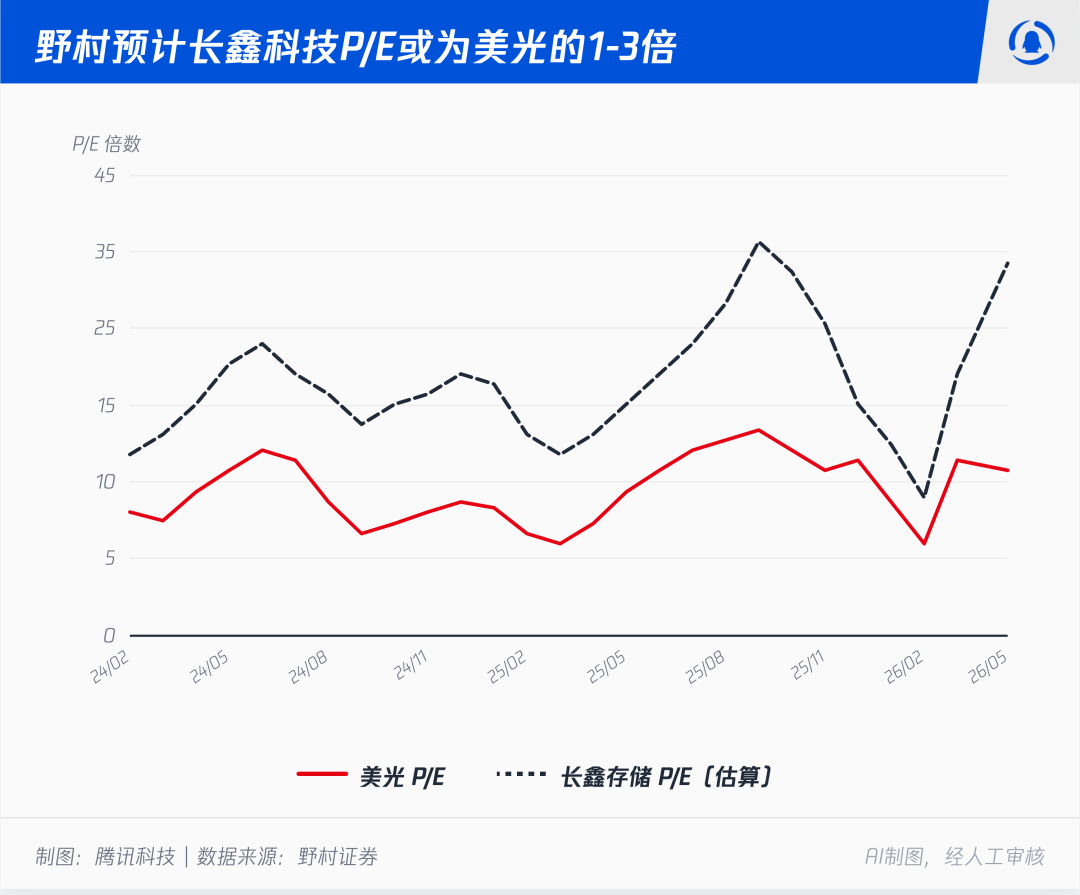
Based on Nomura's target price of 116 RMB, corresponding to earnings per share of 5.8 RMB in 2028, CXMT's forward P/E ratio is approximately 20 times.
"Over 100 billion in net profit supporting a 2 trillion market cap is reasonable," Chen Qi, an investor who has long focused on the semiconductor industry, previously told Tencent Technology. A 2 trillion market cap corresponds precisely to 20 times P/E.
For comparison, Wall Street's expected P/E for Micron in calendar year 2026 is around 10 times, while SK Hynix's is only about 5 times. Chen Qi commented, "When the semiconductor cycle arrives, anything is possible."
In Chen Qi's view, while 10 times P/E has its rationale, 20 times P/E is also within the realm of possibility. "CXMT's real opportunity lies in the fact that it stands opposed to Samsung, SK Hynix, and Micron, representing China's memory storage truly sitting at the table."
Nomura's application of a 20x P/E to CXMT also follows another logic: Micron can be seen as the valuation anchor in the global DRAM field, with its historical forward P/E median around 10 times. Meanwhile, the A-share semiconductor sector has long traded at a valuation premium of 1 to 3 times relative to comparable US-listed stocks. Taking the midpoint of about 2 times, CXMT's P/E works out to 20 times.
The core support for CXMT's valuation is that global memory storage demand is being dragged into exponential expansion by AI, while the supply side, constrained by physical bottlenecks, simply cannot keep up. Nomura estimates that even factoring in a 60% compression effect from various memory efficiency technologies, global memory storage demand will still increase more than sevenfold between 2026 and 2030, with a compound annual growth rate exceeding 60%.
Nomura even proposes a more extreme scenario: if AI robots operate autonomously without the constraints of human operational pace, the upper limit of demand would only be bounded by authorization boundaries, infrastructure carrying capacity, and capital expenditure budgets.
But the supply side's expansion speed is far from matching this.
Nomura expects the compound annual growth rate of industry capacity expansion to be only 30% to 40%. CXMT's bit expansion CAGR between 2026 and 2030 is projected at about 40% to 45%, which, while higher than the industry average, is still significantly lower than the demand growth rate.
Additionally, around the time of Nomura's report, Korean and American chip giants initiated a new round of alignment.
On July 24 (US local time), Samsung Electronics signed a memorandum of understanding with Broadcom valued at over $200 billion, covering high-end memory supply including HBM4, 2-nanometer foundry services, and advanced packaging. Around the same period, SK Group and SK Hynix reached a long-term cooperation intention with NVIDIA exceeding $500 billion, focusing on joint development and stable supply of next-generation HBM.
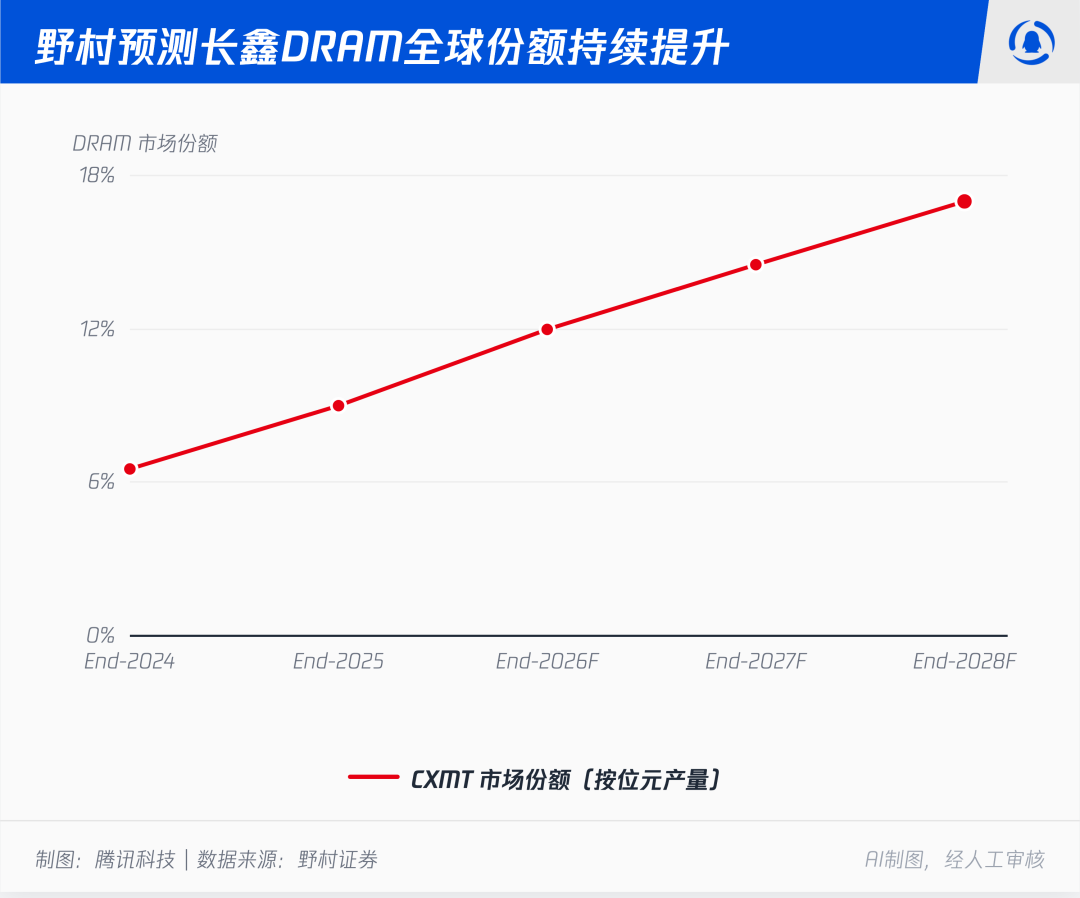
For CXMT, the more the top players focus on HBM, the more obvious the supply gap left in the traditional DRAM market becomes. Nomura predicts CXMT's global DRAM market share will increase from its current approximate 10% to 18% by the end of 2028.
Furthermore, from the perspective of the domestic Chinese market, there is ample room for improving the self-sufficiency rate, providing a growth window for CXMT's performance.
According to WSTS data, China accounted for about 25% of the global DRAM consumer market in 2025. However, based on production revenue, domestic manufacturers held only about 10% global share, implying a self-sufficiency rate of roughly one-third. Looking purely at the domestic Chinese market, the substitution space is substantial.
A Dual Examination Under the Spotlight
The prospects are enticing, but Nomura also devotes a considerable portion of its report to discussing risks.
The foremost risk comes from the embargo of key equipment and materials due to legislation like the US MATCH Act, including lithography, etching equipment, and advanced photoresists. Under the worst-case scenario, besides capacity expansion restrictions, CXMT's revenue and net profit for 2027 and 2028 could shrink by approximately 13%-14% and 30%-33%, respectively.
These external risks substantially overlap with the various shortcomings mentioned in CXMT's prospectus.
CXMT's prospectus mentions "geopolitical risks" including potential inclusion on the 1260H list, as well as the risk of competing in a highly globally monopolized market. Most critically, it highlights industry cyclical risks—the strong cyclicality and significant performance fluctuation risks inherent in the DRAM industry.
Currently, the industry is still within an upward super-cycle, but cracks have appeared in the market consensus on memory storage.
Take Micron, for example. After hitting an all-time high of $1,255 on June 25, its stock fell to a low of $804 within just three weeks, a maximum drawdown of 36%. SK Hynix experienced even more severe fluctuations; its Korean stock price plummeted from a high of 2,987,000 KRW on June 25 to 1,678,000 KRW, a drawdown of 43.8%. Its ADR surged 27% in a single day on July 14, only to fall 9% the next day.
The aforementioned investor who has long focused on China's semiconductor industry told Tencent Technology that cyclicality ultimately returns to basic supply and demand theory. "As long as the market is euphoric, capacity expansion is unlimited. And demand can come to a sudden halt at a certain point. No market is an exception; memory storage is just a more extreme case."
The investor cited the example of Hua Hong's experience in the 1990s, investing heavily in memory storage at the peak of the internet bubble, experiencing violent booms and busts, and eventually transitioning to logic chip foundry services, to emphasize the impact of memory cyclicality. "Few other markets see 5-10x price increases in 1-2 years during boom times, followed by prices plummeting 90% in 1-2 years during downturns. Since 1990, this has happened at least 5 times in history, roughly a 6-year cycle—a very regular pattern."
Therefore, how to maintain strict financial discipline during the upward cycle, avoiding aggressive capacity expansion, also tests CXMT's long-term wisdom.