






Original Author: Jake Pahor
Original Compilation: Shenchao TechFlow
Core Thesis: As an ordinary investor with a family and full-time job, based on the lessons learned from losing money on altcoins in the last cycle, I've chosen a simplified 100% Bitcoin strategy, using the CSH risk scoring system for dynamic DCA and exit planning. The key takeaway is that systematic rules are more reliable than relying on market emotions.
Key Elements:
a. I am currently 100% in Bitcoin, with zero altcoins, because I have to balance family and work and can't keep up with altcoin rotations. In the last cycle, Bitcoin outperformed most of my altcoin holdings.
b. I use the CSH scoring system (currently 25.6/100, in the early cycle phase) for dynamic DCA. I buy when the score is between 10-30, with larger positions at lower scores. My exit plan is also pre-determined to avoid emotional decisions.
c. I track my portfolio against both USD and BTC benchmarks, pointing out that if altcoins' gains don't match Bitcoin's, they are actually losing in BTC terms. Bitcoin remains the core benchmark for the entire asset class.
d. The current market cap of altcoins in BTC terms (TOTAL3/BTC) is 0.37, while the historical cycle bottom is around 0.25, suggesting the altcoin season hasn't started yet and Bitcoin dominance is still rising.
e. Visa launching a stablecoin platform and Morgan Stanley enabling spot BTC trading for E*TRADE clients show that infrastructure is still being built during the bear market, and future buyers may come from traditional finance channels.
Introduction: Australian trader Jake Pahor reveals his real portfolio: 100% Bitcoin, zero altcoins. This isn't about faith; it's the choice of an ordinary person with a full-time job and a family after taking heavy losses in the last cycle. Complex strategies require time and effort, and Bitcoin outperformed almost all the altcoins he held last cycle. He uses the CSH scoring system for dynamic DCA, buying more when the score is low, with exits also fixed in the plan. The value of this system isn't about copying it, but about showing you what it takes: only the rules you've written down in calm times can withstand market emotions at 11 PM.
Every SMSF (self-managed super fund) consultation ends the same way.
We finish the paperwork. Trust deeds, bank accounts, custody, audit records. Everything that keeps people out of trouble. Then there's a pause, and I know exactly what's coming.
"So. Should I buy now? Should I wait? What exactly should I buy?"
I can't answer. Not because I don't want to. I can't. The person asking could be 42 with twenty years left, or 68 with only three. They might sleep soundly through a 30% drawdown or panic at a 10% drop. No one can answer that question for someone else, and anyone who gives an answer is just guessing.
But now hundreds of people have asked me this question, and it's why Tom and I created CSH. So this week, I'm giving the only honest answer: what I do with my own money, and the system that drives it. It's not for you to copy. It's for you to see what a system looks like, so you can build your own.
Everything below runs on the free version of the app.
CSH Risk Dashboard
CSH Score: 25.6/100 — Early Cycle (Stable, +0.7 this week). In the bottom 22% of all readings since 2011, and has stayed in the 20-30 range for 52 consecutive days.
Key Metrics:
BTC: $64,492 / A$91,717 (7 days: roughly flat)
BTC Dominance: 59.2%
ETH/BTC: 0.029
TOTAL3/BTC (Altcoin market cap in BTC terms): 0.37 — Prior cycle bottoms bottomed around 0.25
Fear & Greed Index: 26 - Fear
Total Market Cap: $2.27 trillion
Recap: Last time, I said three things had to happen before this bear market ended. None happened. A week later, still zero for three. The only notable change: BTC crawled back above the 200-week moving average (around $63,300). A necessary condition, but far from sufficient.
Jake's Take: Two weeks of sideways chop between roughly $62,000 and $66,000, with the score staying in the 20s the whole time. The chart is boring, the macro is loud. My plan hasn't changed this week, and that's the point of having a plan.
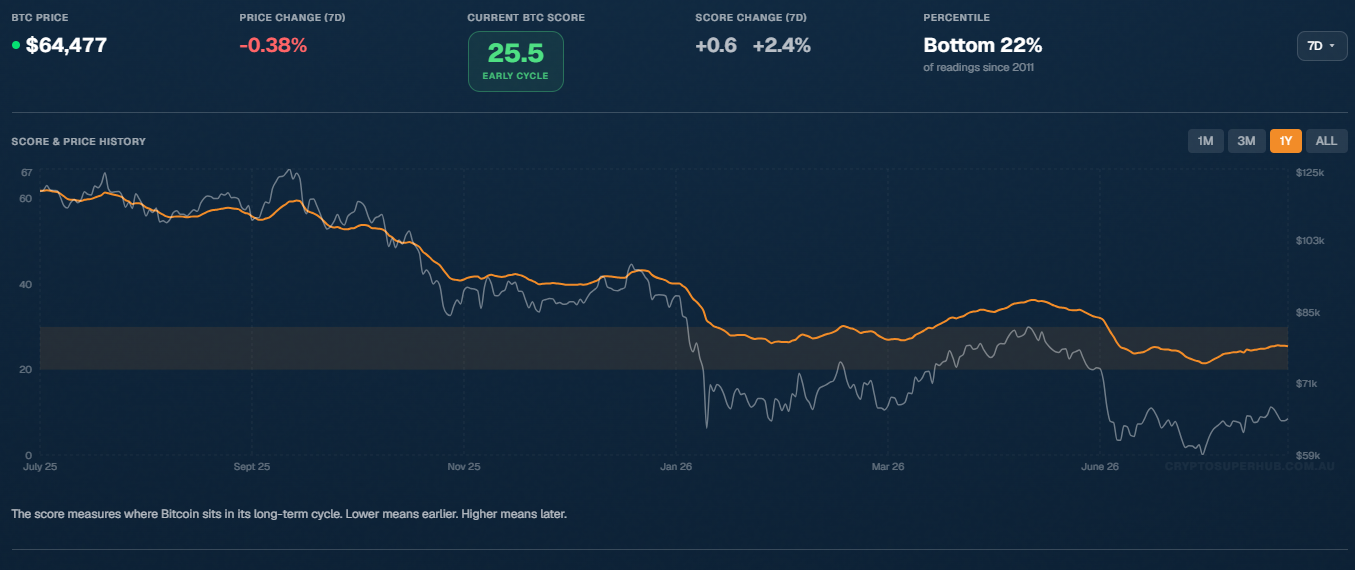
Chart: CSH Risk Score Dashboard, score 25.6/100, in the early cycle phase, and has stayed in the 20-30 range for 52 consecutive days. Source: Crypto Super Hub
How I Invest My Own Money
No headline this week. The question above matters more than any news cycle, so here's my answer, three rules.
Rule one: Benchmark against two standards. I track my portfolio in both USD and Bitcoin. The second number keeps me honest. If your altcoin doubles but Bitcoin triples, you're actually losing. You just don't notice because you're only watching the USD number. Fifteen years in, BTC is still the benchmark for the entire asset class. If I'm holding something else, it's because I genuinely believe it will outperform Bitcoin. Otherwise, why hold it?
Rule two: Core first, know your limits. Right now, I'm 100% in Bitcoin. Zero altcoins. This isn't forever, but it fits my life. I have a family, a full-time job at an exchange, and I'm building CSH in my spare time. Altcoin rotation is a job for people with time. I know because I tried it last cycle, bought a bunch of altcoins without a plan, got crushed, and Bitcoin quietly outperformed almost everything I held. The lesson isn't that altcoins are bad. It's that my portfolio has to match my real life. Start with BTC as the core. Only add complexity when you have the time and skill to handle it.
Rule three: Let the system buy. My money runs a dynamic DCA based on the CSH score. I buy on a schedule, but only when the score is in my range of 10 to 30. The position size is dynamic: the lower the score, the more I buy. At a score of 30, I build a moderate position. At a score of 15, I build several times that amount. Every decision was made months ago, in a calm state. The market can't renegotiate with me at 11 PM.
The same mechanism runs in reverse. My plan sells dynamically above the exit range. In the last cycle, writing down the exit rules was the difference between cashing out the cycle gains and riding the rollercoaster back down. Bitcoin's entire history has followed a rhythm very close to four years. I'm not going to fight it with feelings.
Where am I this week? Score of 25.6, regular buys are running in the range, and a larger position is waiting for a sub-20 score that hasn't shown up yet. Two weeks of deliberately doing nothing new. Inaction is also a position, and this is my position right now.
Jake's Workbench
Big update this week: My Plans feature has been completely redesigned. Email alerts are live. You can set portfolio targets and watch them fill up. Order history is two clicks away, and the portfolio view now shows your average buy price next to the live score. It's becoming the screen I check, instead of the price.
This is my own plan, directly from the app:
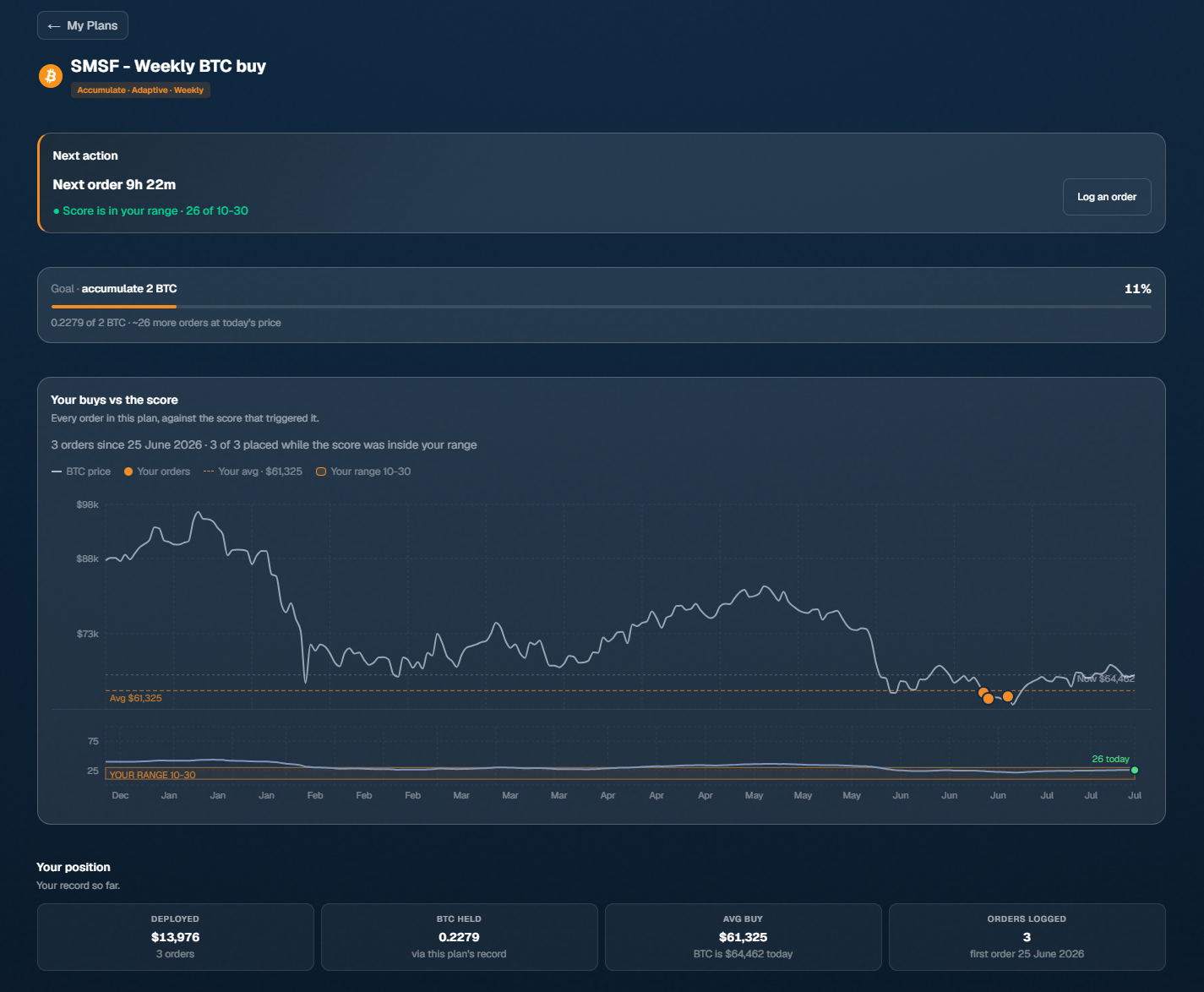
Image: The author's own DCA plan, having bought 0.2279 BTC since the end of June, at an average price of A$87,755, target 2 BTC. Source: Crypto Super Hub
Since the end of June, three orders have been recorded, buying 0.2279 BTC towards a target of 2 BTC, with an average buy price of A$87,755. A quick note to avoid misunderstanding this screen: This plan only tracks the portion I've bought since it went live a few weeks ago. It's a slice of my holdings, not the whole thing. But this is the system from above, running in public, with records starting to accumulate here.
Workbench next steps: CSV upload and exchange sync to make order tracking even easier.
Discussions about an altcoin season are back. My feed is full of rotation calls. The metric I'm watching says it's not here yet: the altcoin market cap in BTC terms is at 0.37. In every cycle, it hits around 0.25 at the bottom before altcoins start running. Dominance is still rising, and ETH/BTC is still flat. So: if someone is pitching you an altcoin rotation this week, ask them what benchmark they're measuring against.
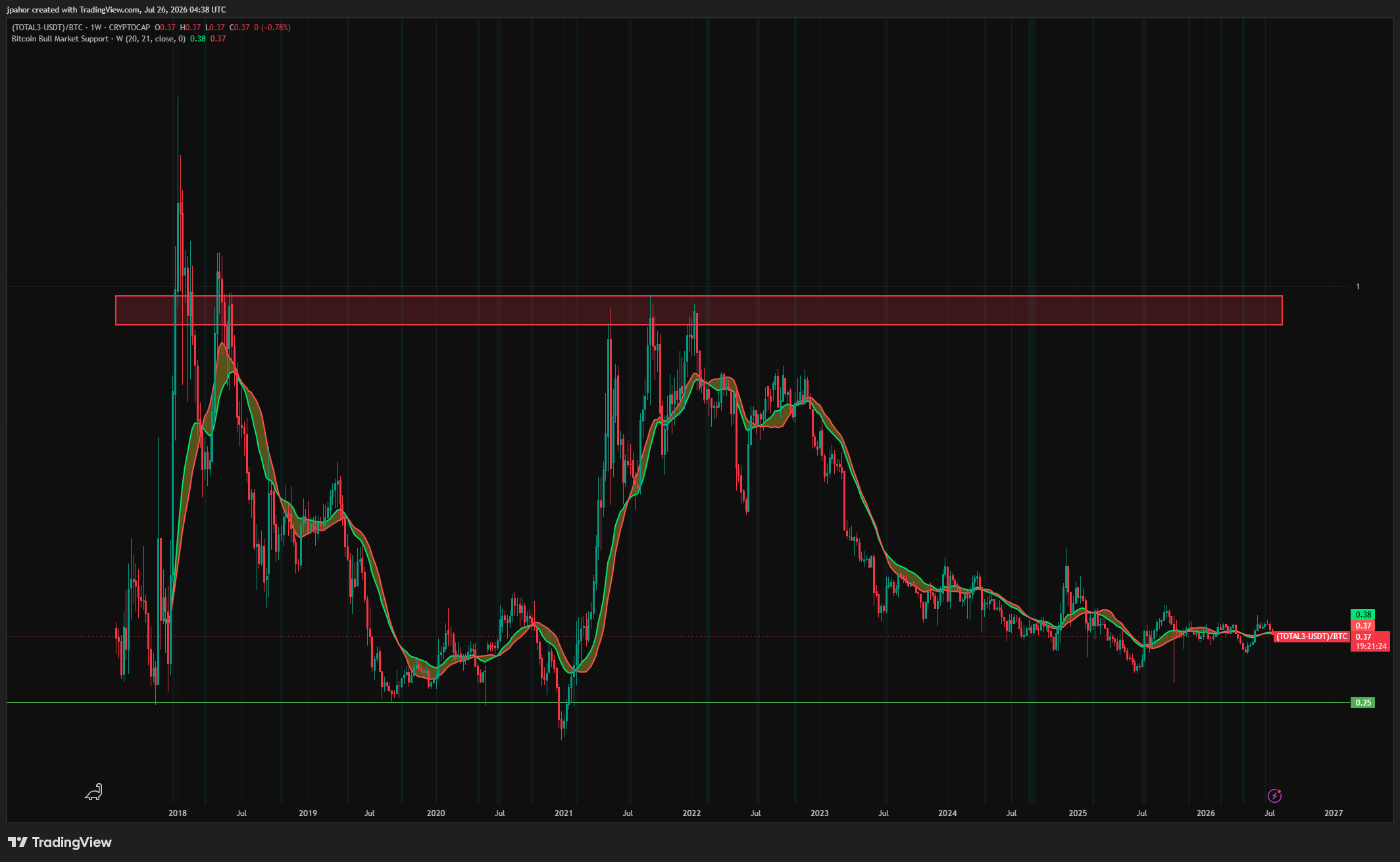
Chart: (TOTAL3 - USDT)/BTC trend, altcoin market cap in BTC terms is 0.37, prior cycle bottoms reached around 0.25. Source: Trading View
The Fed meets on Wednesday (US time). The probability of holding rates is around 85%, but whispers of rate hikes are getting louder. So: unless your plan depends on next month's interest rate, this is noise. My plan doesn't depend on it.
Visa launched a stablecoin platform, allowing banks to issue their own stablecoins without building the infrastructure themselves. So: this is what the bear market is for. Infrastructure gets built when no one is watching the charts.
Morgan Stanley enabled spot trading of BTC, ETH, and SOL for E\*TRADE clients. So: millions of ordinary brokerage accounts are now one click away from Bitcoin. The next wave of buyers won't come from crypto Twitter. They'll come from the screens they already use.
What to Watch Next Week
FOMC decision, Thursday 4:00 AM (AEDT). A rate hold is mostly priced in, so the reaction will depend on the wording. Expect volatility in both directions. Volatility isn't a signal.
200-week moving average, around $63,300. BTC is almost exactly on this line. A weekly close above or below it is what the entire market is watching.
Below 20. This cycle has had zero days below 20 so far. This is the trigger I'm waiting for to make larger buys. If it happens, you'll hear about it here first.
One question gave birth to an entire company: "Should I buy now?" The honest answer was never a date or a coin. It was a system that fits your life, matches your nerves, and is written down before the market gets loud.
Mine is above. If you want to build your own, the scoring and plan builder are free.
I'm curious: reply directly with a number — the percentage of Bitcoin in your current portfolio. I'll share the stats next week.