






Guest Columnist: BIT
Core Thesis: In 2026, the crypto industry is undergoing a structural shift from "internal competition" to "external integration." Crypto capital is flowing into core traditional finance (TradFi) assets at scale and systemically, marking a watershed moment for the industry.
Key Elements:
a. The stablecoin market has reached approximately $320 billion in total value, surpassing the foreign exchange reserves of most countries. However, historically, these funds could only invest in a limited set of on-chain assets, leading to strong demand for portfolio allocation.
b. In Q1 2026, spot trading volume for tokenized gold hit $90.7 billion, while RWA perpetual contract volume reached $524.79 billion—both surpassing full-year 2025 levels. This signals capital accelerating its migration into TradFi assets.
c. Exchanges are collectively offering U.S. stocks, breaking down the barrier between crypto and TradFi capital pools. They now allow users to allocate directly into low-risk, high-certainty assets like U.S. tech stocks and gold using stablecoins.
d. The industry narrative has shifted from the 2023-2025 era of "PvP infighting" (rushing to list, chase TVL, and gain information advantage) to "cross-market asset allocation" in 2026.
e. Tokenized stocks provide exposure to TradFi asset prices but do not confer ownership or voting rights. The path to real U.S. stocks requires addressing traditional financial infrastructure issues like custody, clearing, and compliance.
f. In February 2026, BIT pioneered a path that combines "stablecoin funding channels + licensed broker framework + actual U.S. stock holdings," ensuring users hold real securities and enjoy shareholder rights.
g. Users must choose products based on the nature of their capital: tokenized stocks for short-term trading, and real-holdings paths for mid-to-long-term funds, while paying attention to asset path transparency.
Opening: We Are Witnessing an Inflection Point of an Era
By 2026, many crypto projects have been debunked by the market. Numerous tokens plunge to zero upon listing, crashing immediately at launch, devolving into tools for market makers to "farm" retail investors, while grand Web3 narratives remain unfulfilled.
Meanwhile, the U.S. stock market is booming. Fueled by the narrative of AI as a cutting-edge productive force, U.S. stocks have repeatedly hit new highs.
Against this backdrop, if the crypto industry remains stuck in the zero-sum game of "PvP infighting" or mere Meme wars, its path will only narrow. So we see many exchanges collectively pushing U.S. stocks. At BIT, we pioneered the path of "stablecoin funding channels + licensed broker framework + actual U.S. stock holdings" as early as February 2026.
If you zoom out, you'll see this is the biggest structural shift in the crypto industry in 2026: the industry is moving from "internal competition" (exchanges vying for users, volume, and narratives) to "external integration" (crypto capital flowing into TradFi core assets).
I. Why 2026 Is the "Watershed Year" for Crypto?
Let's start with some striking data.
According to the latest data from DefiLlama (as of June 5, 2026), the total stablecoin market value has reached a historic high of approximately $320 billion. As reported by CoinDesk, this figure surpasses the foreign exchange reserves of 95 countries, including the UK and Canada.
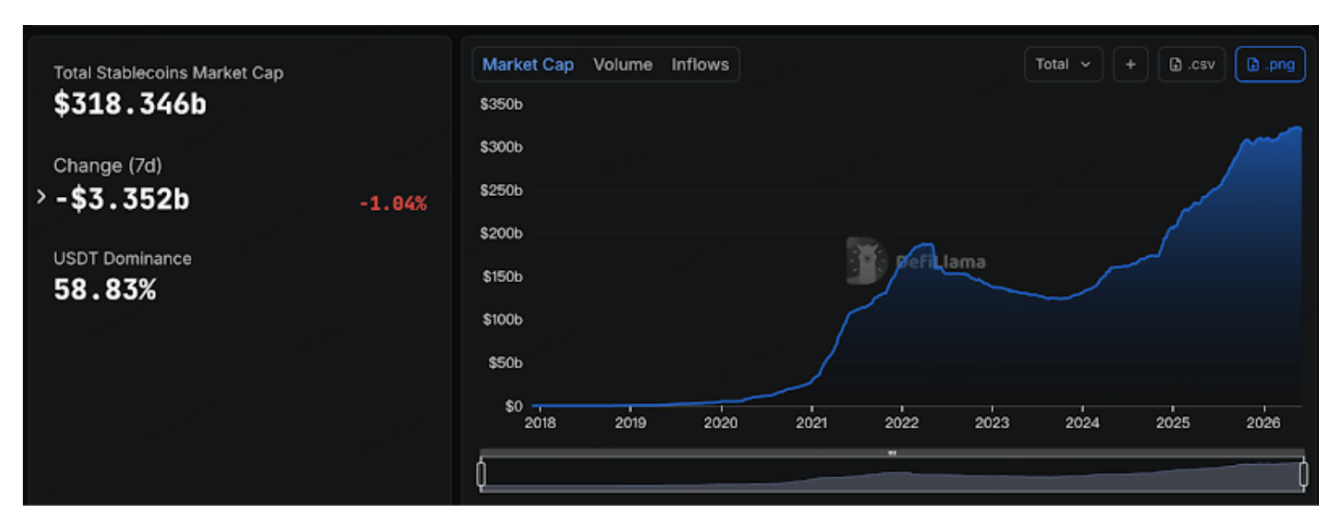
Source: DefiLlama
What does this mean? It means that the "cash pool" of the crypto industry has grown to a scale that can no longer be dismissed as a "niche market." Ironically, despite this massive cash pool, the types of assets available for purchase over the past few years have been very limited—mainly BTC, ETH, various alts, memes, and derivative contracts.
Meanwhile, returns on endogenous assets are visibly declining. According to CoinGecko's RWA Report 2026, RWA perps (real-world asset perpetual contracts), another tool for trading TradFi assets, posted a single-quarter volume of $524.79 billion in Q1 2026, far exceeding the full-year 2025 total of $313.02 billion. Simultaneously, spot trading volume for tokenized gold reached $90.7 billion in Q1 2026, surpassing the full-year 2025 figure of $84.6 billion.
These two sets of data reveal a critical truth: crypto user funds are migrating to TradFi core assets at an unprecedented pace.
In recent years, on-chain asset innovation has fallen into a vicious cycle of "mutual exploitation." When endogenous high-risk assets can no longer consistently deliver healthy alpha, user risk appetites diverge, and demand for traditional macro assets (like U.S. tech stocks and commodities gold) surges.
The reason 2026 is a watershed is that, for the first time, this "allocation demand" is being met at scale on the product side.
II. Exchanges Collectively Push U.S. Stocks: Crypto's Grab for the "TradFi Gateway"
Many exchanges are now intensively pushing U.S. stocks. Though their paths differ, the direction is highly aligned: they are all turning U.S. stocks into an "asset outlet" for crypto users.
Why does this matter? Because it breaks a market convention that has persisted for over a decade—crypto and TradFi are two separate capital pools.
Previously, to execute a macro hedge, you had to buy gold/U.S. stocks through a traditional broker and then open a contract on a crypto exchange. This entire process—bank deposits, broker account opening, cross-market settlement, FX friction—led to extremely low capital efficiency.
Now, this trend is breaking that isolation. The tokenized U.S. stocks or spot assets you hold might also serve as hedges against each other, multiplying capital efficiency.
Furthermore, in BIT's user research, a significant portion of stablecoin holders expressed strong interest in allocating to U.S. tech stocks or gold ETFs. These users haven't turned away from crypto; rather, they have matured enough to understand the need to pair high-risk assets with some low-risk, high-certainty ones.
To meet this demand, BIT has chosen the "heaviest and hardest" path in this ecosystem: not issuing a token that merely mirrors prices, but using stablecoin channels to directly connect with licensed U.S. broker-dealers, allowing users to buy actual publicly traded U.S. stocks. This means we have to handle the entire traditional securities infrastructure: custody, clearing, dividends, voting, corporate actions, and compliance frameworks.
Why opt for this harder route? Because we believe: as the industry moves from "trading prices" to "allocating assets," what ultimately endures is not who has the flashiest charts, but who enables users to genuinely hold assets.
III. From "PvP Infighting" to "Cross-Market Allocation": A Paradigm Shift in Crypto Narratives
Comparing the last three years with today reveals a qualitative paradigm shift in the crypto industry.
Main Theme 2023-2025: PvP Infighting
- Exchanges competing for first-to-list, Launchpad access, and user growth
- Projects competing for TVL, airdrop expectations, and influencer support
- Users competing for "insider info advantage," "buying low, selling high," and narrative first-mover advantage
Main Theme Starting 2026: Cross-Market Asset Allocation
- Exchanges integrating U.S. stocks, gold, and ETFs into crypto funding channels
- Projects building RWA protocols (e.g., Ondo Global Markets' early 2026 launch of 100+ tokenized U.S. stocks and ETFs)
- Users directly allocating U to NVIDIA, Tesla, SPY, QQQ, PAXG
What's the underlying logic of this paradigm shift?
The upgrading of crypto users' asset allocation needs.
In the past, the typical crypto user profile was simple: high risk appetite, seeking quick windfalls, and immune to volatility. But when the stablecoin pool grows to $320 billion, the nature of these funds changes—part is institutional capital, part is "long-term, locked-in" capital from high-net-worth individuals. Their tolerance for single high-volatility assets drops, while their sophistication in asset allocation rises.
When a user holds 100,000 USDT, they no longer go all-in on a meme like they might have in 2021. Instead, they think: should I allocate 30,000 to BTC, 20,000 to ETH, 30,000 to U.S. tech stocks, 10,000 to tokenized gold, and leave 10,000 for high-beta alts?
This is the real mindset of crypto users in 2026.
IV. Buying NVIDIA's Price vs. Owning NVIDIA Stock: Not the Same Thing
Cryptocurrencies are often priced based on consensus, liquidity, narrative, and on-chain mechanics. In contrast, U.S. stocks are the core securities assets of traditional finance, backed by a listed company's cash flow, profits, shareholder rights, corporate governance, and regulatory framework.
Tokenized stocks are on-chain tokens designed to track the market performance of publicly traded stocks. They offer economic exposure (including price movements and, in many cases, dividend-equivalent distributions) but do not confer direct share ownership or voting rights.
This is a critical distinction:
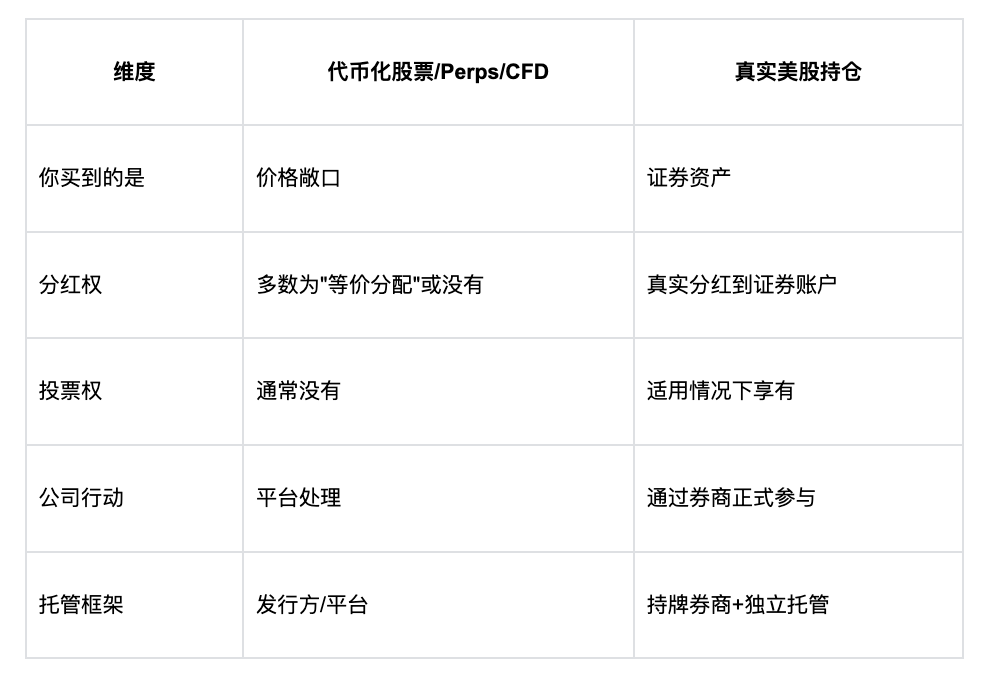
This isn't to say tokenized stocks are bad—they solve the problem of "can I trade the stock's price?"
But when your capital grows, and you start treating U.S. stocks as a long-term allocation rather than short-term speculation, the questions change: am I buying actual shares? Who is the underlying broker? If the platform has issues, how are my stock rights confirmed?
This is the fundamental reason BIT insists on the "real U.S. stock" path during this industry shift.
V. BIT's Position in This Trend: Pioneer of Stablecoin-Powered Real U.S. Stocks
As early as February 2026, BIT pioneered the "stablecoin-to-real-U.S.-stocks" path. This path includes: stablecoin funding channels (allowing users to deposit/withdraw with USDT/USDC 24/7 near-instantly); direct connection to licensed U.S. broker-dealers; support for tens of thousands of major U.S. stocks and ETFs; and, where applicable, shareholder rights (dividends, voting, corporate actions). BIT isn't just adding a "we also sell U.S. stocks" feature; we are building the financial infrastructure for digital asset capital to flow compliantly into a real securities asset system. While other players in the industry are still competing over "who has more tokenized stocks" or "whose stock perps have higher leverage," BIT has been running the real asset path for at least four months longer than peers.
VI. Three Criteria for Crypto Users in 2026
To conclude, we want to offer three practical criteria for every crypto user reading this.
Criterion One: Match Your Strategy to the Nature of Your Capital
If your U is short-term trading capital, chasing high turnover and beta, stock perps and tokenized stocks suffice. But if it's mid-to-long-term capital intended for real cross-market allocation, look for products offering real holding paths.
Criterion Two: Assess "Disclosure Depth" to Verify Path Authenticity
Before buying U.S. stocks, ask: Who is the underlying broker? Where is the custody? What is the clearing path? Is the licensed entity disclosed? Is there a public compliance framework? With the massive stablecoin capital pool, user demands for transparency in asset paths will only increase.
Criterion Three: View Asset Allocation as "Portfolio Management," Not "One-Way Betting"
Crypto users in 2026 shouldn't just think, "Will BTC go up?" Instead, ask: "How will my portfolio of BTC, ETH, U.S. tech stocks, tokenized gold, and stablecoin savings perform under different macro scenarios?" This marks a mature asset allocation mindset—and a sign that the crypto industry is moving from adolescence to maturity.
VII. Conclusion: The Biggest Opportunity for Crypto in the Next Five Years Is "Going Mainstream"
The biggest trend in the crypto industry in 2026 isn't a new L1, a new meme, or a new ETF approval. It's crypto capital entering the TradFi core asset system at scale and systematically for the first time.
The essence of this trend is the crypto industry evolving from a zero-sum game of "playing among ourselves" to an incremental game of "connecting with global capital markets." It means crypto no longer has to rely on "mutual exploitation" to generate liquidity; it can create value by "plugging into the real economy."
BIT's role in this trend is that of a pioneer in the stablecoin-to-real-U.S.-stock model. We don't compete with exchanges over "who does stock price trading better." Our goal is to provide a genuine path into the securities asset system for crypto users as their capital grows, risk appetites mature, and allocation needs evolve.
From "infighting" to "integration," from "PvP" to "cross-market allocation," from "trading prices" to "holding assets"—this is the inflection point worth remembering in the 2026 crypto industry.
And we will keep running on this path.
Data Sources and References
DefiLlama: June 5, 2026, Source: https://defillama.com/stablecoins
CoinGecko RWA Report 2026: Includes key data on tokenized RWAs, tokenized stocks, tokenized commodities, and RWA Perps. Source: https://www.coingecko.com/research/publications/rwa-report-2026
CoinDesk Stablecoin Market Report: May 26, 2026, total stablecoin market cap reaches $322 billion, exceeding FX reserves of 95 nations. Source: https://www.coindesk.com/markets/2026/05/26/at-usd318-billion-the-stablecoin-market-value-exceeds-the-fx-reserves-of-95-nations
Disclaimer
This article is for informational purposes only and does not constitute investment advice or a solicitation. The views of guest columnists do not represent the official position. Financial assets carry high volatility risk; past performance does not guarantee future results. The availability of BIT's services may vary due to regional regulatory restrictions.