





Author: Chaoxiang Research

On June 1, Goldman Sachs released its daily Asia-Pacific equity summary, "The 720," with a cover featuring a long list of names: Samsung, SK Hynix, Kioxia, MediaTek, Lenovo, and BYD. It reads like a comprehensive shopping list, but once you dig in, you'll find it has one absolute core: memory chips.
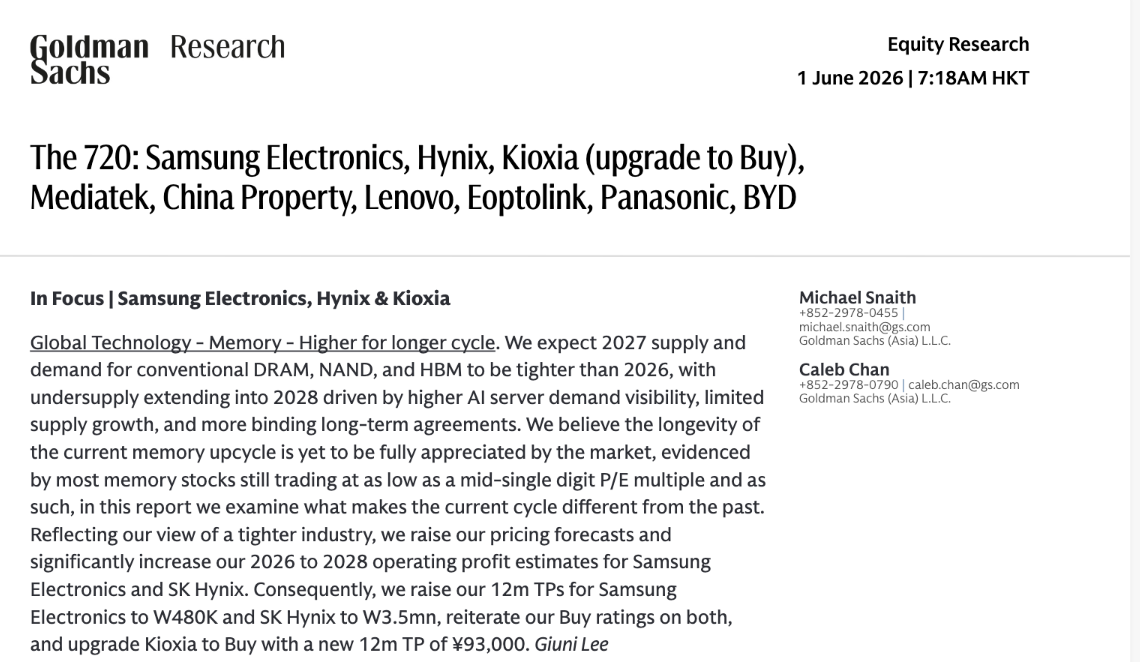
Goldman's biggest call in this issue is that the current memory upcycle will "last longer" (higher for longer), with shortages continuing all the way until 2028—something the market is vastly underestimating. The evidence lies in valuations: most memory stocks are still trading at single-digit mid-range P/E ratios, as if the market assumes this is just another ordinary cyclical rebound. Goldman disagrees.
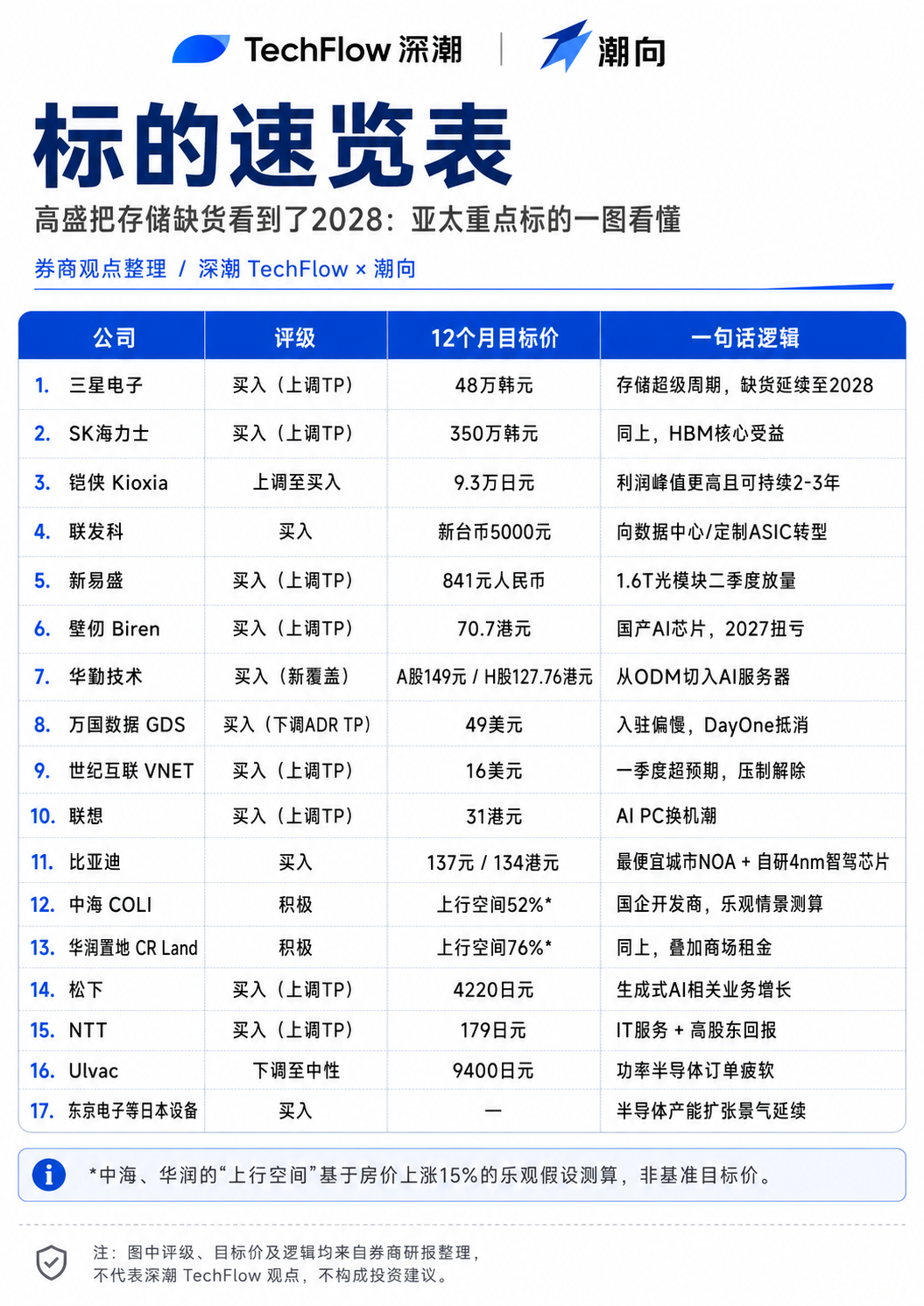
Below, I break it down by importance, ending with a quick-reference table of the targets.
Headliner: Memory Shortages to Persist Until 2028, Three Stocks Upgraded Collectively
Goldman compares this cycle to past ones and concludes this time is different. Three reasons: higher visibility of AI server demand, limited supply growth, and increasingly rigid long-term supply agreements (locking in both volume and price). Combined, DRAM, NAND, and HBM supply-demand dynamics will be tighter in 2027 than in 2026, with shortages extending into 2028.
The most直观 evidence is Goldman's DRAM supply-demand chart. Negative figures indicate supply shortages—the deeper the gap, the stronger the price support. Goldman has revised its 2026–2028 forecasts to deeper shortage territory, with the 2027 estimate slashed from -2.5% to -5.9%, more than doubling. In plain English: Goldman believes memory manufacturers will face increasingly severe shortages next year and beyond, meaning price hikes can sustain longer.
For specific companies, three saw collective target price adjustments:
• Samsung Electronics: 12-month target raised to KRW 480,000, maintaining Buy.
• SK Hynix: 12-month target raised to KRW 3.5 million, maintaining Buy.
• Kioxia: Upgraded from Hold to Buy, new target JPY 93,000.
Kioxia is the only rating upgrade in this issue, and Goldman's logic deserves a closer look: it believes the cycle's profit peak will be higher than previously expected and can last two to three years, not a flash in the pan. Based on this, Goldman has raised Kioxia's operating profit forecasts for fiscal years 2027–2029 by 16% to 48% all at once and expects gross margins to stay around 80%. For a company in the cyclical memory business, projecting three years of sustained high profits is a strong statement.
AI Compute Chain "Full Bundle": From Chips to Optical Modules to Data Centers
Beyond memory, this issue essentially runs through the entire Chinese and Asian AI hardware supply chain, all tied to one overarching theme: global hyperscaler capex is accelerating, and the money flows downstream.
• MediaTek: Buy, target TWD 5,000. The key story is its pivot from mobile chips to data centers and custom ASICs (AI chips tailor-made for specific clients). The company aims to achieve $2 billion in data center/AI ASIC revenue by 2026 and capture 10% to 15% of the $70–80 billion ASIC market by 2027.
• Eoptolink: Buy, target raised to CNY 841. It makes optical modules, critical components for high-speed data transmission in AI data centers. Goldman is bullish on its 1.6T optical module volume ramp starting in Q2 and accelerating in H2, along with capacity expansion in Thailand, leading to 2027 and 2028 earnings forecasts raised by 5% and 6%, respectively.
• Biren: Buy, target raised to HKD 70.7. A domestic AI chip maker, its Bili166 chip received the highest security reliability rating. Goldman expects it to turn profitable by 2027 as it shifts to higher-compute AI chips with rising ASPs, and has raised its 2026–2030 revenue forecasts by 4% to 28%.
• Huaqin Technology: Buy, a new coverage target in this issue. A-share target CNY 149, with initial H-share coverage at HKD 127.76. The logic: it's transitioning from consumer electronics ODM into AI data centers, with projected 32% CAGR revenue growth from 2025 to 2027.
• Data center duo: GDS Holdings (GDS) maintained at Buy, but ADR target lowered to $49 (slower onboarding pace and declining monthly service revenue, partially offset by higher valuation for overseas DayOne business). VNET (VNET) maintained at Buy, target raised to $16 (stronger-than-expected Q1 results, solid capacity ramp execution, and removal of overhang from strategic investor constraints).
• Lenovo: Buy, target raised from HKD 27 to HKD 31. The bet is on an AI PC upgrade cycle, with Goldman expecting its notebook market share to expand to 28% by 2028 and AI notebook penetration to hit 66%, boosting overall ASPs. Its 2027 and 2028 fiscal year earnings forecasts are 22% and 25% above Bloomberg consensus, a notable divergence.
Off the AI Main Track, but Still Called Out
• China Real Estate (COLI, CR Land): Goldman is assessing whether the recent property sector rebound is sustainable. Under an optimistic scenario where 15 key cities follow Shanghai and Shenzhen's price recovery, with home prices rising 15% by end-2028, it estimates COLI and CR Land's cash profits could expand by over 30% and over 50%, respectively, by 2028. Based on sum-of-the-parts valuation, Goldman sees 52% further upside for COLI and 76% for CR Land, maintaining a positive view on these stronger state-owned developers. Key caveat: this is based on an optimistic assumption, not a baseline forecast.
• BYD: Buy, target CNY 137 / HKD 134. The story is its smart driving strategy launch, where it made the "God's Eye B" city NOA a CNY 12,000 optional package across all trims, bringing the entry price for a city NOA-equipped car down to CNY 78,800—the cheapest in China. It also unveiled its first self-developed 4nm autonomous driving chip, "Xuanji A3," already in mass production. Goldman sees these engineering capabilities boosting high-end smart driving penetration, lowering costs, and improving margins.
• Japanese Semiconductor Equipment: Goldman maintains Buy ratings on Lasertec, Ebara, Disco, and Tokyo Electron. The only contrarian move is downgrading vacuum equipment maker Ulvac (6728.T) from Buy to Neutral, cutting its target to JPY 9,400, due to weak high-margin power semiconductor orders and slower-than-expected gross margin expansion.
• Panasonic HD: Buy, target raised from JPY 4,000 to JPY 4,220, bullish on generative AI-related businesses (backup power, CCL, high-performance capacitors).
• NTT: Buy, target modestly raised from JPY 176 to JPY 179, driven by domestic IT service demand and a safety margin from its roughly 5% total shareholder return.
A Macro Overlay: AI Boom Meets Energy Crisis
Tying the stocks together is Goldman's macro view: emerging markets are being torn in two by two forces—on one side, the AI investment frenzy; on the other, an energy supply contraction from a Strait of Hormuz blockade.
Tech-exporting economies like South Korea and Taiwan benefit from surging exports and current account surpluses, while energy-importing nations face rising inflation, currency weakness, and fiscal strain from fuel subsidies. Goldman expects Q4 Brent crude to average $90/barrel, continuing to pressure heavy oil-importing economies, and recommends overweighting stocks in China, South Korea, Brazil, and South Africa. This aligns with the recent Iran situation and oil macro backdrop.
Two other points directly affecting A-share capital flows:
China's imports surged 23.6% year-on-year in the first four months, but Goldman sees this as a highly concentrated phenomenon—gold and semiconductors alone accounted for about 65% of the import increase, not signaling sustained external imbalance deterioration.
For the semi-annual rebalancing of the CSI and CNI indices, Goldman estimates it will trigger over $48 billion in two-way passive fund flows, with tech hardware & semiconductors and capital goods seeing the most inflows (about $3.1 billion and $1.4 billion, respectively), while healthcare and banking see the most outflows. New additions expected to see the largest net passive inflows include Huagong Tech, Yuanjie Technology, Hua Hong Semiconductor, GigaDevice, and VeriSilicon. For index rebalancing arbitrage funds, this is an open secret.
Finally, Goldman includes its usual Easter egg: 2026 World Cup win probability predictions—Spain leads at 26%, followed by France (19%), Argentina (14%), Brazil (8%), and England (5%). The model penalizes defending champion Argentina, so take it with a grain of salt.
Target Snapshot Table
This article is a compilation and interpretation by TechFlow of a third-party brokerage research report. The ratings, target prices, earnings forecasts, and related judgments cited are the analyst's views from that broker, representing only their firm's stance, not TechFlow's, and do not constitute any investment advice.
Three points to keep in mind while reading:
One: Target prices are analysts' expectations for a future period (typically 12 months), predictions rather than commitments, subject to repeated adjustments based on company performance and market conditions.
Two: Sell-side research reports are naturally bullish. It's common for brokers to issue "Buy" ratings on covered companies, and some covered firms have investment banking or other interest relationships with the broker. A list dominated by "Buys" should be read with this underlying bias in mind.
Three: The value of a research report lies in its core logic and underlying assumptions, not a single target price. If the core logic holds, the targets' rationale stands; if it's invalidated, the entire chain weakens. Focus on the logic, not just the price.
Markets carry risks, and decisions require independence. This article should not be used as a basis for buying or selling any securities.