






Written by: Eli5DeFi
Compiled by: AididiaoJP, Foresight News

BlackRock, JPMorgan, Apollo, Société Générale, Banque de France – all these institutions are currently trying to use Ethereum as financial infrastructure.
Not buying ETH, not launching crypto products for retail, not issuing press releases about some "Web3 strategy."
They are using Ethereum as operational-grade financial infrastructure to move trillions of dollars. And apparently, 99% of Crypto Twitter is still busy arguing whether crypto is dead or which coin to pump next.
Let me lay this out because it's almost completely unreported.
First: What the hell is a Repo?
A repo is actually the simplest trade in finance.
Say you need $100 cash tonight, and you have a $100 Treasury bond. You go to a bank and say, "Buy this bond from me today for $100. Tomorrow I'll buy it back for $100.02." The bank agrees. You get the cash. They make $0.02. Tomorrow, the bond goes back to you, the cash goes back to them.
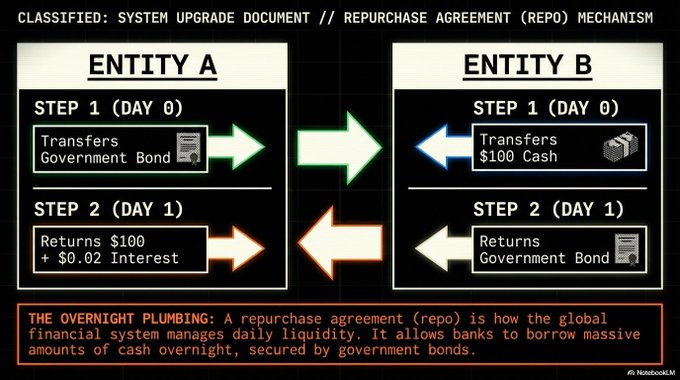
That's a repo. "Repo" refers to the agreement to repurchase the bond. That $0.02 difference is the interest. The Treasury bond is the collateral that makes the trade safe.
Now, scale that to the size of the entire financial system.
Every day, banks, hedge funds, money market funds, and broker-dealers run variations of this trade to manage liquidity. A bank that gets a big deposit on Tuesday but needs cash on Wednesday does a repo. A hedge fund that needs overnight financing for a Treasury position does a repo. A money market fund with spare cash wanting to earn a little risk-free return takes the other side.
The repo market is the overnight plumbing of the financial system.
It's how banks stay liquid day-to-day. It determines the cost of borrowing against Treasuries, which then influences almost every other interest rate you touch.
And as of Q3 2025, in the US alone, this is a $12.6 trillion per day market. Add Europe's €10.9 trillion, and you're looking at roughly $25 trillion in daily volume.
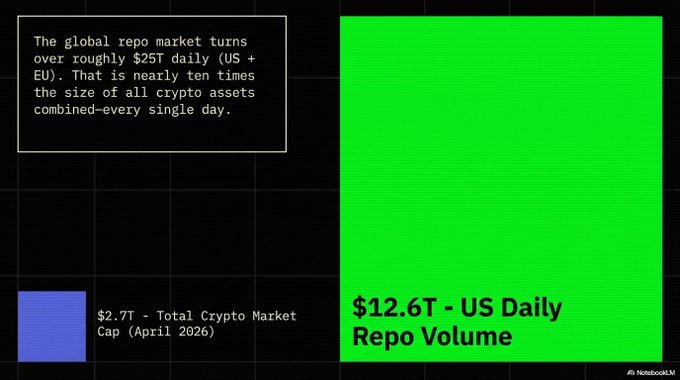
For perspective: In April 2026, the entire crypto market cap is around $2.7 trillion. The repo market turns over almost ten times that amount every single day.
Most people who've held ETH since genesis have never heard of this.
The Day the Global Financial System Almost Seized
To understand why institutions are willing to spend hundreds of millions to move repos on-chain, you need to understand what happened on September 17, 2019.
On September 16, two routine things collided:
- Corporate quarterly taxes were due. Corporations pulled about $35 billion from money market funds to pay them.
- $54 billion in newly issued Treasuries settled, landing on primary dealers' balance sheets all at once. These dealers needed overnight financing for that inventory via the repo market.
Together, these two events drained about $120 billion in liquidity from the banking system in under 48 hours.

That's when the fragility showed. Bank reserves had been declining for two years as the Fed had been shrinking its balance sheet.
By September 2019, reserves had fallen below $1.4 trillion. Pulling $120 billion from $1.4 trillion sounds manageable. It wasn't, because money isn't evenly distributed.
Some banks had plenty, some had none. And there was no efficient mechanism to move funds from surplus banks to deficit banks.
So the repo rate, SOFR, spiked from 2.43% on September 16 to 5.25% on September 17, hitting 10% intraday. For a market that usually moves in basis points, this was an earthquake in a building you thought was solid.
Yes, it was chaos.
The Fed had to inject $75 billion in emergency funds on September 17 itself. Daily liquidity operations continued through June 2020.
The official post-mortem concluded two things greatly exacerbated the spike: limited transparency (price information didn't flow between different segments of the repo market) and market fragmentation (funds couldn't move efficiently between different corners of the system).
In other words, the money was there, the liquidity existed. The system just couldn't get it to the right place, at the right time, fast enough.
And that specific failure point is one that on-chain settlement is structurally built to fix, in a way no other centralized infrastructure can.
Enter Ethereum (Quietly, Without a Press Release)
No one formally announced, "The repo market is moving to Ethereum."
Institutional finance doesn't work like that. Instead, throughout 2024, 2025, and into 2026, a series of decisions were made by institutions that almost never get it wrong:
JPMorgan: $300+ Billion in Blockchain Repo (Already Done)
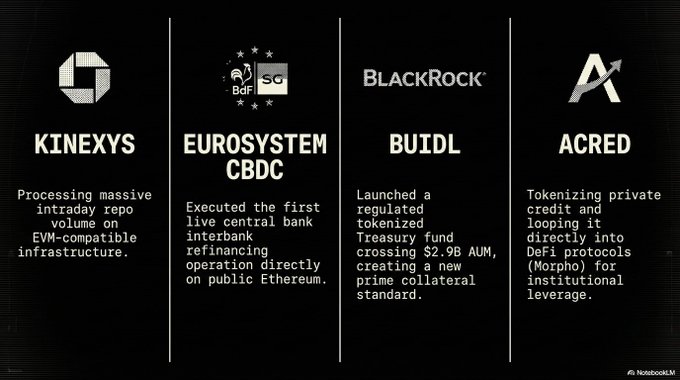
JPMorgan started building blockchain-based intraday repo in 2019, back when their platform was called Onyx (now renamed Kinexys).
The mechanism: institutions deposit tokenized collateral on Kinexys to borrow intraday funds, returning the cash before close.
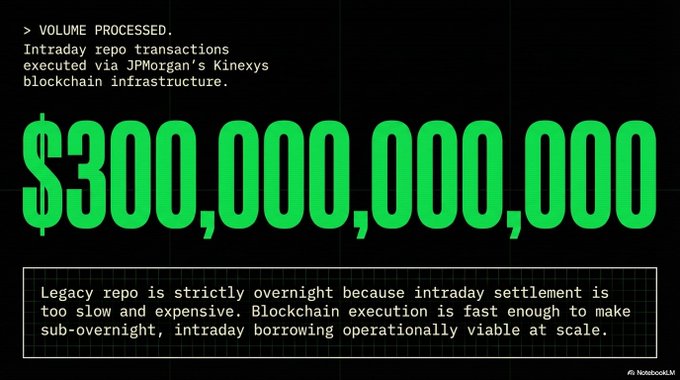
Why emphasize "intraday"? Because traditional repos are mostly overnight.
In TradFi, intraday repos are costly and full of friction, so most institutions don't bother. On-chain, you can execute, settle, and reverse within the same trading day without significant cost.
The result:
Kinexys has processed over $300 billion in intraday repo trades since launch.
The entire platform (including repo, cross-border payments, and FX) has seen over $1.5 trillion in total volume, with $2 billion processed daily.
Clients include Siemens, BlackRock, and Ant International.
In December 2025, JPMorgan doubled down, launching the tokenized money market fund My OnChain Net Yield Fund (MONY) on Ethereum mainnet, seeded with $100 million and redeemable for USDC.
JPMorgan, with $4.6 trillion in assets, is the first globally systemically important bank running a tokenized fund on a public chain.
Société Générale + Banque de France: First Central Bank Repo on Ethereum Public Chain (2024)
In December 2024, SG-FORGE, the digital asset subsidiary of Société Générale, executed the first blockchain repo transaction with a Eurosystem central bank. The structure:
SG-FORGE deposited a bond it issued on the Ethereum public chain in 2020 as collateral.
Banque de France (the French central bank) issued wholesale central bank digital currency in exchange.
End-to-end repo, live on-chain.
Banque de France described this as proving the "technical feasibility of conducting interbank refinancing operations directly on a blockchain." In plain English: "We tested it, it works, we're considering using it more."
The European overnight repo market is €10.9 trillion. The Eurosystem is both a participant and a regulator. The French central bank executing a live repo on Ethereum public chain is a policy signal, not a hackathon project.
BlackRock BUIDL: Tokenized Treasuries Becoming the New Collateral Standard
BlackRock launched its USD Institutional Digital Liquidity Fund on the Ethereum public chain in March 2024.
BUIDL holds short-term US Treasuries and cash equivalents, paying yields directly to crypto wallets daily with near-instant settlement. By mid-2025, its AUM peaked near $2.9 billion, capturing 42% of the tokenized Treasury market.
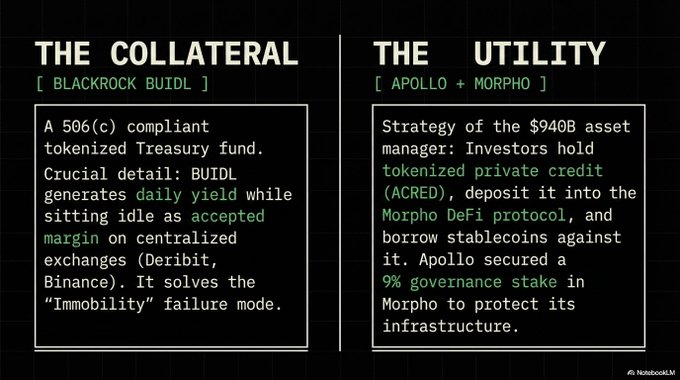
And for overnight repo, here's the key: BUIDL is now accepted as collateral by Deribit, Crypto.com, and Binance. It's a reserve asset for the Frax stablecoin. It's used as margin for derivatives trading. JPMorgan launched the direct competitor MONY in December 2025.
What's really happening here: tokenized money market funds are becoming the new repo collateral. And they're better than traditional repo collateral because they earn yield while sitting idle as margin.
In TradFi, you pledge a Treasury as collateral, and it just sits at the clearinghouse, earning you nothing extra. With BUIDL or MONY, the yield accrues while the asset is posted as collateral.
Apollo + Morpho: Private Credit Enters the DeFi Lending Stack
Apollo Global Management manages $940 billion in assets. In early 2025, they tokenized their Apollo Diversified Credit Securitized Fund via Securitize and deployed it as collateral on the DeFi lending protocol Morpho.
This created a loop:
- Investors hold tokenized ACRED (private credit fund shares).
- Deposit ACRED into Morpho as collateral.
- Borrow stablecoins.
- Redeploy the borrowed liquidity into other on-chain strategies.
- Earn the spread between ACRED yield and borrowing cost.
This is a "loop" strategy. In TradFi, to do this, you need a prime brokerage relationship and a mountain of paperwork. On-chain, it's a few smart contract interactions.
This is the first time a private credit fund has been used in on-chain structured products. Apollo's own words: "Tokenization enables access, and on-chain financial infrastructure creates new utility."
In February 2026, Apollo deepened its commitment: a cooperation agreement to acquire up to 90 million MORPHO tokens (9% of total supply) over 48 months. These tokens have governance rights over Morpho's protocol parameters and fee structure. Apollo isn't just using DeFi infrastructure; they're becoming a stakeholder in it.
Morpho currently holds over $10 billion in deposits across major EVM chains (per Messari). Coinbase's Morpho-powered crypto-backed loan product has accumulated $1.7 billion in collateral (mostly ETH and BTC) and $960 million in active loans since launch.
Bitwise opened a USDC yield vault on Morpho in January 2026. This is becoming infrastructure, not a niche DeFi app.
What On-Chain Overnight Repo Actually Solves
Traditional overnight repo has four structural problems:
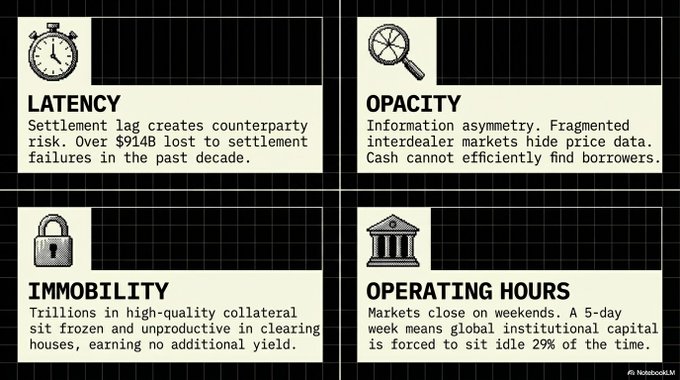
Problem 1: Settlement Lag Creates Counterparty Risk
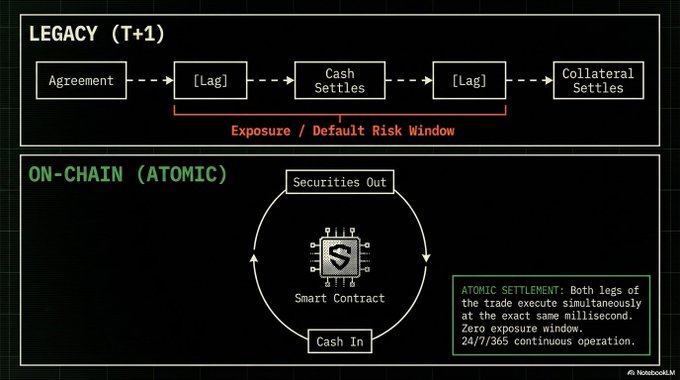
In traditional overnight repo, you agree to a trade today, but the actual movement of securities and cash takes time. In that window, your counterparty could default, and you'd have nothing. Per JPMorgan data, settlement fails cost market participants over $914 billion in the last decade.
On-chain solution: Atomic settlement. In a blockchain transaction, both legs of the trade (security out, cash in) settle in the same instant. Simultaneously. Either both happen, or neither does. No risk window. JPMorgan has already tested cross-chain trades live with Chainlink and Ondo Finance, settling tokenized US Treasuries against dollar deposits in real-time between two different blockchain networks.
Problem 2: Information Doesn't Flow Between Market Segments
The September 2019 crisis was exacerbated partly because different segments of the repo market (tri-party, cleared bilateral, interdealer) didn't share price information in real-time. Banks with excess liquidity didn't know where to put it. Borrowers couldn't find cheap cash. The pipes were clogged.
On-chain solution: A shared, transparent ledger. Every trade, every rate, every collateral position is visible on-chain in real-time. Market participants read the same world state simultaneously. The information asymmetry that worsened the September 2019 crisis is structurally diminished.
Problem 3: Collateral is Frozen and Unproductive
When you pledge a Treasury as repo collateral, that bond is locked at the clearinghouse, useless to you for anything else. In a $12.6 trillion per day market, the opportunity cost of that frozen collateral is massive.
On-chain solution: Programmable, composable collateral. A tokenized bond on Ethereum knows who owns it, can move itself when conditions are met, can earn yield while being pledged, and can be used across multiple protocols simultaneously within defined rules. BUIDL sitting as margin on Binance still earns daily yield from its underlying Treasuries. This was impossible before.
Problem 4: The Market Has Business Hours
The traditional overnight repo market closes on weekends. Banks window-dressing their balance sheets for quarter-end (they pull back loans to clean up their books) creates a predictable stress event every 90 days. A market that only runs five days a week means capital sits idle 29% of the time.
On-chain solution: 24/7/365 settlement. Ethereum doesn't have business hours. JPMorgan explicitly markets its blockchain deposit account for "24/7 same-day settlement." Intraday repo on Kinexys works precisely because blockchain settlement is fast enough to make borrowing for less than overnight operationally feasible.
What This Means for the ETH Asset Itself (Three Demand Vectors)
ETH is still highly macro-driven. It fell 23% from $2,200 to ~$1,700 in early 2026 on tariff pressure, trading as a risk asset in most market regimes.
This institutional overnight repo migration doesn't override short-term price dynamics.
But it does create structural, long-term demand that won't show up in funding rates or retail sentiment. Three mechanisms:
Block Space Demand
Every on-chain overnight repo trade, every BUIDL transfer posted as collateral, every stablecoin borrowed against ACRED on Morpho consumes Ethereum block space. EIP-1559 burns a portion of every transaction fee. More institutional-grade block space demand equals more fee burn equals less supply over time. JPMorgan processing $2 billion daily on Kinexys (largely on EVM-compatible infrastructure) represents a baseline of institutional block space consumption that didn't exist three years ago.
ETH as Prime Collateral
Standard Chartered reported in early 2026 that corporate treasuries and ETH spot ETFs have accumulated roughly 3.8% of the circulating ETH supply since June 2025. Treasuries alone bought ~2.3 million ETH in about two months, a rate nearly double that of Bitcoin's comparable accumulation phase. In Coinbase's Morpho integration, $1.7 billion in collateral (mostly ETH) is actively backing live loans. ETH is acting as prime collateral in institutional credit operations.
Staking Yield as the On-Chain Reference Rate
As more institutional activity settles on Ethereum and institutional idle liquidity parks in ETH-denominated yield instruments, ETH staking yield (~3.8% for solo stakers) is becoming the relevant on-chain risk-free rate. This is a structural demand anchor for staked ETH that scales with the volume of on-chain institutional settlement.