






Written by: Deep Tide TechFlow
Introduction
Despite the gloomy market sentiment, a handful of projects continue to thrive, and Aster is one of them.
According to CoinGecko data from November 19, $ASTER surged over 7.7% in the past 24 hours, 18.4% over 7 days, and 32.1% over 14 days.
As one of the most successful TGE projects this year, after witnessing Aster's remarkable 2800% surge during its TGE week, the market has become increasingly focused on Aster's future trajectory.
After all, having seen numerous projects peak at TGE, sustained user activity, trading volume, and revenue post-TGE are the true tests of a project's resilience in the face of market and community scrutiny.
Meanwhile, with 2025 poised to be a year of explosive growth for Perp DEXs, Aster's突围之战 will become even more compelling amid competition from rivals like Hyperliquid, Lighter, and EdgeX.
So, what is Aster's core competitive strategy?
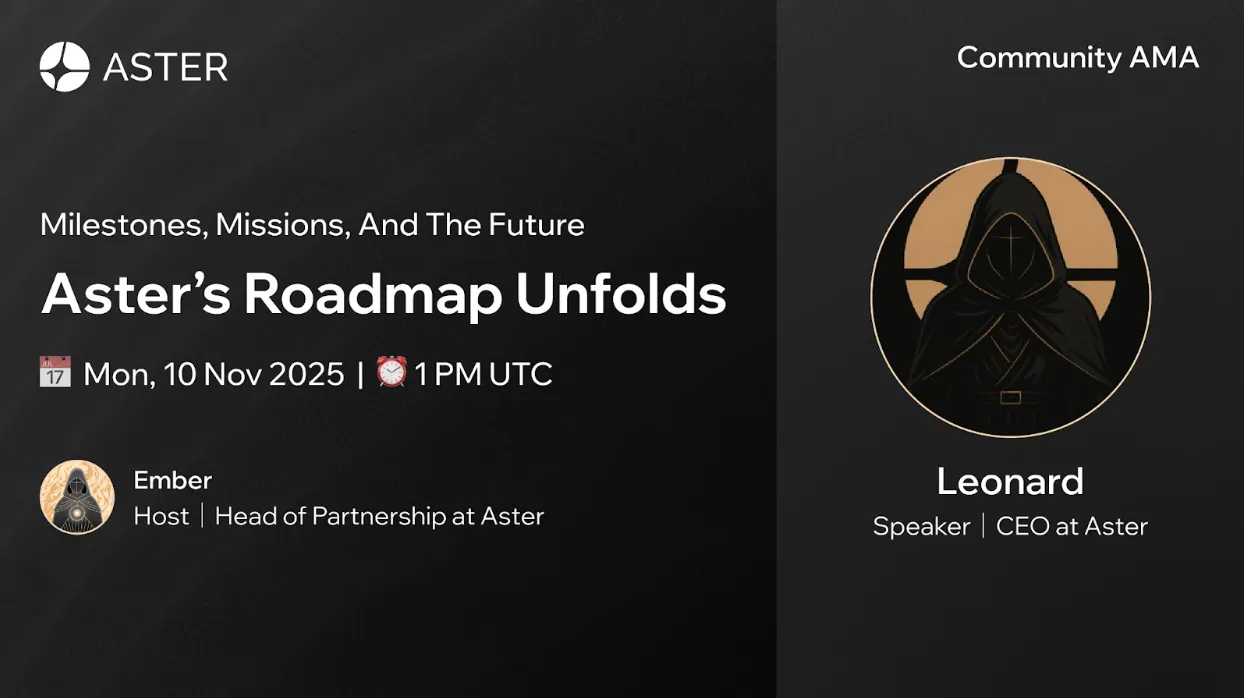
From launching Rocket Launch to provide users with early access to high-quality assets, to introducing a privacy-focused Layer 1, and empowering the $ASTER token through staking/buybacks/burning/fee discounts— on November 10, 2025, Aster founder Leonard provided a clear answer during a community AMA:
The market doesn't need another repetitive, uninspired Perp DEX—it needs genuine trading freedom, integrating security, trust, privacy, efficiency, cost-effectiveness, liquidity, and the discovery and capture of yield opportunities.
And Aster is rebuilding the on-chain trading ecosystem to achieve true, sustainable progress in the realm of on-chain finance.

What did the founder reveal in the AMA clarifying Aster's future?
Summarizing the hour-long AMA, several key takeaways stand out:
Aster is building a privacy-focused Layer 1: The team is working tirelessly to complete internal testing and prepare the testnet technically by early 2026.
Continuous empowerment of the $ASTER token: Previously, Aster introduced specific use cases for $ASTER, including fee discounts, airdrops, and VIP tiers, while continuously enhancing token value through buyback and burn programs. With the launch of Layer 1, $ASTER will unlock more utility in validation, staking, governance, and other scenarios.
Diversifying trading assets: Beyond expanding cryptocurrency support, Aster will extend its offerings to include gold, stocks, commodities, and more.
Optimizing liquidity incentives: Continuously attracting and rewarding market makers, incentivizing both major pairs and those providing liquidity in long-tail markets.
Exploring the degen direction: Launching and operating Rocket Launch to grant users early value-capture capabilities.
Building a global partnership network: Enhancing the trading ecosystem for a richer experience.
While each initiative may seem independent, they will collectively create a trading environment that is truly attractive to all participants—traders, institutions, token holders, and market makers alike.
Ascending to new heights post-TGE
The massive success of the TGE brought a tidal wave of users, trading volume, and community discussion to Aster.
With the TGE concluded, Aster has its own secret sauce for retaining users effectively as a trading platform.
In founder Leonard's vision, this is a dual-track approach: horizontally expanding yields while vertically deepening the user experience.
To retain users, the first step is ensuring they trade comfortably—optimizing the experience. Aster is built specifically for traders, aiming to create an ecosystem that combines CEX-level smoothness with DEX-level trust. For traders, especially professionals or institutions, Aster offers several advantages:
On one hand, its decentralized architecture allows Aster to list tokens faster and expand trading assets more flexibly: Aster remains permissionless and open, supporting not only cryptocurrencies but also assets like U.S. stocks and gold, with plans to add more stocks and commodities, providing diverse trading options on-chain.
On the other hand, Aster is continuously refining its liquidity management. The market maker program incentivizes LPs to bolster liquidity in thinner markets. While depth for major pairs has been significantly optimized, Aster will focus on long-tail assets, offering higher rebate rewards to market makers for smaller tokens to improve depth and execution quality, ensuring smooth, low-slippage experiences for all assets.
Privacy features are a key differentiator for Aster compared to other Perp DEXs. Many users, especially institutional traders, prefer not to have their strategies and positions fully exposed on-chain. Aster's Hidden Orders and concealed delegation systems address this, helping attract more institutional capital.
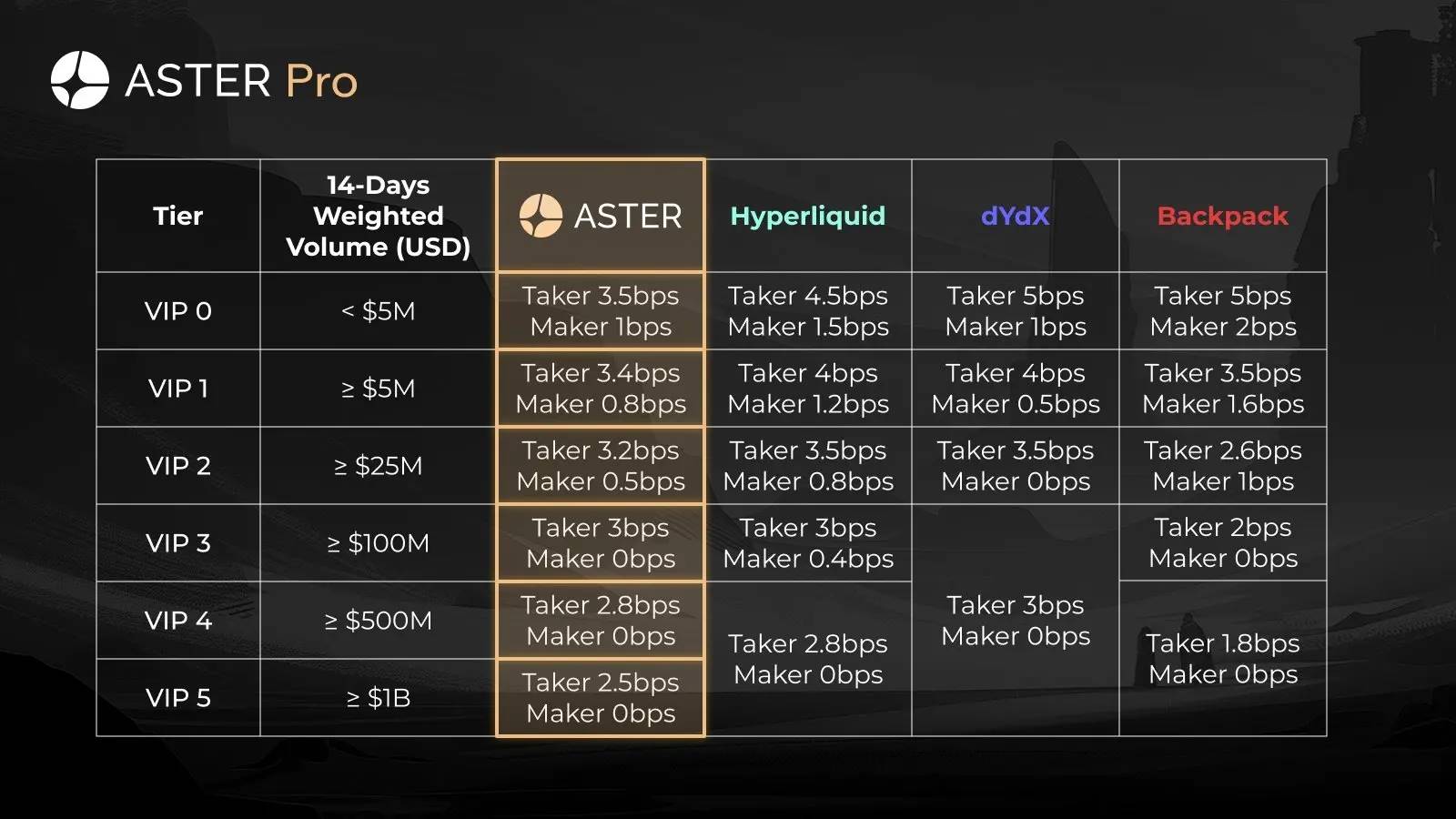
Additionally, features like 1001x maximum leverage and fee advantages will create scalable cost differences for large institutions or high-leverage traders.
Beyond trading experience, traders care about "gaining something," which aligns with Aster's core philosophy: Trade & Earn.
Stable yields are a key module for Aster, aiming to provide users, especially institutions, with higher capital efficiency. By combining lending, perpetuals, and yield pools, Aster maintains risk control while boosting capital returns. Future collaborations with more DeFi partners will introduce additional yield scenarios.
USDF is central to Aster's stable yield module, serving as trading collateral, a liquidity asset, and a passive income source. As a delta-neutral yield-bearing stablecoin, USDF generates returns primarily by deploying underlying assets into low-risk DeFi protocols.
Post-TGE, Aster has rolled out diverse incentives, including ongoing Stage 3 and Stage 4 activities, and the Double Harvest trading competition with a $10 million prize pool, rewarding real trading to attract users and drive ecosystem growth.
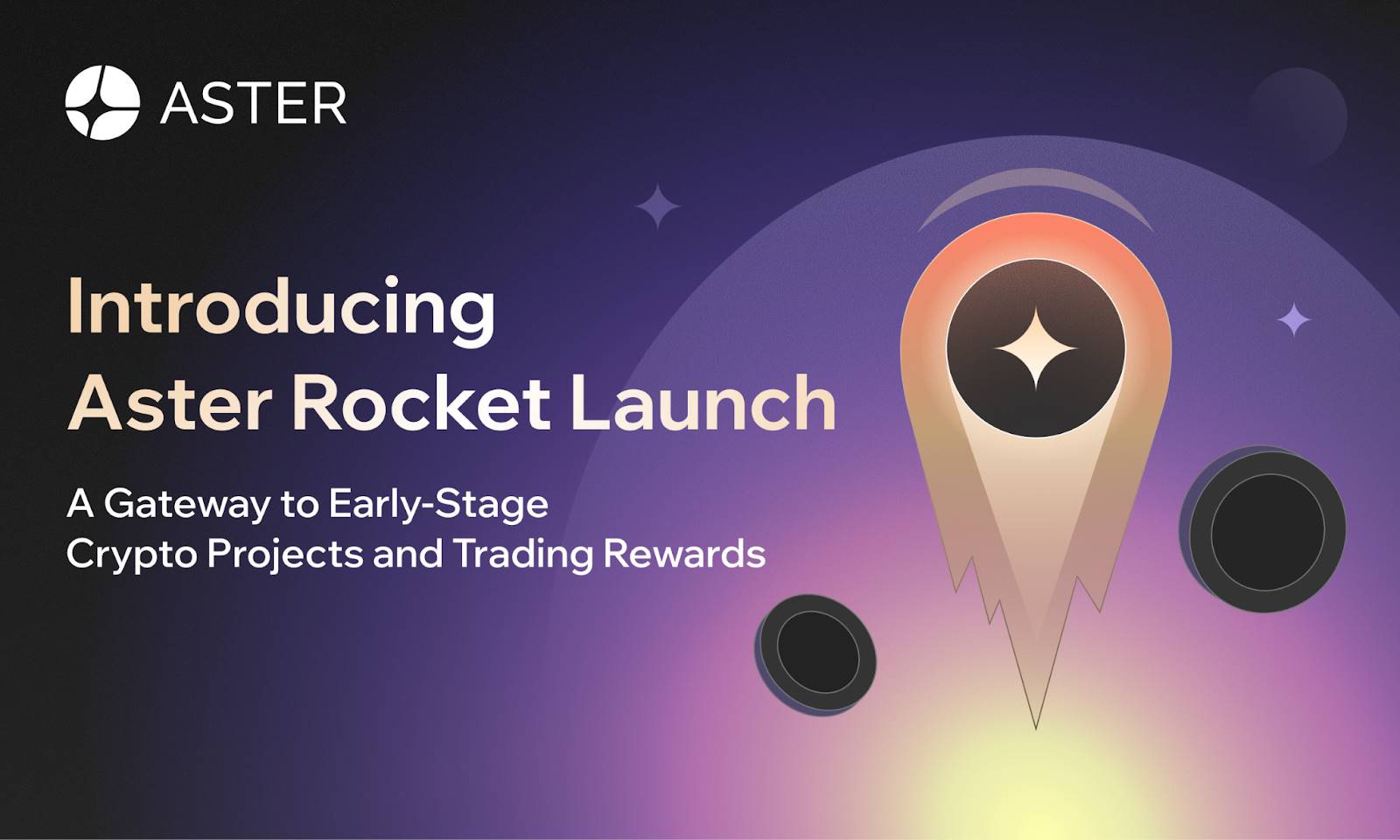
Another notable post-TGE move is the launch of Rocket Launch. As a core vehicle for Aster's "liquidity support" value, Rocket Launch offers high-potential projects a launchpad with both trading depth and long-term value. Projects can set up prize pools to reach broader audiences, while users gain an entry point for degen activities and early opportunity capture. Since its launch, five projects have been listed, with cumulative rewards exceeding $3 million.
Since TGE, Aster's growth logic has proven effective through concrete data:
According to Aster's official data, the user base has surpassed 4.6 million. Dune data shows Aster's 24-hour open interest at $2.329 billion, weekly trading volume over $25.6 billion, and a Perp DEX market share exceeding 20%.
While some metrics have dipped due to the bear market, they strongly affirm Aster's firm footing in the Perp DEX arena, positioning it as a top-tier player.
While steadfastly pursuing the dual-track path of yield expansion and experience enhancement, the ongoing Layer 1 strategy opens up even more promising avenues for Aster's trading ecosystem.
Aster Layer 1: Evolving the narrative from Perp DEX to trading infrastructure
Among the highlights of founder Leonard's AMA, Aster Layer 1 garnered the most attention.
Building a Layer 1 is about infrastructure, and Aster Layer 1 aims to create a chain redesigned specifically for trading.
Why build a new chain? The answer circles back to Aster's初心: achieving a truly decentralized on-chain trading environment with CEX-like experience.
On one hand, Aster believes the trading ecosystem must be built on decentralization, as blockchain's verifiability and self-custody capabilities lay a strong foundation of trust.
On the other hand, for trading ecosystems, the core lies in order book matching. Aster needs infrastructure that delivers performance close to centralized matching. Most existing public chain solutions run matching in contracts or off-chain systems, using blockchain merely for data recording, which comes with many limitations.
Meanwhile, from a pure matching performance standpoint, founder Leonard believes no current chain can outperform centralized matching engines and databases. Thus, while pursuing CEX-like experience, Aster Layer 1 must find its差异化竞争关键—and privacy is Aster's answer.
Many traders prefer not to have their strategies fully transparent on-chain, as it could lead to additional complications. Strategy privacy is increasingly crucial. The case of知名交易员 James Wynn being targeted on Hyperliquid illustrates this, and Zcash's rising popularity further validates market demand. Offering on-chain privacy options fills a market gap and is key to enabling more users and strategies to operate on-chain.
Based on these factors, Aster Layer 1 is taking shape:
Designed for trading: Aster Layer 1 embeds order book logic directly into the blockchain core, integrating the entire trading process—order placement, matching, cancellation—into the consensus and execution layers. This ensures the chain's resource allocation and performance optimization are primarily focused on trading, delivering a CEX-like experience.
Enhanced privacy and security: Privacy has always been Aster's core differentiator, and Layer 1 continues this focus, protecting trading strategies and user privacy.
Verifiability and self-custody: Eliminating the black box of centralized exchanges, allowing participants to set rules and verify trades.
The infrastructure improvements from Aster Layer 1 will seamlessly connect ecosystem modules, triggering a chain reaction:
On one hand,底层优化 of the trading experience;
On the other, achieving true "verifiability + self-custody + privacy" will open doors for institutional adoption and propel Aster's evolution into "trading infrastructure." Whether DeFi projects or traditional financial institutions like brokers, exchanges, banks, and payment companies, they can build on Aster, replicating its success model of "CEX-level smoothness with DEX trust":
Aster provides matching engine + liquidity + risk control; partners provide brand + product + localized operations.
Moving forward, Aster will start in Asia and expand into English-speaking markets, continuously growing its global partnership network for rapid ecosystem expansion.
Additionally, with Layer 1's launch and staking functionality, the value cycle within Aster's trading ecosystem will close through the $ASTER token.
All value converges into $ASTER
As the core value carrier of the ecosystem, Aster continuously introduces specific use cases for $ASTER, empowering token holders. Current implementations include:
Governance: Token holders can vote on protocol developments, including liquidity sources, fee structures, fund management, etc.;
Fee discounts: Discounts when using $ASTER to pay trading fees;
VIP tiers: A multi-level VIP system based on trading volume and $ASTER holdings, unlocking deeper fee discounts, priority liquidity access, higher leverage limits, etc.;
Token airdrops: Holding or staking $ASTER boosts multipliers in Aster Spectra, prioritizing future airdrops;
Event participation: Eligibility for Rocket Launch and other events by holding a certain amount of $ASTER.
Furthermore, Aster is in talks with lending protocols to provide even more use cases for $ASTER.
Additionally, Aster has introduced buyback and burn mechanisms to further sustain token value:
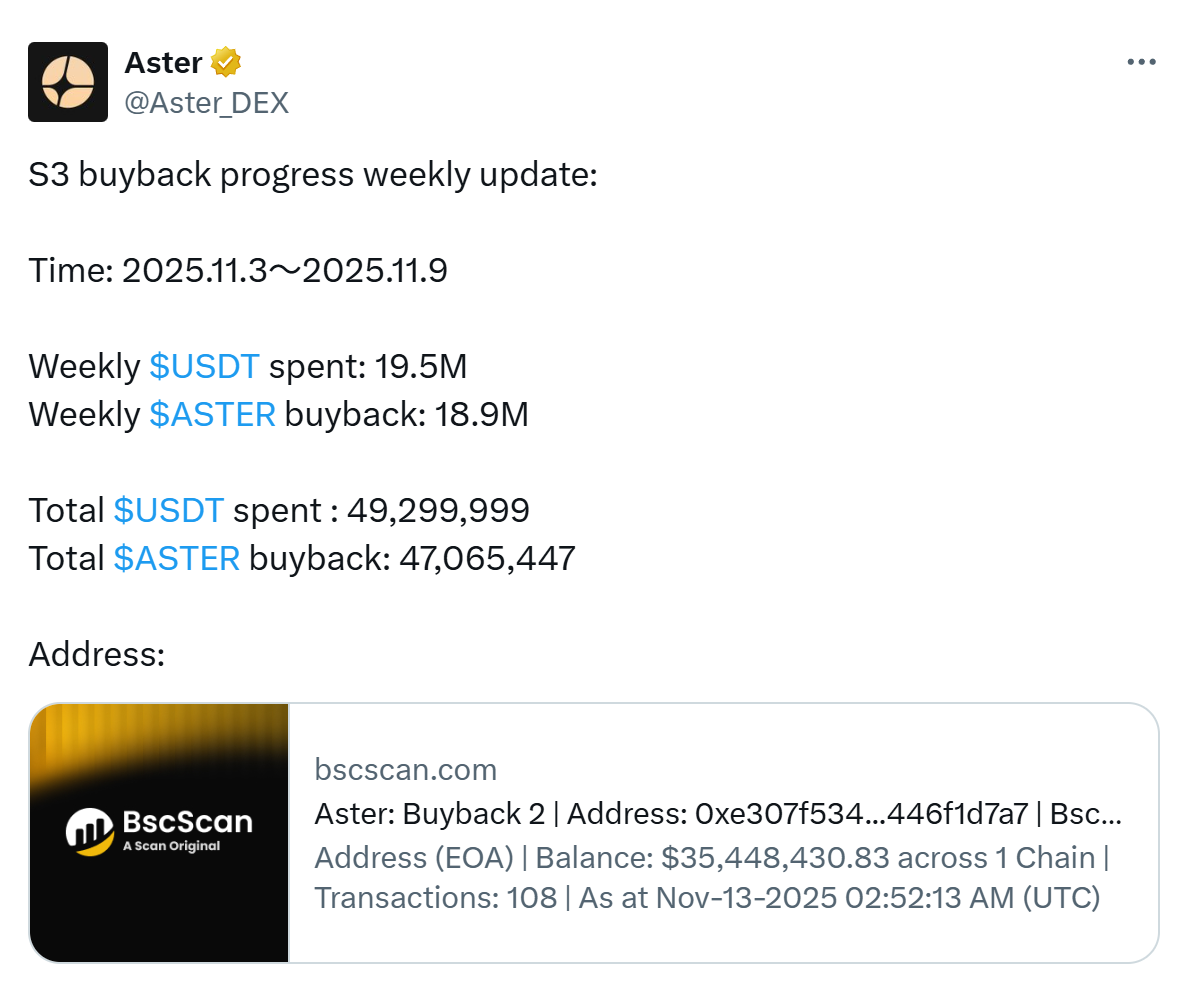
Previously, Aster announced that 70% - 80% of trading fees generated during S3 would be used to buy back $ASTER, with 50% of all buyback funds from S2 and S3 being burned and 50% returned to locked airdrop addresses, reducing token supply and enhancing long-term value.
All operations are executed orderly, transparently, and verifiably, bolstering community trust.
These measures significantly reduce $ASTER's speculative nature, transforming holders into long-term ecosystem builders. The virtuous cycle of "more active trading → higher platform revenue → increased buybacks and burns → further empowerment of holders" creates a sustainable positive flywheel.
With the official launch of Layer 1, $ASTER's value alignment with the entire Aster trading ecosystem will deepen:
On one hand, validator nodes and staking are expected to go live with Aster Layer 1 mainnet. Due to Layer 1's near-zero Gas design, validator incentives will be driven by two sources: ecosystem incentives from the protocol layer and a share of trading fees. Thanks to Aster's consistent positive cash flow, the ecosystem can support stable, sustainable incentive mechanisms, and trading activities gain added significance in maintaining network security.
On the other hand, buyback logic can be directly coded into smart contracts for automatic execution, making each buyback's quantity, price, and address publicly verifiable, avoiding front-running and information asymmetry, while retaining algorithmic flexibility for different parameters at various stages.
Moreover, with Aster Layer 1's launch, $ASTER will unlock more governance scenarios, allowing stakers to participate in on-chain governance votes and ecological parameter decisions, cementing the token's core role in ecosystem governance.
Conclusion
From building a Perp DEX product to重构交易基建, Aster is narrating an evolution of the on-chain trading operating system. This leap from application layer to infrastructure layer signifies Aster's commitment to creating fertile ground for countless trading scenarios to flourish.
When DeFi projects, brokers, exchanges, and financial institutions worldwide can rapidly build their derivative trading platforms on Aster's infrastructure, the $ASTER token, as the value carrier of this vast ecosystem, will see its potential grow with the expanding ecosystem.
It's also worth noting the distinct "Binance lineage" behind this narrative evolution: YZi Labs backs Aster, and notably, on the evening of November 2, CZ announced purchasing 2.09 million Aster tokens with his own funds, marking a strong endorsement and showing industry influencers are voting for Aster's future with action.
From competing on trading performance to achieving trading privacy, Aster chose a差异化竞争路径 for Perp DEXs from the start, quickly capturing market share with its performance. As a new round of Perp DEX competition begins, will Aster repeat its "TGE-phase explosive growth"?
With Aster Layer 1 set to debut by the end of 2025 at the earliest, let's always keep期待 for the future of on-chain trading.