






Author: Shenzhao TechFlow
On September 17, 2025, $Aster TGE was launched and Binance Alpha was officially launched. CZ publicly ordered on X. Within 24 hours, the peak price of $Aster soared 1650%, the transaction volume reached US$310 million, and the total transaction volume of the platform exceeded US$1.5 billion.
Prices continued to rise after the airdrop was distributed. Currently, the price of $Aster is stable at around $2.1, and the 7-day increase has been over 2000 percent.
When $Aster TGE brought the entire market to a boil again, many KOLs were buzzing about it as “the biggest jerk in history,” and there were not a few people who earned one million dollars per coin.
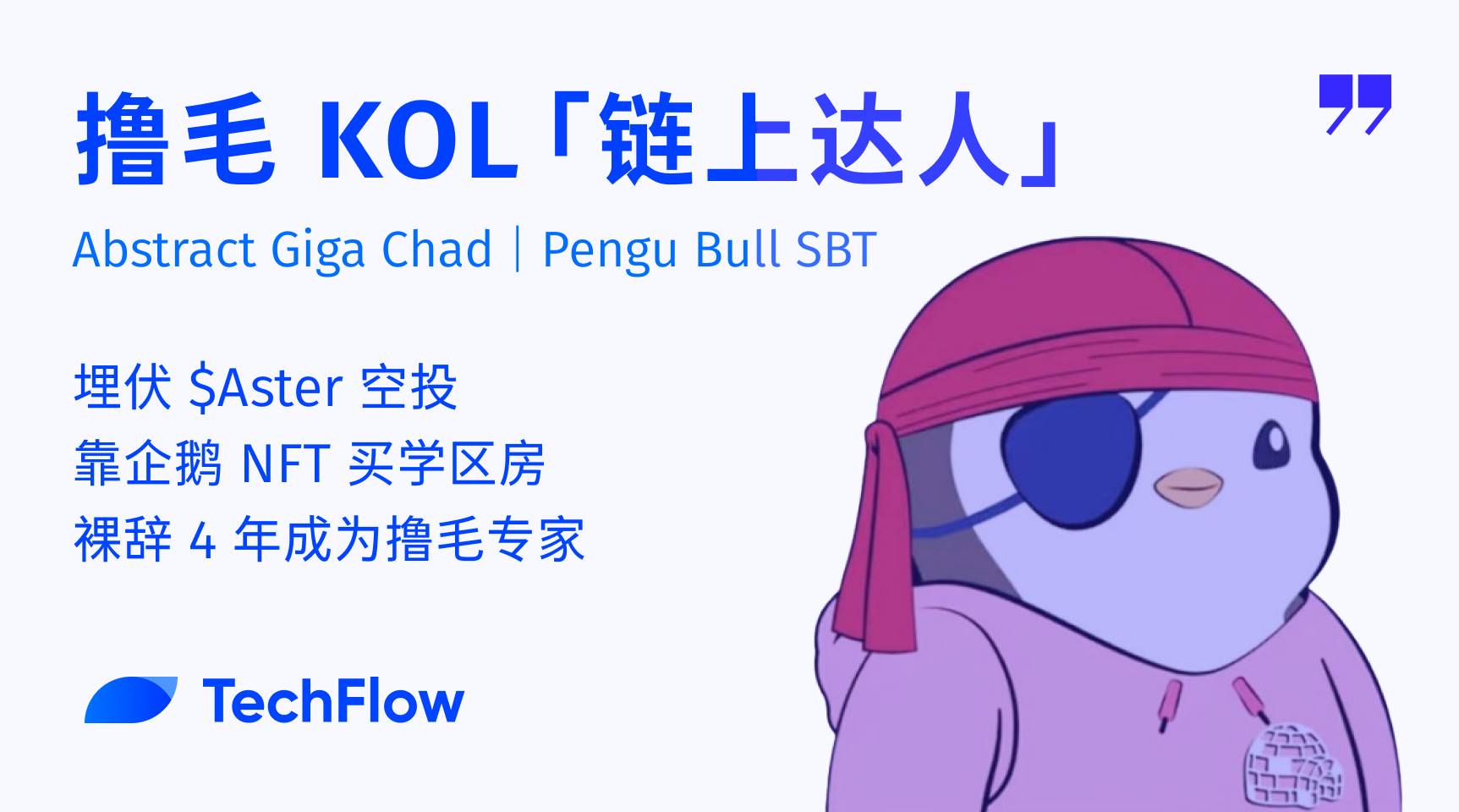
Crypto jerk KOL literature @wenxue600 (expert on the chain) also got good results. He lamented that 98,000 $Aster tokens were sold at 0.11 U, but this operation still brought him considerable rewards.
What is even more impressive is his investment myth in Pudgy Penguins: he bought a penguin NFT for 0.7 ETH (about 2,800 U) in 2021, and then received more than expected returns through airdrops from various external related projects. Literature mentioned in the interview, “I used this airdrop money to buy a school district house. It's really very, very rewarding.”
From entering the coin industry in 2018 due to Xu Xiaoping's phrase “embracing blockchain,” to becoming a full-time job blogger at the end of 2021, literature has witnessed the complete evolution of the industry from fanaticism to calm, from simple to complex. In this speculative segmented circuit, he spent more than three years proving a truth: professional jerking is not only a game of luck, but also a comprehensive test of information acquisition, risk management, and execution.
Today, when more and more studios are pouring into the wobble circuit, and the living space for retail investors is constantly being compressed, how did this KOL, who has transformed from traditional media, get results? How do you view changes in the industry? And how did he select truly valuable opportunities from a large number of projects?
Summary of key points
The transformation from venture capital media to becoming a blogger: the best way to get in touch with an industry is to enter the media. After the exchange felt a professional bottleneck, it discovered a gap in the market where high-quality overseas content creators were scarce, and decided to use it as a self-media outlet.
Fat Penguin Investment Myth: Buying Fat Penguin NFTs for 0.7 ETH (2800U) in 2021 is simply because I like to keep them. Later, they obtained 780,000 U of revenue through various external airdrops, and directly used the airdrop money to buy school district housing. It was indeed very rewarding.
Rational exit from the $Aster project: the expected price is 0.1U. Based on the 20U cost of 2,000 tokens, the 10x return is already very good. There is no regret that it sold out. The idea is to get results quickly, settle in the bag, and then move on to the next project.
The multi-dimensional backbone of project screening: look at the popularity of the racetrack, amount of financing, investor background, and team origin. Binance's exclusive investment projects are ignorant. European and American funds are superior to domestic funds, and are most afraid of projects from India and domestic teams.
The biggest change in the wobble racetrack: The most obvious change is getting more and more, with large players entering the field to dilute the points of small retail investors. However, jerking will last for a long time, because the project party needs users, and users need revenue. This relationship between supply and demand has always existed. The project party, the exchange, the VC, and the Mao Party play with each other and coexist with each other; they are all indispensable.
Survival strategy for retail investors: It is recommended to walk on multiple legs, not only to interact on your own, but also to contribute to the community and transform the output into another identity. Individual combat is dead, and professional teamwork is mainstream.
The lesson of the BTC ecosystem: I participated in a large number of assets such as inscriptions and runes, fantasized about going ashore, and most of the results went to zero. Trust that 99.9% of emotional assets will return to zero, and set expectations to stop profits in a timely manner.
The importance of mentality management: no one is an immortal; it is impossible to sell at the highest point every time, nor is Buffett. The important thing is to meet your expectations and establish a multi-dimensional source of fulfillment.
Promising future direction: Perp DEX is more optimistic about StandX. It was also done by the Binance and OKX teams, and the early stages of the project are quite promising. I'm looking forward to Abstract Chain (Pudgy Penguins Ecosystem L2), and the gameplay isn't easy to be batched by the studio. The parent company of Pudgy Penguins may be listed on the US stock market, and the ETF applied for is expected to pass.
A blogger's sense of accomplishment: The greatest sense of accomplishment is not how much he has worked, but rather receiving thanks from fans who have earned money by discovering projects and sharing tutorials. This sense of accomplishment is indescribable.
Get away from the internet and exchanges and embark on the wobble racetrack
TechFlow: How did you get into the crypto industry?
Blockchain expert: I used to work as a venture capital media on the traditional internet. 2016-2017 was the hottest time to start a business. Bike sharing and various O2O, B2B, and B2C models were very popular.
At the beginning of 2018, Xu Xiaoping's words in the group of entrepreneurs went viral, generally calling for everyone to embrace blockchain, something like “those who follow suit prosper, die”, etc.
I'm working in venture capital media myself, and I've also been involved with some blockchain projects. From that point on, I've been familiar with this stuff. After learning about it, I discovered that compared to traditional internet circuits, blockchain really has great opportunities. Various ICOs grew savagely in 2017-2018, and many people quickly became rich.
At the time, I thought the best way to get in touch with an industry was to get into the media.
In mid-2018, I went to one of the leading cryptocurrency media outlets at the time and learned from scratch, including various blockchain concepts and technologies, while studying and exporting.
I experienced many major industry events during my time in the media: the launch of the EOS main network in 2018, DeFi mining, Bitcoin halving, BCH forks, exchange wars, etc. Although the market was not good at the time, the industry was very lively.
After two years of media experience, I have basically penetrated the entire racetrack, but the media also knows that more lives means less money (laughs). I decided on two directions at the time: one was to enter VC because I could directly invest in projects and access first-hand news; the other was to enter the exchange. These two are basically at the top of the industry.
Later, I joined a leading exchange, mainly doing copywriting work, but after a period of time at the exchange, I felt a clear career bottleneck.
On the one hand, as a newcomer, it's difficult to get promoted quickly on large exchanges. The cycle is very long, and writing work is not a core business; it's basically a “see the head at a glance” state. I think if we want to achieve big results in this industry, we can't develop in a step-by-step manner.
Second, I prefer to research new things. At the time of the first wave of DeFi Summer in 2021, many people in the entire marketing department didn't even have wallets, didn't participate in mining, and didn't even know about LP free losses. I think the information here is too limited, but there are actually plenty of opportunities in the industry.
The third opportunity was to discover pain points in the industry. In 2021, domestic regulations were strict, and large financial bloggers were banned, and they switched from Weibo to Twitter, but high-quality overseas content creators were scarce. We had the budget but couldn't find the right marketing channel, so we joked with our colleagues about “why don't we just do it ourselves?”
Exactly in that year, my child had just been born, and I wanted to spend more time with my family. Since the market was good at the time, I thought, “Would you like to come out and do something yourself?”
Shenchao TechFlow: How did you get on the wobble track after quitting your job?
On-chain expert: At the end of 2021, although I had early airdrop experiences such as Uniswap, there was no specific “jerk off” concept at the time; I participated more as an on-chain player myself. At the time, I only decided that I wanted to be a self-media company, but I didn't really think about what to do.
Chain games were very popular back then. I was deeply involved in the Wolf Game (Wolf Game) community, posting project news as soon as a broadcaster every day, chatting and meeting in the community. Because my assets were also inside, it was like fighting chicken blood back then. As a result, it has amassed its first group of fans.
After the online game went out of service, I began to focus on overseas channels. Using the time to feed the baby in the middle of the night, I immediately translated Vitalik's articles and some overseas research reports and posted them on the public account. As a media background, I know the importance of “original+debut”. A few popular articles were posted in the evening, and many requests for disclosure were received from other media the next day.
In 2021, there were very few Chinese Twitter users, and there were almost no bloggers dedicated to fake news. Top bloggers mainly focused on the secondary market. Later, I moved from my official account to Twitter and began sharing “wealth cryptographic” content such as NFT white orders and how to participate in project financing. With a few thousand followers, I was able to read tens of thousands of “Fortune Code” tweets, which made me realize that this is a blue ocean market.
Later, I began to focus on the Wobble Track and participate in various projects such as Arbitrum. I was also recommended by some leading KOLs at the Wobble Track, and gradually built up my own fans.
Investment recovery: $Aster sells out, but I'm not sorry
Shenshao TechFlow: Can you share your experience of getting results on the $Aster project?
Blockchain expert: My gains on $Aster are still very good. The large one took 98,000 tokens, and the small one almost 1,500-2,000. At its highest value, it reached 200,000, but I sold it out.
In fact, I've known about this project for a long time, because a VC friend introduced me to it, and I also know about its relationship with Binance. There were actually opportunities to invest in the private equity round at the time, but since the quota was not as large as expected, I didn't want it in one fell swoop, and I really missed it (laughs).
Since it didn't work, I was only able to participate in their activities. The campaign is mainly divided into two parts: one is to save money to earn deposit points, and the other is to earn transaction points by trading. Because I know this project very well, I've been saving money since the beginning, but after I finished saving money, I actually didn't care much about it; I've been waiting for airdrops.
Shenshao TechFlow: Are there any key operating nodes?
Blockchain expert: There are two key reminders. First, they launched a new promotion campaign for new users, set transaction volume thresholds of 10,000 U, 100,000 U, and 1 million U, and unlock corresponding points after completion. After a comprehensive evaluation at the time, I felt that this activity was very cost-effective, and using new user standards to complete it was much more cost-effective than for old users.
To be honest, the old users of that campaign are all defending their rights, but defending the rights shows that it has touched the interests of old users, and new users will definitely have to fight hard. I directly tweeted the entire analysis at the time. The strategy was to roll out 100 accounts, each with enough trading volume for 100,000, and the group also gave a reminder.
The second key reminder is that after the event is over, I remind everyone to stay active as there may be loyalty rewards. As a result, I was really guessed during the airdrop — if you continue to brush after participating in the event, you can get hundreds of each number, up to a maximum of 1,000.
Shenchao TechFlow: What were your earnings expectations for this project at the time? Do you have any regrets about selling flights?
On-chain expert: Yes, my expected price was 0.1U at the time, and 0.5U was already beyond my expectations. According to our cost, after airdropping, it costs almost 2,000 units for 20U. If you calculate 0.1U, it's 200U. The 10x return is already very good for jerking.
I learned that the private equity round valuation is 200 million, which is 800 million in market value based on 0.1 U. This valuation is OK. As a result, I didn't expect it to continue to rise after reaching 0.5U, but I've already sold it.
There are actually no regrets about selling the flight, because it has already met expectations. Our idea of jerking is not the same as in the secondary market. Wobbling is more about getting results quickly, settling in the bag quickly, and then moving on to the next project and rolling up the capital. Level 2 probably places more value on long-term holdings because they themselves entered later than us. Through large capital, they directly bought hundreds of thousands of dollars, and as long as they doubled their profits, it would be great.
Deep Wave TechFlow: Because of the sharp rise in $Aster, many people are now watching the perps DEX circuit. What do you think?
On-chain expert: Now that the whole track is up, I definitely want to participate, but it might be very difficult to make big money simply and crudely like $Aster.
I'm currently watching some of the most popular ones in the market, such as Hyperliquid, etc., but I don't expect $Aster to be high. Because it's so crowded now, many big players have been trading, basically diluting all the points of small retail investors. It's a bit late to participate now; unless you spend a few times more effort than others, it's hard to reap big benefits.
In contrast, I'm more optimistic about StandX now, and it was also done by the Binance and OKX teams. This project is still very early. Currently, you can only participate in saving money, forming an LP (Liquidity Provider, which provides liquidity to earn fee share), or Swap (token exchange). The contract product hasn't been launched yet, and it will take October at the earliest.
Therefore, the starting line of the contract is the same for everyone. Once the contract is out, it will be swept to death, and the chances of early projects are greater.
Jermao actually doesn't pay that much attention to the future of the racetrack. What we think is very realistic: either invest time and energy, or invest some money to ambush the project, and just wait for a good return when the coins are issued.
As for how this track is and what the event is like, to be honest, most jerks don't care (laughs). It's OK if I make money within my cognition and ability. Big things have nothing to do with me; I can just make money at the pace.
Deep Tide TechFlow: What was your most memorable or successful wobble experience?
On-chain expert: Of course it's Pudgy Penguins (Pudgy Penguins). This is considered a jerk, but it's also an investment.
I started following NFTs at the end of 2021 because they were very popular back then, including Fat Penguin, Bored Ape, etc., and there were many celebrity projects.
I really liked Fat Penguin at the beginning, but I missed Mint and had to go to level 2 to take over.
Fat Penguin first became popular and rose to a few ETH in a short period of time. At that time, ETH was very valuable. At that time, it was more than 10,000 U, which was quite expensive.
I didn't buy it the first time, but I've been watching. Then one day, I suddenly saw that it fell below 1 ETH. I started buying and buying all the time when it was 0.7 ETH. Because I simply loved it and never sold it, it looked good even when it went back to zero.
I really didn't expect this kind of profit later.
The entire penguin community was a mess when I bought it. The first team did a very bad job and eventually led to a split in the community. There was a lot of scandal, and they were looking for someone to take over. Luca Netz then took over, and the project began to get on the right track, and it began to rise continuously.
However, it can still rise in a bear market, which is completely unexpected, including the issuance of coins later. It's equivalent to catching up with this series of good things because of holding it.
Fat Penguin later received airdrops for many projects. An external airdrop of 780,000 U was estimated at one penguin. Fat Penguin airdropped the coin to the holder, and it was also very generous. Basically, it was unique.
The only thing that can be compared is a monkey, but it's amazing that penguins were able to do this in the market at the end of last year. I directly relied on this airdrop to buy a school district house for my child, which is really very rewarding.
Shenshao TechFlow: In turn, do you have any particularly regrettable jerking experiences? What lessons have been summed up from the failure experience?
On-chain expert: What broke the thigh the most was the BTC ecosystem. At that time, I participated in many inscriptions, runes, small cards, etc. Basically, I had quite a few popular assets.
At that time, the BTC ecosystem was crazy. An asset could double many times the day it was issued, and I imagined going ashore in waves through these assets in my hands.
As a result, I didn't expect the trend to come and go so fast, and they were unwilling to cut meat during the decline. In the end, most of the assets went back to zero. There was so much shrinkage that I didn't want to calculate it.
In my opinion, trading should hold to the bottom line. Trust that sentiment assets will definitely return to zero after 99.9%. There are really few people who can get out. Don't imagine that if you get an inscription, it's the next ORDI; it's basically not OK to claim “the next one.”
After figuring this out, set expectations for yourself. For example, you can leave as much as you earn; if you want to blog, keep a portion; don't think about eating a big fat person in one bite; that's very difficult.
Multi-dimensional back-tone, relaxed mentality
Shenchao TechFlow: Facing the large number of new projects on the market, how do you select projects worth watching?
Blockchain expert: Actually, this stuff is very similar to the backbone of VC investment projects; I'll look at it from many dimensions.
First, look at the track. Either it's popular now, or it's more promising in the future. Then look at the amount of financing. If the amount is large, it means that participation is more necessary.
Investors are also very important. I will look at two aspects: one is the investors' past investment cases. If they have invested in some relatively successful projects, this type of institution can follow first; second, it depends on the institutional background, such as whether it is a European or American fund. Europe and the US will definitely give priority to following, and domestic VC and domestic projects will run away at every turn.
It also depends on the team's background. The one with the worst reputation right now is the Indian and domestic team's projects.
For example, $Aster, the most attractive condition is Binance. In its early days, this project was a project supported by Binance Investments. However, Binance's overall leading position in the industry is unshakable, so the projects it supports can be ignored.
However, there is still something to be aware of, because Binance Labs invests in a large number of projects, but there are differences between these projects. Some are exclusive Binance investments, while others have Binance as a participant, and the amount of money is not the same. Binance's exclusive investment is more strategic, and we can look forward to future support from Binance Security.
Shenchao TechFlow: What channels do you usually use to obtain high-quality project information and back-tuning?
Blockchain expert: As an online blogger, the accounts you've been following since the beginning are basically your database. I followed exchange founders, VC agencies, project teams, etc., all first-hand information. The messages on Twitter are the most first-hand.
For funding information, I often use Chaincatcher and RootData. RootData is most in line with the usage habits of Chinese people, and the collection is very complete and timely, which is enough for newbies.
With regard to project information, it is now possible to search everything using AI. I usually use Grok directly to put in the Twitter ID of the project, and I can basically search for anything, so that's enough to judge.
Wobble clubs have always existed; retail investors need to walk on multiple legs
Shenchao TechFlow: What significant changes do you think have taken place at the rollerblading circuit over the past few years? Will jerking last a long time in the future?
On-chain expert: The most obvious change is that it's getting more and more voluminous. In the past, it was possible to get good benefits just by participating casually, but now more strategies, earlier layouts, and more systematic operations are needed.
Now more and more large players are entering the market. They have a large amount of capital, which directly dilutes the points of small retail investors. Therefore, if we want to get good benefits now, we must either study and implement it sooner or more carefully than others.
But I think wobble will continue to exist for a long time, because the project side needs users, and users need revenue. This relationship between supply and demand has always existed. It's just that the gameplay will get more complicated, and the threshold will get higher and higher.
The project party, the exchange, the VC, and the Mao Party play games with each other and coexist with each other; they are all indispensable.
Shenchao TechFlow: What wobble advice would you give retail investors?
Blockchain expert: My advice is to walk on multiple legs.
I'm a great example. At the beginning, on the one hand, I was interacting and doing some activities on the chain, and the other party contributed to the community. For example, after I discovered this project, I would continue to export and follow up, and after posting it, I lost it to this community content channel.
After posting too much, I went directly to the project to talk about it. I've always contributed to you. Would you like to give me a premium status? We have long-term cooperation in the later stages, etc. The latter status itself will also have an air vote.
The ideal state is to create a project yourself and then export it at the same time, turning this part of the output into another identity, rather than simply browsing the interaction or mixing the community.
If you do a good job wrestling, it's actually easy to set up an account from 0 to 1 and set up your own personal IP.
For jerky bloggers, the greatest sense of accomplishment isn't about how much you've worked yourself, but rather receiving thanks from fans who have earned money by discovering projects and sharing tutorials. This sense of accomplishment is truly indescribable.
Shenchao TechFlow: Are you personally considering transformation in the future?
Blockchain expert: I can't talk about transformation; it's probably more that they may consider collaborating more with studios and scientists in terms of methods. Everyone complements each other's strengths. What resources do you have, what resources do I have? Let's all play together, and then share the cake together when we get to the results.
Professional teams and collaboration later must be mainstream. If a single soldier survives the battle, it is only one profit, but it is very difficult for many to get some extra income.
I have limited energy and don't have much control; now the studio does the rest. Because some require direct scripting, while others require manual labor, every project is different, and different strategies are formulated according to the type of project and activity.
This stuff is just like that; it's really hard not to dive deep into it.
Shenchao TechFlow: Can you share a few unissued projects you are currently optimistic about?
Blockchain expert: I'm currently involved in a lot of projects, but what I'm looking forward to most is Abstract Chain, the L2 project of the Pudgy Penguins ecosystem. I'm really looking forward to it, because the game isn't easy to get hit by the studio in terms of gameplay, so veteran players who are deeply involved should be very profitable.
Fat Penguins' resources are Wang Bang. Basically, they have all the resources you can think of, including the US government.
According to my estimates, it is entirely possible that Pudgy Penguins' parent company will be listed on the US stock market. In addition to the ETF it has applied for before, it should go through without a hitch. If it passes, not only will it be good for the project itself, but it will also be of great benefit to the industry.
Deep Tide TechFlow: How to balance the boredom and psychological fluctuations of jerking?
Blockchain expert: We still need to focus. Research something new every day, new projects, new ways to play, new activities, and keep up the output.
If you want to establish a multi-dimensional source of accomplishment, don't keep thinking about escaping the top every time; this immortal can't do it either. To be satisfied in a timely manner, I usually post a tweet. The number of views is good and the interaction data is good. This is also a sense of accomplishment.
I'm considered an old leek myself. I've been involved a lot. I've seen all kinds of big winds and waves. You probably thought you were going to die or live at the time, but in fact, after watching it, it's just a few trivial matters; there's no need to spend time domestically.
Selling fast is unavoidable. What you can do is give yourself an expected goal, and when you meet it, come out one after another. If I'm worried about selling the flight, I'll keep some; the main purpose is to participate, get results, and settle the bag for safety.
Everyone isn't an immortal; it's impossible to sell at the highest point every time, and Buffett can't either. Just meet your expectations.
To be honest, there are plenty of opportunities, and as you jerk off more, this kind of thing is very common. You can't accurately escape the top every time; it's 100% impossible. What matters is mentality.