






Author: @Web3Mario Summary:
In this article, let's analyze one that has been very popular recently The opportunity in the agreement is Pendle's launch of Borors for CEX perpetual contract rate derivatives market. The author will comprehensively analyze this platform in terms of basic principles, opportunity risk points, etc., and share an advanced interest rate arbitrage strategy that the author thinks is good. Overall, in the current market stage, shorting the capital rate on Boros is an option where the benefits outweigh the risks, and through the three platforms of Binance, Hyperliquid, and Boros, it is possible to achieve a Delta Neutral, and a fixed interest rate arbitrage combination with a yield
of 30%.How did
100% of the long/short rate ROI on the Boros homepage come from? When I
opened
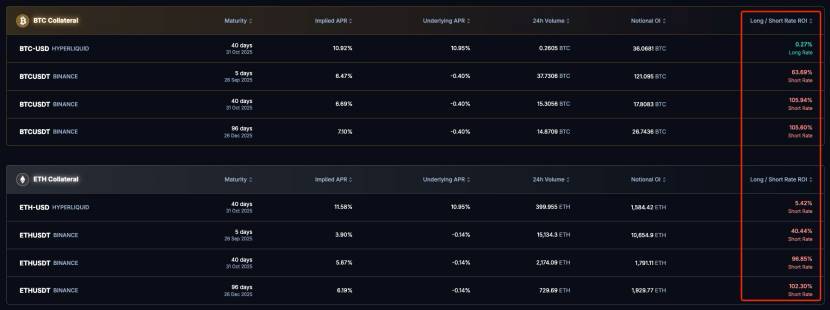
the Boros homepage, what caught my eye was a market list. At this time, the biggest question for many friends unfamiliar with Boros should be how the high ROI in the far right column came from. Next, I will introduce Boros in conjunction with this point.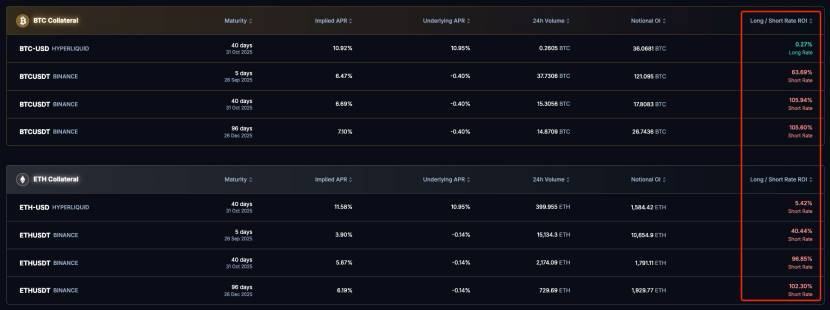
First, Boros's value is that it has created a derivatives trading market with an off-chain yield It allows users to conduct leveraged transactions, hedging, or speculation on such yield derivatives without directly participating in native income scenarios. Currently, it is mainly capital rate derivatives
in the CEX perpetual contract market.This confronts a critical problem in the perpetual contract capital rate arbitrage market, which is the uncertainty in the yield brought about by interest rate fluctuations on this strategy. As an example, we know that the core principle of Ethena is to use Delta Neutral's arbitrage strategy to earn the capital rate of the perpetual contract in CEX, that is, to increase the spot crypto asset, short the corresponding crypto asset perpetual contract, and earn the capital rate. The proceeds obtained from this will be distributed to susDE holders. This means that fluctuations in funding rates will significantly affect SusdE's yield, which in turn affects the attractiveness of the agreement to users. We can clearly observe this fluctuation in
the dashboard on the official website.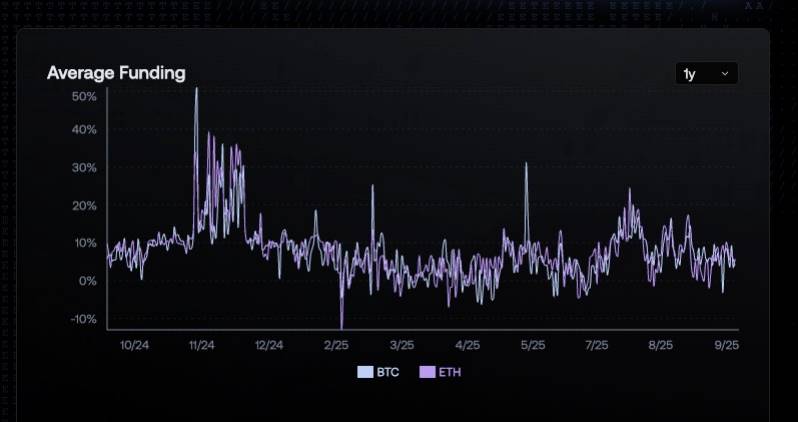
The fluctuation in perpetual contract funding rates, for arbitrators like Ethena, is It cannot be affected, because it mainly depends on the overall trading preferences of users in the cryptocurrency market. Only in a bull market, speculators in the perpetual contract market are willing to pay higher funding rates for long contracts, and when the market enters a volatile or bear market, the funding rate will drop significantly, or even be negative. This introduces risk to arbitrage strategies. Therefore, how to hedge against the risks caused by rate fluctuations is a major pain point for this group of arbitrators. The advent of Boros has provided a solution to this pain point. Simply put,
you can hedge capital rate fluctuations by trading Boros's corresponding funding rate derivatives.So how exactly is this achieved, let's take a look at the basic principles of Boros. Boros designed a new asset target called YU. It is similar to the YT asset principle in Pendle. The main difference is that YT is similar to a native crypto asset in stock. Since earnings are settled on a chain, they can be automatically settled directly through smart contracts, while YU is a contract derivative. Because earnings anchor the off-chain scenario, it relies on the settlement of margin accounts between the parties involved in the contract
transaction to track off-chain earnings.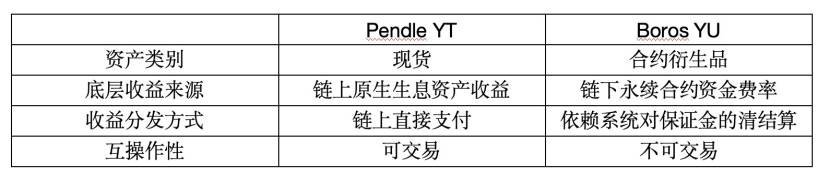
Specifically, let's talk about how YU works. First of all, for the buyer of YU, it is equivalent to the ability to obtain the capital rate corresponding to the perpetual contract during the future life period. Each unit of YU corresponds to each unit's original target. This portion of the revenue is paid from the security deposit by Boros's settlement mechanism. The specific revenue is paid by the YU seller from the security deposit. However, the matching interest rate during the purchase process corresponds to the Implied APR in the interface, which defines the fixed interest rate that the buyer needs to pay to the YU seller during the lifetime, and this also relies
on the settlement mechanism.Let's take an example to illustrate. Assuming that a trader buys 5 long positions on the YU market on EthUSDT-Binance with an expiration date of December 25, 2026, this means that from now until the expiration date, you will continue to receive the funding rate for 5 ETH short positions. This portion of the proceeds will be settled from the YU seller's margin account along with Binance's rate settlement every 8 hours. At the same time, you will also pay interest to the seller according to the matching interest rate when opening the position. Judging from the results, as long as the interest you accrued on the due date is lower than the interest you received, then this transaction is a positive ROI, and vice versa, a loss. In addition to this, if you choose to close your position in advance before the expiration date,
your profit conditions will also depend on the matching interest rate of your closing transaction.Having introduced these, let's take a look at the current state of Boros. We can see that the ROI of shorting YU is very high. In a market with a long expiration date, the final ROI can easily exceed 100. This means that assuming that Implied APR remains at the current level, your return on investment as soon as the expiration date arrives is 100%. This is mainly because now, following the FED's September interest rate decision, Powell's “hawkish defensive interest rate cut” speech and the corresponding bitmap showed the conservative attitude of various voting committees on drastic interest rate cuts, which brought market sentiment back to a neutral level from greed before the decision was made, to a neutral level. As a result, capital rates are falling rapidly, or even negative. So by shorting YU at this point, you pay interest according to the Impiled APR and get the fixed interest rate income of Impiled APR. Corresponding to the current actual value, since the Expected APR is negative, you actually earn familiarity in both directions. This is also the reason why the current instantaneous return rate is over 100%. If this interest rate difference can continue for a period of time, then the final actual return is also quite good
compared.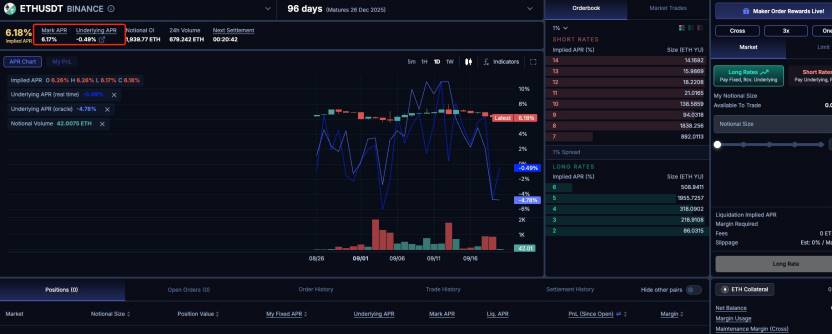
The reason behind this is also because currently Boros is still in its early days, and the liquidity is not high, so Potential trading slippage is significant, which hinders speculators' trading, as reflected in the interest rate chart, where Impiled APR is unable to effectively keep up with changes in APR. Of course, for small-capital users, the widening of interest spreads is also an opportunity. In particular, Boros allows traders to open a position with up to 3 leverage, so opening a position when the slippage and Impiled are appropriate, the benefits are also very impressive, but when capital leverage is
added, the liquidation risk caused by Impiled APR fluctuations should be considered.In addition, looking at the front-end of the product, Boros has also designed a Vault function to enrich liquidity sources and provide users with an LP staking pool's liquidity experience through a DeFi implementation method similar to Uniswap v2, thereby reducing product learning costs. Since this part of the official documentation has not given too much detailed explanation, we won't discuss it here, but I think the idea should be to follow AMM's for the funds in the staking pool Bonding curve forms are distributed in the order book to complement the depth of the order. However, providing liquidity in this market may face impermanent losses,
so readers are advised to wait for more detailed information to be disclosed before choosing to participate.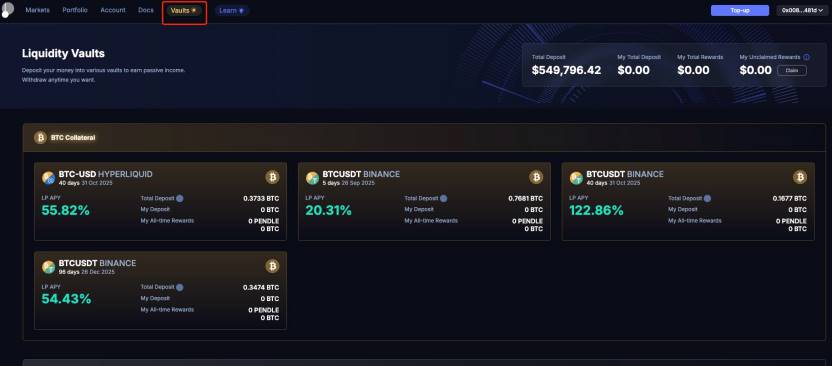
Share an advanced interest rate arbitrage strategy to achieve a delta with a 30% yield Neutral's fixed yield arbitrage
After introducing the basic situation of Boros, the author hopes to share an advanced interest rate arbitrage strategy using Binance, Hyperliquid, and Boros to achieve Delta Neutral's fixed yield arbitrage. Boros and Hyperliquid launched Hyperliquid's BTC and ETH perpetual contract YU market a few days ago
, which provides a prerequisite for this strategy.We can intuitively see from this chart that Hyperliquid's funding rate is significantly higher than Binance's, so what is the reason for this situation, or whether this situation is caused by instantaneous transactions or will continue for a period of time. This is traced back to the calculation logic of capital rates in the CEX perpetual contract market.
Normally, we make a sentimental judgment when Spot's index price is higher than perpetual When the price of a contract is marked, the contract market is underpaid, and bears pay the rate to the long, and vice versa. However, this is not necessarily the case. In fact, in the process of calculating the funding rate, another critical influencing factor is the depth of the order. Let's take a look at the two exchanges' introductory documents on funding rate calculation separately
.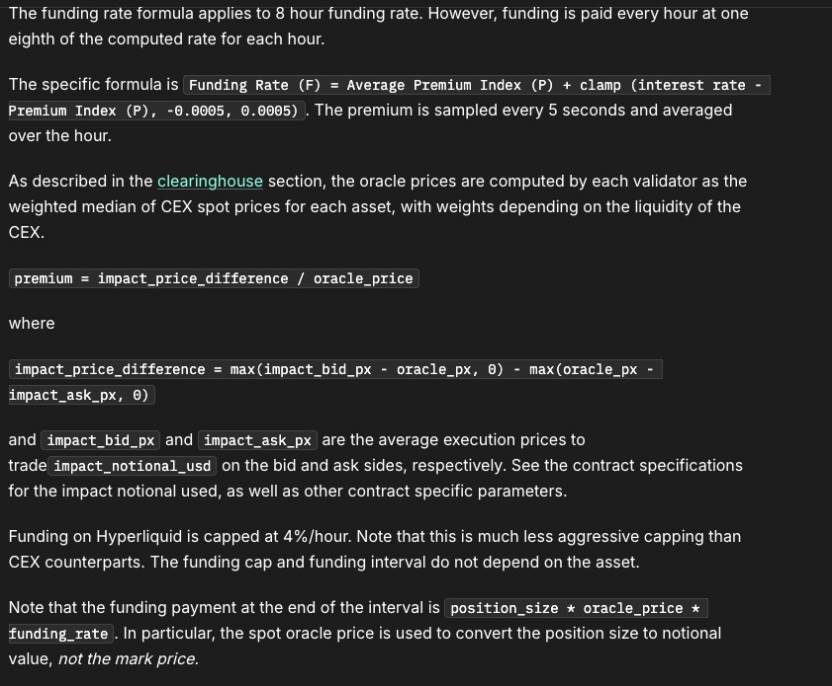
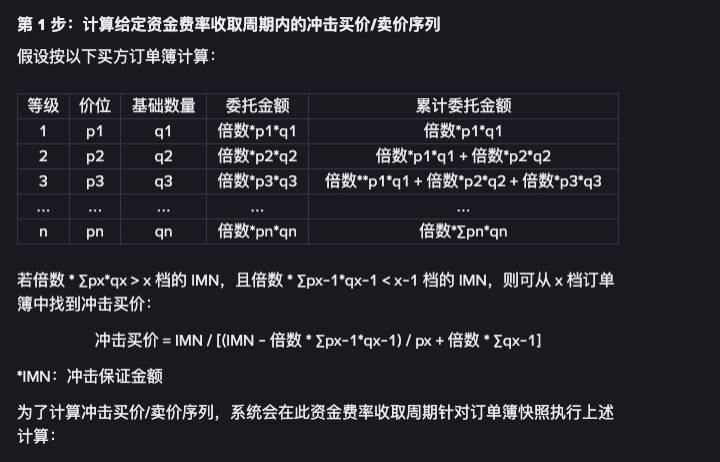
Simply put, the funding rate calculation formula for both is as follows:

The difference is that the MAX_RATE and MIN_RATE settings and the premium index calculation are slightly different, so readers can Roughly understood, this is a segmented function with the highest and lowest values. The calculation of the premium index includes deep thinking about the order book, which is reflected in the calculation of the impact purchase price impact_bid_px and the impact selling price impact_ask_px. The calculation process of this value needs to be calculated in conjunction with an instantaneous order book pattern of information collection. Generally, an order with a transaction volume is pre-set, and then the final transaction price of the transaction with the current order depth is calculated as an impact purchase price and impact the selling price. It is collected at intervals over the next period of time, and finally the weighted results over a period of time are calculated. In terms of the price index, there is also a slight difference between the two. Binance uses the price of its own Spot market as the price index, while Hyperliquid uses the weighted price of multiple exchanges calculated by Oracle as the price index. This is also reasonable, because in the spot market, there is still a big difference
in the depth of liquidity between the two.
So let's consider a question, why when Binance's funding rate is negative, Hyperliquid's funding rate is still high. The reason is that the depth of the two is different. In other words, the depth of sales orders in Hyper Liquid is not strong at this time, causing the impact price to be higher than the price index, so the final premium index is still large. This is also in line with both market stages. Therefore, we can conclude that this
pattern of interest rates should be maintained for a period of time rather than instantaneous.So, is it possible to arbitrage this spread through some kind of position opening strategy? The answer is yes. We can implement the Delta Neutral interest rate arbitrage model by opening long positions in Binance with low interest rates and opening short positions in Hyperliquid. So what is Boros's role in it, that is, locking in interest spreads. We can lock in quantitative interest rates separately through Boros, and have already implemented a fixed interest rate Delta Neutral arbitrage strategy. Based on current data, assuming we use 5x leverage on the ETH-USD markets of the two exchanges and use Boros to lock in interest rates, we
can obtain:

Of course, in more detail, we also need to consider the Boros margin's use of the principal amount, as well as Binance and Positions are balanced between Hyperliquid to avoid being liquidated unilaterally. Interested friends can further communicate with the author.